

10 Supercars Inspired By Iconic Airplanes
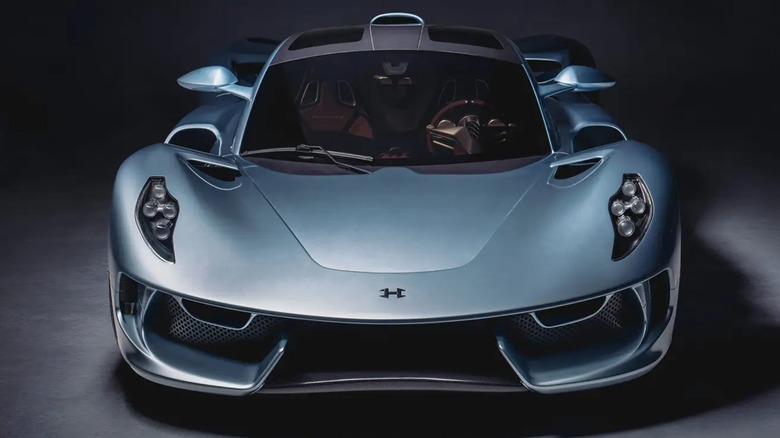
A ton of amazing supercars and hypercars have been made over the years, and each have features that distinguish them from the competition. Some rely solely on power and speed, while others incorporate specific aesthetic or design choices to stand out. Most are amazing feats of engineering that the world's car enthusiasts appreciate, even if they can't afford one of their own.
When someone sits down to design the next supercar, they often look toward something else for inspiration. This can be anything from a different-generation supercar to, say, an airplane. It turns out, a handful of impressive supercars have taken direct inspiration from a variety of the world's most legendary military aircraft, including fighter jets, trainers, and strategic bombers in the past.
Like any supercar, those inspired by iconic airplanes vary in price and specs, with some topping out at several million, while a couple don't bust the $1 million price tag. Each of these incredible supercars and hypercars was designed to honor a specific aircraft, and you can see it in their design, composition, and color choices. They're arranged in order from least expensive to most expensive, and some are so rare that there are only a few in existence.
Rezvani Beast Alpha X Blackbird
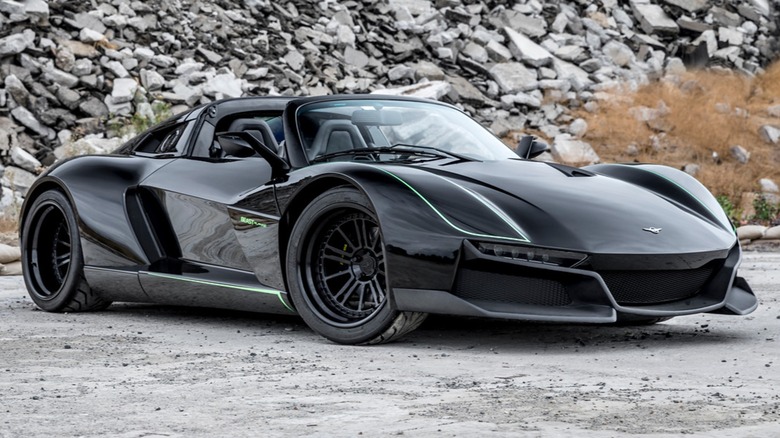
Rezvani's Beast lineup includes plenty of fast and beautiful cars based on the Ariel Atom, but another one is far more impressive: the Rezvani Beast Alpha X Blackbird. As you can probably guess, it takes its inspiration from the SR-71 Blackbird, the fastest jet aircraft ever built. While the Alpha X Blackbird won't get you from Los Angeles to Washington, D.C. in 64 minutes, 20 seconds, it's still got plenty of power.
Rezvani is a supercar brand that many haven't heard of, but it's nonetheless the height of ... let's call it affordable supercars. Most supercars are limited to the extremely wealthy 1% of the world, but the Beast Alpha X Blackbird starts at a relatively reasonable price of $325,000. What you get for that amount of cash is a car that can go from 0-62 in 2.9 seconds, has 700 hp under the hood, is equipped with the Rezvani 2.5L turbo racing engine, and weighs only 2,150 pounds.
The Alpha X Blackbird also comes with a removable hard-top, sidewinder doors, specially designed seats, high-intensity LED headlights, a close-ratio six-speed manual transmission, a carbon fiber body, and a race-inspired instrument cluster. As far as supercars go, the SR-71-inspired Alpha X Blackbird isn't necessarily restricted to the ultra-rich, and it certainly looks the part, thanks to its black exterior and gorgeous design modeled on the Lotus Elise chassis.
Lamborghini Indomable
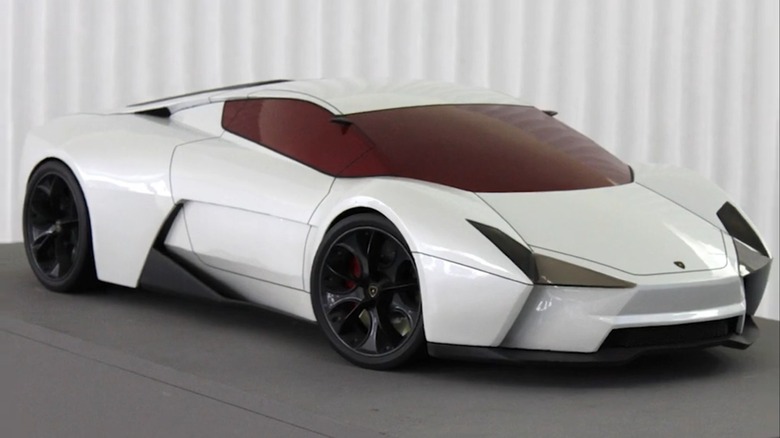
The Lamborghini Indomable began as a concept car, taking direct inspiration from the F-22 Raptor fighter jet. Daniel Chinchilla Ochoa and Alberto Fernandez Albilares came up with the design at the SPD Master program, and it's based on the Gallardo package. Different spects of its look and features were derived from the F-22, including its engine cover, so the lines and overall look are reminiscent of the aircraft.
This continues throughout the car's body, where a side view shows what almost looks like a wing, as does the taillight in the rear. The concept car's design found its way to an American company, 215 Racing Inc., which purchased the rights to transform it into a real production supercar. The task of building around 50 of them went to subsidiary Mostro Di-Potenza, which planned to rename the concept the Mostro Di-Potenza SF22 in honor of its inspiration.
Unfortunately, since the announcement in 2011, that hasn't happened, though it hasn't been outright canceled either. Regardless, the car, should it be made, would weigh under 3,000 pounds; it would pack 2,000 hp under the hood alongside 2,000 lb-ft of torque via its twin-turbocharged 9.4-liter "572" GM crate engine. In 2011, the cost of an SF22 was estimated to begin at $950,000 with a $1,000 deposit, though it's unclear if anyone ordered the car while it was in development.
Lamborghini Pregunta
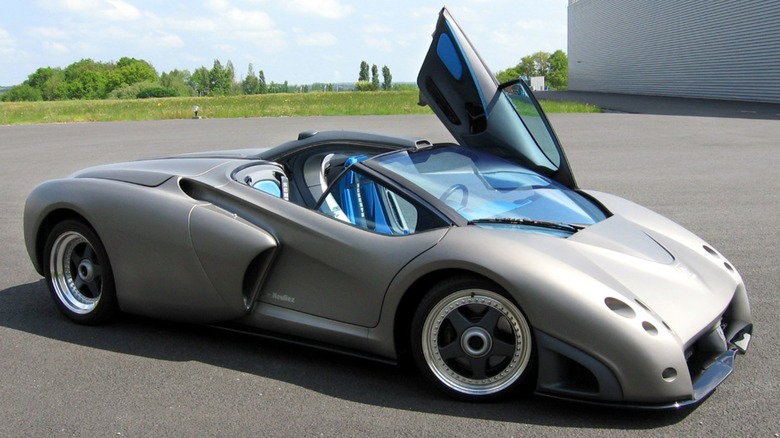
Lamborghini has made some exceptionally cool concept cars, and that includes the Lamborghini Pregunta, though it never left the concept stage. Designed in 1998, one model was produced, featuring bodywork, cockpit, and paint inspired by the Dassault Rafale, a canard delta wing multirole fighter operated primarily by the French Air Force and Navy. The car was based on the Diablo and features a 5.7-liter V12 engine controlled by a five-speed manual gearbox.
The Pregunta's coloration, including its Azure blue Alcantara seats and blue dash, is reminiscent of the Rafale. It can accelerate from 0-62 mph in 3.9 seconds and boasts an impressive top speed of 209 mph. It first debuted at the 1998 Paris Motor Show, offering onlookers a chance to peer at the unusual design in person. Only the one-off drivable example was made before Lamborghini moved on to other concept and production cars.
This unique Lamborghini supercar found its way to Broad Arrow Auctions, where it was expected to reach as much as $4.1 million. News of the auction arose in late 2025, but the Pregunta didn't sell, as bidding didn't reach the reserve, with the highest bid of $1.8 million. When Lamborghini built the Pregunta in 1999, it cost around $800,000 ($1.6 million in 2026). It's unclear what the reserve was for the auction, but the seller accepted an unknown amount from a provision bid.
X-1 Mustang
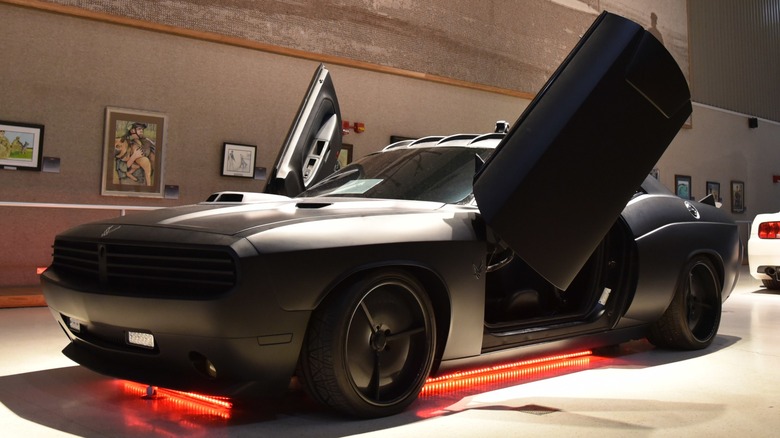
Most of the time, a supercar is made to turn a nice profit by selling it to the public, but that's not the case with the X-1 Mustang. Instead, Galpin Auto Sports built this supercar for the United States Air Force. The project resulted in the creation of two cars, with the other being the "Vapor" Challenger, though it's not inspired by an aircraft like the X-1 Mustang, which takes its inspiration from the Bell X-1.
The Bell X-1 was the first aircraft to break the sound barrier, piloted by Capt. Charles E. "Chuck" Yeager. While the car takes its name from the historic aircraft, it doesn't look like it, and instead features fighter jet-inspired designs that are more modern. These include a cabin styled after the cockpit of a fighter jet, an ejection seat in the center of said cabin, which utilizes a flight stick and fighter-esque instrument panel. It also has a concealed motorized steering wheel and more.
The X-1 Mustang is powered by a 500 hp 4.6-liter engine. The reason the Air Force wanted supercars was for its 2009 Project Supercar recruiting campaign. In this capacity, the cars toured the U.S., showing off Air Force technology to would-be recruits. After spending some time on the road, both the X-1 Mustang and "Vapor" Challenger found their way to the National Museum of the United States Air Force, where they remain on display as of writing.
Lamborghini Reventón
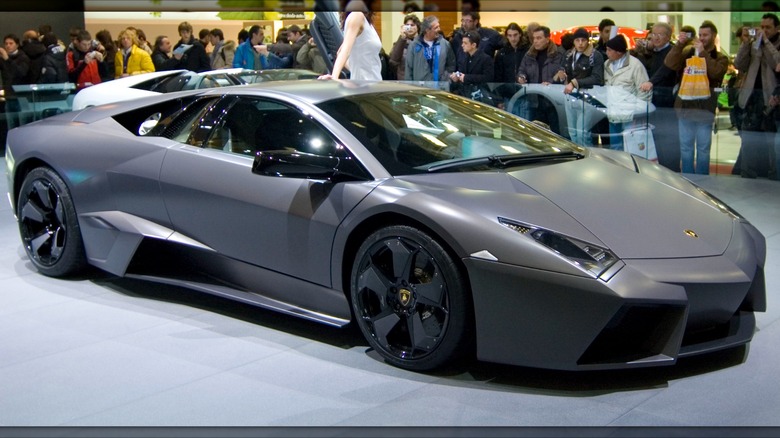
While the Lamborghini Indomable hasn't made it to production, the same cannot be said of the company's beautifully designed Reventón. Not only is the car at the high end of power and performance, but the Lamborghini Reventón also takes its inspiration from the F-22 Raptor. The supercar is based on the Lamborghini Murciélago, though the two look very dissimilar, thanks to the angular silhouette and sharp lines that show the Reventón's similarity to the U.S. Air Force fighter jet that inspired it.
If you've never seen one on the road, that's to be expected because all 20 production Reventóns sold to private collectors almost immediately. They sold for €1 million each in 2007 ($1.4 million), and rarely appear at auctions. A Roadster version, of which 15 were made, sold in 2025 for $1.67 million at auction, and that was a steal, seeing as the Roadsters sold for more than $2 million at launch.
To design the Reventón, designers and engineers toured various aircraft on an Air Force base and settled on the F-22 as their source of inspiration. The Roadster features a 12-cylinder 6.5-liter engine, and the supercar accelerates from 0-62 mph in 3.4 seconds with a top speed of 205 mph. The OG coupe model has similar specs, though its top speed is 211 mph. One sold in 2022 for $1.95 million, so they tend to get scooped up quickly whenever they do show up on an auction block.
Aston Martin Vulcan
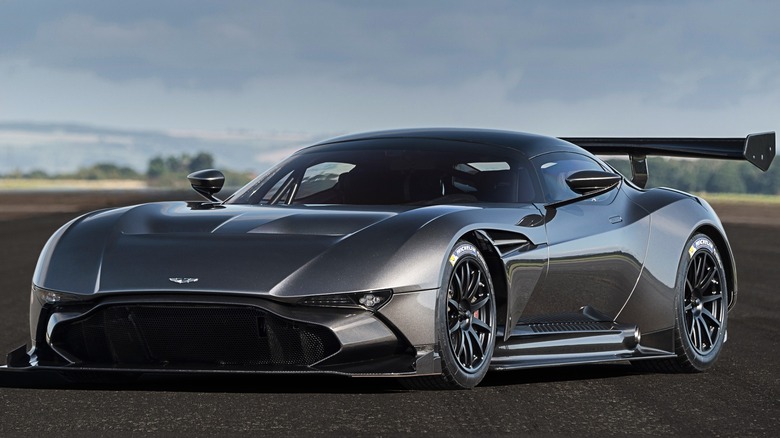
Aston Martin is well known for its luxurious automobiles, and the Vulcan is no exception. Unfortunately, it's a track-only hypercar, but if you've the means to buy one, you probably already have a track close at hand. The supercar's design was inspired by the Avro Vulcan, a delta-winged high-altitude strategic bomber used by the Royal Air Force of the United Kingdom. Aston Martin's hypercar honors the name of the legendary Cold War-era bomber, and it avoids superficial homages.
Aston Martin produced 24 Vulcans, so they're rare, and they aren't cheap either, costing $2.3 million upon release in 2015. Here's what you get for that price: a 7.0-liter V-12 engine straight out of Aston Martin's GT3 program, which provides 820 hp and 575 lb-ft of torque. The driver can choose between three engine modes that reduce power to 657 or 550 hp should they desire to do so.
With its rear wing installed, you're limited to around 208 mph, but after removing it, the car's total drag is significantly reduced. This enables the Vulcan to reach higher speeds, though it's unclear what its potential top speed is. The Vulcan can go from 0-62 mph in 2.9 seconds, and the optional AMR Pro Package, which costs $405,760, improves aerodynamics and acceleration times beyond that. Sadly, you can't take these on public roads, as they're not equipped with the right kind of emissions or safety equipment, but get one on a track, and you can open it up to its fullest potential.
Hennessey Blackbird
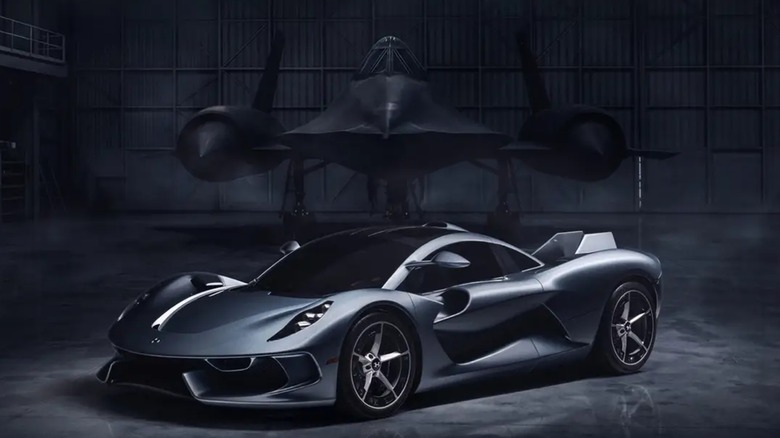
Looking at the SR-71 Blackbird, it's clear why so many cars take inspiration from its look. The Hennessey Blackbird is one among many to do so, though its homage to the legendary spy plane goes a bit further than most. The hypercar goes back to basics with a 6.2-liter naturally aspirated V8 engine and a six-speed manual gearbox. It also eschews the common modern practice of using screens in the cabin, preferring to keep it old-school.
Hennessey designed the Blackbird to feature the performance of a modern hypercar, but with analog controls reminiscent of 20th-century vehicles. It can go from 0-62 mph in 2.5 seconds, with a top speed of 220 mph. To honor its namesake aircraft, the overall design features a long, low-silhouette body with automatic active rear stabilizers that kick on at 71 mph and 71 degrees. It also features a diamond-shaped quad exhaust that takes its inspiration from another aircraft.
The Bell X-1 boosted the visual appeal of yet another vehicle, while the side pods and other aerodynamic elements of the Blackbird found inspiration in Formula One-style cars. In terms of entertainment, there's no cabin screen or infotainment center. Instead, there's a large tachometer and other analog devices. Fortunately, it does feature smartphone connectivity, so it's not devoid of entertainment. Hennessey limited production to 71 Blackbirds, and each will cost $2.5 million, with expected delivery by 2030.
Icona Vulcano Titanium
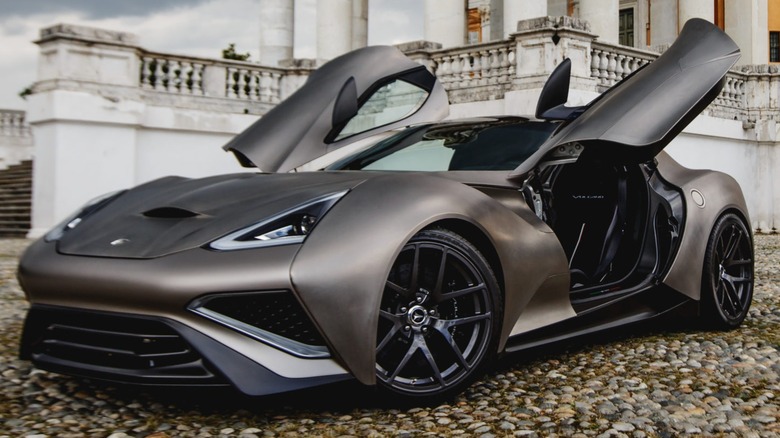
The Vulcano Titanium is yet another supercar inspired by the SR-71 Blackbird, but unlike its competition, it is actually coated with titanium (just like the Blackbird). It's touted as the world's first titanium car, and there's a reason for that, as titanium is difficult to work with and it's incredibly expensive. Perhaps relatedly, Icona produced this vehicle a single time, using carbon fiber and titanium in its unique construction.
It took more than a thousand hours of labor for specialized workers to literally hammer out the body, which Icona considers to be an artistic sculpture. Most supercars based on aircraft have sharp, angular lines, but the Vulcano Titanium abandoned this practice for a smoother look, mirroring the smooth lines of the aircraft that inspired its creation. It's truly unparalleled.
The Vulcano Titanium features a 680 hp engine and a paddle-shift gearbox from Modena. The engine's horsepower can also be turned past 1,000 hp if desired, but its baseline stats are nothing to sneeze at. The car goes from 0-62 mph in 2.8 seconds, and it has a top speed of 220 mph. The car's interior features a robust infotainment system. While Icona only produced one Vulcano Titanium, it went on sale in 2017 for $2.9 million, though it doesn't appear that the car was sold to a private collector, as it seemingly remains in Icona's hands at time of writing.
Pagani Huayra Tricolore
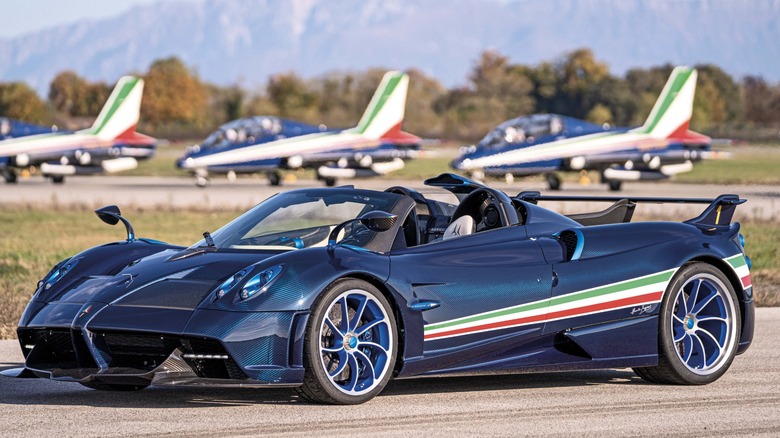
Unlike most supercars modeled after airplanes, the Pagani Huayra Tricolore honors both an aircraft and the people who fly it. The car's design is a celebration of 60 years of the Frecce Tricolori, the world's largest aerobatic patrol. The Tricolori flies the Aermacchi MB-339/PAN, a single-seat jet trainer and light attack aircraft used for aerobatic demonstrations at air shows. Much of the Huayra Tricolore's design takes inspiration from the iconic Italian aircraft, including its colors.
As you can see in the above image, the stripes along the car's sides mirror the body and tailfin stripes of the Aermacchi MB-339A/PAN, which just so happen to also be the colors of the Italian flag. If you want to get your hands on one, that could be a problem. Not only are there only three in existence, but the Huayra Tricolore costs a whopping $6.75 million.
There's a cheaper option, but you'd still have to shell out a stunning amount of money to buy a base Pagani Huayra. The Tricolore's design features a blue carbon-fiber weave with blue detailing on the wheels. For power, the supercar relies on a twin-turbocharged 6.0-liter V-12 engine that produces 840 hp and 738 lb-ft of torque, making it the most powerful Huayra ever made as of 2010. It's unclear what its top speed is, but the Pagani Huayra has a top speed of 238 mph and can go from 0-60 mph in 2.8 seconds.
General Motors Firebird I XP-21
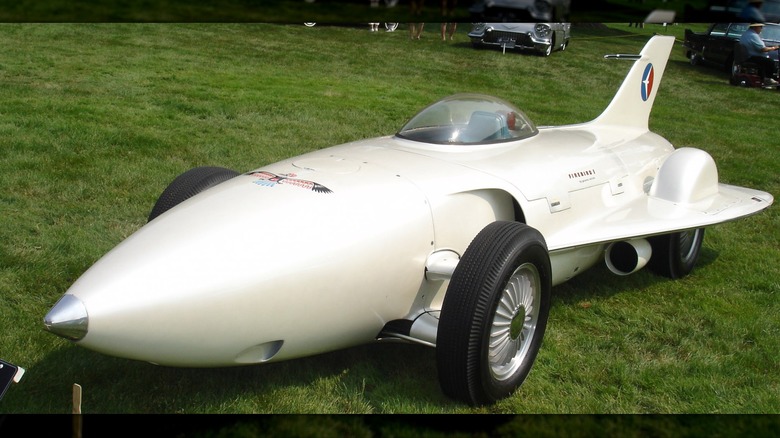
Dig through the history of supercars, and you'll eventually uncover the General Motors XP-21 Firebird 1. The prototype car was built in 1953 and was the first of four vehicles inspired by early fighter jets in their design. You can see that clearly in the Firebird I, which looks a lot like a fighter jet on wheels that includes wings. It holds the distinction of being the first gas turbine-powered car built and tested in the U.S., and nothing about its design screamed consumer-ready.
The car was outfitted with a so-called "Whirlfire Turbo-Power" single-stage, axial-flow turbine engine that produces 370 hp at a power turbine speed of 13,000 rpm. Unfortunately, wherever it goes, the Firebird I spews out jet exhaust, which doesn't make it particularly street legal. The Firebird I's design was inspired by the iconic Douglas F4D Skyray, a carrier-based fighter-interceptor operated by the U.S. Navy and Marine Corps throughout the early 1960s.
The Firebird I was meant to be tested at the Indianapolis Motor Speedway, where it would likely have reached its estimated top speed of 200 mph. Unfortunately, a VP at GM crashed it, causing himself serious injury and destroying the car's body, which was eventually replaced. GM opted not to test its speed because of this, so the Firebird I's top speed remains an estimate. It's also of incalculable value, as it holds a great deal of importance in automotive history, and GM has no intention of selling it for any price.