

5 Of The Weirdest Gadgets Sold In The '70s
When it comes to purchasing something weird, you don't have to look very far — there's more than enough online and sold at specialty stores that fits the description. You don't even have to look back through history, as products like a Godzilla microwave cleaner and microfiber mop slippers are available right now, and more weird stuff is no doubt on its way, with an abundance of As Seen On TV Products made available for anyone who wants them.
While weirdness and consumer products come together nicely, especially around Christmas, thanks to White Elephant gift exchanges, it's not a new phenomenon. Back in the 1970s, it was much like it is today, though for folks to get something weird, they had to either go out and buy it, order it from a catalog, or give in to an infomercial and purchase a product by making a phone call. Of course, calling something weird is truly in the eyes of the beholder because what's weird to one person might just be the product that someone else has been waiting for their entire lives.
The '70s had it all, thanks to the burgeoning video game industry, the widespread use of TV infomercials, and more than enough catalogs, all of which placed some weird products into consumers' hands. Each of these five products, arranged in no particular order, is one of the weirdest you could buy in the '70s, and while they all had their useful applications, they're weird by today's standards.
Popeil Pocket Fisherman
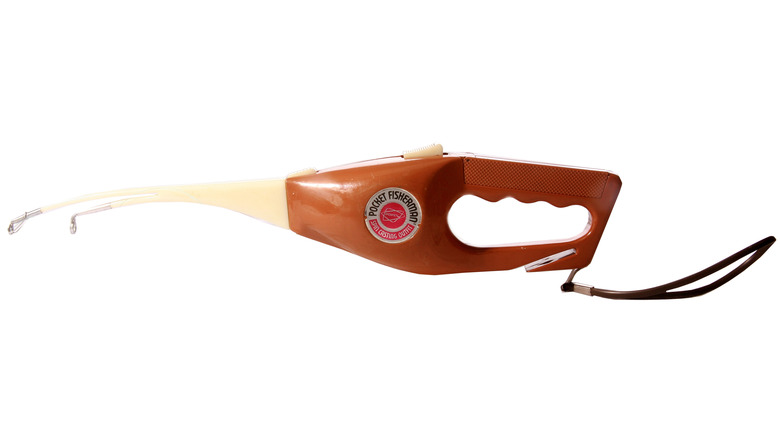
One of the biggest inventors of television infomercial products was Samuel Jacob "S.J." Popeil, and he named his first TV-pitched product after himself. Commercials for the Popeil Pocket Fisherman were all over TV broadcasts throughout the 1970s, and it came with this oft-repeated pitch: "Convenient design. Fits in your glove compartment. Attaches to your belt. Contained in the handle are: hook, line, sinker, and bobber... It's the best gift you can give to any kid or adult."
The pitch describes the product perfectly. It's a collapsible fishing rod that contains everything you need to cast a line if you're driving past a particularly picturesque river and feel the need. The Pocket Fisherman was made of plastic, measured about 10 inches long (18 inches when unfolded), and it looks as weird as it sounds. On the surface, the Pocket Fisherman is a practical device, but it was never going to win anyone first place at a fishing tournament.
The Pocket Fisherman was introduced in 1972 and was sold through Ronco, the company founded by inventor and infomercial king responsible for the Showtime Pro Electric Rotisserie Oven, S.J.'s son, Ron Popeil. It sold for $19.95 and was particularly successful around the holidays. As Ron once told the Los Angeles Times, S.J. often said of his gizmo, "It's not for using. It's for giving." The Pocket Fisherman has also made a comeback; you can purchase one today on Ronco's website for $41.99.
AT&T Picturephone
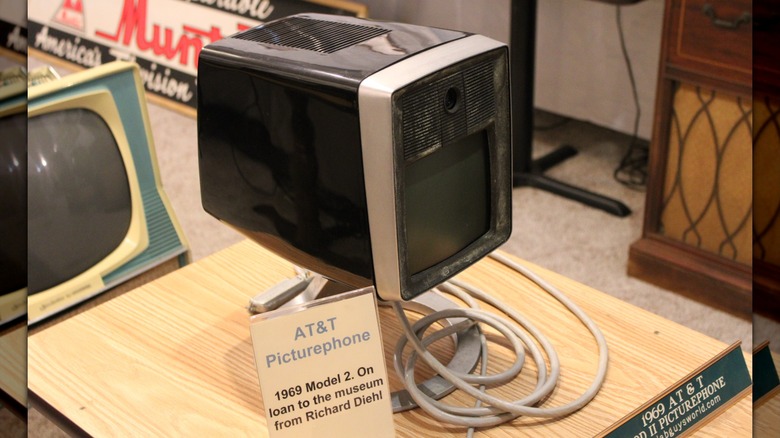
These days, it's pretty easy to have a video chat with someone through a variety of devices, but throughout the 20th century, they were the stuff of science fiction. However, the technology that Apple's FaceTime and other services evolved from actually dates back to the 1960s.
AT&T's Bell Labs designed a product called the Picturephone, which was displayed at events like the 1964 New York World's Fair. It wasn't commercially available to the public until 1970, when it was made available for rent in and around Pittsburgh, Pennsylvania, and Chicago, Illinois. The Picturephone was a legit, sci-fi-esque video phone capable of transmitting audio and black and white video displayed on a small CRT television across standard phone lines, but as you already know, it never caught on with the public.
In its 1970 debut between Pittsburgh Mayor Pete Flaherty and John Harper, the Chairman of Alcoa, the Picturephone had no latency, sound, or video issues, so the technology worked. They sat in offices only a block apart and spoke for several minutes. The Picturephone was weird because it was new and straight out of a sci-fi movie, though it was a commercial failure. AT&T pulled the product due to costs and consumer disinterest, particularly in businesses where folks didn't want to appear during phone calls.
Milton Bradley Microvision
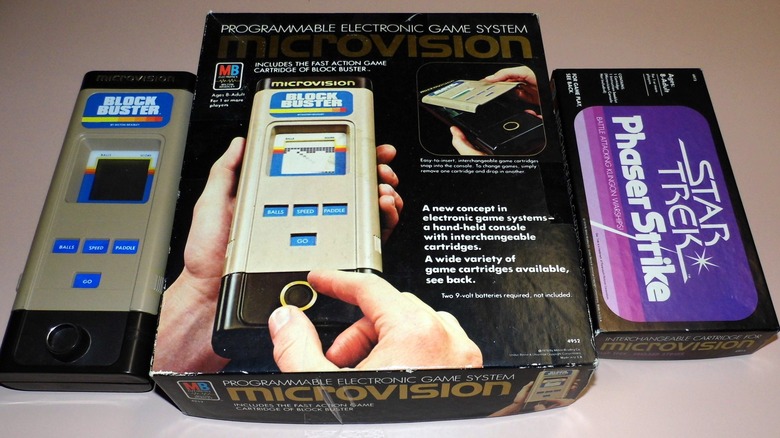
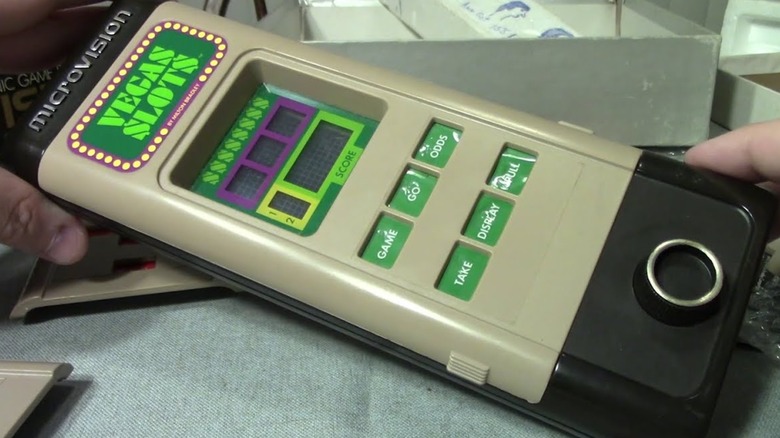
In 1989, Nintendo released the Game Boy, one of the most successful handheld gaming consoles of all time. It was especially appreciated by the public for its ability to swap games easily. However, it wasn't the first system of its kind. That distinction goes to the Milton Bradley Microvision, a handheld gaming system the board game developer released way back in 1979.
The Microvision was both innovative and weird, especially by today's standards. It cost $49.99 and used interchangeable cartridges. Jay Smith, the eventual engineer of the Vectrex, created the Microvision, and it was both innovative and simplistic. The system boasted a game library of only 12 titles that could be swapped in and out with ease. It featured a 16 x 16 LCD screen, so in terms of graphics, it was limited, though this didn't detract from the entertainment value of playing games like "Connect Four" on the go.
One interesting aspect of the Microvision's design was that it didn't have a CPU. Instead, each game cartridge had a unique CPU. They also had text indicating the game, the buttons, and instructions, and bezel art. The games cost $19.99, and while the Microvision didn't stay on the market for long, it popped up in "Friday the 13th Part 2" in 1981. The system's final game, "Super Block Buster," was released only in Europe in 1982, ending the Microvision's product line.
Presto Hot Dogger
There are a lot of weird kitchen gadgets and cookers on the market today, and it was the same throughout the 1970s. Some were relatively ordinary, some were rather odd, like the Presto Hot Dogger, first launched in 1974. There are several ways to cook hot dogs, depending on preference, convenience, and what you have on hand, but the Hot Dogger used metal prongs you'd stab into each end of a hot dog. An electric current would pass from one prong through the hot dog to the other, directly cooking it from the inside, via electrocution.
The Hot Dogger worked, though it came with some problems, including split dogs, uneven cooking, and some potential safety hazards.
If a kitchen gadget with open electric probes like this was sold today, it would probably wind up seeing some lawsuits over burns. It was incredibly easy to injure yourself with a Hot Dogger if you weren't careful. The device was discontinued in 1977, possibly for this reason, but also because there are better ways to make hot dogs than torturing them until they split open. These days, there's the Hot Diggity Dogger, which not only heats up the meat but also toasts your bun at the same time.
Pong Home Console
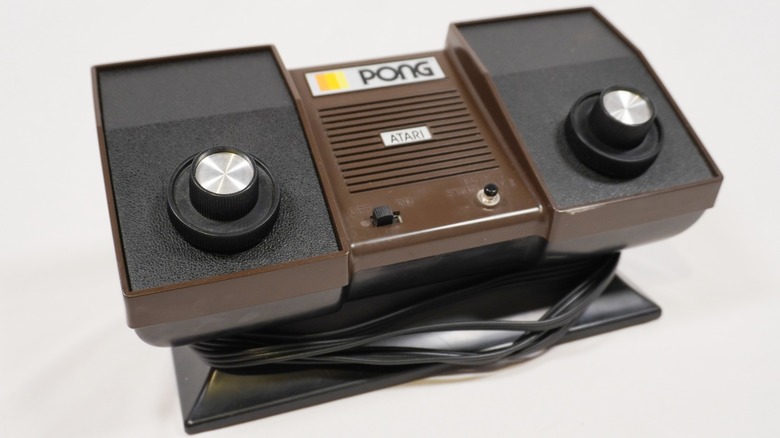
Many people incorrectly believe that Atari's "Pong" was the first video game. This isn't true, though it was the first commercially successful video game, and proved the viability of the medium, so it's an incredibly important title nonetheless. "Pong" started out in arcades in 1972 as a derivative of the Magnavox Odyssey's "Tennis." Before long, Atari teamed up with Sears to exclusively release the Pong Home Console, which is exactly what it sounds like.
Pong Home Consoles came in various shapes, sizes, and forms, and by today's standards, they're weird-looking, cumbersome devices. That said, they were also incredibly innovative, helping to significantly boost Atari's place in the home console market, which was barely in its infancy when the first model released in 1975. In terms of innovation, Atari's "Pong" was one of many clones available in the late 1970s, but it was far more advanced.
Unlike the competition, Pong Home Consoles used a single chip capable of producing sound and displaying on-screen scoring, which was new at the time. Other "Pong" clones typically relied on mechanical scoring, making Atari's system far more compelling to anyone who wanted to play the game at home. Atari and Sears had a huge hit with the Pong Home Console, achieving around 150,000 sales in the '75 holiday season alone, becoming Sears' best-selling product. People may wonder what happened to Atari these days, but in the 1970s "Pong" helped make it a behemoth brand.