

11 V6-Powered Exotic Cars, Ranked By Horsepower
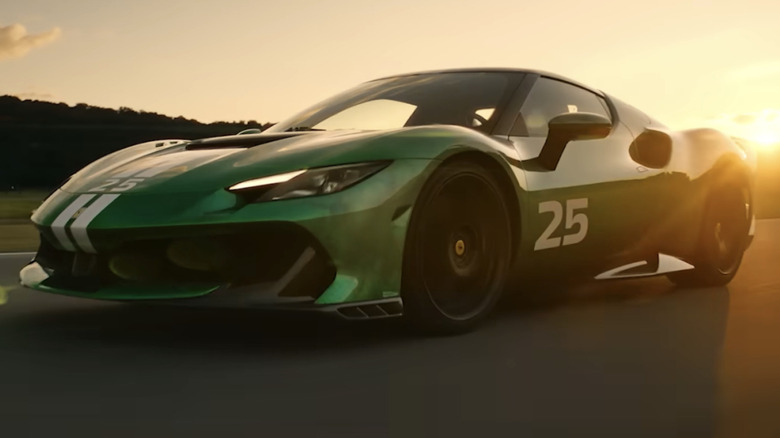
Us humans have an instinct to group things together, to find the common denominators and build classification methods for everything around us. It can be hard to keep track of the many different categories of cars. Economy cars, supercars, off-roaders, sports cars, hypercars, and the list goes on and on, but sometimes, the definitions get fuzzy. Take the exotic car, for instance. What exactly makes a car exotic? A few things come to mind immediately: sculpture-esque looks, high-performance engineering, fine materials inside and out, emotional appeal, hefty price tags, and high cylinder counts. Most of these things are characteristic of the exotic car, but we often forget that more doesn't always mean better.
In limiting the exotic car to those with the most cylinders, we miss out on some of the most exciting members of the family. Both in recent years and historically, the V6 has appeared in some of the world's finest exotics. Often performance-oriented, exotic cars benefit greatly from the V6 layout, which is compact and light, but still powerful. Throw in a turbocharger or two, or some electric motors, and you're looking at power figures well into the triple digits. The V6 may be down a handful of cylinders, but the engineering behind these engines, the cars that are built around them, and the feats they are capable of make them absolutely deserving of the exotic label. Here are 11 V6-powered exotic cars, ranked by horsepower.
Honda NSX-R
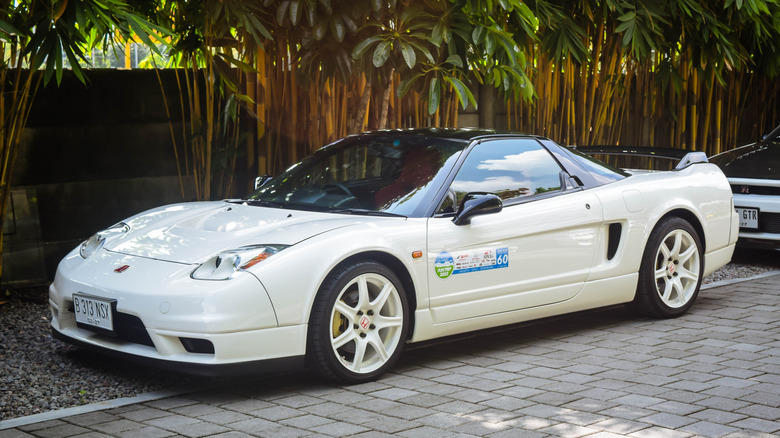
In September 1990, Honda graced the world with one of the best cars it had ever made. The NSX was a lightweight, mid-engined sports car, and even in its most basic form, it was a legitimate competitor. With driving dynamics developed from the advice of Ayrton Senna, the NSX was a true driver's car in every sense of the word. In 1992, Honda pushed the NSX even further with the NSX Type R. The NSX received all the fixings you'd expect for a radical performance car. All creature comforts like AC, sound system, and sound insulation materials were dropped for weight, and the leather seats were traded for Carbon-Kevlar Recaros. The suspension was tightened up, the traction control was removed entirely, and the 3-liter V6 maintained its 280-horsepower output, the same as the base model.
Following the Type R, the truly special NSX-R appeared in 2002 for a very limited production run of 140 units that lasted until closure in 2005. The R featured a facelifted design, no power steering, and a plethora of carbon-fiber body panels that further saved weight in this already-light car. The star of the show remained the engine, though. During the development of the original NSX, Honda landed on the V6 design for its compact size and high power output. It was transversely mounted to improve weight distribution, and in the R, many of the internals were hand-machined to meet Honda's rigorous standards. All said and done, the NSX-R's V6 made 290 horsepower.
Lotus Emira
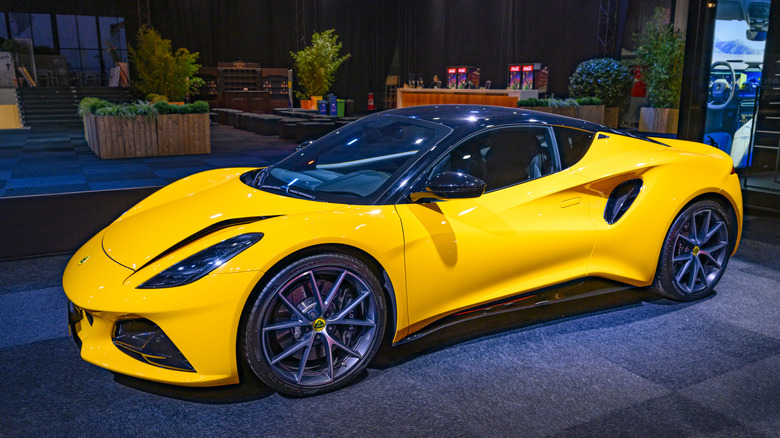
One of the crown jewels of England, Lotus produces some of the world's most honest and lively sports cars. For years, its focus on the driving experience has been paramount to the character of a Lotus. If you want to be comfortable, buy an LC500, some might say — a Lotus is for driving, and only driving. The Emira, however, reshapes the brand's reputation. There's a leather-coated interior with creature comforts and reassurance technologies like cruise control, lane change assist, and parking sensors.
Despite these sudden additions of civilian tech, the Emira retains its ultimately Lotus character. It's light on its feet, tipping the scales at just over 3,200 lbs. It uses communicative, hydraulic steering over electric power steering, and it can be optioned with a six-speed manual transmission. It also looks fantastic. Its mid-engined proportions evoke silhouettes of cars with price tags that dwarf the Emira's. Its lines are harmonious, and the intakes are tastefully aggressive. The overall look is of something far more capable and far more expensive, and yet Lotus has managed to wrap all these elements up in a tiny package without creasing the paper. As it has in the past, Lotus has sourced the Emira's engines from other manufacturers, which allows it to focus on integrating and calibrating them for the car's distinctive character. At the head of the pack is a Toyota-sourced 3.5-liter supercharged V6, putting out a healthy 400 horsepower.
Alfa Romeo Giulia GTAm
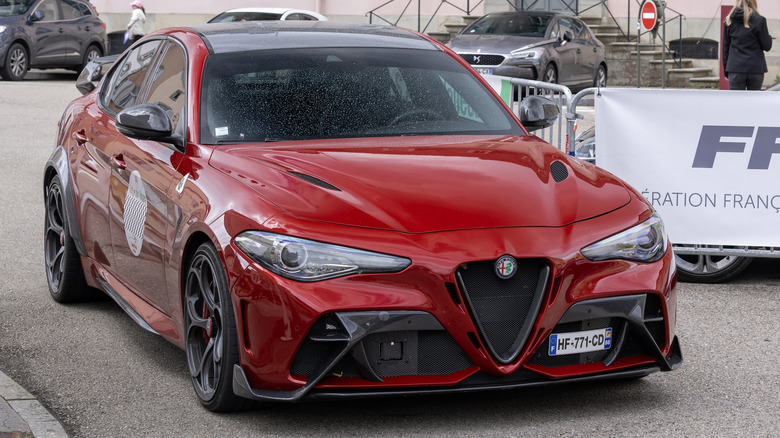
It may seem strange to denote a four-door sedan as an exotic car. If that were the only fact you knew about the Giulia GTAm, it would be easy to cast it into the oblivion of sports sedans, but one look at the Giulia GTAm's spec sheet, or its face, and you will quickly realize it is absolutely deserving of the exotic label. As is the case with most Italian cars, the Alfa Romeo Giulia GTAm is eye-wateringly gorgeous. GTA stands for "Gran Turismo Alleggerita," the final word meaning "lightened," and many of its exclusive aluminum or carbon body panels feature fresh designs along with their weight-saving capabilities. The grille, massive rear wing, and vivacious paint colors immediately elevate the GTAm to neck-craning status, and it has the performance to match.
Those aforementioned aero elements aren't just for looks, though. The GTAm's body was sculpted by the wind tunnel wizards at Sauber, Alfa's F1 team partner, giving it racing-level aerodynamics. Alfa also takes the Alleggerita label very seriously, as the rear windows are made of polycarbonate, door handles are fabric loops, and the rear seats have been deleted in favor of a roll cage. In total, the GTAm sheds 275 lbs from the original. Under the very pretty hood is the main attraction. The GTAm is powered by a twin-turbo V6 which features GTAm-exclusive upgrades including more boost, improved electronics, and a sonorous Akrapovic exhaust, all of which contribute to its 533 horsepower output.
Jaguar XJ220
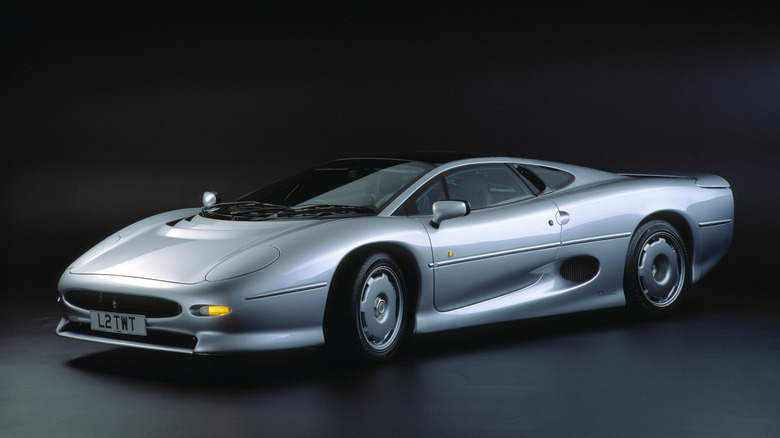
When the world first saw the Jaguar XJ220 concept car at the 1988 British International Motor Show, Jaguar was on fire. It was coming off a Le Mans win, and everyone wanted a piece of the pie. The pie in question was the XJ220 concept car, an enormous, elongated thing promising to put V12-derived power to the tarmac via an AWD system. It was the essence of the Jaguar racing spirit, and that made it highly desirable. However, the stretch from concept to production was long and full of obstacles. Just a year after the reveal at the British International Motor Show, Jaguar was struggling. As a fully independent automaker, it simply did not have the capital to compete with larger brands and conglomerates, and it experienced a plunge in sales and profit. Across the Atlantic, Ford had its sights on Jaguar and offered a $2.5 billion acquisition deal, which Jaguar accepted.
The time was tumultuous, and the XJ220's development reflected this. When the final product came out in 1992, its looks were largely unchanged, but the internals were reworked. Mainly, it was now RWD, and power came from a turbocharged 3.5-liter V6. It was still a supremely impressive performance car despite the adjustments. Built on an aluminum honeycomb chassis, the XJ220 was remarkably light for its size, and equipped with a five-speed manual transmission. In its birth year, it was crowned the fastest production car in the world, able to hit 217 mph, thanks to the V6's 542 horsepower.
Acura NSX Type S
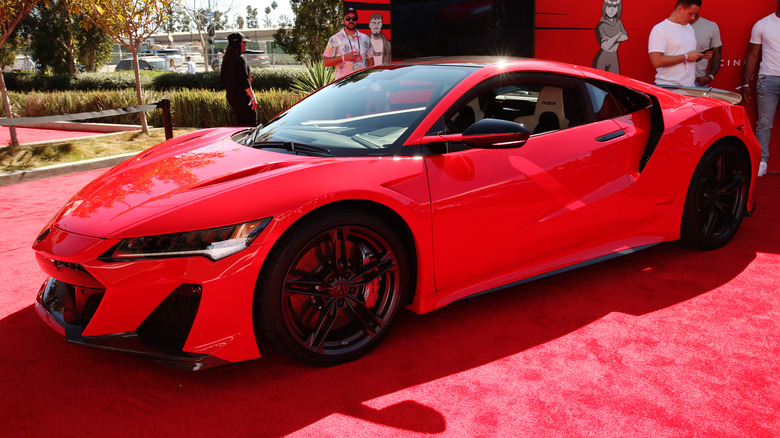
The second mention of the NSX nameplate brings an entirely new version of the car to the table, but it preserves the driver-focused spirit of the original. Introduced in 2016, the NSX was one of the pioneering hybrid supercars. It introduced new technologies like Acura's Sport Hybrid Super Handling AWD system, which allowed for torque vectoring functions, drastically increasing handling and agility. The new NSX was a true supercar, with the looks and performance needed to compete with the best, all with a more comfortable price tag. In 2022, the new NSX generation was coming to an end, and to send it off, Acura made the turned-up NSX Type S.
Acura pulled out all the stops for the ultimate version of its ultimate performance car. Production was ultra-limited, with just 350 units being made, and each one boasting upgrades like increased turbo boost pressure, speedier gear shifts, and stiffer racing suspension. The main attraction, though, was the powerplant. Acura's longitudinally mounted 3.5-liter twin-turbo V6 produced 520 horsepower on its own, a 20-horsepower increase from the standard NSX. Its 75-degree V angle was chosen for a lower center of gravity in its mount, and it was supplemented by three electric motors, one sending power to the rear wheels and the other two being independently assigned to each of the front wheels. When this complex powertrain put everything together, the NSX Type S was good for 600 horsepower on the dot.
Maserati MCPura
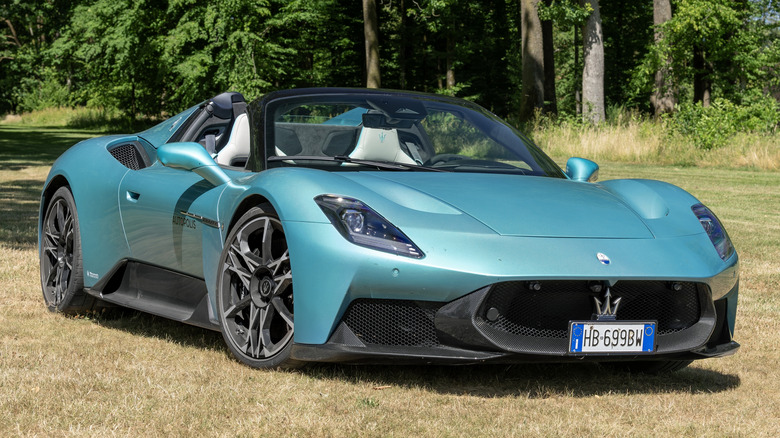
To talk about the MCPura, we must first talk about the Maserati MC20. Five years old at the time of the MCPura's debut, the MC20 was introduced in 2020 as a return to form for the Italian automaker. Maserati hadn't built a true supercar since the MC12, and the brand was in need of a halo car to remind the market that Maserati was a name to dream of. The MC20 was in development for two years, with much of the focus being on its V6 engine. Maserati hadn't developed an engine in-house since 1998, and its return had to be a memorable one. Lucky for Maserati, it was. The V6, codenamed Nettuno, was a masterclass in supercar engineering. Its main attraction was the Maserati Twin Combustion system, a form of pre-chamber ignition. Long story short, it helps burn fuel quicker and more efficiently, making for more power.
The MCPura was revealed in 2025 as an updated evolution of the MC20, refreshing Maserati's halo supercar five years into its lifespan. The MCPura, as the name suggests, is all about purity. Part of its commitment to driver purity comes in its low weight, with the MCPura weighing in at just over 3,300 lbs, thanks to its carbon-fiber monocoque and other composite materials. The design is purely Maserati too, full of theater and sculpted curves. Powering the MCPura is the Nettuno, complete with its tight 90-degree V angle and twin turbochargers. Thanks to the MTC technology, the Nettuno puts out a strong 621 horsepower.
Ford GT
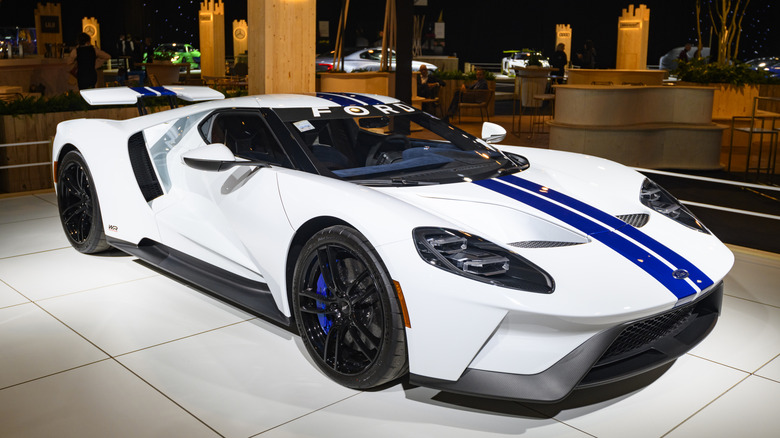
It is a rare thing for Ford, the American giant, to make a true supercar. Often, the pinnacle of its road-going performance division comes in the form of a souped-up Mustang, like today's GTD, but once in a blue moon, it makes something truly wonderful. The Ford GT's history goes back to the GT40's iconic, Ferrari-vanquishing Le Mans win. To commemorate its motorsport version of David and Goliath, Ford revived the GT as a V8-powered road car in 2004, and in 2015, it revealed the next modern iteration of its Le Mans-inspired superstar.
While the 2004 GT preserved the look of the original with some retro-styling, the second-generation GT brought a faithful but entirely new look. It was a stunning car, and every crease and corner was lightweight and functional. Flying buttresses, hollow taillights for ventilation channels, and other sculptural trickery made the GT as capable as it was striking, with the drama factor further increased by things like its track mode, which hunches the car down in attack mode, seemingly grazing the ground. Nestled into the middle of its teardrop body is the longitudinally mounted, 3.5-liter twin-turbo V6. Like the rest of the car, the engine is light, made up entirely of aluminum, and it sends power exclusively to the rear wheels via a seven-speed, dual-clutch automatic gearbox for an authentic race car experience. The GT employs sticky carbon-ceramic brakes all around for stopping power, which is necessary given the V6's 660 horsepower output.
McLaren Artura
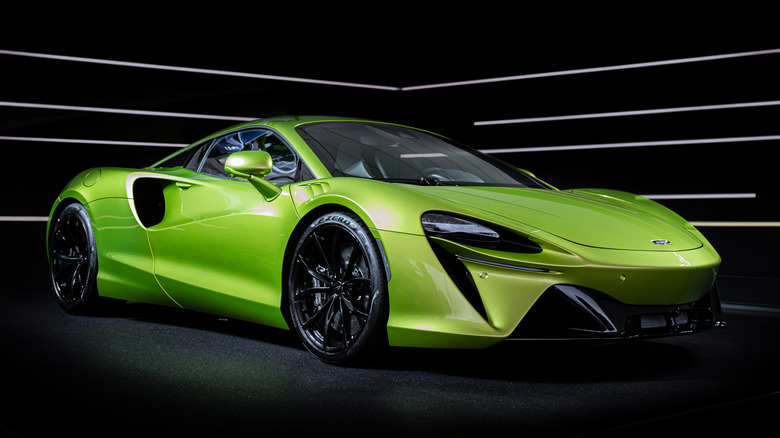
Times are changing, and the world of supercars has to change with it. Brands that once might scoff at the idea of an engine with fewer than eight cylinders, or may consider a battery in their car sacrilegious, have had to adapt with the times, and remake their principles. The McLaren P1 proved hybrid tech belongs in not just supercars, but hypercars, and the McLaren Artura now makes a case for the V6 as the future of entry-level exotics.
The Artura is a car of firsts for the brand. The name itself feels like a name, rather than McLaren's usual cold numeric codes. It's the first car from McLaren to feature an electronic limited-slip differential, helping with cleaner and quicker corner exits, or drifts depending on the driver's desires. It's the first McLaren built on the brand's McLaren Carbon Lightweight Architecture, which provides supreme rigidity and lightness. The MCLA monocoque is a new development from McLaren, reserved for its hybrid models, with its structural accommodations and safeguards for the battery, making for a more efficient and stable drivetrain package. It uses an axial-flux electric motor, a more compact alternative for electric power compared to the industry-standard radial-flux motors. Despite all this newness, it is still very much McLaren in looks and capabilities. Its RWD drivetrain can send the Artura to 60 in just 2.6 seconds, thanks to the 690-horsepower combined output of the axial-flux electric motor and the 3-liter twin-turbo V6.
Ferrari 296 Speciale
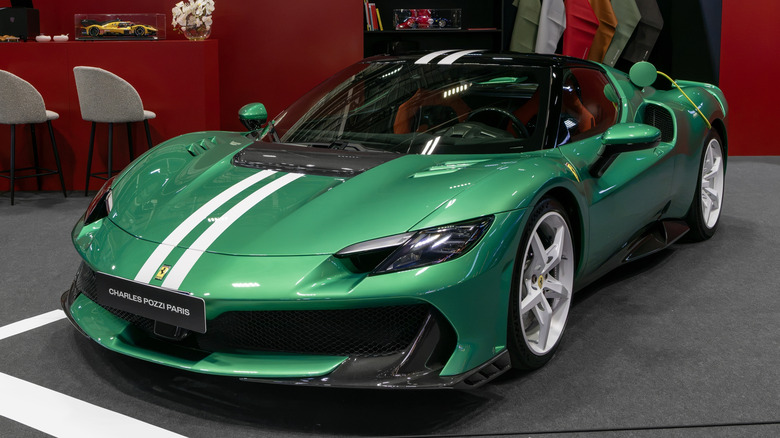
The Ferrari 296 could be considered the main rival of the McLaren Artura for its similar market placement and V6 hybrid powertrain. While the better of those two might be a matter of opinion, the greatness of the 296 Speciale is a bit more objective. Ferraris are always extreme from the factory, but every so often the Modena madmen turn things up a bit. The 360 Challenge Stradale, the F430 Scuderia, the 458 Speciale, and the 488 Pista are all Ferrari at their purest form. Revealed in 2025, the 296 Speciale is the most recent example, and it might be Ferrari's best work yet.
One look at it, and the aero elements are obvious. There's a channel going through the hood, ducts before the front wheels that smooth out passing air and help cool the brakes, and corner winglets, reminiscent of the FXXK's, to provide downforce, with the help of an active wing flap that constantly adjusts its deployment angle. This trickery means the Speciale produces 959 lbs of downforce at 155 mph, which is necessary when you look at its power figures. Improved boost management and lightweight internal components make the Speciale's V6 set a new specific power record for its class at 234 hp per liter. Its 120-degree V angle is wide open and houses the twin turbochargers as close as possible to the exhaust exits, all of which helps the Speciale make 869 horsepower.
Mercedes-Benz AMG One
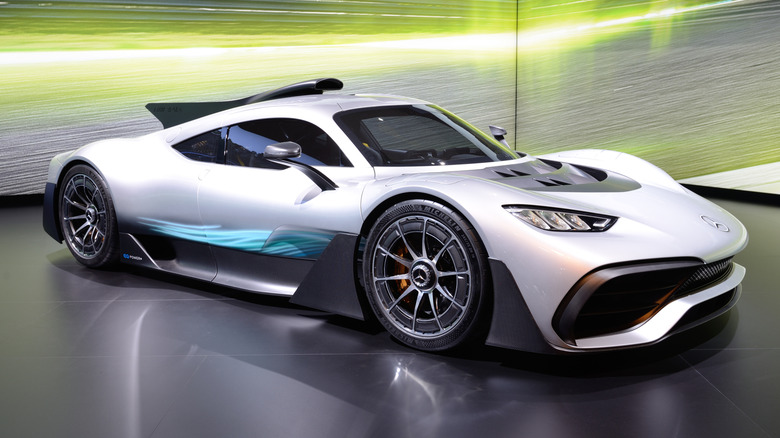
Every so often, a manufacturer comes along and claims it has built a hypercar that brings the Formula One experience to the road. Often, these cars are quite close, but if any one example can claim the crown, it has to be the Mercedes-Benz AMG One. When the concept premiered in 2017, the Mercedes Formula One team was at the pinnacle of the sport — who else would you want making your road-legal F1 car? The task at hand was already a huge undertaking, and the pandemic slowed development even further. Finally, in 2022, the AMG One was ready for its first deliveries, and the motoring world was curious to see what Mercedes-Benz had come up with.
The result was astounding. The One lived up to its claimed title, and it was an exercise in performance that seemingly did the impossible. Starting with the bones, the One was built on a carbon tub. Impressive, but the real wonder was that Mercedes-Benz elected to mount the engine straight to the chassis. This is generally avoided as it decimates creature comforts with loud chassis vibrations, but the weight savings and rigidity benefits are unmatched. The most impressive part, though, was the powertrain. The turbocharger for the 1.6-liter V6 used a Motor Generator Unit-Heat system, derived straight from F1, to keep the turbo spooling at all times with the help of an electric motor. With two more electric motors at the front wheels, the combined horsepower was an enormous 1,049.
Ferrari F80
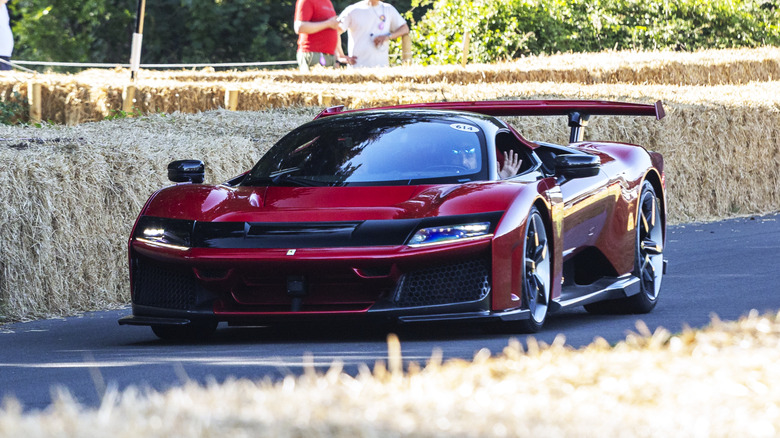
Every so often, Ferrari blesses the world with a car that acts as a summary of the brand. These are its finest creations, where it pulls out all the stops. Not a dollar is spared, and there is no idea too wild to explore. The 288 GTO, the F40, the F50, the Enzo, and the LaFerrari are all what have come before, and now we have the F80 as the newest addition to Ferrari's ultimate flagship supercar lineage.
Given that the previous models all came with V8s and V12s, the idea of a V6 in Ferrari's grandest production model ruffled some feathers. But one close look at that V6 and the car itself makes it clear that the F80 is purebred motorsport royalty. The powertrain is adapted from the 499P, Ferrari's Le Mans-winning hypercar. The cockpit is entirely driver-focused, with its color-coded emphasis and race-car wheel. From the pilot's seat, you are cocooned in a lightweight speed machine, complete with independent active suspension on each wheel and a massive active rear wing. Its aero produces an astonishing 2,315 lbs of downforce at 155 mph, and its computer brain can map a track and calculate optimal power delivery zones. Its AWD delivery keeps the F80 planted and primed for devouring corners while producing face-removing acceleration, as the F80 can hit 60 in just 1.9 seconds. The twin-turbo V6, when combined with the three electric motors, gives the F80 a whopping 1,184 horsepower to work with.