

5 Compact Cars With More Powerful Engines Than Most SUVs
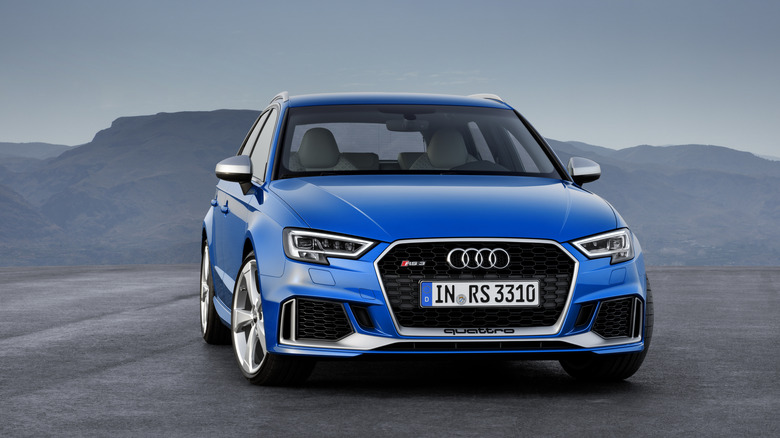
When you picture a compact car, what are the elements that come to mind? Fuel economy, for sure — compact cars are favorites of hypermilers everywhere for a reason. They're also usually hatchbacks or coupes, with the odd sedan in the mix. They're often quite light and nimble, and often have short wheelbases. But what if we took that light, nimble chassis and shoved a massive engine into it? Welcome to the wonderfully wacky world of overpowered sport compacts and hot hatches.
That's the idea behind them, but what exactly is a compact in this case? There are two distinct definitions: the de jure U.S. government classification of a car with an interior volume between 100 and110 cubic feet, and the de facto definition of a car that's small, but not super small. The latter is, of course, a bit vague, and it has certainly evolved; there's a big difference in size between, say, a 1974 Volkswagen Golf and a 2024 model. Likewise, SUVs gained an awful lot of power over the years. Thus, we're going by decades and judging these compacts against the SUVs of their time.
Many of these compacts will be, frankly, quite ludicrous, but they were all available from factory dealerships — no mods, tuner cars, or anything of the sort. So, which compact cars could you have bought new that came with more power than a contemporary SUV? Let's dive in
2020s: Mercedes-Benz A45 AMG
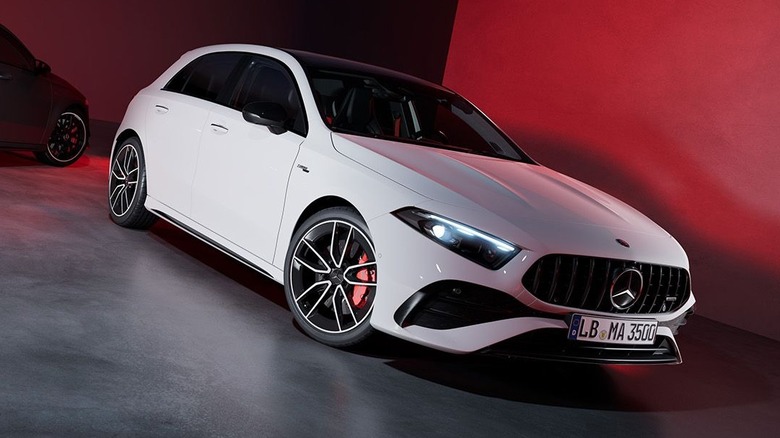
At a glance, the Mercedes-Benz A45 AMG barely even registers as a sports compact. Sure, it has a pronounced lip-style rear wing, but it's far removed from something like the Audi RS 3, for example. If the RS 3 was a Volkswagen Golf that'd been lifting for several years, the A45 AMG looked like a Golf dressed up in a business suit. But looks can be deceiving and, in their infinite wisdom, AMG's engineers decided to give this thing 415 hp and 369 lb-ft of torque.
That's significantly more than, say, a top-tier 2026 Ford Explorer ST, which has 385 hp from the 3.0-liter EcoBoost. And remember, it's not just the power, but also the power-to-weight ratio. Having less mass to move around, with a more aerodynamic body, dramatically improves acceleration. The less weight you have for the same level of force, the harder you accelerate — that's why the A45 only needs 415 hp to hit 60 in just 3.9 seconds.
Sure, there are more powerful cars out there, some of them "compacts" in their own right. A good example is the Hyundai Ioniq 5 N, with its ridiculous 641-hp electric motors. But that's a compact crossover, not a hot hatch in the true sense of the word. As far as mass-produced hot hatches go, nothing beats the A45 AMG on paper. Certainly not most SUVs from the 2020s, unless you're talking about something like another AMG or a Ford Raptor or something. Even a non-hybrid F-150 produces 400 hp, and that's from a full-size pickup truck with a 5.0-liter V8.
2010s: Audi RS 3
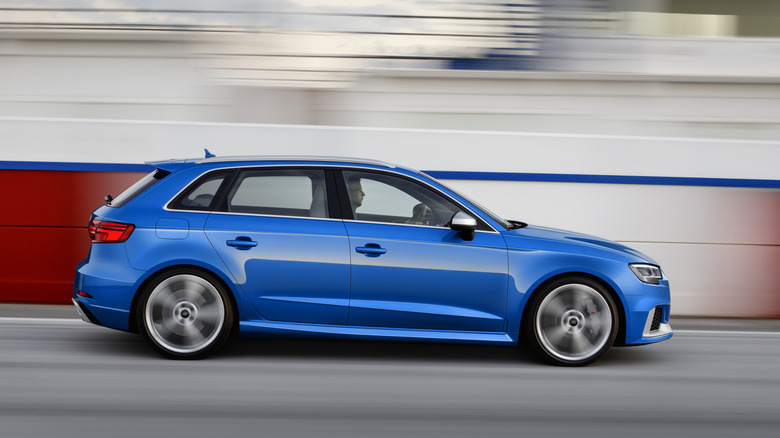
The 2010s Audi RS 3 easily outpaced its rival, the first-gen A45 AMG — and most SUVs of the time, for that matter — with 395 hp. That's a huge chunk of power through all four wheels of what's basically a Mark 7 Volkswagen Golf. And a Golf with 75 more horsepower than a 2010 SVT Raptor with the 5.4-liter V8, at that.
395 hp seems small today in a world with 1,000-plus-horsepower sedans, but think about it this way: the RS 3 was a regular production hatchback with power figures on par with a base-model C6 Corvette. If this car was built with that amount of power in the 2000s, it would've certainly entered budget supercar territory. And it's a Golf, as a reminder — a Golf that can reach 60 in just 4.6 seconds. Some markets got different power figures, granted, but even the U.K. model's 362 hp was still mighty impressive for such a small and understated car.
The original RS 3 predated the whole "every car must look angry" trend, so it retains those classic Audi lines, with some tasteful accents like wider vents and larger wheels. It's a more refined-looking hot hatch than what we'd get today, retaining Audi traditions like the five-cylinder engine, rounded edges, egg-crate grille design, and office-like interior. Audi has kept the flame alive, too: while the 2025 Audi RS 3 is a big departure from the original aesthetically, it's still as brilliant as its predecessor.
2000s: Renault Clio V6 RS
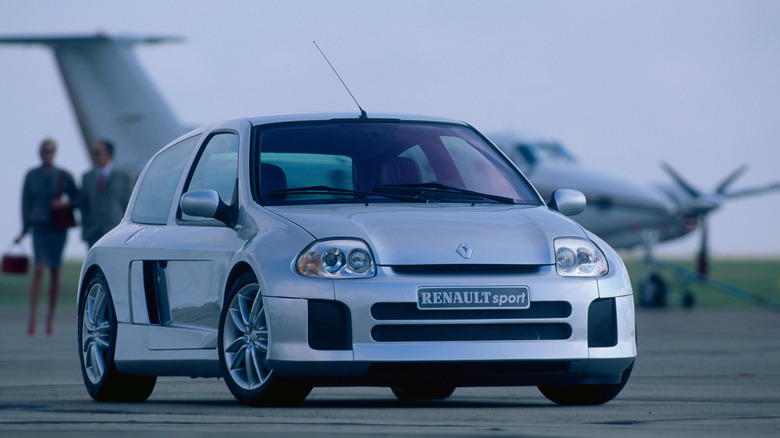
The concept for the Clio V6 RS sounds like some strange machination a mechanic YouTuber built in their backyard, but it had a warranty sticker. It was, frankly, a completely insane idea: Renault built 3,000 pedestrian-looking hatchbacks with a totally inappropriate engine over the rear axle, something that required as much ingenuity as it did imagination. Debuting in 2000, the V6 RS was the result of a collaboration between Renault and Tom Walkinshaw Racing (TWR), and was based on race-going versions that had competed in a Renault-organized racing series in the late '90s.
Owing to its history, this car is effectively just a touring car with a fully furnished interior. And like your typical race car, not much of the original Clio it shares its image with remains; the V6 Clio has a totally different powertrain, different running gear, and bespoke bodywork. Everything is widened and tuned for track use, not the least of which was the 3.0-liter V6 itself, which Renault and TWR managed to squeeze 255 hp and 221 lb-ft of torque from in its final form, creating one of the best Renault production cars of all time.
That doesn't sound particularly powerful, but bear in mind that this was the early to mid 2000s. The top-tier 2004 Explorer, for example, put out some 239 hp by comparison, and the Clio V6 is effectively half the size. It even had 20 more hp than the V8-powered Toyota Land Cruiser of its day. The only trucks with more power at this point had high-performance engines of their own, like the Jeep Grand Cherokee with the 5.7-liter HEMI.
1990s: Nissan Pulsar GTI-R
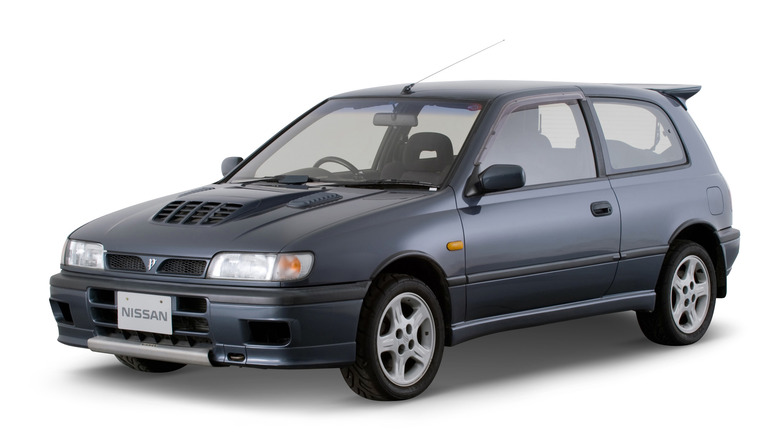
Nissan's Pulsar GTI-R — also known as the Sunny GTI-R — is a rally car without the livery. A Group A rally car, more specifically, that competed during rallying's 1990s heyday alongside icons like the first-gen Subaru Impreza WRX STI, Mitsubishi Lancer Evolution, Ford Escort Cosworth, and so on. Nissan's entry is somewhat lesser-known, partly because the Pulsar GTI-R only competed for two years, with its best showing being a third-place finish. But while it didn't excel in rally, it was a whopper of a compact hot hatch.
The Pulsar GTI-R was something of a technological showcase for Nissan at the time. Nissan was riding high off the success of the R32 Skyline, which was utterly obliterating the (on-road) Group A class in the All Japan Championship, and the Pulsar used much of the same equipment. It had an SR20DET shared with the Silvia K's, producing some 228 hp, coupled to an ATTESA 4WD system and ventilated front disc brakes. More impressively, despite the heavy 4WD, it only weighed 2,689 pounds, compared to the R32's 3,152 pounds.
The Pulsar GTI-R was, effectively, a hatchback S13 Silvia turbo with an R32 4WD system — without the R32's price tag. It punched well above its weight, accelerating to 60 in just 5.4 seconds and handling like it was on rails. Nothing could touch it in terms of power or handling as far as SUVs were concerned; an equivalent-year Jeep Grand Cherokee with a V8 2.5 times the Pulsar's engine size only made 190 hp, while Nissan's own Pathfinder produced a comparatively paltry 168 hp, a full 60 horses down on this hot hatch.
1980s: Lancia Delta S4 Stradale
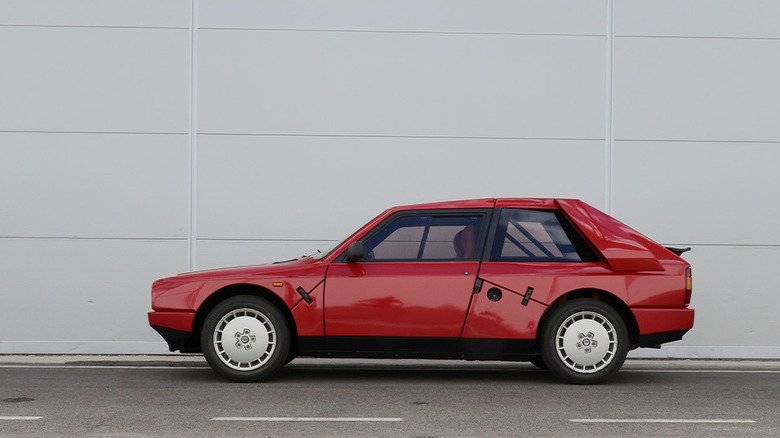
If sheer lunacy were a car, it'd be this monstrosity. The Lancia Delta S4 was a homologation special, a car that only exists so the manufacturer can build its racing variant. The Delta S4 was the product of Group B racing, which stipulated that competing cars had to have 200 road-going versions, and it was an example of manufacturers stretching the rules to within an inch of their lives to remain competitive. Enter the Delta S4 Stradale.
Lancia utilized everything it had to build this car: advanced materials like Kevlar and carbon fiber, which were new in the 1980s; full-time 4WD that could vary between 65-35 rear-bias to 80-20 rear-bias; and perhaps most famously, a twin-charged engine. No, not an engine with twin turbos: a twin-charged engine, namely one with both a turbocharger and supercharger.
As for power figures, well, it's complicated. The Stradale roadgoing version, trimmed in Alcantara leather, was otherwise significantly detuned down to a "mere" 250 horses. In race trim, however, the S4 was powerful enough to rip itself apart, with 510 hp from its 1.8-liter engine. That's effectively four times the power that virtually any SUV made in the 1980s from an engine less than half the size. Case in point: even a full-size Jeep SJ Grand Wagoneer produced at most 140 hp from a 360-CI V8, and these were the days before performance trucks were commonplace, so that power level was par for the course for those big boats.