

5 Used Dodge Compact Cars & SUVs That Won't Break The Bank
Dodge is one of the most prominent U.S. carmakers, offering everything from the small Dodge Hornet to the Dodge Durango, a three-row mid-size seven-seater SUV built for everything a family could ask for. Price-wise, you can get a base new Hornet for as little as $30,000, while a brand-new Durango will set you back the better part of $40,000.
Both come with a warranty and that new car smell, plus you can customize them from the factory however you want. But what if you don't want to pay the new car premium? Both the Hornet and the Durango are expected to lose around 62% of value after five years. On an MSRP of $30,000, that is $18,600, while on the Durango's $40,000, that is $24,800.
These numbers are also associated with base-spec models, meaning that true depreciation for a well-equipped, higher-trim variant is more drastic. In this case, the best thing you can do is search for the best used Dodge compact cars and SUVs that won't break the bank, all while making sure you avoid these ten used Dodge models. Here is our pick of the lot and why buying a used Dodge might be your best course of action.
1. 2023 to 2024 Dodge Hornet GT
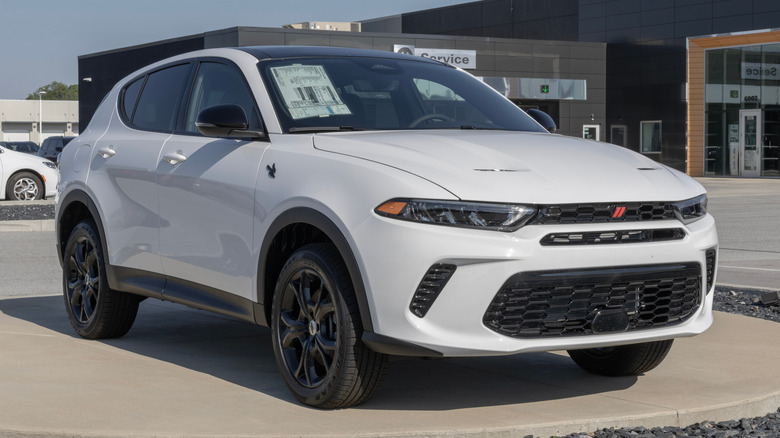
If you want a compact Dodge that is also an SUV, well, you want the Hornet. The Hornet is the newest nameplate on this list and the fastest-falling. A 2024 car now sits at $19,000 on KBB. KBB slots the model into the 75th-100th percentile band for depreciation against every other 2024 SUV — the worst-performing quarter of the segment, which is grim news for the original owner and very good news for you.
Edmunds runs its appraisal from $15,765 to $29,033, so condition and history swing the price by more than ten grand. Look further out, and it gets uglier for anyone buying new. KBB's five-year projection on a 2025 Hornet is a $20,563 drop to a residual of $11,427, against a five-year cost-to-own of $68,405. CarEdge reckons buying a two-year-old example saves $17,562 over sticker. What you actually get for that money is not a penalty box. The GT has 268 horsepower with a 6.5-second run to 60 mph.
Interestingly, iSeeCars puts the Hornet third among Dodge models for five-year value retention at 61.5% — worth noting that figure implies a 38.5% loss, whereas CarEdge projects 62%, so the two sources are working from different assumptions. We do have to stress that not everyone is satisfied with the Dodge Hornet given its recalls, sales numbers, and owner complaints – which perfectly explains those steep depreciation numbers.
2. 2013 to 2016 Dodge Dart
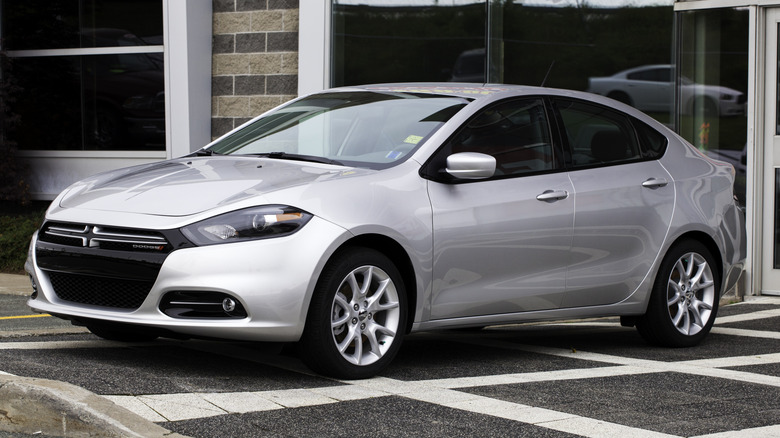
The compact Dodge Dart is the surprise of this list. RepairPal scores its reliability at 4 out of 5 and puts the annual bill at $597, with owners averaging 0.3 unscheduled shop visits a year. The ranking is where it gets interesting — 28th out of 36 compact cars, which says less about the Dart than it does about how brutal that segment is.
Money-wise, buying a used Dart is as cheap as it gets. KBB puts a 2015 GT Sedan at $6,050 and an Aero at $7,500. The GT stickered at $21,990 new, so more than a decade of depreciation has done its work. Owners rate the car 4.1 out of 5.
Underneath sits a modified Alfa Romeo Giulietta platform — the same trick Dodge would pull again with the Hornet a decade later. A six-speed manual was standard equipment, and there were three four-cylinder engines to choose from. Try finding either of those things on a $7,000 compact today. The Dodge Dart has been discontinued twice now because it never really managed to sell all that well.
Although the overall reliability ratings put it above average, owners have complained that this generation of the Dart experiences issues with the powertrain, most notably the transmission. But when Car Wizard was asked whether the Dart is a good buy, his answer, delivered over a tidy 136,000-mile example, was that "they can be if they've been maintained like this one" — the quality of maintenance does the heavy lifting here.
3. 2007 to 2012 Dodge Caliber
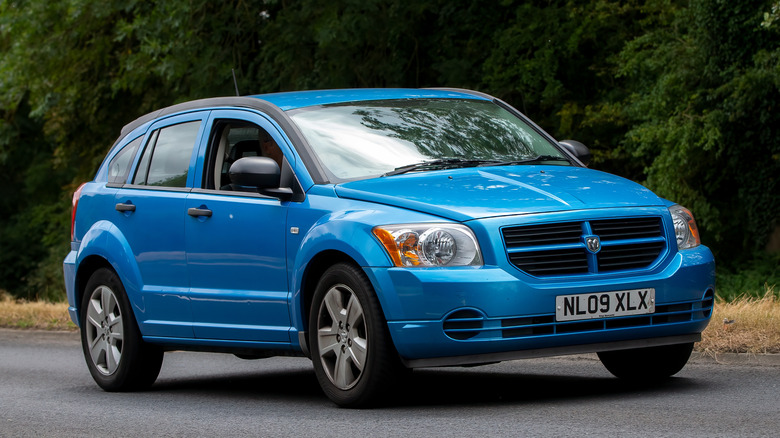
If you want the most amount of car for the money, the Caliber is likely the cheapest way into this list by a wide margin. However, you should keep in mind that it is regarded as one of the worst-looking Dodge models ever made. Either way, the numbers are almost comical. KBB has a 2011 Express opening the range at $3,825 against an original sticker of $18,130.
A Mainstreet can be had for $3,950, the Heat asks for $5,100, and the range-topping Rush Sport Wagon would set you back $5,600. Edmunds runs the 2012 car from $1,121 to $4,814. The running costs are the genuinely interesting part. RepairPal scores the Caliber 4.0 out of 5.0 and ranks it 16th out of 36 compact cars — better than any other compact Dodge here.
This repair bill comes to about $501 a year, against a $526 compact-car average. The odds of a repair turning severe sit at 12%. Owners on KBB rate the 2011 car 3.9 overall across 786 ratings, with reliability and styling both scoring 4.2. KBB's own reviewers flagged the interior plastics and the noise levels as the low points.
Two things to check before you buy. Blocked sunroof drains send water into the cabin rather than out of it on 2007 through 2011 cars, and 2009 owners filed more complaints than any other year. CarComplaints also logs suspension trouble on the 2007 Caliber, traced to ball joints and control arms.
4. 2007 to 2011 Dodge Nitro
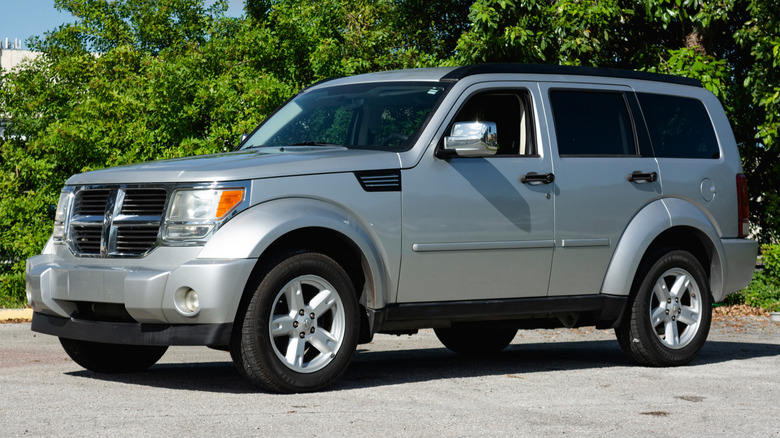
If looks are important to you and you never really gelled with the Caliber, in many people's eyes, the Dodge Nitro, the boxy one, was one of the best-looking Dodge SUV models ever. The Nitro uses the same Chrysler KK platform that underpinned the Jeep Liberty, at 178.9 inches nose to tail. RepairPal scores it 4.0 out of 5.0 and ranks it 8th out of 26 midsize SUVs, at $582 a year against a $573 class average.
Owners average 0.3 unscheduled shop visits annually, and the odds of a repair becoming severe are 12%. Since the whole question of this article centers on saving money when buying used, money is the headline here. Edmunds puts 2011 trade-in prices between $1,215 and $5,484, with a clean Detonator worth $1,953 to a dealer, $3,061 private party, and $3,705 on a forecourt.
Tidy Heat examples turn up on KBB listings for around $7,500 with 90k-ish miles, which is the premium you pay for a genuinely low-mileage one. There was never a four-cylinder option in America. KBB lists the 2011 range running from 210 horsepower in the SE to 260 in the Shock, the former from a 3.7-liter V6 and the latter a 4.0-liter.
Rear-wheel drive was standard, with four-wheel drive optional, and towing capacity tops out at 5,000 pounds when properly equipped, compared with 2,000 pounds as standard. Fuel economy is the price of admission, though: 16 city and 22 highway for a two-wheel-drive 3.7, dropping to 15 and 21 with four-wheel drive.
5. 2019 to 2020 Dodge Journey
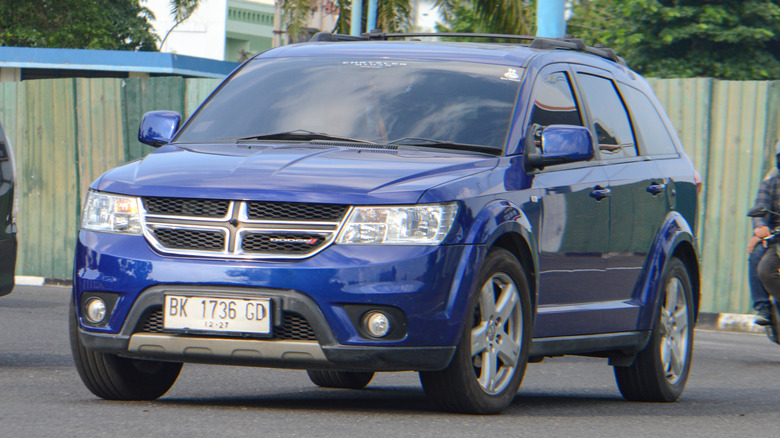
The Journey closes this list as the practical one, and the model year you pick does most of the work. RepairPal scores it 4.0 out of 5.0 and ranks it 6th out of 26 midsize SUVs, at $562 a year against a $573 class average. Owners average 0.3 unscheduled shop visits annually and face a 12% chance that a repair will become severe.
Targeting the 2019 model is a good idea, as it is one of the best model years for the Dodge Journey. It carries comparably fewer complaints than other Journey models. The best part is – the depreciation is savage, which is exactly what you want as a buyer. KBB opens the 2019 range with an SE at $10,550, against a $24,740 sticker price.
The real story is at the top: a range-topping GT stickered at $37,040 and now asks $10,400 — less than the base car. Spec has stopped mattering, so buy the best-equipped example you can find. Edmunds puts 2020 trade-in money between $8,508 and $14,955, with a clean Crossroad worth $9,965 to a dealer and $11,891 private party.
RepairPal rates the Journey 4.0 for reliability, but owners posting on the same site average 2.9 out of 5. The repair invoices and the ownership experience are telling different stories, and cabin quality drew criticism right through to the final cars. Either way, prioritizing well-maintained examples lowers the risk of experiencing these problems.
How we made the list
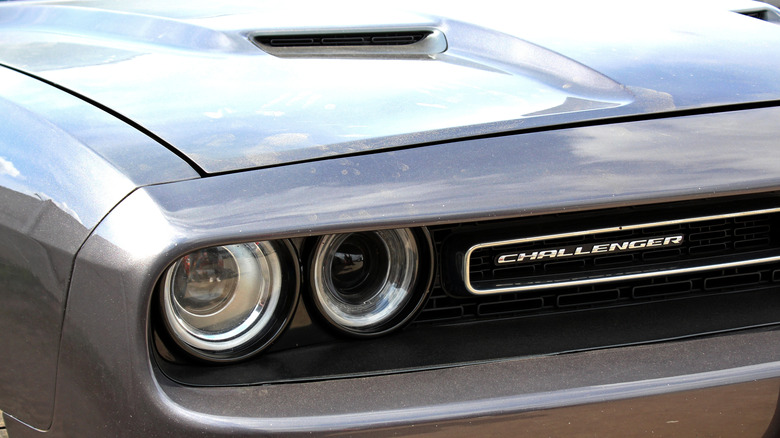
Assembling this list was not difficult in the sense of finding candidates — Dodge's used-car market is deep and well-documented. The challenge was the brand itself. Modern Dodge simply does not build many compacts, and the ones it has built were mostly discontinued years ago, which meant reaching back through the catalog rather than picking from what sits on forecourts today.
To keep the selections grounded and easy to verify, we pulled figures from established valuation and ownership sources rather than relying on impressions. Pricing and depreciation data came from Kelley Blue Book, Edmunds, CarEdge, and iSeeCars. Reliability scores, annual running costs, and repair frequency were sourced from RepairPal and cross-checked against owner complaint records on CarComplaints and NHTSA filings, where available.
Beyond the raw numbers, we weighed owner satisfaction ratings, common fault patterns by model year, and the practical experience of mechanics who work on these cars. We also drew on our previous coverage of the brand, along with contemporary road tests from outlets including Car and Driver, to ensure each pick holds up as something worth owning rather than merely cheap.