

5 Signs You're Using The Wrong Motor Oil For Your Car
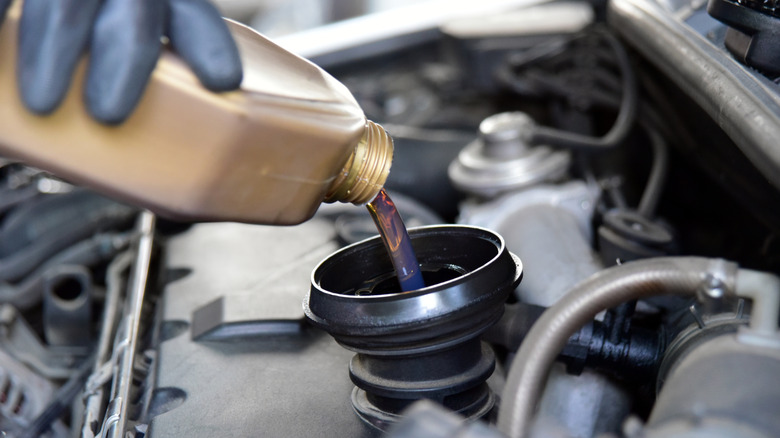
Owning a car is a necessity for much of the population, even as some might consider it a necessary evil. That ownership subgroup might be quick to tell you that cars, trucks, and SUVs are a fairly expensive necessity right from the jump. On top of the initial financial investment, cars require almost constant maintenance if you want to keep them running well, and the cost of visiting automotive professionals for upkeep is hardly cheap either.
If you count yourself among the world's millions of car owners, you already know that the list of things you need to do to properly maintain an automobile engine is pretty extensive. You're no doubt also aware that regularly changing the oil is among the most important things you can do to keep your engine in good running order. Motor oil is basically the life blood of an engine, and if your vehicle doesn't have enough, your engine is likely to endure the sort of damage the average driver can't afford to repair.
Along with ensuring that they always have enough oil flowing through to function, it can be every bit as important to ensure you are using the right kind of oil. Engines are precision machines, tuned to function at peak capacity only when the correct products are used in their operation. Here are a few tell-tale signs that you might be using the wrong oil in your car.
The oil you're using doesn't match the manufacturer's recommendation

As noted, car engines are precision machines that are calibrated to utilize specific products in their function. That absolutely includes the motor oil you choose to keep them properly lubricated and pumping smoothly when you are out on the road. In general, if you take your vehicle in for service by automotive professionals, the mechanic should be able to determine which grade of motor oil is the correct one for your engine.
If you are instead looking to change the oil or top off the contents of your oil reservoir without seeking professional help, you are not flying blind. Your car's automaker will have almost certainly provided you with the precise style of motor oil your car needs.
That information will typically be in your owner's manual, along with virtually everything else you need to know about operating and maintaining the vehicle. If you're not familiar with that publication, it's the big book-like thing that's probably been taking up space in your glove box since you drove the vehicle off the lot. And yes, if the grade of motor oil you are using in your car does not match the manufacturer's recommendation, it's absolutely a sign that you are using the wrong one. So please, please, please consult your owner's manual before you even think about putting oil in your car.
You notice a dip in fuel economy
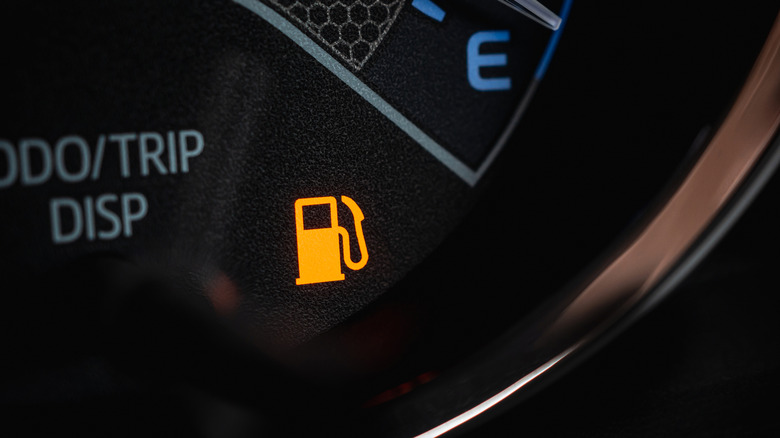
Fuel economy is one of the bigger deciding factors for many folks in the market for a new car. That's probably just as true if you're shopping for a used car too — gas only seems to get more expensive these days. To that end, once you're behind the wheel, you're likely paying closer attention to how frequently you find yourself pulling into a filling station to top off the tank.
If you find that you are suddenly shelling out for a fill with increased frequency, there are any number of issues that could be behind the problem, and that list includes using the wrong motor oil. More specifically, the issue could be due to you filling your oil reservoir with a product that's too thick for your engine.
Motor oil thickness is often referred to as viscosity, which is measured by an oil's resistance to flow. Thus, viscosity — which is designated on a motor oil bottle by a letter and number combination –directly affects how well the fluid passes through an engine. If the motor oil you are using is too thick, the engine will have to work overtime to keep the flow going. That, in turn, will directly affect how much gas your vehicle is using when you're out driving. If you're experiencing that issue, you may want to confirm that you're using the correct oil.
You are seeing exhaust smoke
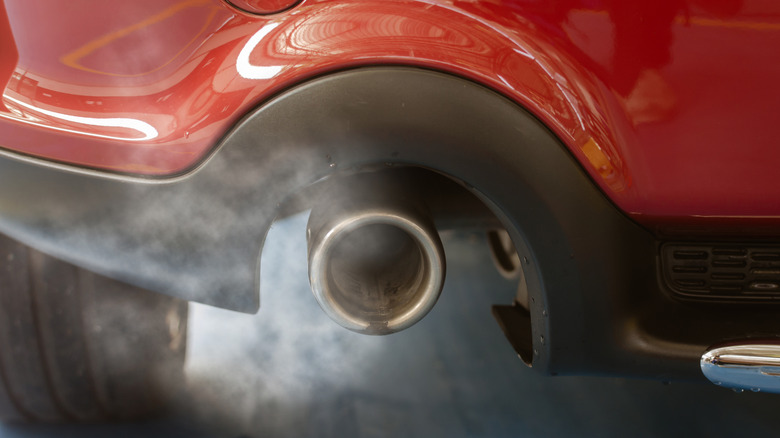
Seeing smoke anywhere around your car is pretty much never a good sign. If you see it coming out of your vehicle's exhaust, it's a signal that something might be wrong with your vehicle's engine or exhaust system. In either case, you can likely expect to spend a small fortune to correct the problem if repairs are needed.
There are, of course, different kinds of smoke that can be seen coming from your exhaust, and if you're seeing blue or black smoke coming out of your tail pipe, the news may not be as dire as you think, since those colors may reflect that your are simply using the wrong motor oil in your car. If that's the case, you'll likely see said smoke when your vehicle is accelerating, and it reflects the possibility that oil is actually entering the combustion chamber. That may be the result of using the wrong grade of oil with incorrect viscosity.
An oil with incorrect viscosity for the engine could lead to the lubricating fluid bypassing certain vital components within. When that happens, oil residue can collect in parts of the engine where it shouldn't be, and eventually be burned away when the engine operates. It can also cause performance and emissions issues, and thus the problem needs to be diagnosed quickly.
Increased oil consumption

While mileage and frequency recommendations may vary by vehicle, any automotive professional would be quick to tell you that the oil in your car, truck, or SUV needs to be changed with some frequency. The vehicle's manufacturer will no doubt agree with that recommendation, and assuming you do keep on top of those oil changes, there should be no need to top off your oil levels in between visits.
Using the wrong motor oil will likely not be the first culprit that comes to mind if you do find yourself regularly needing to fill the oil reservoir in between scheduled service visits. If, however, your vehicle is experiencing rapid declines in oil levels, it can indeed signal that you're using the wrong kind. As the theory goes, using the incorrect grade of motor oil can lead to thermal instability in the engine. That lack of stability will eventually lead the oil to evaporate under excessive heat while the engine is running, causing you to top the fluids off when you shouldn't otherwise need to. That can be an expensive prospect, of course, as quality motor oils are hardly cheap these days.
If you leave the issue unchecked, it will not only result in the inefficient operation of your vehicle, but potentially contribute to the presence of contaminants therein. It should go without saying that such an issue could eventually cause irreparable damage to your engine as well.
Your engine is overheating
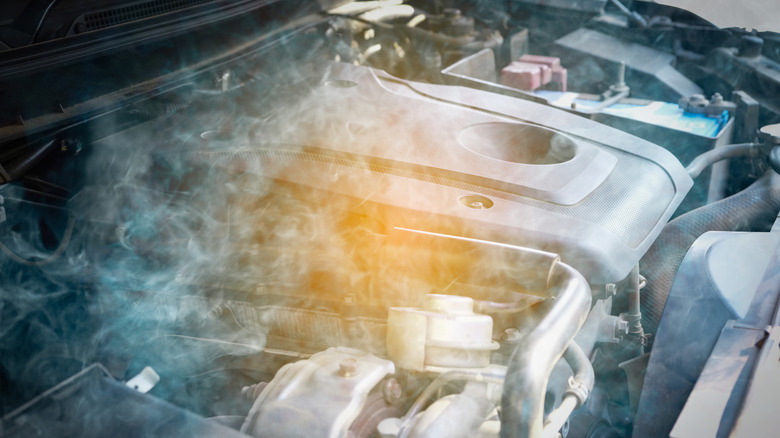
If you are using the wrong motor oil in your car, some of the issues we've gone over may be preceded by the oil warning light in your dash display turning on. This is one of the many in-dash warning lights car owners should never ignore, because it may lead to more sinister warnings and issues in your engine. That list includes the dreaded engine temperature warning, which signals that your engine is either already overheating or getting dangerously close to it.
If you see the engine temperature light, you should stop driving the vehicle as soon as possible, as continuing to drive will almost certainly result in catastrophic engine failure. There are many factors that can contribute to an overheat, but low oil levels or using the incorrect grade of oil rank pretty high among them.
In the latter case, the incorrect viscosity tends to be the culprit, as using a motor oil that is too thin or too thick for your engine often results in thermal instability. This is particularly true in warmer climates, and when heat builds up in the engine, excessive pressure is put on various components. The extra stress can contribute to an overheat in even normal driving conditions. So if you see that warning light, or smoke coming from under your hood, make sure your mechanic checks that the right oil is being used.