

There's A Good Reason Why Some Car Components Are So Hard To Reach

If someone asked me how to describe the anatomy of a car, I'd likely start with the word "complicated." That's not to say that the way a car functions is a difficult concept to grasp, nor even implement. It's a series of controlled explosions inside an enclosed space, with a bunch of moving parts to turn that energy into rotation. Internal combustion engines have operated this way for over a century. It's a well-understood science at this point. Why, then, does it seem like some components are designed to be egregiously inaccessible?
As a former tech and someone who's worked on her cars for about 15 years now, this bothers me enough that I exclusively daily drive classic cars in part because they're easier to work on. Well, some of them, at least — but I'll get to that later. But it seems like every time I open up the hood to do something as basic as change the oil on a modern vehicle, I'm met with a filter that requires contortionist-like flexibility to reach, a bunch of plastic covers and wiring obscuring the engine itself, and even the strange omission of something as basic as a dipstick.
But what is the reason, really? Is it the engineers being ignorant of how hard they're making it for us? Is it policy and cost-cutting? Is it that cars are simply too complicated now? In truth, I don't think it's the engineers' fault at all, but I do stand by the latter two points. It's a combination of business politics, packaging, and the general automotive zeitgeist. Let me explain why.
Why modern cars are horrible to work on

Modern cars, by design, feature a lot of electronics. They automatically adjust your seat, climate preferences, tint the mirrors, display warnings as you reverse or you merge onto the highway, and so forth. A lot of this bloat is because of the NHTSA, which has either mandated or strongly encouraged such features in the name of safety and efficiency — at the cost of ridiculous complexity.
Meanwhile, we also have the modification or elimination of repair-critical components like dipsticks, monitoring gauges, and more. BMW even filed a patent for a new screw design that requires a specialist screwdriver to remove. The right to repair is unfortunately no longer a given — or, at least, not in practice. BMW isn't the only company guilty, either: in 2026, President Trump claimed that both Ford and GM were pushing for a bill to stop people from working on their own cars. Manufacturers, as a whole, seem to give little or no thought to serviceability because the assumption is that you're just going to bring the car in for warranty anyway, then trade it once planned obsolescence kicks in.
To be clear, I don't have any issues with tech in modern cars. In a perfect world, all of this would be easily serviceable. Unfortunately, there's no reason for manufacturers to spend time and money on packaging their cars and the supporting hardware in ways that make it easy for us to fix them.
Old cars have different issues
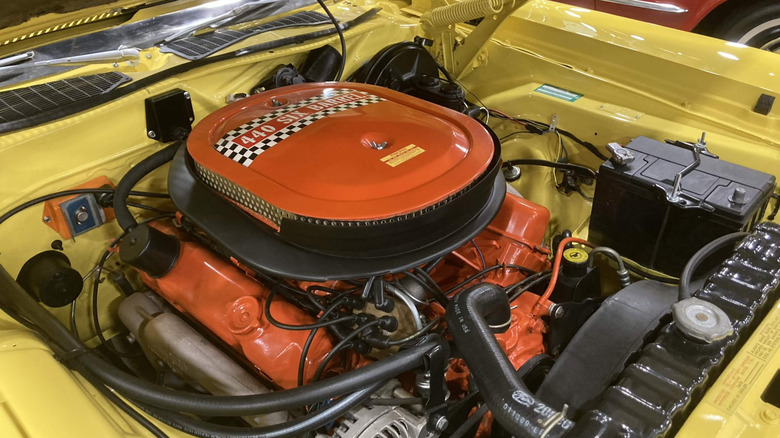
Alright, so modern cars bury all the mechanical parts under tech, but what about cars that don't? Well, the term "blood, sweat, and tears" is very real with classic cars, and it's often a dimensional problem, not a technical one. Sure, you can get the odd vacuum-powered emissions control from the Malaise Era, which can be seemingly deliberately obtuse, but for the most part, classic cars are simple, right?
Yes and no. I was the unfortunate owner of one 1973 Volkswagen Super Beetle. I had to drop the engine out a lot, and I got good at it. But first, I had to find the four bolts holding the engine onto the transmission; these required me to reach in between the fan shroud and body at an awkward angle. Likewise, the engine bay of my dream JDM car, a Nissan Skyline, is so cramped that I had to remove the radiator to get at the crank pulley to replace the timing belt.
These are not the fault of engineers. They're the constraints of the vehicle's dimensions. My Skyline's straight six is long, so it lacks clearance from front to back. My Volkswagen was air-cooled and had the giant fan in the way. Things get more complicated when you add on components like turbos, bigger intakes, fuel injection, and so on, combining these old designs with new tech. Then it's a measure of arithmetic — how much would redesigning the whole engine bay to accommodate all that actually cost? Often not enough to justify such an undertaking, I believe, and that's why many cars like these end up so horrible to work on.