

How Much Horsepower Does A Ford 300 Inline-6 Have & Is The Engine Any Good?
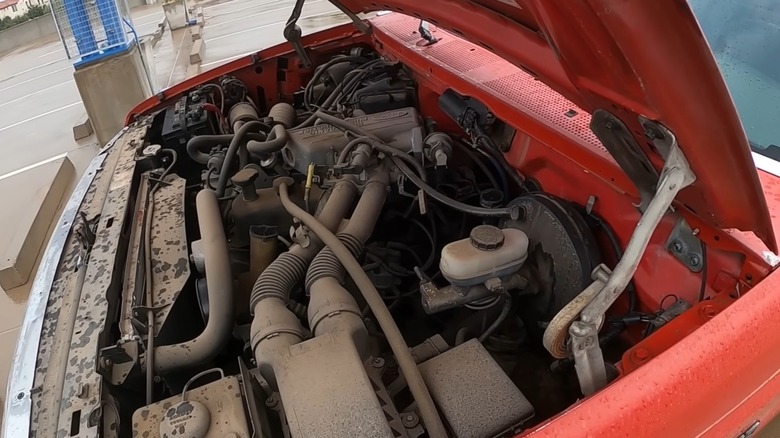
The Ford 300 is arguably one of the most famous and long-lived straight six engines of all time, famously representing the entry-level powertrain of the F-series line from 1965 all the way to 1996. What's even more amazing is nothing much has changed in that timeframe. Sure, the engine was originally offered in two flavors — the 240 or the more iconic 300 — but overall the general configuration, power figures, and intended purpose largely remained the same. Arguably its biggest change occurred when it went to multi-port electronic fuel injection in 1987. Ford must've been doing something good, then. Right?
For one, the company had physics on its side. Straight six engines embody the art of simplicity, and that's by design. It's a rather unique configuration because, unlike most other engines, straight sixes have perfect primary and secondary balance characteristics. Most engines need balance shafts and weights to balance out the forces exerted by the pistons, but straight sixes don't. This makes them less complicated from the get-go, and less complicated means fewer failure points. Robustness is what powers serious trucks for serious purposes, which is why so many semi-trucks still use straight sixes to this day.
Ultimately, it's not strictly about ruggedness, not the power — though it does help when you put your 300 cubic-inch engine into 1960s heavy-duty commercial trucks. The engine did produce a respectable 170 hp at 3600 RPM in 1965, alongside a seriously impressive 283 lb/ft torque at 1400-2400 RPM. Interestingly, that number actually dropped by its final year, sunsetting with 150 hp at 3400 RPM and 260 lb/ft at 2000 RPM. But there's a reason for that as well, so let's dive into it.
How much power did the Ford 300 actually make?
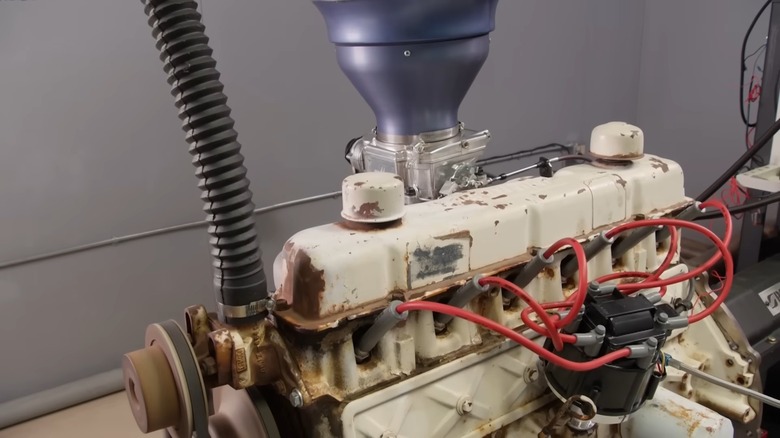
This is a deceptively complicated answer because, on paper, the engine actually got worse. But that's not exclusive to this engine at all; sure, the Malaise Era choked a lot of these powerplants to within inches of their lives with primitive emissions-cutting equipment. What about in 1996, though, when the 300 six was making 150 hp versus 170 in 1965? Enter the wonderful wacky world of SAE.
SAE stands for the Society of Automobile Engineers, a firm which dates back to before the automobile was ever mass-produced. These are the people who effectively wrote the book on horsepower and everything it entails, so when an engine was rated at, say, 170 horsepower, that number was defined by SAE as just that. But what does 170 horsepower mean in this context?
Prior to 1971, that figure meant 170 gross horsepower. That is, horsepower measured without accessories or the parasitic drag of the vehicle's drivetrain — just the engine alone, like gross pay before taxes. After 1971, that number drastically decreased across the board because SAE adopted its net horsepower figure, which was the horsepower actually put down by the vehicle's wheels. Basically, it's your actual income after taxes, rent, and bills are accounted for.
Now we go back to the 300 six. The engine's gross horsepower rating in 1965 was 170, but its net power in 1996 was 150. That means it's likely just as or even more powerful in the 1996 configuration despite its lazy tune; that 150 horsepower is the actual figure you as a driver experience, so that is the "truest" power figure in real-world terms. Of course, mileage will vary depending on year, but they all generally hover around the 120-170 horsepower figure.
How good are Ford 300 straight-sixes, though?
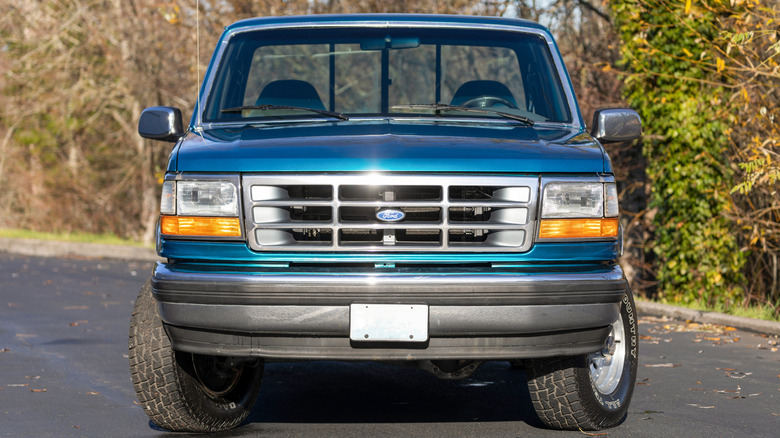
In today's world where your truck is considered a bit of a wet noodle below 300 hp, how practical is something with half that figure? In truth, highly practical, even specifically sought-after.
Bear in mind that these engines were not designed for ridiculous levels of power. They were fitted to base-model farm trucks, commercial vans and loaders, and fleet vehicles. Hardly any of these vehicles had anything that wasn't absolutely functional, aside from maybe air conditioning and a radio. They were simple, honest, manual work trucks, which is reflected in the design of the engine.
Take for example the design of the 300's timing mechanism. Unlike many engines which use a timing belt or chain, a 300 six uses timing gears. These are louder, certainly, but you'd earn a medal if you found a way to break them. Moreover, they were hideously overengineered for the amount of torque they put out. 300 sixes are large, cast-iron blocks that could double as boat anchors in a pinch, but all that weight also meant plenty of metal to absorb the rigors of constant heat cycles.
This whole era is chock-full of engines like this. You have the 300 six alongside the Chrysler Slant-Six or the infamously unkillable AMC six that survived basically unchanged until 2006, among many other legendarily reliable straight six powertrains. So sure, on the surface, this engine looks like a wimp because it's got roughly the same displacement as a 5.0 V8 but with a third of the horsepower. But if you're just looking at power figures, then you're missing the point of why these engines (and the trucks they powered) are so legendary.