

4 Common Problems With V8 Engines
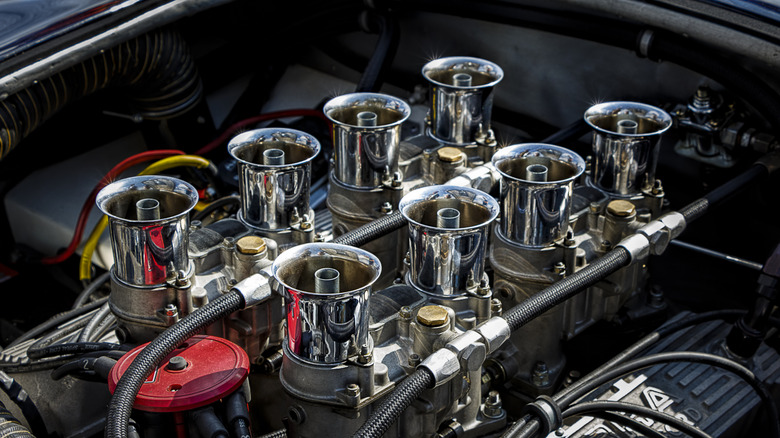
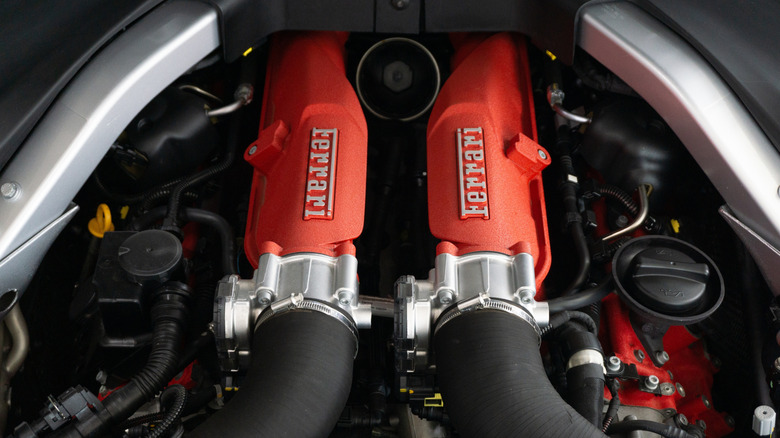
Few things in the automotive world command respect quite like a V8. Eight cylinders arranged in two banks of four, joined at the crankshaft in a V configuration — it's a layout that has powered everything from muscle cars and pickup trucks to supercars and endurance racers, and it comes in more than one flavor. For instance, Ferrari built its reputation on the shrieking, high-revving flat-plane crank V8 that defined a lot of its thoroughbred supercars.
On the other hand, supercharged American V8s typically represent the thunderous cross-plane approach that muscle cars are well-known for. Regardless whether it's a flat-plane crank or a cross-plane crank V8, both speak the same universal language of car enthusiasm. People love V8s for reasons that are almost primal.
The sound alone — whether it's an exotic wail or a lopey, burbling idle — is enough to empty bank accounts. Add in effortless torque, muscular power delivery, and the way a V8 always seems to answer the call when you bury the throttle, and it's easy to understand the devotion. Even in the age of electrification, the V8 refuses to bow out.
Modern examples pair hybrid assistance and clever engineering with old-school displacement, producing more power than ever while sipping fuel in ways their ancestors never could. Still, longevity and legend don't equal perfection. V8s carry their own set of weaknesses, some baked into the design itself and others born from specific engineering choices. Here are four common problems with V8 engines.
The V shape traps heat between the cylinder banks
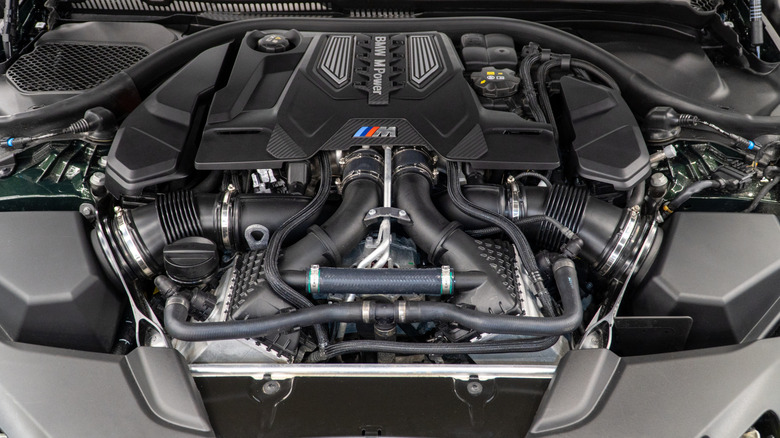
The space between a V8's cylinder banks used to house nothing hotter than an intake manifold. Then manufacturers started filling it with turbochargers and exhaust plumbing, and a somewhat of an industry-wide pattern of heat-related failures followed. BMW went first with the BMW N63 V8, which was the first production hot-vee V8, and a class action lawsuit alleged the design caused "excessive heat-soak," with the settlement covering many 2013–2019 BMW models.
Owners in a separate suit reported adding a quart of oil every 750 to 1,000 miles, and BMW's Customer Care Package could escalate to full engine replacement. Audi's 4.0 TFSI — the hot-vee V8 shared with Porsche, Bentley, and Lamborghini — followed the same script. As it stands, repeated heat cycling near the turbos takes a toll on nearby plastic components; breather hoses, vacuum lines, and coolant lines are the most common casualties, becoming stiff and prone to cracking with age.
Audi issued the TSB 2044640 for damaged turbochargers along with a service campaign replacing turbo coolant lines and O-rings. Mercedes-AMG uses the same valley-mounted turbo layout on its own twin-turbo V8s. Cadillac's Blackwing V8 has had its maximum power output limited due to heat constraints, while Ford's 6.7-liter Power Stroke diesel V8 also experienced turbocharger failures. The first-generation ceramic ball bearings couldn't handle the punishment of that environment.
The sustained heat and constant load swings in the reverse-flow, valley-mounted layout left them prone to chipping and uneven wear over time. It must be noted that this is not an issue affecting all V8 engines or every hot-vee design, but the thermal challenges are evident. A V8 generates substantial heat and is often packaged tightly, so placing turbochargers and exhaust components within the engine valley improves performance and response at the cost of increased thermal stress.
Packaging and size constraints
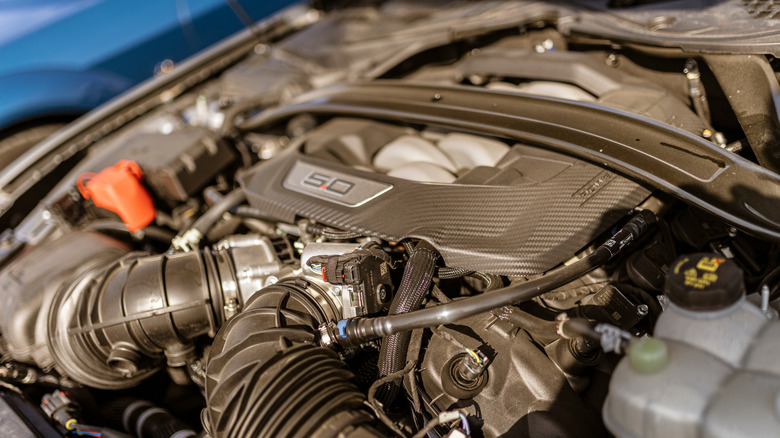
A V8 is a big engine, and often it fills an engine bay wall-to-wall. Access problems compound on turbocharged V8s that mount hardware in the valley. On BMW's N63, the intake and exhaust valve stem seals sit buried beneath the turbochargers and their plumbing, so reaching them means pulling the whole engine out of the car. Buying new seals costs next to nothing; the labor bill for that removal is what actually hurts.
Ford's 5.4-liter V8 carries its own packaging tax at the spark plug. In certain versions, plugs can seize inside the cylinder head and snap off during removal, leaving broken fragments lodged in the threads behind. When VAGTechnic, a UK-based Audi/VW specialist shop, tore down an Audi B7 S4's 4.2-liter V8 for a timing chain rattle, the technician said on camera: "engine out unfortunately we can't do anything when the engine is in the car."
It is a similar story with the Ferrari F355 V8 which requires the engine to come out for a major service or even timing belt replacement. In modern times, V8s are even more complex, especially when hybridized. This leaves less and less room within the engine bay for technicians to work, and that can be a challenge. All of that size and weight is a direct con of a V8 engine.
V8 cylinder deactivation problems
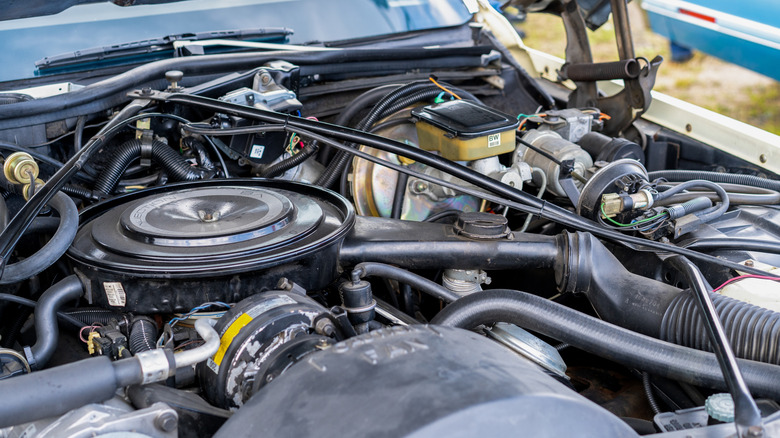
Cylinder deactivation isn't unique to V8s –Honda uses it on V6s, and Volkswagen has even run it on a turbocharged inline-four since 2011. Be that as it may, on a V8, the mechanism always does the same thing — it shuts down exactly half the engine. GM's Active Fuel Management does this on its 5.3-liter and 6.2-liter V8s by diverting oil to collapse the lifters. That collapsing mechanism is also where V8 deactivation systems fail.
A federal class action against GM, still active in the Eastern District of Michigan as of March 2026, centers on the L84 5.3-liter and L87 6.2-liter V8s, alleging premature lifter failures. Mercedes recalled its M176 V8 because of cylinder deactivation issues that could even cause a fire. Chrysler's own MDS-equipped 5.7-liter Hemi relies on the same kind of collapsing lifters as GM's AFM, and it's common enough for owners to delete the system entirely – some over reliability concerns, some simply because MDS changes the exhaust note or gets in the way of a cam upgrade.
According to Holley, GM and Chrysler both "developed systems that would mechanically deactivate cylinders in the engine during light-load driving scenarios." Cadillac's L62 V8 was one of the very first engines to ever have it, and it was plagued with issues because the electronics weren't capable of powering it.
Cylinder deactivation is more notable on V8s because these systems shut down four cylinders at once, and that requires dedicated collapsible lifters, an oil-control circuit, and extra ECU programming just to manage the switch – all of which is extra hardware that adds extra ways for something to break, which is a big part of why V8 deactivation systems account for some of the most-documented reliability complaints out there.
Complexity
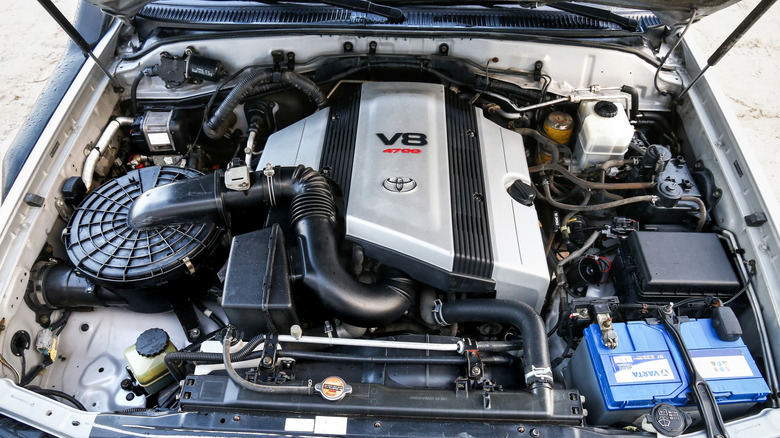
A V8 engine has eight cylinders, and with those cylinders come many additional components. This means eight pistons, eight connecting rods, sometimes even 32 valves, two cylinder heads, four camshafts, two valve covers, and a more complex valvetrain. All of this means a V8 has more components that require maintenance, more things that require servicing, and inevitably, more things that can fail.
With a two-bank architecture, this also means more seals, gaskets, bearings, and many other internals a smaller engine does not need to worry about. The two-bank layout also requires a more intricate timing system, as the crankshaft must precisely synchronize the valve timing of both cylinder banks – with two camshafts per head, that's four camshafts total, all needing chains and tensioners kept in sync.
Naturally, two banks and more of everything also requires more cooling, more piping, more galleys, and often more fluid to circulate. Add longer harnesses, more sensors, more injectors, and more fuel hardware in general, and you are way above what a smaller engine needs, regardless if its about general maintenance or repairs.
It must be said that none of these are actual drawbacks, but rather that a V8 adds more complexity, and that can turn into a problem since more of everything can become a problem. When you scale this architecture to some of the biggest V8 engines ever made, you start to see just how much more of everything these engines have.
How we made the list
A V8 will always be a compromise. It rewards you with power, presence, and a sound nothing else quite replicates, but it also asks more of you in return — higher fuel bills, pricier maintenance, and, as this piece has shown, mechanical complexity that smaller engines simply don't carry. Hot-vee packaging buys better turbo response at the cost of accessibility, while cylinder deactivation buys fuel savings at the cost of extra failure points.
What you get and what you give up depends entirely on what you value in a car. Regardless of where you land on that trade-off, V8 engines remain genuinely susceptible to the issues detailed here. To keep this grounded in fact rather than forum folklore, we leaned on primary sources wherever they existed — NHTSA recall filings and technical service bulletins, active federal class-action court records (via ClassAction.org and CarComplaints.com), and manufacturer service documentation.
We supplemented that with reporting from Jalopnik, SlashGear, DrivingLine, Autoblog, Motor Authority, and Holley's technical archive, plus firsthand teardown footage from independent specialist shops. Where a claim came from a dealer-adjacent blog or parts retailer rather than an editorial outlet, we cross-checked it against the underlying recall, technical service bulletin, or lawsuit filing before including it.