

6 Measuring Tools Homeowners Should Always Have On Hand

Measurement tools form a crucial foundation in literally every job you'll take on as a homeowner dabbling in the DIY renovation and repair world. Regardless of how complex the task might be, measuring ahead of an installation or augmentation is one of the first steps in any project. Whether you're building a new raised garden bed in your backyard to grow vegetables with your children or repairing leaky plumbing under the sink, it's impossible to accurately tackle a part swap or building task without knowing the size of your components.
The tape measure is a classic, and natural starting point, but it's arguably not the most important measurement gear I use in my own renovations. As a homeowner frequently finding myself handling new projects around the house (most recently exploring major air tool brands and building a concealing frame for the oil tank in the backyard with a pneumatic nailer), these are six of the most important measurement tools I reach for during a job. Most of these tools are inexpensive, making them easy to bring into your tool collection, although in certain niche cases, it's entirely possible to spend a great deal more on a larger or more potent upgrade to one or more of these foundational pieces of equipment that unlock so much precision and capability in your DIY wheelhouse.
The speed/rafter square
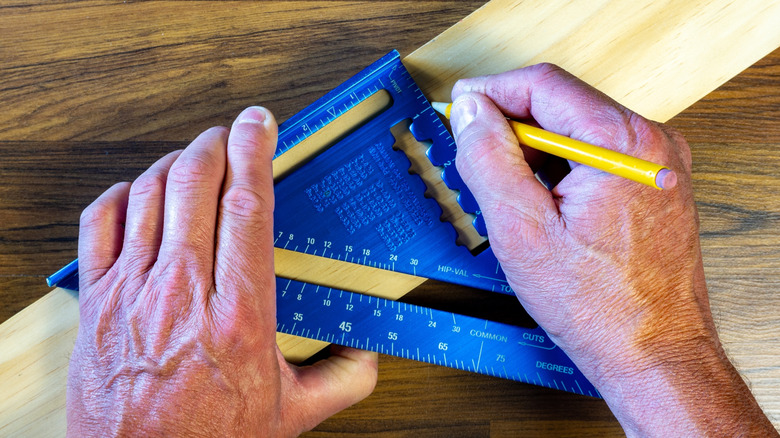
Feel free to disagree, but for my money, the most important measurement tool in my collection is the speed square, hands down. Also known as a rafter square, this tool is purpose-built to support the construction of roofing elements. The square is triangular in shape and features a wide range of angle markings and other integrated measurement elements that help mark boards to be cut at precise angles in accordance with desired roof slope. The tool can also be used to mark out a bird's-mouth cut and other pieces of a fully designed roofing support system.
Roofs are just one area of the speed square's capability, though. At its most basic, this tool features a lipped edge that can be set against the side of a board you're looking to cut. Its triangular shape delivers a perfect 90-degree angle, allowing you to make cross-cut marks with exacting precision. The classic speed square measures about 7 inches, giving you a small part measurement tool that won't require you to reach for your tape at all when building with smaller workpieces. It also features step markings along its dimension (often in half-inch increments), allowing you to stick a pencil into one of the depressions and drag a rip cut line straight across your workpiece. This tool is one of the most underrated pieces of equipment you'll come across in any workshop, and regardless of brand, you'll find these and other intuitive features built straight into the unit.
Tape measures
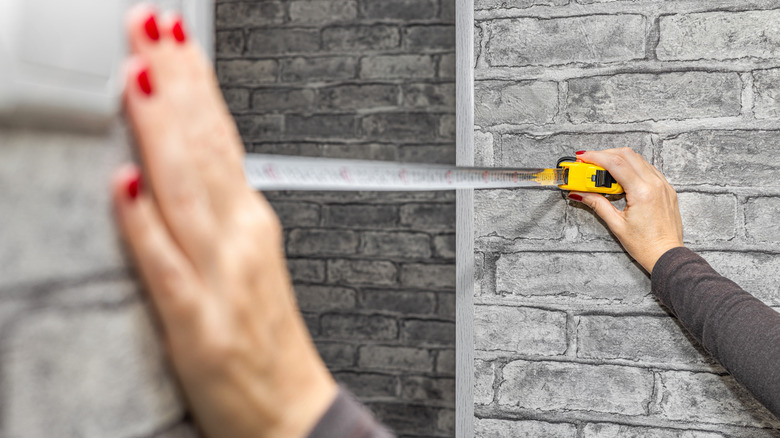
Naturally, your tape measure is always going to have a place in the toolkit. Large and small, tape measures feature at least 8 or 10 feet of measurement capability, allowing you to lay out larger work areas or materials with the same precision you'll be seeking for smaller parts. It's a good idea to have at least one tape measure in any home improvement toolkit, but those who frequently pull out their tape will often want to have redundant backup tools available because the tape measure is something you'll put down so frequently that it's easy to misplace and then frantically search for numerous times throughout a job.
Most tape measures will have a belt clip on the back face, and one of the important tricks to keep in mind when using your tape is to actually use this belt clip. With a longer tape, clipping it to your belt and then pulling the blade out to measure with one hand on the loose hook end (more on its purpose here) and the other midway up the tape allows you to keep the device on hand at all times. Of course, the shorter your tape, the less utility you'll have when handling this kind of measurement operation. Your tape can also be used to scribe marks with its metal clip end, and folding the blade over on itself allows you to do basic layout math with the tool acting as something of a slide rule to prevent you from having to pull out your calculator or jot down figures on a scratch sheet of paper.
Laser level
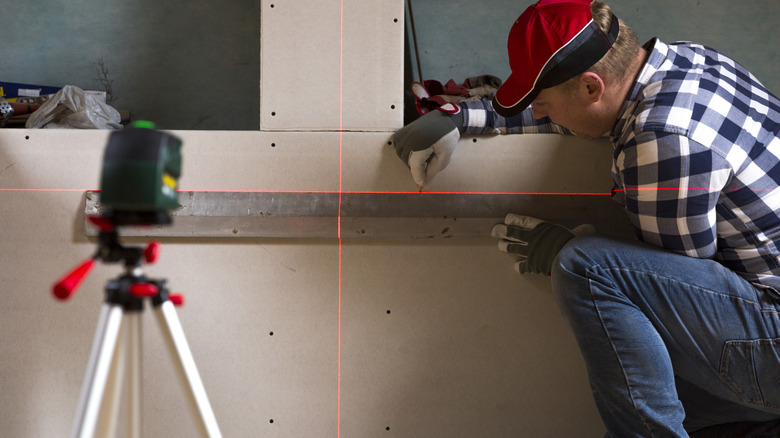
A laser level is a great addition for anyone who frequently puts up shelving, decorations, or mounted elements in their home. Installing a TV mount, getting multiple light fixtures at the same height in different places around the room, and much more can benefit significantly from this tool. The most expensive laser levels you'll encounter have extreme ranges and feature multiple planes. Simple options tend to offer horizontal and vertical beams for indoor use and a more modest range. Although it's worth noting that even a 'modest range' when speaking about lasers is more than capable of delivering accurate beams across virtually the entire span of a typical house.
Laser levels feature an internal leveling element that allows them to wobble until they reach an equilibrium. From here, it's all about marking your target area. In addition to this highly technical gadget, a simple roll of masking tape can really elevate your precision installation tasks. Finding your measurement and then sticking masking tape on the wall allows you to mark up the target area without having to clean off your handiwork later on. You can also make adjustments if necessary without adding to the markings that would otherwise go directly on the wall. To really power a laser level to its full capability, you'll want to also invest in at least a basic tripod stand. The typical level of this nature features a threaded insert at the bottom to attach to stands of this nature, and even something like a camera stand can serve in this role if you already have one.
Box levels in varying sizes
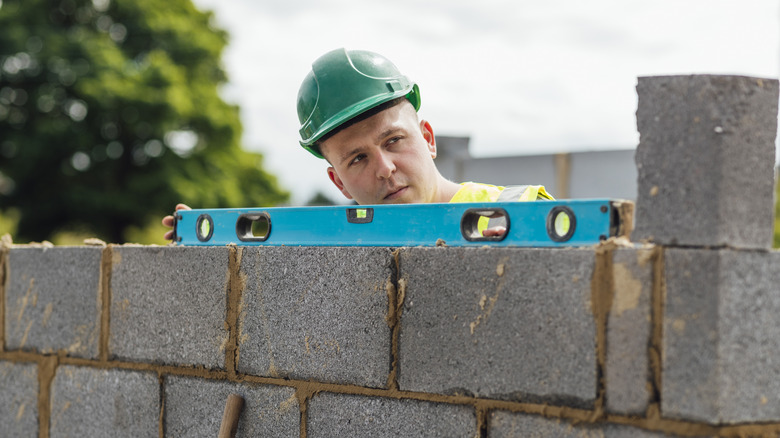
The analog version of a laser level is the classic box level. These come in a range of sizes, and you'll often hear a smattering of different names thrown around to describe both long and short levels. Generally speaking, every level that features liquid-filled vials with a bubble to indicate level is called a 'spirit level.' Short options that are under a foot long are typically referred to as torpedo levels, while longer models are known as box, I-beam, or other names. You'll frequently want to invest in a few different leveling tools of this nature if you're going to use the classic box level in your projects, and even with laser levels and other measurement tools, these come in extremely handy for all manner of building tasks. For one thing, unless you've invested in a top-of-the-line laser level, you're almost certainly not going to be able to use it outside. If you're installing new fence posts, handling wall installations, and much more, you'll want to use these tools instead.
Another extremely important spirit level is one that frequently gets overlooked. The tiny couple-inch-long level featuring string line hooks is a tool that I have used on countless occasions. It fits into small areas seamlessly, and I've used it when installing new back boxes while handling electrical repairs in the house. They're also great for attaching to a string line and achieving a level reference plane across a lengthy span. As long as you can pull the line taut, you can measure level with one of these tools across any distance you require.
Calipers (preferably a digital model for speed)
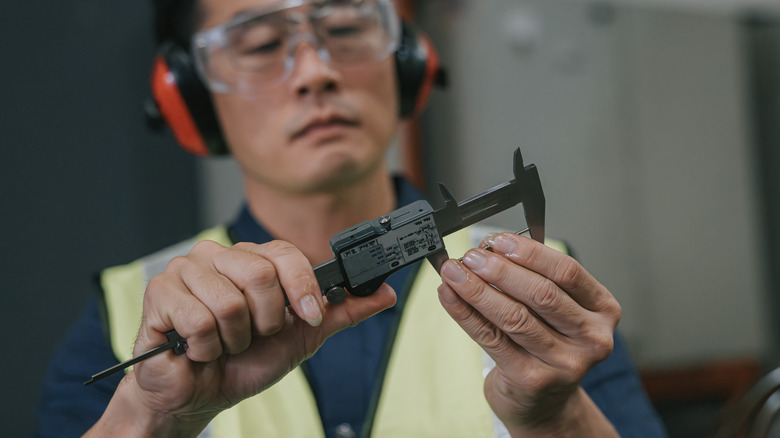
Calipers allow you to measure small-diameter sizes. It's difficult to take accurate measurements of circular holes and similar components when performing part replacements and repairs. Calipers allow you to place the jaws in your target area and open them to the exact measurement you require. The same can be said for outer dimensions, allowing you to close the jaws onto a component to take sizing measurements. This is great for circular elements as well as other pieces you may be working with.
Calipers come in many formats, but a digital model allows for enhanced speed, and generally speaking, you won't lose any precision or effectiveness when opting for this kind of tool. Calipers allow you to measure difficult elements, letting you match parts with confidence or find the exact cut dimensions you require when fabricating new material for a project. This tool is almost certainly the most niche element on this list, but it remains crucially important for all kinds of tasks, and the specificity it brings to the table can lift your finished product from good to great.
Combination square
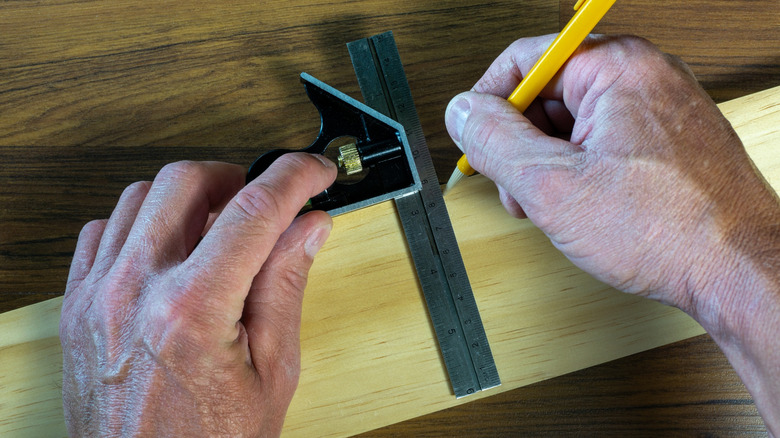
The combination square offers a similar measurement capability to the speed square we began with on this journey. Combination squares feature fewer integrated functional highlights, but they offer a mobile ruler that slides into the tool body and can be locked in place to make repeated marks on varying workpieces. The tool features a similar lipped edge that gives you a perfect 90-degree measurement function while grabbing onto the edge of a workpiece.
Combination squares tend to offer a 45-degree angle on the back end, as well, delivering even more versatility than they immediately appear to provide. These tools can be large or small, although the one I use is only about 5 inches in length. They're also spiritually similar in nature to the engineer's square, which is a large, one-piece L-shaped ruler of sorts that offers similar functionality, albeit without the mobile component.
This tool isn't designed for major measurement tasks (as the engineer's square is), although within its wheelhouse it shines immensely. The tool offers precision markup capabilities that can't be found with many other elements. Moreover, with a more delicate overall build than the bulkier speed square, I find that you can generally get a higher degree of precision in your marking when doing basic layout tasks with a combination square instead. It plays a surprisingly versatile role in handling all sorts of measurement tasks around the DIY jobsite, rounding out a robust set of layout and measuring equipment ready to take on anything you can imagine.