

Should You Buy Subaru's Trailseeker Or Toyota's bZ Woodland? It's Complicated
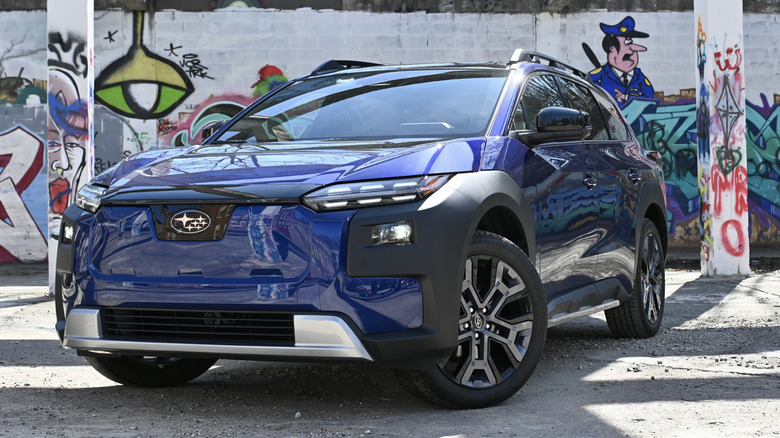
Subaru is a relative newcomer to the electrified scene, both with hybrids and EVs. The battery powered lineup grew seeming overnight with Subaru's lineup now comprising of the Uncharted, Solterra, Trailseeker, and — later this year — the Getaway. Making more out of the partnership that we saw with the Toyota 86 and Subaru BR-Z, Subaru's EVs carry a lot of Toyota DNA, with the Toyota bZ Woodland providing a lot of parts.
Either way you map the DNA, all the Subaru EVs carry its constellation badge and general aesthetic vibe. In the case of this 2026 Subaru Trailseeker, that means an EV that looks a lot like an Outback if it replaced the boxer engine with a set of electric motors.
My family has been Subaru fans over the years, with the current valiant and faithful steed of my family being a 2006 Subaru Outback. If you've read other Subaru reviews I've written over the years, you'll know that I have a lot of love for the brand. The newest batch of Subaru hybrids are compelling, so what does a Subie look like going full EV?
Some Subaru, a lot of Toyota
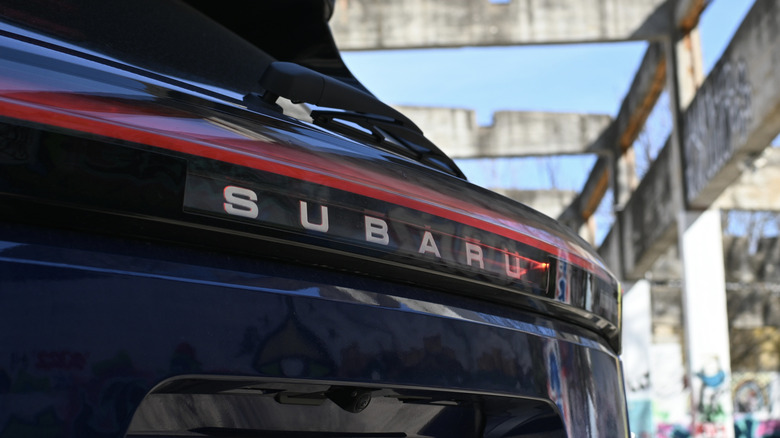
Underneath the blue paint and Outback-like disguise, the Trailseeker is an all-wheel drive wagon-ish SUV with two motors that generate a total of 375 horsepower. The electric juice is provided by 74.7 kWh battery that, according to Subaru, gives you an estimated 274 miles of range. Apart from the pretty steep horsepower number, it's much like every other SUV EV on the market; aside from the Subaru-ness of the shape, nothing really sticks out as particularly unique about the Trailseeker. Still, it's not a bad looking car and the specs show that it's competent in a quickly growing and incredibly competitive market.
How does it drive? Well, contrary to its suburban grocery store parking lot exterior, it's remarkably quick. That 375 horsepower unlocks a 0-60 time of 4.4 seconds and, for posterity's sake, makes it the quickest and most powerful regular production Subaru to ever wear the Pleiades badge. Even with its weight of 4,510 pounds, it hauls, and that weight really only come into play when you're sawing through corners at speed. The all-wheel drive system is competent enough that the weight doesn't feel like its sloshing around when you go into a windy back road with some alacrity. It's not quite a WRX STI when it comes to driving dynamics, but for a family SUV, it's not slow, either.
Convenience and charging
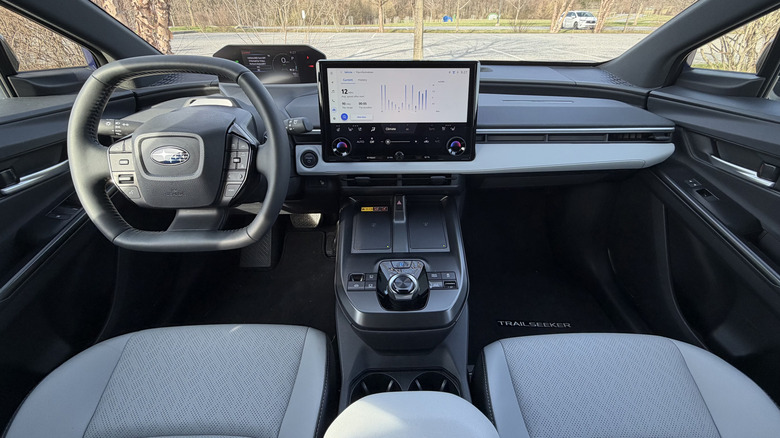
The inside is where the Subaru-ness falls away entirely. It's almost identical to a Toyota bZ Woodland, down to the funny little shifter-knob-dial thing. Like the new Outback, the old portrait-oriented touchscreen has been replaced by a more restrained rectangular infotainment display towards the top of the dash, only the Trailseeker's runs Toyota's software, not Subaru's.
All that sameness leads to a pretty well laid-out interior (especially if you're familiar with other Toyotas), and if you haven't already driven a bZ (or newer RAV4 for that matter) then you probably wouldn't notice much of a disparity. Generally it's very comfortable, and the EV drivetrain leads to a generally pretty drama-free driving experience.
The little amount of drama I did experience came when it was time to charge. The Trailseeker has a NACS charging port, meaning that it can natively charge from Tesla Supercharger stations without an adaptor. That's great... if you live near a Tesla charging station. Fortunately it comes with a CCS adapter to allow charging at other brand's stations, but I can say that given the generally uneven quality across America's charging infrastructure, that adaptor doesn't always play well with others.
After hunting around for charging stations with a gradually depleting battery, Electrify America eventually saved the day. This is not a review of charging stations in Maryland, but it's absolutely worth keeping in mind if you are planning to switch to an EV and don't already have a charging solution installed in your house.
Pricing out the Subie
The base price of the Trailseeker is $39,995 for the "Premium" trim, which puts it firmly towards the top of most expensive Subarus you can buy. The Trailseeker I evaluated was the nearly top-of-the-line "Touring" trim which gives you a Harmon Kardon sound system, heated and ventilated seats, and a panoramic sunroof. It starts at $46,555 (the otherwise identical "Touring Leather" adds, unsurprisingly, leather seats for $300 more); throw in a destination charge of $1,450 and you arrive at $48,005 which puts it just below the more luxury-oriented trims of the Ascent in the spectrum of Subaru pricing.
In what must be a boon to simplified production, there are no options beyond exterior color and — on some versions — interior fabric color available on any of the Trailseeker trims; even leather seats are just considered a different trim. The battery is the same across all trims as well. Just going off the numbers, nearly $50,000 puts you right within the ballpark of most five-seater family-oriented EVs, like the Ford Mustang Mach-E, the Toyota bZ Woodland the Trailseeker is based on, and the recently launched Tesla Model Y Premium.
2026 Subaru Trailseeker verdict
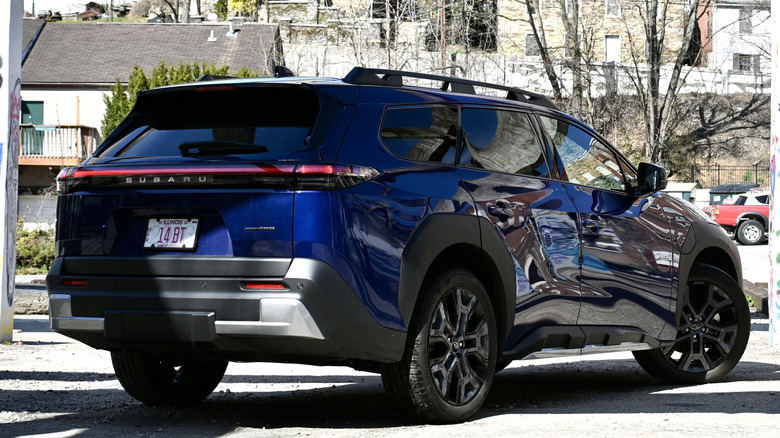
So which one to buy? The Subaru Trailseeker is good, there's no doubt about that, and the fact co-developed with Toyota means you know it's going to be built well. But is there any reason to buy it over the nearly identical bZ Woodland? Cargo volume, as you would expect, is identical at 71.8 cubic feet with all of the seats folded down. The range is also roughly the same (Toyota lists the bZ Woodland at 281 miles, but I suspect the difference comes down to tires).
As unsatisfying a conclusion as it is, it may come down to brand loyalty, what deal you can secure on the day, and whether or not you like the Subaru or Toyota color choices the most. The vehicles are so similar, that it's hard to pick a conclusive winner amongst the two.
Among brands that aren't Toyota or Subaru, you're going to be losing out on space, but gaining a bit in range with the Mach-E, which maxes out at 59.7 cubic feet of cargo space and 300 miles of range. If you opt for the Model Y, and decide to open that whole can of worms, you'll get a little more range at a max of 327 miles. In this line of work, it's unusual to come across a small segment of vehicles where there is no clear victor amongst the options. If it were me, I would probably opt for the Trailseeker just because I like the color and the lizard part of my brain prefers to stick with the brand that I'm familiar with. Even if it's actually a Toyota.