

5 Sports Cars With Better Ratings Than The Mazda MX-5 Miata
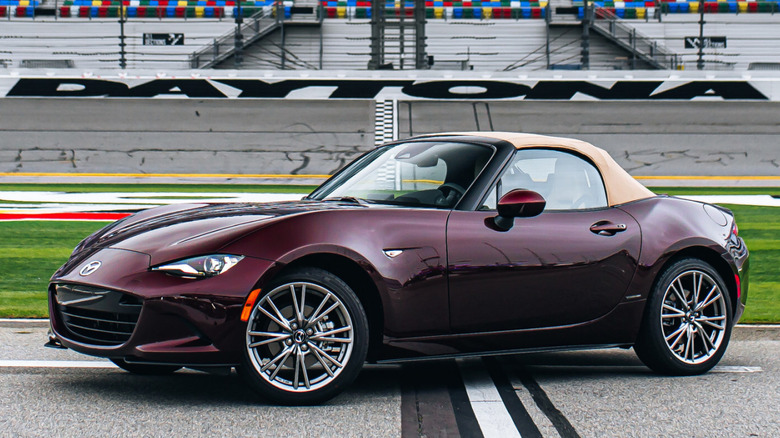
The Mazda MX-5 Miata is a classic two-seater sports car that has received plenty of praise during its 36-year lifetime. It ushered in an era where sports cars could be reliable and affordable, with a beautifully compliant chassis, a truly excellent manual transmission, and an engine that responds to your commands. It has become a benchmark for other sports cars that have entered the market since the Miata's introduction as a 1990 model.
Current performance stats for the Miata, as tested by Car and Driver, show that the latest Miata does the 0-60 mph run in 5.5 seconds, the quarter-mile in 14.3 seconds at 96 mph, and pulls 0.90g on the skidpad. Braking distance from 70 mph to zero is 176 feet. Miata pricing starts at $31,665 including destination.
But while other sports cars have come to the market, some have received higher ratings than the Miata, elevating them in the eyes of certain reviewers. One source is Consumer Reports, which recently ranked its top six two-seater sports cars. Spoiler alert — the Mazda Miata ended up in sixth place, according to the CR rankings. Five other two-seater sports cars finished ahead of the Miata. What this really means is that picking the right sports car for you is a very subjective exercise, so it is essential to drive them all before selecting the one that speaks your language.
5. 2026 Nissan Z
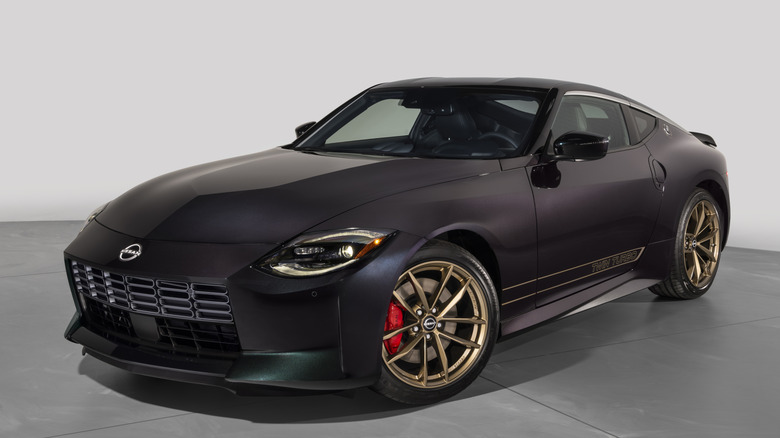
The Nissan Z originally debuted in the 1970 model year as the Datsun 240Z. It became an extremely successful two-seater sports car, with significant sales of over 46,000 in 1973 alone. Fast forward to today, and a mere 899 examples of the Z were sold in the first quarter of 2026. But the Nissan Z still pulls its weight in terms of performance, with a front-mounted twin-turbo V6 that produces up to 420 horsepower. The power flows through either a six-speed manual or a nine-speed automatic transmission to the rear wheels.
Performance of the Nissan Z, as tested by Car and Driver, saw the 420-horsepower Nissan Z NISMO do 0-60 mph in 3.9 seconds, with the quarter-mile going by in 12.4 seconds at 114 mph. Lateral acceleration on the skidpad was measured at 1.02g, while the braking distance from 70 mph was 153 feet. All of these numbers are better than those of the sixth-place Miata.
Inside the Z, the furnishings are suitably upscale, with dual-zone climate control and power seats, plus gauges that monitor turbo speed, boost level, and battery voltage. Other relevant standard equipment includes launch control, double wishbone suspension with high-performance tires, deep bucket seats with padded knee bolsters, 12.3" digital dashboard, configurable nine-inch touch-screen display, intelligent cruise control, and Bose premium audio system. Pricing for the Nissan Z starts at $44,265 for the Sport model, increasing to $67,045 for the NISMO version.
4. 2026 BMW Z4
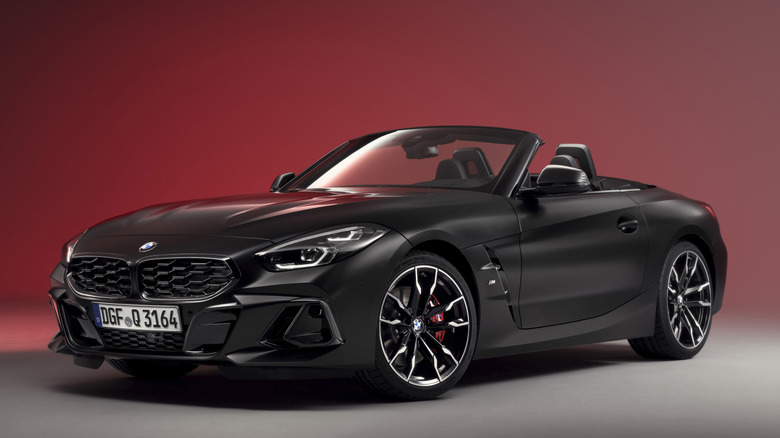
The BMW Z4 is the company's only two-seater sports car, for which 2026 was its final model year. It is available only as a convertible, and production ended in March of 2026. The Z4 represents the third and final generation of BMW's two-seater Z4 roadster, which traces its lineage back to the Z3 roadster of the 1996 to 2002 model years, followed by the first-gen Z4 that ran from 2003 to 2008, the second-generation car with retractable hardtop that remained in the lineup from 2009 through 2018, and the final model that returned to a folding fabric top and continued from 2019 through the current model year.
The BMW Z4 is powered by either a 2.0-liter turbocharged inline four producing 255 horsepower, mated to an eight-speed automatic transmission, or a 3.0-liter turbocharged inline six producing 382 horsepower, available with either an eight-speed automatic or a six-speed manual. Performance testing by Car and Driver produced 0-60 mph results of 5.1 seconds for the turbo four and 3.5 seconds for the turbo six paired with the automatic. The latter combination zipped through the quarter-mile in 12.0 seconds at 116 mph, managed 1.00g on the skidpad, and recorded braking from 70 mph to zero in 149 feet.
Some notable standard equipment that comes on the Z4 includes M Sport suspension, 18-inch alloy wheels, paddle shifters, launch control, heated seats, LED headlights, and rain-sensing wipers. BMW Z4 pricing starts at $57,450 including destination charges.
3. 2025 Porsche 718 Boxster
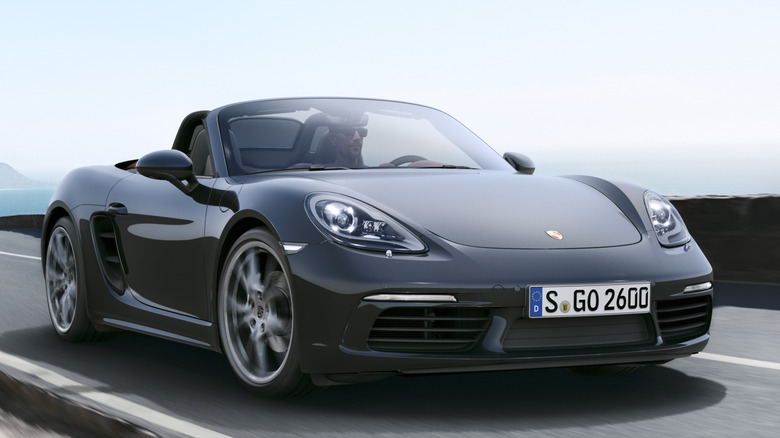
The Porsche 718 Boxster is Porsche's mid-engine roadster and the stablemate of the similar 718 Cayman coupe. The Boxster has been in Porsche's lineup since the 1996 model year, with four generations of this sweet-handling sports car produced. The Porsche 718 Boxster (and Cayman) ended production as an ICE-powered vehicle in October of 2025 as Porsche planned to make a new EV version of this vehicle. Our review of the Porsche Boxster showed it to be a modern icon.
The good news about the fourth-generation Porsche 718 Boxster is that even though it's no longer in production, there are nine years' worth of used examples for buyers to choose from. The final version of the 718 Boxster came with four different engines — a 2.0-liter flat-four with 300 horsepower, a 2.5-liter flat-four with 350 horsepower, a 4.0-liter flat-six with 394 horsepower, and a 4.0-liter flat-six with 493 horsepower. Transmission options include a six-speed manual or a seven-speed dual-clutch automatic, both driving the rear wheels.
Testing by Car and Driver of the base-engine model produced a 0-60 mph time of 4.3 seconds, while the highest-performing version, the Spyder RS, reached 60 mph in 2.8 seconds. The Spyder RS did the quarter-mile in 10.9 seconds at 127 mph, pulled 1.05g on the skidpad, and stopped from 70 mph in 147 feet. Major standard equipment on the basic Boxster includes 18-inch alloy wheels with performance tires, a pop-up rear spoiler, a power top, Xenon headlights, Apple CarPlay, dual-zone climate control, and partial leather upholstery.
2. 2026 Toyota Supra
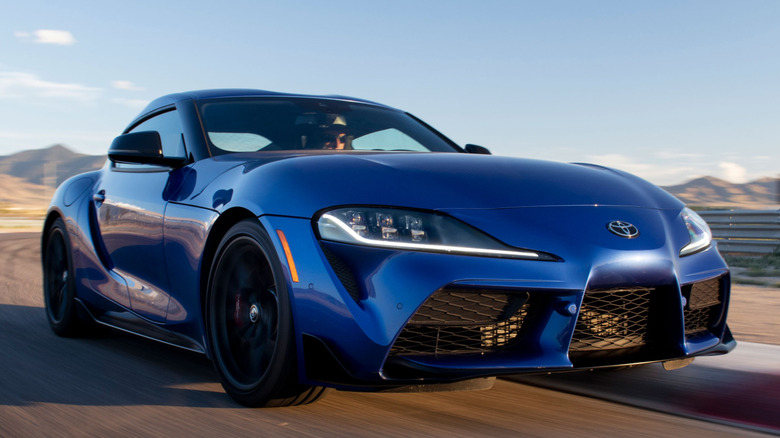
The Toyota Supra can trace its history back to 1979, when it debuted as a six-cylinder version of the Celica. Over time, the Supra evolved into the legendary 1993 Mark 4 Supra, with its massively powerful 320-horsepower twin-turbocharged engine. The Supra's run in the U.S. ended in 1998, and it would be more than 20 years before the Supra returned as the fifth-generation GR Supra, named for Toyota's affiliation with Gazoo Racing, its dedicated racing division. The GR Supra was styled by Toyota but based on the mechanicals of BMW's Z4. Our review of the 2024 Toyota GR Supra called it an affordable stick shift coupe that gets the recipe right.
Like the BMW Z4, the Toyota GR Supra has concluded production as of Spring 2026. For its final year, its flagship powertrain is available with an inline six-cylinder engine producing 382 horsepower, with that power flowing through your choice of a six-speed manual or an eight-speed automatic before landing at the rear wheels. Performance testing of a six-speed manual version by Car and Driver produced the following stats — 0-60 mph in 3.9 seconds, the quarter-mile in 12.4 seconds at 115 mph, lateral skidpad acceleration of 0.98g, and braking from 70 mph in 155 feet.
Standard equipment on the GR Supra includes adaptive sport suspension, Brembo fixed-caliper disc brakes, active rear sport differential, dual rear exhaust outlets with stainless steel tips, 14-way power-adjustable seats, and engine bay chassis braces. Pricing for the Toyota GR Supra starts at $59,595 including delivery.
1. 2026 Chevrolet Corvette
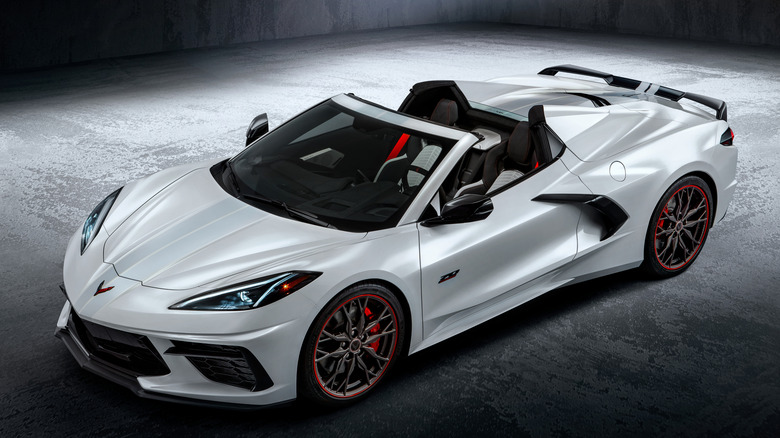
First place in Consumer Reports' sports car rankings goes to the 2026 eighth-generation Chevrolet Corvette family, which includes the Stingray, the E-Ray, the Z06, the ZR1, and the 1,250-horsepower ZR1X. The Corvette's origin story goes back to 1953, when only 300 cars were produced. From these humble beginnings, the C8 Corvette has grown into a full-fledged mid-engine sports car with unmatched bang for the buck and enough performance to shame many of today's hypercars.
The 2026 Corvette family of sports cars covers a range of outputs from its V8 engines that goes from 490 horsepower in the entry-level Stingray all the way up to 1,250 horsepower in the bonkers twin-turbo ZR1X. All Corvettes use an eight-speed dual-clutch automatic to power the rear wheels, with the E-Ray and the ZR1X adding an electrically driven front axle for all-wheel drive. Car and Driver's 0-60 mph times range from the Stingray's 2.8 seconds to the ZR1X's 2.1, with the quarter-mile taking 11.4 seconds at 120 mph for the Stingray and 9.2 seconds at 155 mph for the ZR1X. The ZR1X delivers the highest lateral acceleration at 1.15g and brakes the shortest distance from 70 mph at 139 feet.
Stingray standard equipment includes 19-inch and 20-inch forged aluminum wheels, Michelin run-flat tires, a body-color roof panel, a 12.7-inch infotainment system, a 14-inch driver information center, wireless Apple CarPlay and Android Auto, and a Bose 10-speaker audio system. Pricing for the Corvette Stingray starts at $72,495, including destination freight.
How we ranked this cars
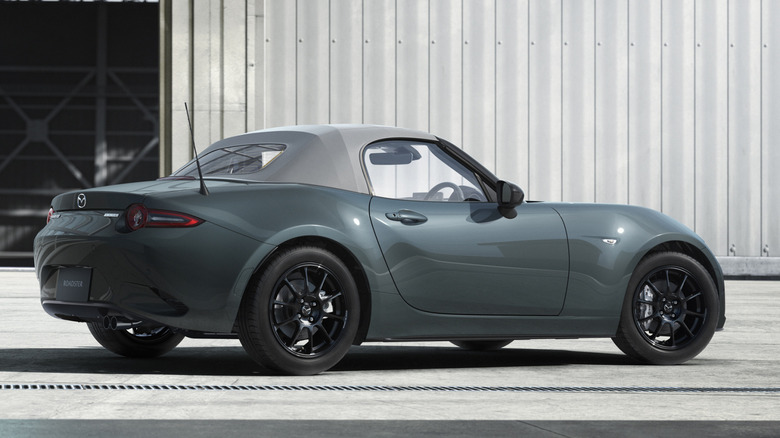
The cars used in this article were taken from Consumer Reports' "New Sports Cars & Convertible Ratings," filtered for sports cars with two seats. Six results were provided. These ratings place the Mazda MX-5 Miata in sixth place, with the other selected vehicles rated above it, as shown. The rated characteristics for each two-seater sports car included each vehicle's predicted reliability, predicted owner satisfaction, and its road test score.