

5 New Milwaukee Patents In 2026 That Hint At What Could Be Coming Next
We may receive a commission on purchases made from links.
One of the many reasons Milwaukee is often considered one of the best major cordless power tool brands on the market today is that the company is constantly innovating and investing in new technologies. Just about everything that sets its tools apart, from its incredibly popular RedLithium battery systems to its One-Key tracking and management system, is a technology that was developed exclusively for Milwaukee products. These proprietary technologies help distinguish Milwaukee from its competitors and keep the brand's products at the cutting edge of the industry.
A big part of the process in how Milwaukee's research and development department does this is by acquiring patents. These protect the company's proprietary technology, ensuring that you will only find these specialized features on Milwaukee products. These patents are often filed months or even years before you'll actually see the tools that use them on hardware store shelves, so it can be tricky to say when you might actually be able to buy them. It's also not guaranteed that Milwaukee will even use these patents, as any number of factors could lead to their cancellation before they're announced. Even so, taking a look at the technologies that the company has recently secured the legal rights to can sometimes be a strong indicator as to what kinds of products we're likely to see the brand come out with next.
1. Battery-powered portable cooler
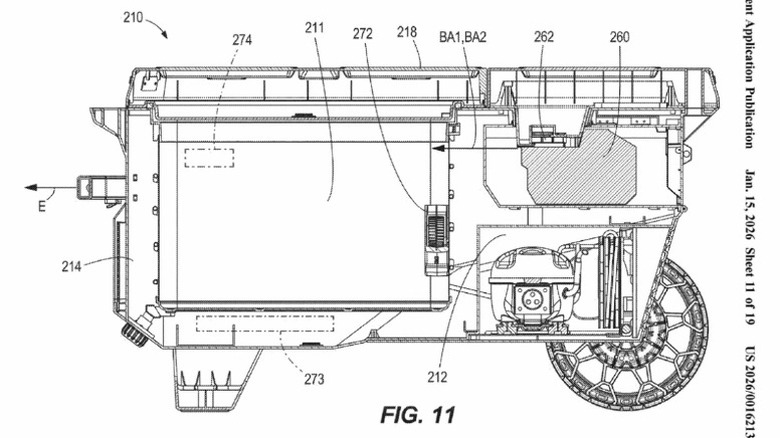
Milwaukee already makes a lot of different add-ons that help working professionals liven up their workspace, such as its popular line of Packout coolers. Even so, these still rely on ice or cold packs to keep them frosty, which costs money and requires a few extra steps. One of the patents that Milwaukee filed in late 2025 and has continued to update in the months since is for a battery-powered portable cooler.
This is an insulated cooler that has an active refrigeration unit with an electric compressor, condenser, expansion valve, evaporator, and circulation fan built in. So it doesn't just keep cold things cold; it actively cools them. All of this fits in a cooling compartment that takes up about a third of the overall bulk, leaving two-thirds for storage. As you might have guessed from the name, this is designed to be powered by the Milwaukee M18 battery system. But it can also be powered by a basic DC cord if you have access to one, and it might even have an onboard charger that can charge one or more attached battery packs.
The patent also describes a user interface with a screen that will show you both the temperature that it's set to and the current temperature inside the tub. This allows users to actively control the power and temperature. The cooler itself is designed to be Packout-compatible, with attachment fittings on top, an extendable handle, and large wheels at the base. The patent shows it also having additional features such as USB Type-C ports, a rapid cooling mode, and, of course, a bottle opener right on the side of the case.
2. Food warming device
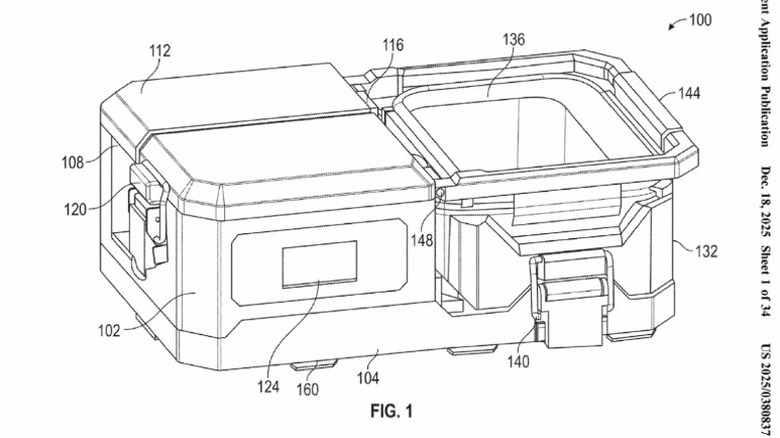
As cool as having a working refrigeration system on the jobsite is, you don't always want a cold lunch. Cold-cut sandwiches are nice now and then, but sometimes it's good to have hot food as well. That's why it's so exciting that Milwaukee appears to be developing a food-warming device as well. The initial filing for this was in June of last year, but there are new updates pending.
This isn't a microwave or a portable stovetop. Rather, it's an insulated case that has resistive heating elements built into the base and walls. So, you can think of it a bit like a slow cooker that uses radiant heat to warm food from the outside in. These heating elements appear to have two different heat levels, which can be set via a user interface display–one for warming your food quickly and one for slowly bringing it up to temperature. The user can set times for these modes to activate, so that their food is warm and ready by a specific time if they take their lunch at a specific hour.
The warmer, like the cooler, can operate on M18 battery power or via a DC power connection. The display will even check the battery's current charge and let you know if it still has enough juice to heat your food to the desired temperature. This is also Packout compatible, so you can even set it right on top of the cooler and cart it in with the rest of your gear if you want to.
3. Work light with control based on context detection
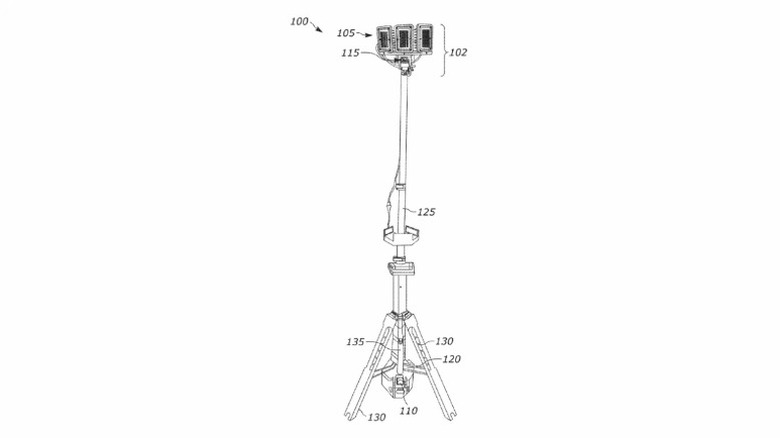
Milwaukee already makes a lot of different lighting options, but most of these are pretty straightforward in their utility. Plug in a battery or cord, turn on a light, and adjust brightness. But these generally rely on human input to change how they perform. One of the company's newer patents is for a smart tech that would make it so that a worklight would be able to automatically react to certain environmental contexts.
This one seems like there's still a lot in the planning phase, but it essentially describes "a light source comprising a plurality of light-emitting diodes (LEDs), wherein the lighting device is a portable lighting device and at least two subgroups of LEDs of the plurality of LEDs are separately controllable to illuminate at different brightness levels." This mounted rocket light hardware would work in tandem with an electronic processor that would power the patented smart lighting control system, and a thermal imaging camera that would gather visual information about the worksite. These three components, put together, can dim or brighten the individual diodes in the light in response to what the camera observes and what the processor contextualizes.
This could have a couple of potential utilities, many of which have to do with prolonging the battery life of the light itself. It could allow the light to detect when a worker is in the area and focus lighting on that specific workspace rather than lighting the whole site, saving power. It can also power itself down when it detects that there are no workers in the area. The patent also states that this would be able to automatically dim when cars drive by, so as not to blind the drivers.
4. Modular power supply for a battery pack of a power tool
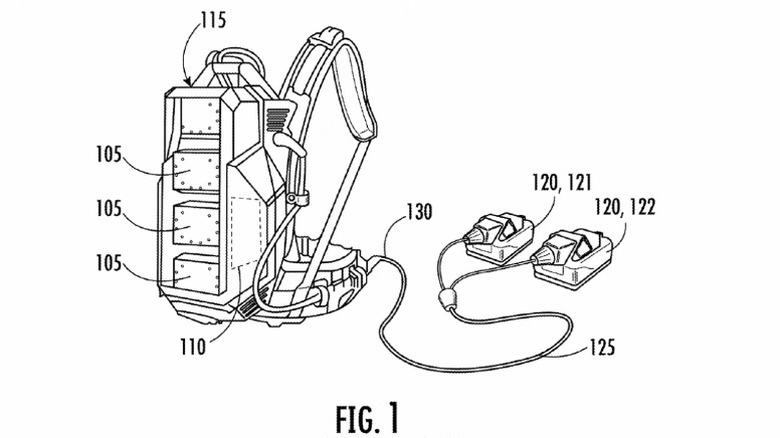
As battery power has been replacing more and more tools that have traditionally been powered by gas engines, a number of solutions have been proposed to provide these tools with sufficient voltage to deliver gas-like results. DeWalt, for instance, offers the Flexvolt and Flexvolt Advantage systems, which can operate at 20V or 60V. Milwaukee has been filing an ongoing patent that started in July, 2025 that seems to be taking a different tack.
The patent is for a modular power supply system that can serve as a collective power load for tools. The designs indicate that this will be a wearable backpack. The description states this would host "at least one adapter configured to receive the common load and electrically couple the common load to at least one of the plurality of batteries for supplying power to the common load." Illustrations included in the patent show that this would accept up to four M18 batteries along the spine that would be connected to a tether which could slide into two separate adapters designed to fit into regular M18 battery slots. This likely means that the backpack should be able to be used with tools that may accept more than one battery at a time, such as the M18 Fuel Dual Battery String Trimmer, or the M18 Fuel Dual Battery Backpack Blower. The patent also states that these can be run in series or parallel, so they can either get more power by boosting voltage or greater longevity by extending capacity.
5. Portable battery charger
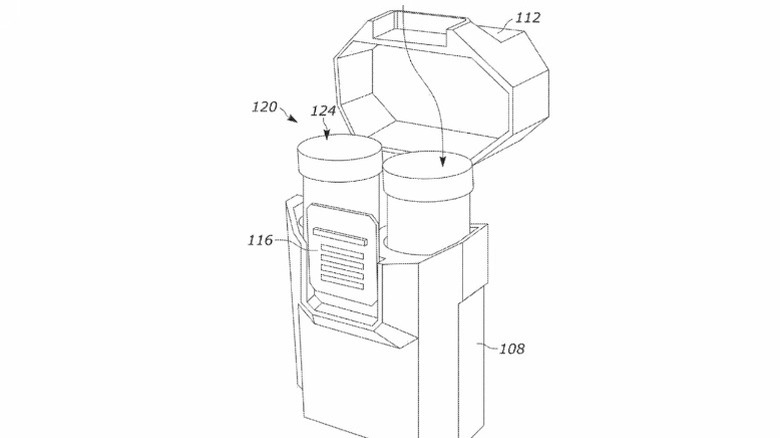
Most of the new patents are for the brand's popular M18 battery system, but there's at least one interesting patent in the works for Milwaukee's M12 portable productivity system. This one is for a portable battery charger that uses the system's smaller batteries to create a compact, lightweight power station.
This is a small case with two bays for M12 Redlithium batteries. While it's called a portable battery charger in the patent, the device is actually able to direct power in two directions. You can use it to charge any slotted batteries, or as a power bank that draws power from them. The unit in the illustration has two USB Type-C ports, with one marked as input/output and the other marked as output only. That isn't to say that this is the only possible design, however. The patent also states that, "other configurations may utilize more ports, have different port types (e.g., USB-A, AC, etc.), include discrete input and output ports, and output at a variety of voltages and wattages as understood in the art."
The housing has a heater, temperature sensor, and an electronic processor that can determine battery temperature and turn it off if it overheats or warm it up if it gets too cool. The notes suggest that the case's latched lid may include a seal to prevent water, dirt, and even cold air from reaching the batteries. The case also has a belt clip option, making it easy to transport and use on the go. Some illustrations also depict a push-button interface that can be used for enabling and disabling charging or for cycling through different power modes.