

5 Of The Most Common Mazda DTC Codes (And Their Fixes)
All cars break down eventually. That is simply the reality of owning one. Some of the problems they experience are well-documented, relatively affordable to fix, and easy to diagnose. Others are more niche and require specialist knowledge and equipment to properly identify and resolve. Given just how complex modern vehicles have become, accurate diagnosis is often a hurdle not many drivers are familiar with.
Thankfully, that process became much more structured in 1996, when the U.S. government mandated that all vehicles sold domestically comply with the OBD-II (On-Board Diagnostics II) standard. Under this system, a car's engine control module (ECM) — which Mazda specifically refers to as the powertrain control module (PCM) – continuously monitors vehicle systems and stores a diagnostic trouble code (DTC) whenever it detects a fault.
To access those codes, you plug an OBD-II reader into the car's OBD-II port, which on most vehicles is located beneath the dashboard on the driver's side. Mazda builds reliable, driver-focused vehicles, but no manufacturer is immune to fault codes. Some brands experience certain problems more often than others, and here are five of the most common Mazda DTCs, what each one means, and what the typical fix looks like.
P0171 — System too lean (Bank 1)
The P0171 code is one of the most common codes you can find on any car and is therefore very common with Mazda cars as well. Mazda themselves acknowledged the issue, issuing TSB #MT-021-17 for 2012-2013 Mazda 3, 2013-2023 Mazda CX-5, and 2016-2023 Mazda MX-5 models. Specifically, the P0171 code indicates a problem with the car's air-to-fuel mixture ratio, meaning the car is receiving too much air relative to fuel in the combustion mixture.
On Mazda 3 models, P0171 frequently traces back to a vacuum leak that throws off the fuel trim system. This can happen due to a dirty or failing MAF sensor or low fuel pressure caused by the fuel pump. Despite how intimidating a check engine light can feel, the underlying cause of P0171 is often as straightforward as a vacuum leak or a failing PCV valve.
When MorFab Industries diagnosed a 2009 Mazda experiencing P0171, the mechanic confirmed it was a leak, specifically noting that "a very common vacuum source leak location is the intake gaskets themselves." Therefore, it is best to start with a visual inspection of all vacuum hoses and intake connections for cracks or loose fittings. Clean the MAF sensor before considering replacement. If both check out, test fuel pressure and inspect the injectors.
P2096 — Post-catalyst fuel trim system too lean (Bank 1)
Unlike most fault codes that point to a worn or failed physical component, P2096 is frequently triggered by a software defect. Mazda has issued multiple TSBs across the CX-5 and Mazda6 lineup acknowledging that this code often appears without an actual mechanical failure. TSB #01-006/16, covering the 2016 CX-5, sees Mazda addressing the issue of certain vehicles experiencing the check engine light, but the problem was entirely software. In other words, faulty PCM control software.
TSB #01-011/19, covering the 2018-2019 CX-5 and 2018-2019 Mazda6, states the same. In both cases, the official fix is a PCM software reprogram — no parts required. P2096 is stored when the PCM detects that the air-fuel mixture downstream of the catalytic converter on Bank 1 is running too lean. On affected Mazda vehicles, this reading can be false — caused by PCM software misinterpreting downstream oxygen sensor voltage as an actual lean condition in the exhaust.
An OBD-II port can tell you more than you think by identifying whether a code requires professional repair or a simple fix. In this case, before replacing any parts, contact a Mazda dealer and check whether your VIN is covered by an applicable TSB — on eligible vehicles, the fix is a free PCM reprogramming. If no TSB applies, inspect for exhaust leaks first, then test the downstream O2 sensor before considering catalytic converter replacement.
P0126 — Insufficient coolant temperature for stable operation
When we talked about how reliable Mazda's Skyactiv engines are, we specifically noted that the thermostat issues can lead to temperature-related problems. In particular, P0126 is one of the most distinctly Mazda-specific codes on this list and indicates the engine is failing to reach its intended operating temperature. The problem became so widespread across the Skyactiv-G non-turbo lineup that Mazda has been issuing TSBs for this specific failure continuously since 2021 — TSB #01-011/21, TSB #01-013/22, TSB #01-005/23, TSB #01-005/24, and TSB #01-001/26.
Mazda ultimately issued the Special Service Program SSP D8, extending the warranty for this specific repair to 15 years or 150,000 miles on the 2018-2025 CX-5, 2019-2023 Mazda3, 2019-2022 CX-3, 2018-2021 Mazda6, and 2020-2023 CX-30. For instance, TSB #01-005/23 identifies the root cause as coolant infiltrating a dry cavity inside the failsafe thermostat. This forces it open at temperatures between 104 and 176°F — well below the engine's normal operating range.
Overall, these problems stem from a design flaw in the Coolant Control Valve integrated into Mazda's Skyactiv-G non-turbo engines, where coolant enters the failsafe thermostat, causing it to stick open, and preventing the engine from reaching or maintaining temperature. Before paying for any repair, it is worthwhile to contact a Mazda dealer with your VIN — SSP D8 covers this specific failure free of charge on eligible vehicles. The current fix involves replacing the internal thermostat within the Coolant Control Valve with an updated dummy plug kit and a PCM software update.
P0300 — Random/multiple cylinder misfire detected
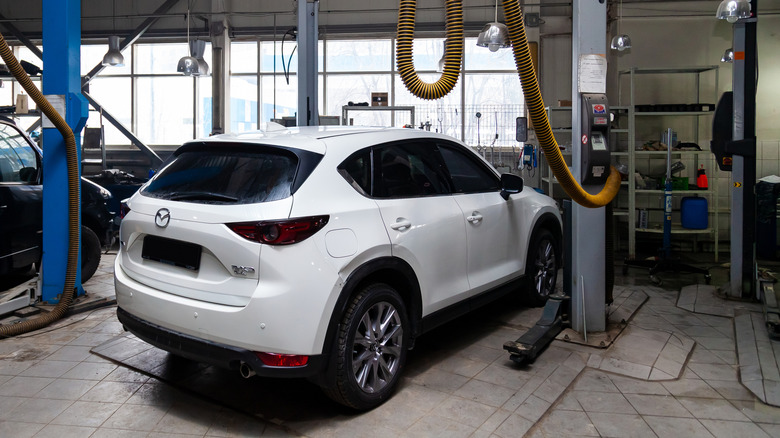
The P0300 code is also one of the most common OBD-II codes across all vehicle makes and models. Mazda itself acknowledged the issue. TSB #01-014/16 covers 2013-2016 CX-5, 2014-2016 Mazda3, and 2014-2016 Mazda6 vehicles in which affected cars could develop rough idling, reduced engine power, and an illuminated check engine light — all of which trigger the P0300 random misfire code.
P0300 is stored when the PCM detects that one or more cylinders are not firing correctly, but cannot pinpoint which specific cylinder is at fault. The most common causes of misfiring are worn spark plugs and failing ignition coils. When Chris Brown of No-Nonsense Know-How diagnosed a 2014 Mazda CX-5 with a P0300 misfire, the culprit turned out to be a factory spark plug that had never been replaced, leading him to note, "These are factory Mazda spark plugs and I doubt that they have ever been replaced in 140,000 miles."
It is worth noting that a flashing check engine light alongside P0300 signals a severe misfire that requires immediate attention, as continued driving risks destroying the catalytic converter. Start by inspecting and replacing spark plugs. Swap ignition coils between cylinders to isolate a failing unit before purchasing a replacement. On higher-mileage Skyactiv engines, check for intake valve carbon deposits and consult any applicable TSBs for your specific model year.
P0420 — Catalyst system efficiency below threshold (Bank 1)
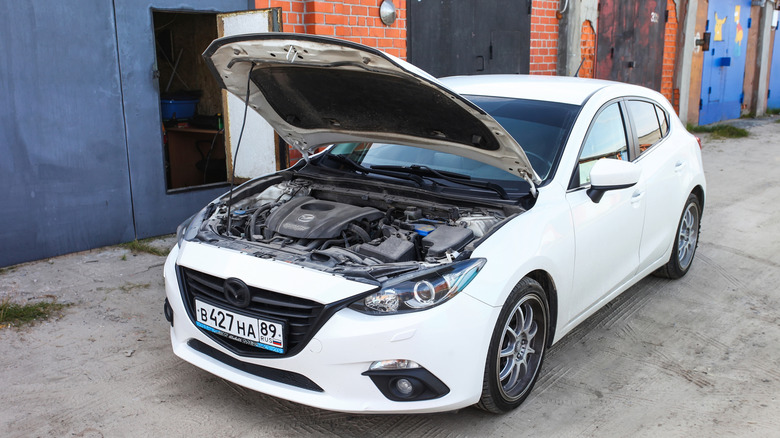
TroubleCodes, maintained by an ASE-certified technician, lists P0420 as a known recurring issue across the Mazda 2, 3, 5, 6, MX-5, CX-5, CX-7, and CX-9, with each model exhibiting its own documented failure pattern associated with the code. As with many previous codes, the P0420 code is common across multiple different makes and models, including Mazda.
P0420 is stored when the ECM (PCM in the case of Mazda) detects that the catalytic converter on Bank 1 is operating below the efficiency threshold. The PCM monitors two oxygen sensors — one upstream and one downstream of the converter. Once the downstream sensor begins mirroring the upstream sensor's readings, the PCM registers that the catalytic converter is failing to clean the exhaust and stores P0420. On Mazda vehicles, a worn catalytic converter is the most common trigger, but a downstream O2 sensor sending inaccurate voltage data to the PCM can generate the same fault code even without a converter failure present.
A catalytic converter replacement is an expensive repair, which makes it essential to rule out cheaper causes — exhaust leaks, a faulty O2 sensor, active misfire codes — before committing to one. If the converter is confirmed failed, use an OEM or OEM-equivalent part. Catalytic converter degradation is one of the most common problems these components face over their lifespan, and a substandard replacement will not resolve the underlying issue.