

5 Alternative Fuel Types (And Why More Cars Don't Use Them)
Uncertainty around gas prices has encouraged more new car buyers to choose hybrid cars over traditional gas-powered cars, although demand for all-electric cars has not increased to the same degree. Arguably, BEVs remain too much of a radical transition for many buyers, and high prices aren't helping either. After all, none of the cheapest new cars on the market in 2026 are all-electric, but a couple of those models are available in hybrid form.
BEVs remain the most mainstream type of alternative fuel vehicle, but they're far from the only ones on the market. In fact, you might well be surprised by the range of alternative sources of fuel that are already on offer in some segments. Plenty of buyers won't be aware that these vehicles exist at all, and in virtually every case, there are good reasons why they're not more popular among car manufacturers.
In some cases, it's the technology behind these fuels that remains the limiting factor, but in others, infrastructure is primarily to blame. These five alternative fuels are all among the most notable on the market right now, but you still shouldn't expect to see them being widely adopted by carmakers in the near future.
Hydrogen
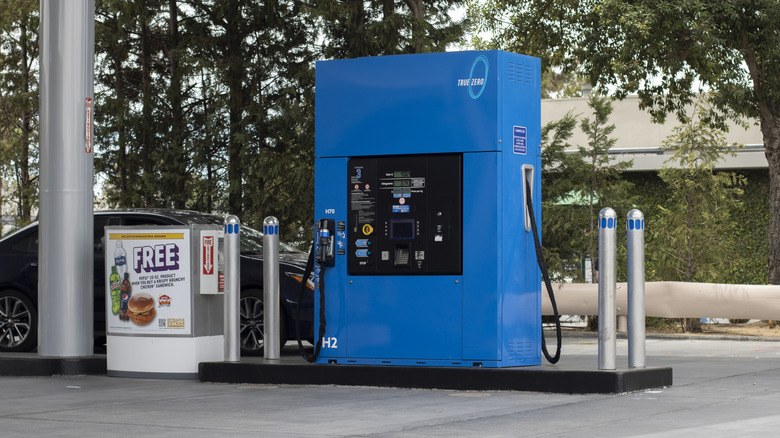
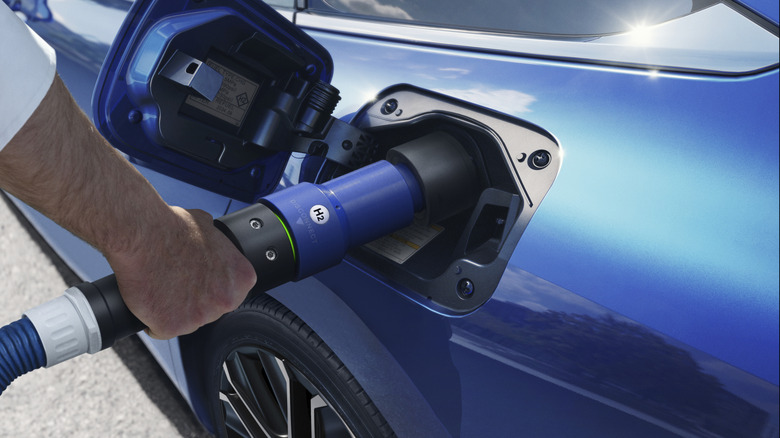
Battery EVs have taken the limelight in the race to popularize zero-emissions vehicles, but they're not the only way to completely cut harmful tailpipe emissions. Hydrogen-powered vehicles emit only water vapor and hot air, making them an appealing alternative to BEVs on paper. Several major manufacturers have developed hydrogen-powered cars, with Toyota being the biggest proponent of the technology.
The Japanese carmaker has been developing its hydrogen engine for several decades, and has actually sold a hydrogen-powered car, the Mirai, in certain parts of the U.S. for over a decade. It remains available at select Californian dealerships as a 2026 model year car, and has an official range of over 400 miles. Unlike a BEV, refueling a hydrogen-powered car at a filling station takes only a few minutes, roughly the same time as filling a gas-powered car.
Of course, that assumes that drivers can find a hydrogen filling station in the first place. Primarily, the reason that hydrogen cars aren't more popular is that hydrogen filling stations remain few and far between, making owning and driving them outside of a few Californian cities virtually impossible. Even in California, they're not as practical as a BEV, since there are only 46 hydrogen filling stations in the entire state at the time of writing. The vast majority of those are clustered in Los Angeles and the Bay Area.
Producing hydrogen using clean energy also remains expensive, and those expenses are passed down to drivers. Unless hydrogen fuel prices drop and the fueling network drastically increases, hydrogen powered cars will remain a rarity on the roads.
Propane
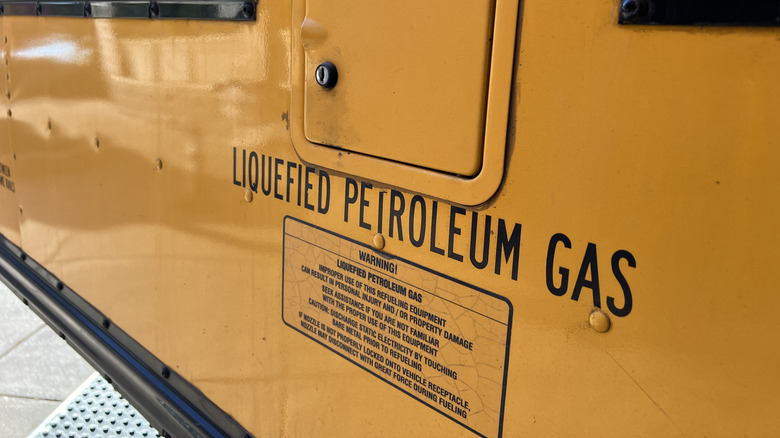
Much of the attention surrounding alternative fuels has been directed towards fuels that produce no tailpipe emissions, while propane has been largely overlooked by car manufacturers in recent years. You might see propane sold as LPG (liquefied petroleum gas), and it offers a few benefits compared to using gas or diesel. Engines that run using propane can often last for longer than a traditional gas-powered engine, and they're less susceptible to cold start issues in freezing temperatures than diesel engines are.
Propane conversions can also allow some vehicles to run on either LPG or gasoline, making them especially versatile. While burning propane still produces harmful emissions, it can sometimes produce significantly less greenhouse gases than an equivalent gas or diesel engine. However, the reduction in emissions varies significantly based on how the propane is produced, what type of vehicle the engine is fitted in, and what type of driving it's doing.
It's thought that around 60,000 propane-powered vehicles are on American roads, with the majority of those being fleet vehicles like school buses or police vehicles. Despite the benefits it can offer, it's unlikely we'll see a significant uptick in cars using propane as a primary fuel, because it doesn't solve the problem of eliminating tailpipe emissions. In today's car market, fuel-sipping gas-electric hybrid drivetrains are a more convenient option than propane for most buyers who want to reduce their carbon footprint without altering their driving habits.
Ethanol
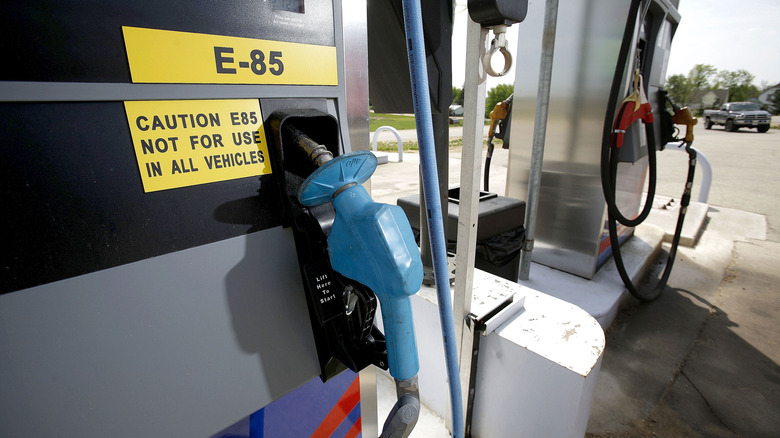
Although it's classed as an alternative fuel in its own right, ethanol is most commonly used as part of a gas-ethanol blend. Across the U.S., most of the gas sold at gas stations is actually a blend of around 10% ethanol and 90% gasoline. You might see it marked as E10. Some gas stations also sell E85, which contains up to 85% ethanol. Only certain car makes and models can accommodate E85 fuel, and they're referred to as flex-fuel vehicles or FFVs.
Plenty of drivers own an FFV without realizing it, since these cars will also run normally on regular gas. To take just a few examples, the 2026 Chevrolet Silverado with a 5.3-liter V8 engine, 2026 Chevrolet Trax, and 2026 Buick Envista are all flex-fuel vehicles, and so can run on E85 fuel.
While ethanol-gas blends can potentially produce fewer tailpipe emissions than using gas, there are some drawbacks to using the fuel. Ethanol is mostly produced from corn in the U.S., and growing all of that corn takes a significant amount of land that could otherwise be used to grow food. Brazil is one of the leading adopters of ethanol as a biofuel, but multiple studies and reports have linked increased biofuel production to deforestation.
Aside from the potential environmental drawbacks, there are also some practical ones. Ethanol is more susceptible to contamination than gasoline, and it can cause problems when it's used in some older vehicles. Using pure ethanol in a conventional car would also make it extremely difficult to start in cold weather, which means carmakers don't produce entirely ethanol-powered cars for road use in the U.S.
Solar generated electricity
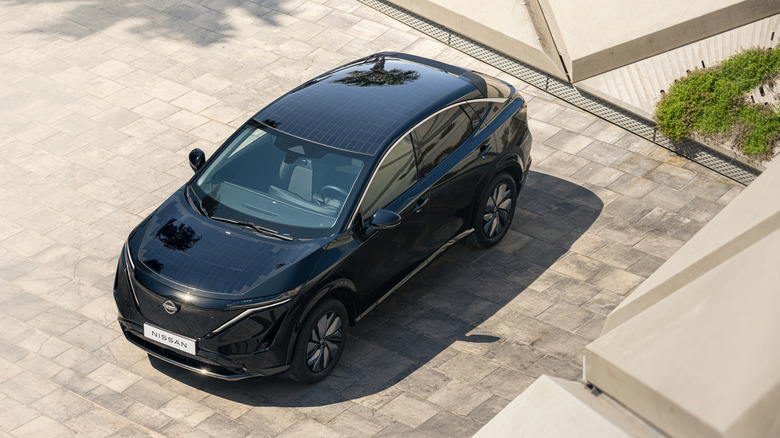
One of the main limiting factors preventing the wider adoption of BEVs is that they need to be charged at a charging station. Public charging infrastructure around the U.S. is rapidly improving, and a record number of new charging points were installed across the country in 2025. Yet, many drivers are still put off electric cars by range anxiety. One way that some car manufacturers have proposed getting around this is by adding solar panels to a car to boost its range.
Carmakers like Hyundai have already introduced models with solar panels on their roofs, although they're only capable of adding a few miles of range per day. However, a startup called Aptera claims to have developed a prototype car that can generate up to 40 miles of range per day off its solar panels, which is more than the average American driver drives in a day.
Those claims might sound promising, but we've previously broken down exactly why we're skeptical of Aptera's claims. In short, the limited amount of data that the company has shared indicates that its real-world range gains are likely to be far less than Aptera is predicting, and the prototype itself has some major design limitations that make it impractical for most American drivers.
Even if current solar panel technology isn't efficient enough to be a car's sole source of power, it still might play a larger supplemental role in the future. Nissan has been developing solar panel technology that it plans to put into production soon, and Hyundai has shown off an off-grid camper van that uses its solar panel technology.
Natural gas
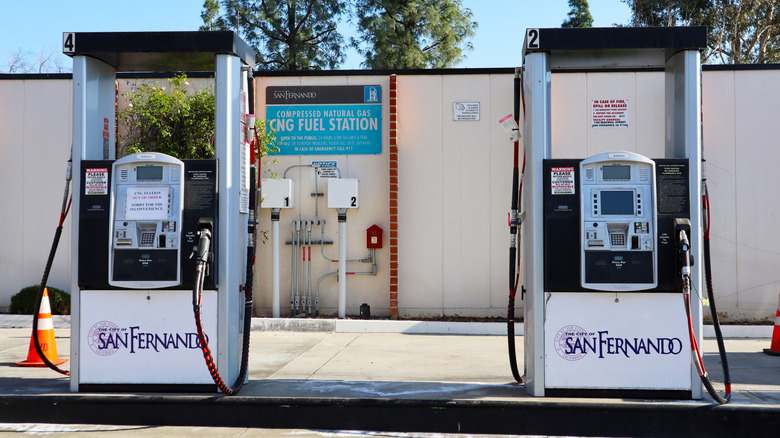
While propane (often sold as LPG) is a more popular option for heavy-duty vehicles, natural gas can also be used to power certain trucks. It's available as both compressed natural gas (CNG) and liquified natural gas (LNG), with the latter offering better fuel efficiency. Methane is the primary component in all natural gas, but how it's sourced can vary. Some natural gas is produced from fossil fuel extraction, while other sources produce methane through the decomposition of sewage from humans or animals, including cattle.
Puneet Singh Jhawar, the general manager of the Global Spark Ignited Business at Cummins, says that almost all dairy farms have the potential to produce renewable natural gas with relatively straightforward equipment. The trouble is, outside of that industry, the fuel is not as easy to come by. According to the Department of Energy's alternative fueling station locator, there are only around 700 CNG stations in the U.S., and just 24 LNG stations. That limited availability means that it's only really a practical option for vehicles that run fixed routes and stay within areas that are well served by fueling stations. As such, it isn't much use for passenger cars.
It also isn't that much more environmentally friendly. According to Cummins, it produces around 13-17% fewer emissions than diesel. A modern hybrid powertrain in a passenger car can cut a significantly higher percentage of its emissions compared to a traditional gas-powered car, making it a much more efficient and convenient option.