

Why Did U.S. Automakers Start Switching To Metric Bolts In The '70s?
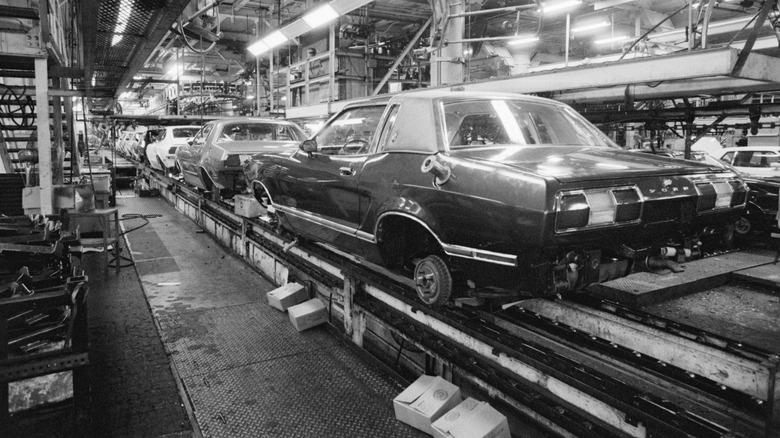
Walk through the service bay of any American car dealership in the early 1960s and nearly every wrench hanging on the wall would have been sized in fractions of an inch. By the end of the 1970s, however, mechanics increasingly found themselves reaching for metric tools to service vehicles built throughout America's automotive heartland. This change was not immediate, but it reflected a profound transformation in the American auto industry.
The catalyst for this transformation lies in a combination of globalization, engineering efficiency, and growing international competition. As American manufacturing expanded, the disadvantages of maintaining uniquely American tooling became harder to ignore. Metric offered greater standardization, simplified manufacturing processes, and made it easier to share components between vehicles sold across international markets.
The transition wasn't smooth. Imperial, or Society of Automotive Engineers (SAE), fasteners continued to be used alongside metric hardware well into the 1980s. Even today there remains some evidence of America's imperial measurements legacy across locally produced automobiles. Regardless, this shift represented a critical step in how America's domestic automotive production aligned with an increasingly interconnected automotive world.
Manufacturing for a global commercial environment
During the 1970s, the American automotive industry found itself operating in a globally expanding commercial environment. As American automakers sought to grow their presence internationally, they increasingly relied on foreign production to improve efficiency, reduce costs, and meet growing demand. Many of these operations were located in countries where the metric system was already deeply embedded in industrial practice, making metric the natural choice for outsourced production.
Ford expanded production across Europe and Mexico while increasingly integrating components and sub-assemblies from overseas suppliers, primarily Japan. General Motors, the first to begin introducing metric tooling in 1973, expanded forging, foundry, and engine production in Mexico while strengthening assembly operations in Canada. These international networks allowed American manufacturers to access lower-cost labor and create more integrated global supply chains, but they also demanded common measurement standards. Metrication simplified this dispersal of production.
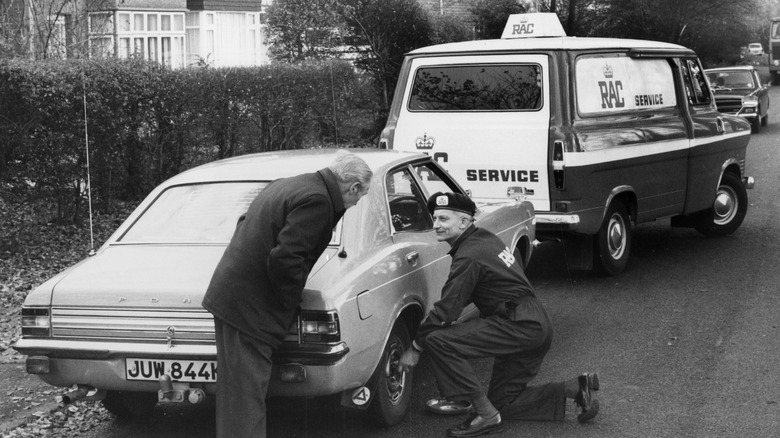
Simultaneously, while American manufacturers expanded foreign production and sales, Japanese and European companies were establishing a stronger presence in the U.S. Following the 1973 Oil Embargo and subsequent decline of the muscle car era, foreign automakers gained popularity in the United States by offering reliable, fuel-efficient alternatives to larger domestic vehicles. As import numbers grew, American repair shops and parts suppliers were increasingly exposed to vehicles designed entirely around the metric system.
America increasingly recognized the isolation that was inherent to imperial usage, and that the common technical language of metric was necessary for operations spread across multiple countries. Although the United States never formally adopted the metric system as its primary national standard, the success of imported vehicles during the 1970s played a major role in driving the automotive industry toward metrication and greater integration with international manufacturing practices.
An Imperial Legacy

Across modern production, America's automotive industry maintains numerous links to its history in imperial production. Horsepower ratings, wheel diameters measured in inches, and fluid capacities expressed in quarts, remain common features of American automobiles. However, these coexist alongside specific metric expressions. Engine and drivetrain specifications are typically expressed in liters, electrical and wiring standards use metric ISO standardization, and almost all fasteners on American-built vehicles are metric.
Perhaps one of the last nonmandatory imperial bolts that could be found on an American-built automobile was the 7/16"-20 flange bolts securing the driveshaft to the differential housing on the Dana super 44 rear axle, present on generation III+ Dodge Viper SRT-10s until as recently as 2017. In 2026, only one example of an imperial fastener or bolt can be consistently found within mainstream, international auto manufacturing. For America specifically, in accordance with 49 CFR 571.209 (Federal Motor Vehicle Safety Standard 209), seatbelt assemblies must utilize a specific 7/16"-20 Unified National Fine bolt for seatbelt and harness anchors.
More than half a century after America began its shift to metric hardware, almost every American-built vehicle still carries a small reminder of the country's engineering past. The federally mandated 7/16"-20 seatbelt anchor bolt remains one of the last physical pieces of the American motor industry's imperial legacy.