

What's The Difference Between American And European Coolant?
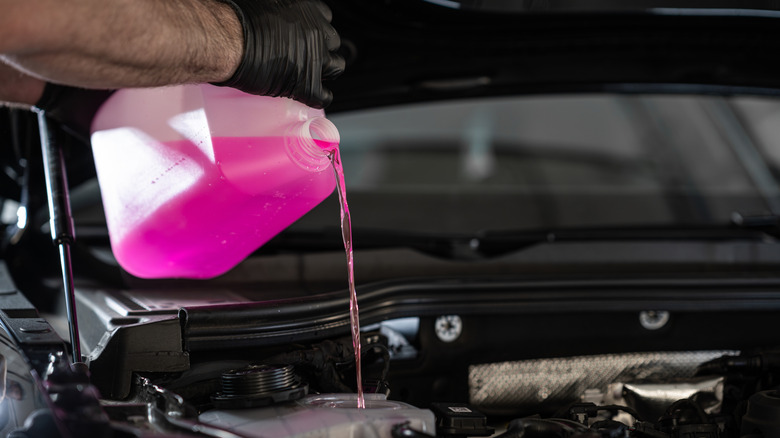
Similar to different oil weights, coolant comes in many shapes and sizes, and it can be daunting to walk into an auto parts store and see so many different varieties. A rainbow of colors will usually greet you on the coolant rack, with labels such as 50/50, Glycol, and others, all mixed in with stuff like, For Use in European or whatever nationality vehicle you have. Companies often don't make it easy, either — even within the same geographic region, different manufacturers will often have different colored coolant.
And yes, the color itself does matter — the color denotes what chemicals are present in the coolant itself. To be clear, coolant itself is colorless. Companies add dyes to the product to make it clear which one is which, and there are a lot of different colors. Not all coolant can be safely mixed, nor will all coolant work in your car to begin with.
Different manufacturers build cars with different parts and to differing specs, which is one reason why oil has so many different grades — thinner or thicker oil being better is one of many myths you need to stop buying into. Likewise, coolant is not universal, either. Different colors indicate different additives, some of which can damage certain materials common in American or European engines, respectively. Moreover, there are other considerations like how long the fluid lasts and what its antifreeze properties are.
In this article, we'll be discussing the physical differences between European and American coolant and why they can't be interchanged. The short answer is that neither is "better" nor "worse," they're simply built for different engines. As always, if in doubt, check your owner's manual, or just look at the color of the fluid already in your car.
What types of coolant are there?
Firstly, the most basic type of coolant is simply water. Unlike actual coolant, however, water has a lower boiling point and offers no rust protection — iron plus water equals rust. Nevertheless, if you have a leak and need to get home, it's always acceptable to just add water, as long as it's distilled.
As for dedicated coolant, you have six types, with three major subgroups. The most common coolant, ethylene glycol mixed with water, is bright green colored. It's known as IAT, or Inorganic Acid Technology, and contains rust inhibitors which can degrade rubber and cause scaling on aluminum. Ethylene glycol's properties mean it has a much lower freezing point and higher boiling point than water, making it useful as antifreeze — yes, antifreeze and coolant are different. Water expands when it's frozen, and the last thing you want is expanding substances in a pressurized system with delicate parts such as rubber hoses and pumps.
OAT coolant is up next, meaning Organic Acid Technology. This coolant comes in a variety of different formulations depending on the company, but the short answer is that this plays better with aluminum and rubber parts than IAT coolant. The color is based on the specific formulation, set by the manufacturer.
HOAT, or Hybrid Organic Acid Technology, is the yellow universal coolant, which theoretically combines all the pros of IAT and OAT coolants. As the name suggests, companies market this coolant as being safe for all vehicles, regardless of origin or vintage. It uses elements like silicates to increase rust protection for aluminum parts, such as radiators, heater cores, and engine blocks.
The difference is in the formula
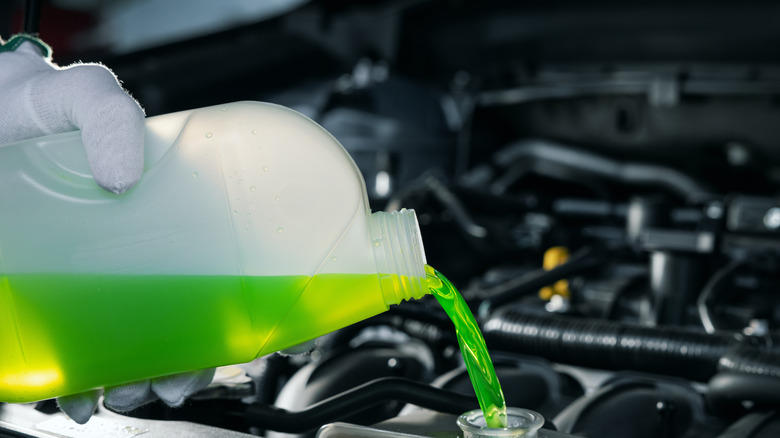
There are many ways to build cars. Some use iron engine blocks, others aluminum, and others even use magnesium. Every company has its own proprietary material compositions as well, with different compounds for hoses and radiators and all the rest of it. Bear in mind as well, not all coolant is created equal — some companies are better than others. So which is right for you?
Put simply, you cannot pour European coolant into American cars (or vice versa), or indeed any vehicle that's not rated for that coolant, because that coolant type is specifically formulated for that car. Certain manufacturers will go so far as to specify no other coolant but the type they recommend, making it doubly confusing for consumers who see that coolant brand next to one labeled as universal.
Typically, European coolants are of the pink, blue, or purple OAT or HOAT varieties, with some phosphate-free mixtures for engines with aluminum components. American coolant is generally orange for GM vehicles dating back to 1994, along with HOAT used in modern Fords. Each of these coolant types has its own proprietary mixture — Volkswagen purple, for instance, is designed to meet G12 specifications, whereas the blue is designed for a G11 rating. Coolant manufacturers will specify on the packaging which grades the fluid meets or exceeds, though to be on the safe side, always use the coolant recommended by your owner's manual.