

5 Forgotten Tools That Used To Be In Every Garage
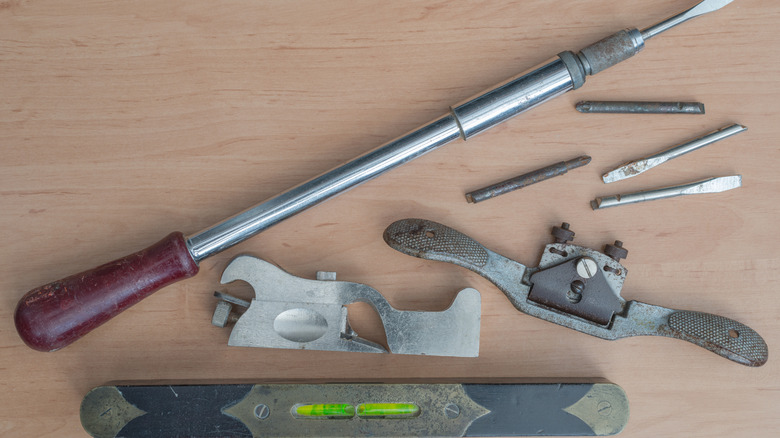
If you were an auto mechanic or a hobby tradesman at some point from the 1940s to the 1980s you had something like a classic muscle car sitting in the middle of your garage, flanked on either side by workbenches and shelves lined with hand tools. Back then, household appliances were fixed, not thrown away (generally, anyway), and repairs were simple but often time-consuming. Even the cars themselves were analogue, but behind every one of these vehicles rested an equally analogue set of tools.
We're rewinding the clock back to when sensors weren't nearly as prevalent, when cars used distributors, carburetors, and vacuum tubes with nary a motherboard in sight, and when every garage carried a stable of unique and quirky tools to keep them all running. Many of these tools are still common today, though some have significantly evolved — basic hand tools like ratchets and wrenches, all the way up to pneumatic air tools. But many more have been relegated to the pages of history, either because of advances in manufacturing techniques, different emerging technologies, or the cars and appliances they were designed for also fading away.
Owing to the unique and diverse nature of the auto and modern tooling industry in its adolescence, many of these tools have little or no equivalents today, so if you happen to dig these up, be sure to hold onto them. That said, let's have a look at the toolbox of yesteryear.
Pre-OBDII diagnostic scanners
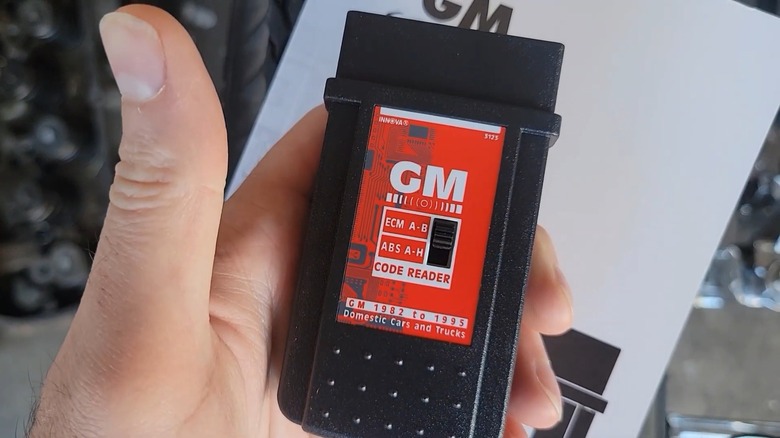
Once upon a time, in the mythically-old age that was the 1980s, automakers found themselves faced with the dilemma of growing emissions requirements. This was immediately after the second Oil Crisis, which occurred in 1979 — regulations on emissions tightened around the globe, dragging the Malaise Era kicking and screaming into the new decade. However, there was no standardized method for enforcing these restrictions. Enter the On-Board Diagnostics system, or OBD for short, pioneered by California in 1988 — a relatively short-lived but crucial point in automotive history.
The original OBD version 1, simply OBD 1, was a diagnostic tool that was specific to different manufacturers — you had to get a Chrysler tool to read Chrysler products, a GM tool for GM products, and so on. These devices plugged into a diagnostics port located on or beneath the dashboard. From there, the OBD 1 interfaced with the vehicle's on-board computer and translated the data into readable error codes, with each code language also being unique; like the tool itself, you cannot use a GM trouble code to diagnose a Chrysler vehicle.
OBDII diagnostic tools became compulsory on all vehicles produced from model year 1996 onwards, meaning the original OBD 1 is now obsolete as far as mechanics are concerned. Multiple examples of OBD 1 to OBDII cables exist and are readily available as well, but they cannot translate error codes to modern diagnostic standards. If the car can't give that information, a reader can't interpret it. So, the gold standard still rests with the original tools, making them relatively obscure but critical for maintaining the health of this specific age bracket of car.
Dwell meters
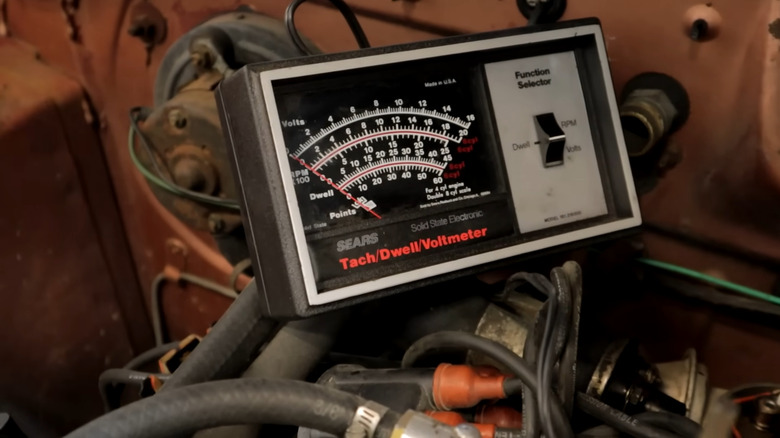
To rewind the clock even further, we're diving into the wonderfully wacky world of distributors and points-based ignition systems. These were how engines fired before the advent of electronic ignition — you had what were effectively little breaker switches that got thrown as the distributor rotates. This in-turn completes and disconnects a circuit, which sends voltage to a designated spark plug. It's all done with a spring-loaded clip that holds the breakers, called "points," shut until a cam on the distributor shaft opens them. It's fairly complicated to explain, so instead, here's a video showing how it works and how to set points if you're curious.
In order to maintain that kind of system, you needed a dwell meter. In a distributor, "dwell" is measured by the time in which the points are closed, and these meters are designed to measure this interval. Points, the wiring within the distributor, even the distributor cap will wear out over time and need replacement, and when they do, cars experience ignition and spark problems. You connect the dwell meter between the distributor and the ground and it'll give you an angle measurement.
The angle describes how far the distributor rotates before the points open and the current flows from the distributor to the spark plug via a magnetic field. If the points remain open for too long, then the electricity has the potential to arc and even damage the distributor. If it's too little, then the current will be too weak to reliably fire the spark plug. Therefore, getting the angle right using a dwell meter was crucial in this archaic ignition system.
Yankee screwdrivers
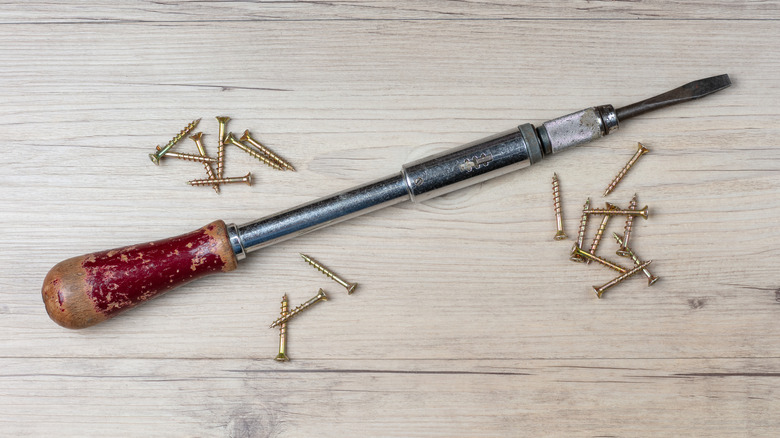
This is by far one of the most versatile tools that genuinely should never have been retired — Yankee screwdrivers were the predecessors to modern power drills and electric screwdrivers. But unlike their replacements, these clever devices fit the whole mechanism into the size of a normal screwdriver and didn't require any batteries — just a couple of firm pushes.
First invented in 1895 by Zachary T. Furbish of Maine, the Yankee Spiral Screwdriver, as it's officially called, at first glance resembles just a particularly long screwdriver with an intricately cut pattern on the shaft. Theoretically you could use it like a normal screwdriver — that's not what makes this tool so awesome, though.
Instead, you're supposed to push down on the handle, which acts like a plunger. The handle engages the cuts on the shaft, which in-turn rotates the shaft (thus, the screw tip), sort of like the rotating motion of a ballpoint pen. There's a little switch that you toggle to select whether the screwdriver rotates to the left or right. Basically, you push the handle down and it spins the screwdriver without ever needing to spin your wrist.
Yankee screwdrivers were — and remain — incredibly useful devices for getting into hard-to-reach places. Electric screwdrivers can be amazing, but they're also somewhat bulky by comparison. Obviously, they have more power potential than a Yankee screwdriver, but that doesn't diminish the latter's validity — you could operate one dozens of times without ever getting tired or breaking a rhythm because all you're doing is pressing down on the handle and letting the screwdriver do all the work. Sadly, Stanley stopped producing the original Yankee screwdriver in the mid-2000s, relegating these wonders to eBay listings today.
Speeder wrenches
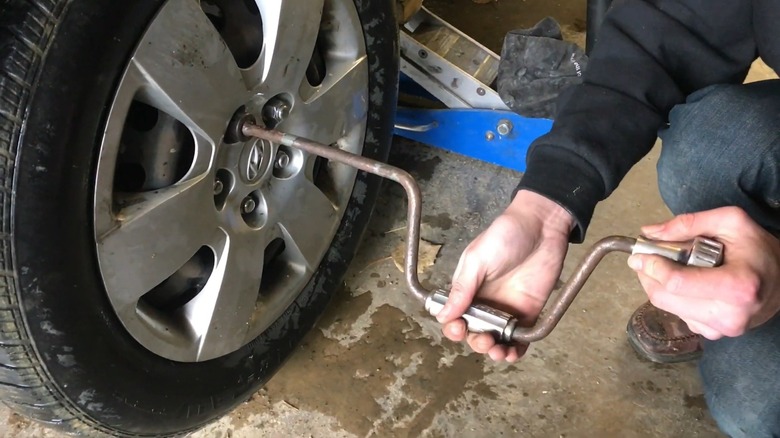
In the same vein as the Yankee spiral screwdriver, there's a good way to get a bolt off that doesn't involve air tools. You can use a ratchet, but if that's too slow or you don't want to constantly adjust your grip, there is (or was) another solution. That's when you got what were known as speeder wrenches — these were simple hand-crank wrenches which could accept standard socket sizes. Some also had a specialized grip on them which would rotate independently of the main body, meaning as the body turned, the grip did not.
The principle was simple but effective. You have an offset wrench, so you rotate the bit by cranking it around and a loose grip meant you didn't have to reposition your hand — you just held on and kept cranking. It was incredibly fast, as the name implied; these were easily the fastest means to remove loosened nuts. Companies like Snap-On carried speeder tools since before World War II, cementing their reputation as garage staples throughout the adolescence of the automobile.
Fast forward to today, and we largely associate this job with impact wrenches and pneumatic air tools, which remain some of the best tools in professional shops. But suppose you don't have the room for an air compressor or other bulky (not to mention expensive) equipment; speeder wrenches remain widely available and just as useful. Plus, you will never have to worry about over torquing or other downsides associated with high-powered tools.
Hand crank grinders
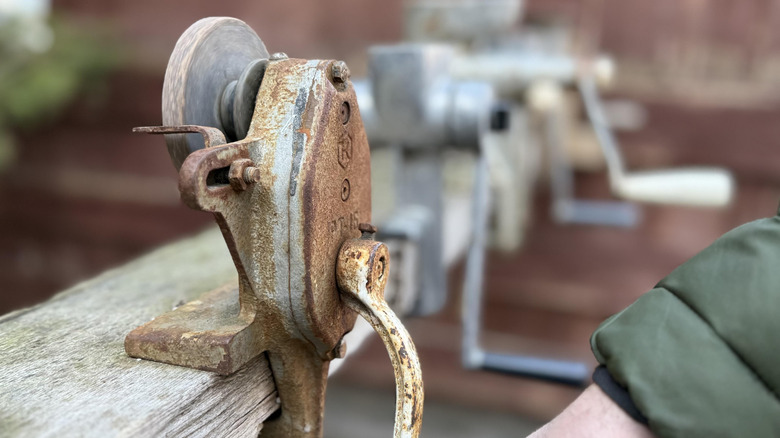
Grinders were among the most universal tools you'd find in any garage, or indeed smithy, for thousands of years. If you wanted to sharpen a dull blade with accuracy and speed, you turn to the grinder. A sharpening stone is another crucial part of finishing the product, but that's time-consuming and laborious. Instead, you use either a hand crank or foot pedal grinder wheel; instead of grinding the work against the stone, you grind the stone against the work.
Original hand-powered grinding wheels utilized stone for abrasion and were used with everything from toolmaking to food preparation — sometimes you find these in the kitchen among other forgotten appliances. The designs evolved and were miniaturized by the Industrial Revolution into what became the common hand crank grinder seen throughout the 19th and early 20th centuries. Rather than a full-blown grinding wheel, these small devices were clamped onto the side of a workbench — one end held a grindstone, and another had a hand crank.
Unlike modern electric grinders, hand grinders afford a level of tactile feel that you simply don't get anymore. Sure, it may take longer to complete, but the hand-crank grinder is still widely available and useful for small, finicky, or delicate projects requiring a precise touch.