

Motorola Razr Ultra (2026) Review: What's New?
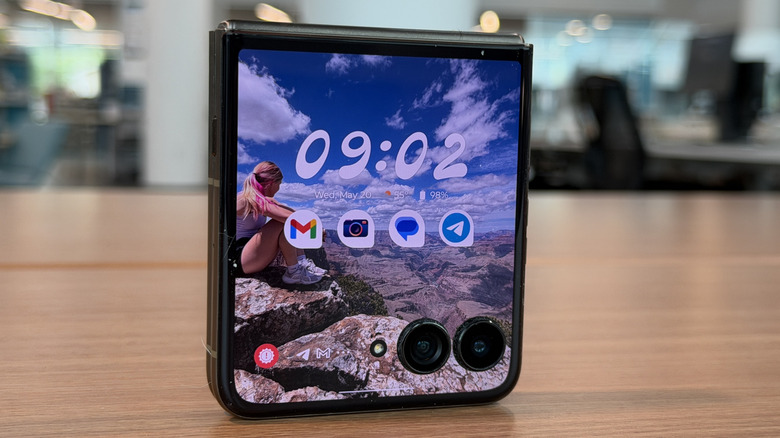
So, here's the thing. You came here to read about the Motorola Razr Ultra 2026. That's great! You love foldables; we all do. As the great scholar once said in the epic play "Die Hard" in 1988, "Welcome to the party, pal!" We're here for a good time. The time has come to tell you all about this foldable, and I couldn't be more excited to tell you about it.
But the thing is, I already did. If you read my review of the Moto Razr Ultra 2025, you already know more about this phone than you really have any right to. Let's run down the list, shall we? The body is the same; the screens are (mostly) the same. The processor is the same. The water resistance is the same. There's really not much that is different here. If you have a Moto Razr Ultra, you already have this phone.
If this refrain sounds similar, it's because that's basically the same thing Google did with the Pixel 10a. This is becoming a disturbing trend in 2026, and we still have a few flagships to go, so I'm getting a little worried. There are some differences here, and I'll talk about them, but if you are a spec nerd, get ready to be disappointed. I've been using a Motorola Razr Ultra 2026 review sample provided by Motorola for one week, and this is my full review (again).
The Razr Family
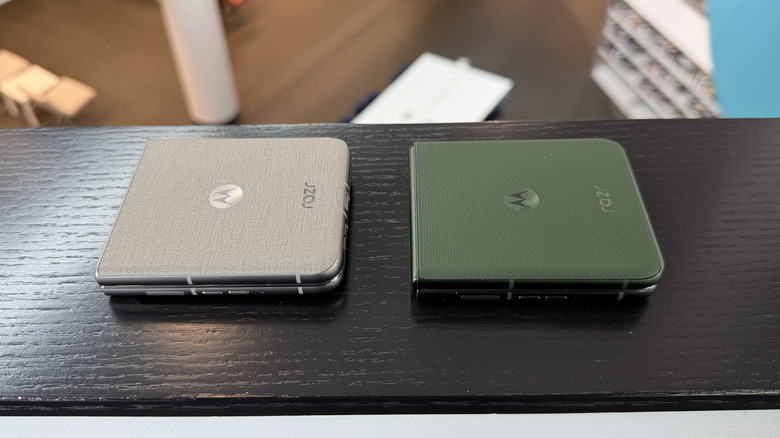
Before we dive into the Razr Ultra, it's important to note that this is not the only "Razr" device launched this year. Like last year, Motorola launched the entire Razr family at once (four devices, all foldable) with the Razr, the Razr Plus (or Razr+, if you prefer), the Razr Ultra, and the Razr Fold along for the ride. You may have already read about the Fold, and I'm still smitten by the way, but the Razr Ultra has two smaller siblings worth talking about. Just like the Razr Ultra though, there's not much new going on here.
The Razr Plus has the same processor, memory and storage, Dimensions and screens as its predecessor (the Razr Plus 2025). This year, Motorola swapped the telephoto camera for an ultrawide, and the silicone-carbon battery is a bit denser than its predecessor, upping it from 4,000 mAh to 4,500 mAh. It also only comes in one colorway — Mountain View Green.
The Razr has a small improvement with the new MediaTek Dimensity 7450X (last year's had 7400X), a new option for RAM/ROM (now there's a 128GB 8GB RAM version, too), and a similar bump up in battery chemistry from 4,500 mAh up to 4,800 mAh. The ultrawide camera is now bumped up from 13 megapixels to 50 megapixels and that makes a pretty decent difference overall, so that's nice. The Razr comes in Hematite, Violet Ice, Sporting Green, and Bright White. It's also worth noting that the Razr is a bit thicker than the Razr+ by a few millimeters.
So, what's new?
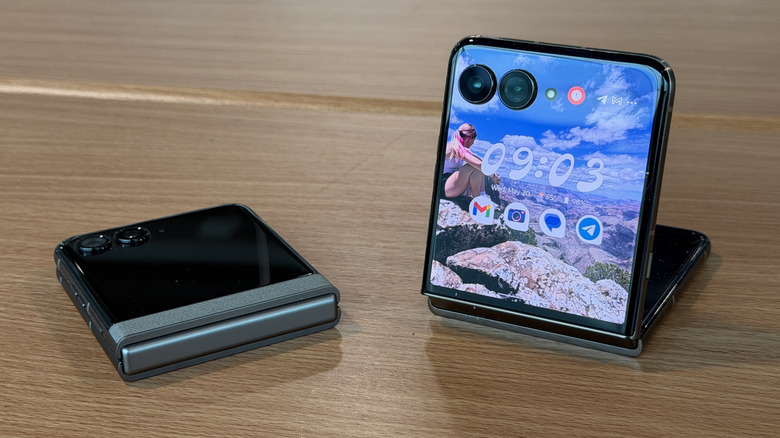
The big story with the Razr Ultra is the same battery chemistry improvement, taking the Razr Ultra up to a 5,000 mAh battery. For those keeping score at home, the diminutive Motorola Razr Ultra has the same battery capacity as the Samsung Galaxy S26 Ultra (also 5,000 mAh). To be fair, the Razr is just as thin as the S26 Ultra when opened, and it doesn't have a garaged stylus, so Samsung can be forgiven in this case, but I still find that little factoid hilarious.
The Moto Razr Ultra comes in two colors. I reviewed the Cocoa, which is a wood backplate. The other colorway is Orient Blue, which is my favorite of the two because it's quilted Alcantara. The other difference with this phone is in the camera and its new LOFIC camera sensor, which is supposed to enhance dynamic range, prevent blowouts, and prevent shadow clipping. We'll talk more about the cameras later though.
Same AI, too
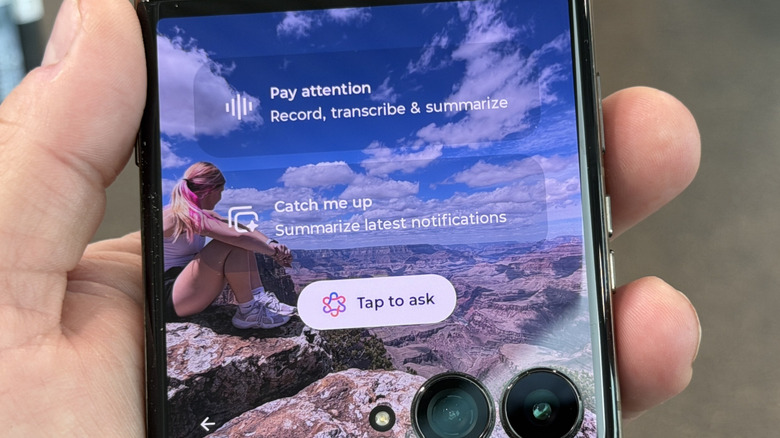
So the bad news about the Moto Razr Ultra is the AI features are still basically the same as last year. Motorola introduced us to Qira at CES this year, and thankfully, that's the last I heard of it. Nary a Qira was mentioned during our briefing in Los Angeles, California a few weeks back — or at least if it was, I blocked it out.
But the same Motorola AI stuff is still there — Look and Talk, Pay Attention, and Catch Me Up. My favorite of those is Catch Me Up, which summarizes any new communication-based notifications that rolled in since the last time you checked them, and summarizes them for you. It's similar to iOS notification summaries in that most of the time they're accurate, but other times, they're markedly unfamiliar.
The Moto Razr Ultra also has its built-in AI button which the same lack of programmability as the Razr Fold. Speaking of buttons, one thing that is missing from this year's Razr is the ability to press and hold the power button and summon Google's AI system "Gemini" when the phone is closed. This was actually a big thing that Moto was proud of last year that is simply not here in 2026 for some reason. That's actually a bummer, because there's nothing more futuristic than holding up a folded phone and asking it a question.
I still love the cover screen
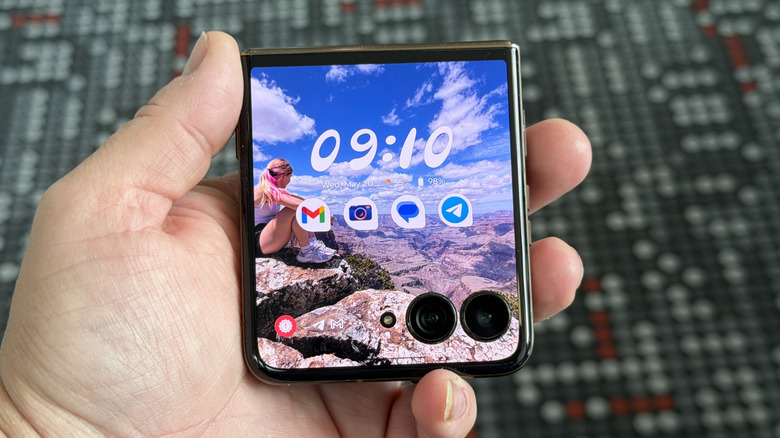
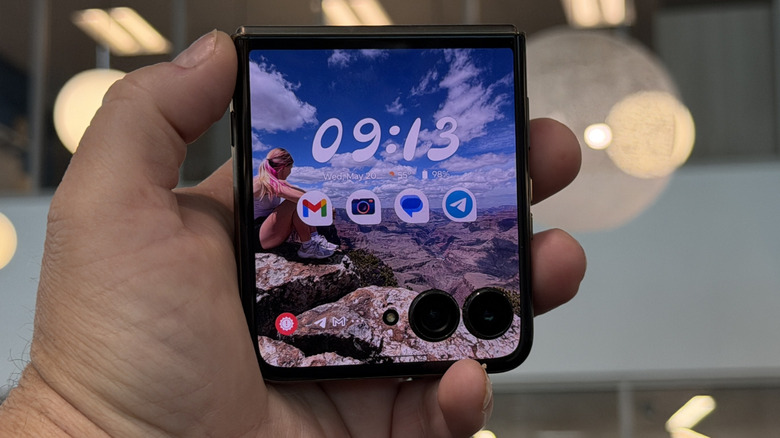
Of course, with all things being the same, I still love the cover screen on the phone. It's awesome. But here again, Motorola has stagnated. The same complaint I had about the cover screen every year it has existed is still there. Put simply: you can add basically any app that you want to a launcher so it'll run on the cover screen. That's great.
But they get added to the launcher in the order in which you add them, and aside from picking up and dragging each icon to where you want it to go, there's no way to sort them, say, alphabetically. It started off as annoying, but it's migrated into genuinely irksome. Sorting is not hard; launcher have been doing it for years.
This year, the cover screen also supports video wallpapers, which is fun. But those video wallpapers have the same limitations at those outlined on the Razr fold — portrait mode only (it's a square cover screen), 1080p only, and on the Ultra, they only work on the lock screen and not the home screen — which is particularly maddening. There does not appear to be any obvious reason why — they just don't.
Still plenty powerful
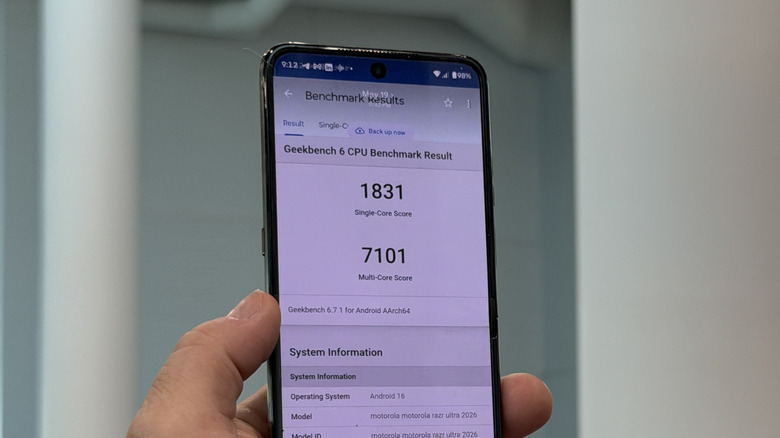
On the processor and memory side, the Snapdragon 8 Elite processor is still very powerful. If you go strictly by Geekbench standards, it's actually a tad more powerful than last year's phone. This year the phone scored 1,831/7,101 single/multi-core scores, which are both about 5-8% better than last year, so that's fun.
The real trick comes with the battery which is up to 5,000 mAh. This phone is pretty hard to kill. On my hardest day which included 12 hours away from Wi-Fi, streaming video, snapping photos at a soccer game, and then hitting the road to my amusement park, I still went to bed with 36% left in the tank. That's impressive for such a diminutive phone.
The cover screen is doing a lot of heavy lifting here, but I had the phone open quite a bit too. In addition to all that activity, I spent about an hour typing away on a story I was working on while waiting in line for a ride that shut down and never started back up. So overall, the battery remains impressive this time around.
New trick, but worse trick
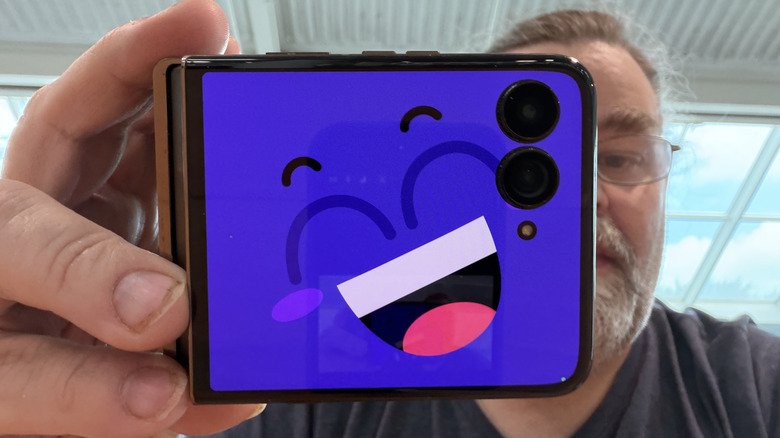
The big new trick on the Moto Razr Ultra and its siblings comes in the form of video capture in camcorder mode. This mode has been around for a few years, and it hearkens back to when camcorders were a thing — before they got cool again, that is. Camcorder mode is activated when you're in the camera and you fold the phone to a 90-degree angle. By holding the bottom half of the phone you get a viewfinder in the top half, similar to those cameras of yore.
Now, when you enter camcorder mode, the phone start video capture right away — last year gave you a three-second countdown by default. The new trick is that you can tilt the phone to zoom in and out, which gives you a smoother action than trying to pinch to zoom. The horizon stays level when you do this, by the way.
I really dig this — I was a sucker for camcorder mode when it first came out, and I love it now. The only problem is video capture on this phone is not good. Specifically, when you zoom in, the frame gets extremely fuzzy. It's hard to tell if this is an autofocus issue, or a resolution issue — or both. I suspect it's mostly autofocus. But the results of shooting video are not amazing and that is frankly disappointing.
Cameras are a mixed bag — still

The cameras on this phone are fine, I guess. As we learned while shooting video, just don't zoom in — like, at all. The main sensor falls apart really quickly after 2x, so just don't do it. It's what makes diagnosing the zoom issue so difficult. Is autofocus bad, or resolution, or both? This is a disappointing step back for Motorola, whose Razr Fold cameras are really solid. I know there's limited space to work with here because of the form factor, but there has to be a better answer.
Portrait mode, on the other hand, is surprisingly good. It handles the stray, and increasingly gray, hairs sticking out from the back of my head with absolute aplomb, and it's lovely to behold. It's honestly one of the best portrait mode cameras I have used — and that's saying something.
Action mode and burst mode are both fine. The thing holding back action mode is there is no zoom ability at all — you're stuck at 1x. Maybe in retrospect, that's a good thing considering how bad zooming elsewhere is, but when you're standing on the sidelines of a soccer field, as a parent, that's disappointing.
Night time is surprisingly not bad?

At night, things are...actually not terrible. Moving subjects are still challenging to the surprise of absolutely no one. But taken on its own, if you're subject can stand still, like for a selfie, you can get some respectable shots with this camera. There's also less judder in footsteps when walking — it's still there, but it's not nearly as bad as it has been in the past.
Getting back to the LOFIC camera sensor, it doesn't seem to be improving things all that much. Ironically, on some of my night shots, the light sources were the biggest problems — something that a LOFIC sensor is supposed to fix. In particular the lights surrounding my Village Hall were blown out with artificial looking halos around them, so make sure you're keeping light sources out of the shot, and make sure your subject are prepared to stand still. If you can do that, you'll probably be not bad.
Shadow clipping is (at least a little bit more than in past devices) accounted for here — the darkest areas aren't completely blackened out to nothing, for the most part.
Moto Razr Ultra 2026 Price, availability, and verdict
Pricing for this phone starts at $1,499.99, which has a complicated story behind it. Last year, the Razr Ultra launched at $1,299.99, but if you went to Motorola.com three weeks ago, you'd see it was currently selling for $799.99, with an MSRP of $1,499.99. So, is this phone more expensive? It's hard to say. This is Motorola, so give it a few weeks (tops) and the price will come down (if the past informs the future).
Like I said at the beginning, if you have any version of the Razr 2025, you already have the 2026 version of the device, more or less. If you're using the Razr Ultra 2025 right now, you already have the 2026 version of this phone, full stop. There's no need to upgrade, there is nothing worth it.
If you have an older phone and you want to upgrade, that's fair. I said last year, this is a good phone. That's still the case here. But I don't think it's a $1,500 phone; it's a $1,300 phone at best, and even that is stretching things.
Mostly, it just feels like Motorola has stagnated in this space. That's not generally a major problem, because in this writer's opinion, Moto has (still) been pretty far ahead of its U.S. competition, but Samsung is catching up, so Moto is squandering its lead.
Yes, this is a good phone, but it's last year's flagship at this year's price. If (and when) it makes it back down to $799.99, go ahead and pick it up; it'll be a great deal. But until that happens, you can wait.