

11 Niche Makita Tools You Probably Shouldn't Waste Your Money On
Collecting tools can be like collecting anything else. Once you have a few tools, they almost demand that you get a few more. After all, if a few tools are good, more tools must be better, right? Besides, there are some real hidden tool treasures out there to be found.
Then again, there are tools which are useful to the average person, and there are others with specific and uncommon use cases that most buyers are unlikely to encounter. If you're planning to spend your weekend browsing the hardware store shelves, or if you're hunting down the perfect gift for the tool lover in your life, you might be tempted by specialized niche tools with interesting bells and whistles, especially when looking through brands like Makita.
The thing is, the simplest and most accessible tools often have the broadest range of applications. The more niche a tool is, the more likely it is to have a specific use case. Put simply, most of the general consumers can get away with a basic tool set filled with ordinary screwdrivers, wrenches, hammers, and the like. Unless you're doing specialized work and you've done your research, you can probably steer clear of these niche tools.
Rebar tying tool
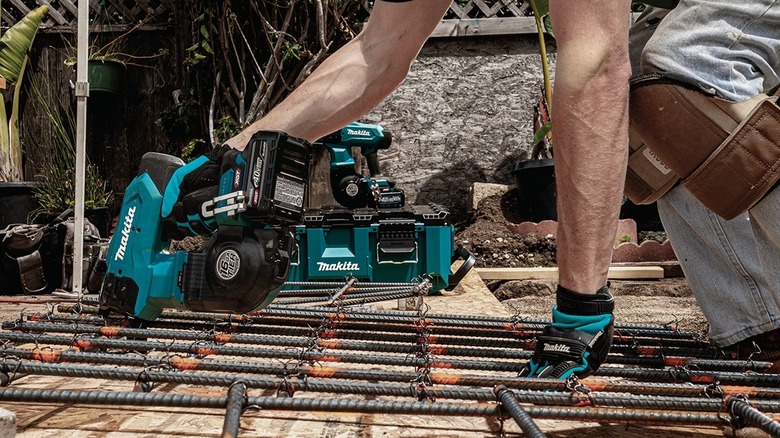
Rebar is commonly used as a structural support material in construction projects, from roads and bridges to swimming pools and buildings. Before pouring concrete, workers often have to lay down lots of rebar and then tie those bars together so they remain in place. A rebar tying tool takes most of the effort out of what would otherwise be slow, painstaking work. It can also reduce back strain and hand or wrist injury from repeated mechanical motions.
Makita's 40V max XGT 16 gauge rebar tying tool has a bay for storing coils of 16 gauge wire and offers six different tension strengths. It can make up to 245 ties per reel of wire before you'll need to reload, and it can make approximately 3,600 ties per charge using a 40V max XGT 2.5Ah battery. It can tie together bars as small as two #3 rebar (3/8-inch diameter each) or as large as a #8 rebar (1-inch diameter) and a #9 rebar (1-1/8-inch diameter).
To use the tool, you slip the jaws around the bars you want to tie off and press the tying button. A small band of wire comes out, wraps around the bars, and ties itself off all in the blink of an eye. It's a cool and useful tool under the right circumstances, and it stands apart in the power tool landscape, but most of us are unlikely to tie off rebar supports very often.
Vacuum sweeper
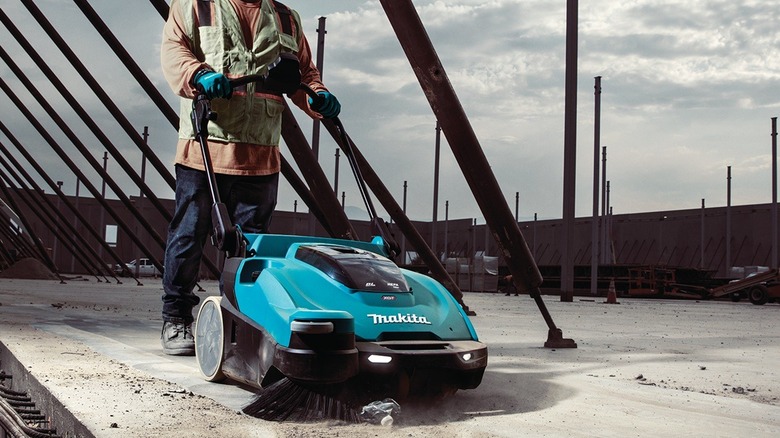
Vacuums are an ordinary part of a typical household cleaning arsenal, but this is no ordinary vacuum cleaner. The 40V max XGT 25.5-inch cordless vacuum sweeper has onboard controls that let the user choose between quiet or standard brush speeds and standard or quiet suction modes. It's a powerhouse cleaning tool capable of cleaning an area more than two feet across in a single pass.
While a standard vacuum can pick up ordinary household dust and debris, this sweeper can pick up debris as large as a 19.6-inch plastic bottle. Using two of Makita's 40V max XGT 8Ah batteries, it can clean an area of up to 93,000 square feet. It also has an array of LED lights that illuminate your work area and a built-in HEPA filter that captures at least 99.97% of particles 0.3 microns in size. In spite of its power, the machine weighs just 65 pounds, offers a carrying capacity of 6.3 gallons, and folds in half for storage between uses.
As you can probably guess, this tool is intended for big cleaning jobs. It makes more sense in a professional setting than a personal workshop. It's an impressive cleaning machine, but it's overkill for just about any ordinary person.
Metal hole punch
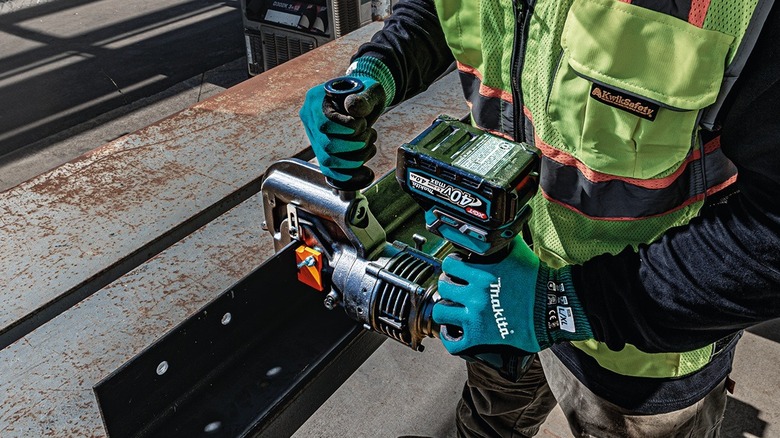
If you've ever worked with wood, you probably understand the value of creating holes to fasten pieces together. A metal hole punch lets you make similar openings in thin sheet metal materials for a variety of metalworking applications.
Makita's 40V max metal hole puncher looks more like a futuristic dystopian sci-fi weapon than a power tool. You can use it to create holes in steel plates as thick as 3/8-inch and stainless steel as thick as a quarter-inch, so we suppose it could serve as a weapon in the future war against robots. An adjustable depth guide lets you move the location of your punch up to 40 millimeters (1.57 inches) from the edge. A built-in retraction mechanism automatically pulls the die back once a hole has been punched, so you can move on quickly.
An LED work light illuminates your workspace or materials, and you can adjust your position using the 360-degree rotating handle and auxiliary side handle. It's an obviously useful tool for making holes in thin metal plates, but that's just not a job standard home users are called upon to do very often.
Advanced AVT breaker hammer
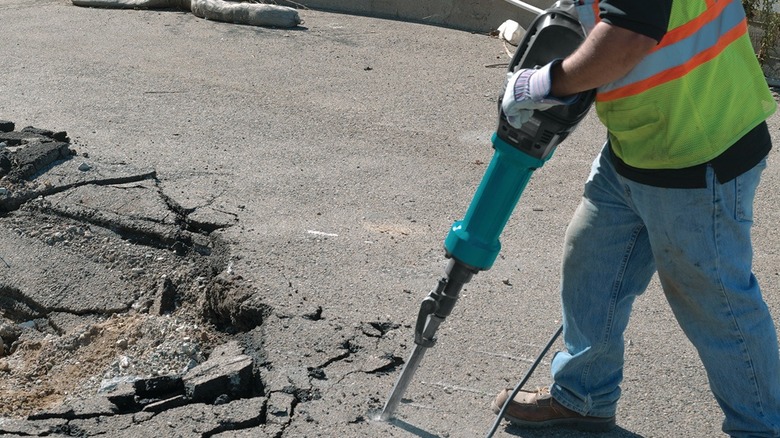
It's been said that it's easier to destroy things than to create them, but that's not always true. When it comes to concrete, pouring something new is usually easier than breaking and removing an existing structure. That's where Makita's advanced AVT breaker hammer comes in.
It's a heavy-duty demolition hammer dropping 53.9 foot-pounds, or 73.8 joules, of impact energy to smash up concrete and other dense materials. The tool weighs about 70 pounds and comes with a premium metal dolly for transportation and support. It also comes with a hex wrench, two self-sharpening bull point tips, and a flat chisel.
A built-in counterbalance system, rubberized fixed movement handles, and housing engineered to absorb motion all work together to reduce vibrations felt by the user. The breaker features two informational LED lights, one to tell you about a switch failure or cord damage and another to alert you roughly eight hours before the brushes need to be replaced. Makita's advanced AVT breaker hammer is useful for smashing up dense materials with relative ease, but it's probably more power than everyday users should have.
Masonry saw
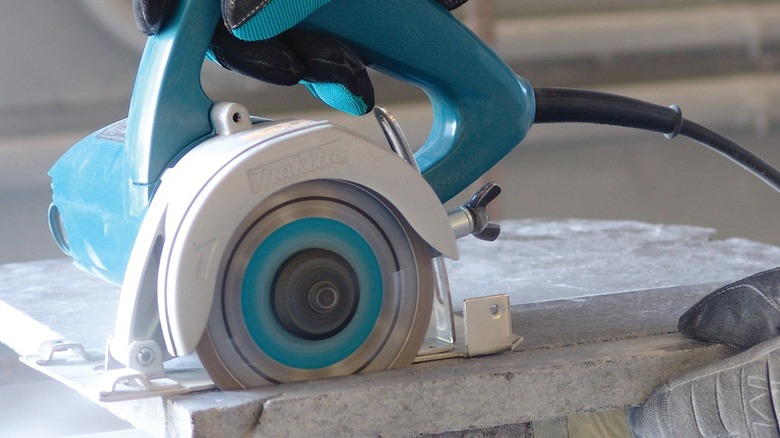
There's something so satisfying about the cutting power of a saw, letting you slice through wood and other materials like a hot knife through butter. So, we understand the appeal of a masonry saw's rock cutting power.
Makita's 4-3/8-inch masonry saw features a 4-inch diamond blade that lets you slice through typically impervious materials like brick and concrete. However, casual users don't have reason to cut rocks very often, and that sort of work comes with dangers you might not have thought about.
Cutting bricks or other silica-containing materials can create harmful crystalline silica dust capable of causing lung damage when inhaled. The Occupational Safety and Health Administration (OSHA) recommends wet cutting to reduce dust creation and exposure, as well as cutting outside or in well-ventilated areas. You should also consider a dust collection system and appropriate respiratory protection. Unless it's your day job, having a masonry saw could create more danger than you need and might not actually be that useful day to day.
Chain mortiser
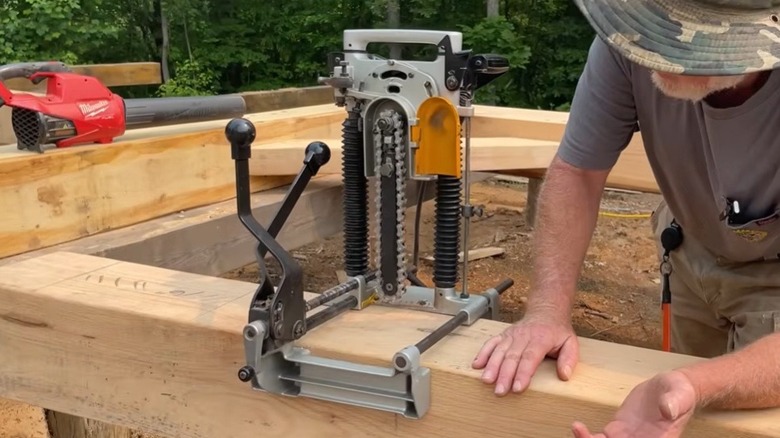
A mortiser is a tool used to cut square or rectangular holes in logs or wooden beams. You can make mortises by hand using chisels and bits, but if you need to make relatively large holes, or you need to carve a bunch of holes quickly and consistently, a chain mortiser can be useful.
Makita's chain mortiser features a length of chain with cutting teeth connected to a housing that moves up and down. It's basically a tiny mounted chainsaw you can plunge into lengths of wood to carve out openings. The machine weighs 38.1 pounds and has a built-in carrying handle at the top for easier transport between jobs. An adjustable knob lets you change the position across your material, and you can adjust the plunge depths in 1/8-inch increments.
An adjustable vise lets the mortiser grab onto logs between 3-1/8 and 12-1/8 inches wide. It looks like a modern torture device, and its specific niche use case makes it worth passing over for the average buyer. It's the sort of thing you might use to do timber framing or make giant Lincoln logs to build a log cabin. Unless you're planning a dramatic career change to become your neighborhood mountain man, you should probably put it back.
Rebar cutter
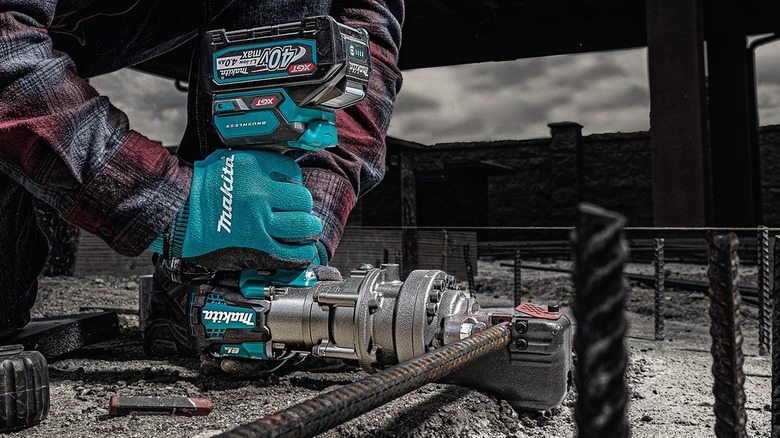
If you've ever wanted to cut through a metal rod like a pair of scissors through a hot dog (an admittedly weird analogy), this is your chance. Rebar is a common support material, particularly when pouring concrete. The bars act like a skeleton to support the overall structure, but first someone has to build that skeleton. Much of that work can be done by laying down rebar and tying it together into a support frame, but somewhere along the way, you're likely to need to cut some rebar to the appropriate length.
Makita's 40V max XGT rebar cutter can slice through #5 rebar (5/8-inch diameter) up to 250 times with a fully charged 4Ah battery. An adjustable stopper holds the bar steady so the blades can cut more easily, and a rotating head lets you customize the angle of your attack. It's important to have the right tool for the material you're working with, but before you buy this, ask yourself when was the last time you had to cut through metal bars. Then admit that it was never and put the rebar cutter back on the shelf.
Material handling frame
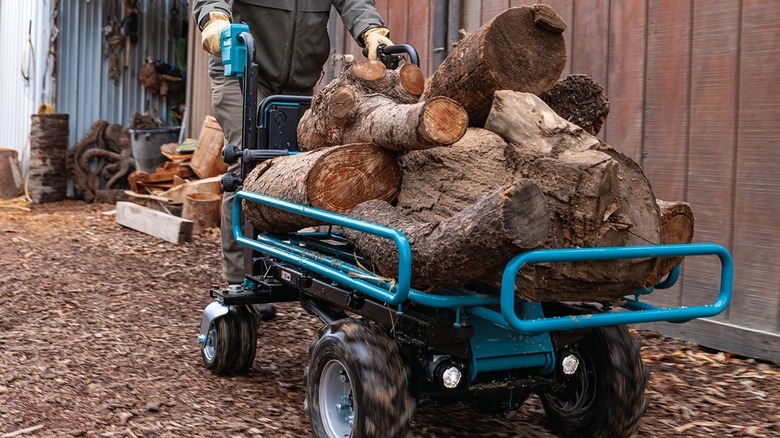
Wheelbarrows and hand trucks are time-honored ways of moving big piles of stuff from one place to another. Makita's 36V LXT material handling dump/pipe frame takes things up a notch by trading in the wheeled basket for an adjustable metal-framed rectangle on powered wheels.
The frame holds four 18V LXT 6Ah batteries and uses two at a time for 36V of combined power. It can run for up to 100 minutes on two fully charged batteries, and it can move up to 650 pounds of cargo a maximum distance of 4.5 miles. You can choose between three forward speeds, up to 3 miles per hour, and one reverse speed. Hand-operated disc brakes let you take it on gradual inclines without it rolling away.
A telescoping loading platform lets you adjust the dimensions, expanding the length from 57 inches to 63 inches, the width from 28.75 inches to 41.5 inches, and the height from 31.25 inches to 40.5 inches. Front headlights illuminate your way, and a lock lever release allows you to dump your materials all at once when you get to your destination. It's undoubtedly more convenient and more powerful than a wheelbarrow, but it's a pro-level tool casual DIYers don't need.
Multi-surface scanner
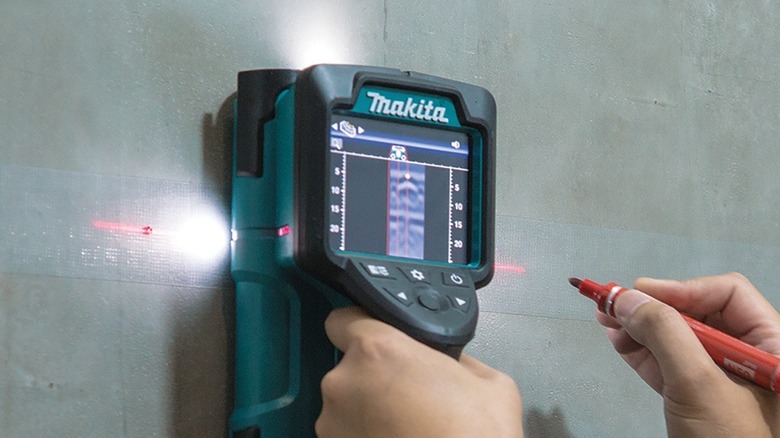
This is about as close to a piece of spy equipment as the hardware store has to offer. You can use it to scan your walls, floors, and ceilings to locate the materials hidden inside. Makita's 18V LXT cordless multi-surface scanner is like an X-ray machine for your house, letting you see what's going on beneath the surface to plan cutting and drilling activities and avoid unintended damage.
An LED illuminates your workspace and a laser guide helps you maintain a level scan across your surface. A 4-inch backlit color display shows you the center, edge, width, and depth of embedded objects to give you enhanced multi-angle detection. You can choose from a selection of base materials like wet concrete, dry concrete, wood, drywall, and hollow block, and the device can detect a variety of materials including steel, aluminum, copper, wood, plastic, and shielded wires up to 7 inches beneath the surface.
It's an impressive gadget you might not even have known existed and it runs on Makita's relatively small 18V LXT lithium-ion batteries. But unless you're planning to go treasure hunting in your walls, you probably don't need to add this to your collection.
Dethatcher
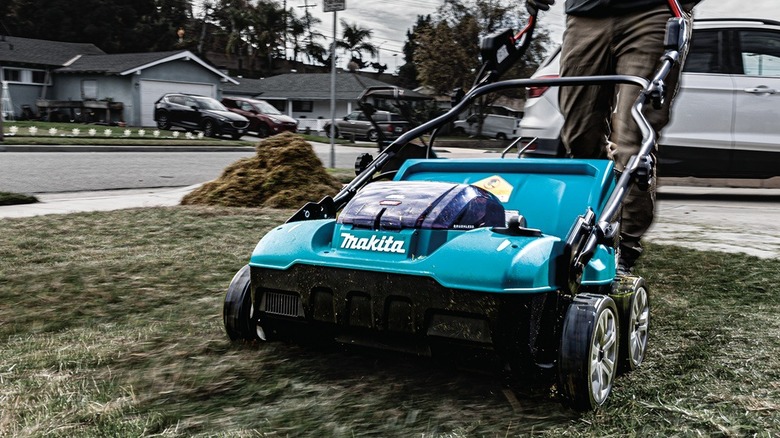
Makita's 40V max XGT 15-inch dethatcher, also known as a scarifier, is designed to get beneath the top layer of your grass to dig up dead grass, leaves, stems, roots, and other organic material that doesn't easily break down, otherwise known as thatch. This buildup can naturally collect around the base of grasses.
Some thatch, less than about half an inch, can be beneficial. It helps to reduce water loss and prevent the germination of weeds. It basically acts like a tiny shielding layer, keeping good things in and bad things out, but if the shield gets too thick, it can suffocate your grass. More than about half an inch can prevent the grass from getting enough water or air. It can also increase the risk of insect or fungal infestations.
There's no golden rule as to when or how often your grass would benefit from dethatching. The rate of thatch buildup depends on a variety of factors like frequency of watering, soil composition, and the species of grass you have. Some grasses might benefit from dethatching as frequently as every year, while others might only need to be dethatched every few years. It's the sort of thing you can pay a service to do every once in a while and probably not something you need to own for yourself.
Concrete vibrator
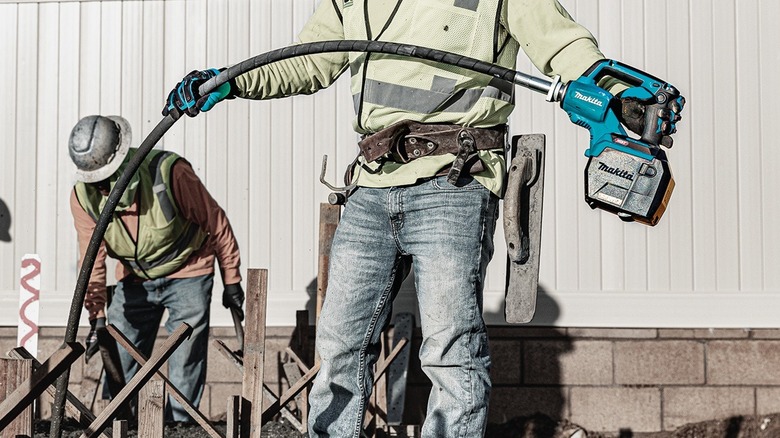
Concrete is the single most commonly used construction material in the world. In fact, it's among the most consumed materials in the world, second only to water. It's used to make everything from buildings and sidewalks to floors, statues, and more. It's useful in large part because its liquid form can be poured into pretty much any shape a person might want, then cured into a durable solid.
It's made from a mixture of cement (limestone, silica, and a few other ingredients), some chemical additives, water, fine aggregate like sand, and coarse aggregate like gravel. When the cement and water mix, calcium silica hydrates are formed, creating tight bonds that hold the whole mixture together. From there, it's all about getting a good pour.
Trapped air bubbles are among the most common structural challenges in concrete, which is why concrete vibrators exist. By jiggling the concrete, air bubbles get shaken loose and the mixture consolidates more evenly, creating a more durable end product. Concrete vibrators, like Makita's 40V max XGT 8-foot concrete vibrator, are practically an essential part of a professional construction outfit, but unless you pour concrete for a living, you probably don't need one.