

5 TV Myths It's Time To Stop Believing Once And For All

We may receive a commission on purchases made from links.
The television industry is worth a few hundred billion dollars, and it's expected to smash past $500 billion by 2030. That sounds all very impressive, but a chunk of that comes not from selling people their dream TV, but from selling them things they don't need. It's not an accident, either; it's a business model.
Buying a TV should be simple. You can confidently shop for one online, or you can walk into a store, check out one that looks good, get the hard sell, and then take it home. But with the salesperson's technical jargon and overinflated claims, you might get a feeling that you've bought more than you needed once you settle down on the couch to watch that first show — or maybe you didn't get the features you actually need. The problem is, many of us do not have the time or the technical knowledge to push back. Therefore, we trust the spec sheet and believe the salesperson, which can result in overspending.
To arm yourself before you go to the store, we've listed five of the most persistent myths in the world of TV buying. They've been repeated over and over to the point that they now feel like common sense. But are they? After debunking these myths, we hope you can save a little bit of money, whether you're on the way to the store or contemplating your next purchase. Here are five TV myths it's time to stop believing once and for all.
Myth: you need 4K on a small TV
Walk into any electronics store with the intention of buying a TV and salespeople will tell you that 4K is the essential viewing experience. They're not wrong. However, if it's a small TV you need (we're talking 44 inches or under), you can save yourself a bit of cash by opting for a 1080p display instead.
According to researchers at the University of Cambridge and Meta Reality Labs, there's a limit to how much benefit your eyes get from higher resolution on a tiny display. The explanation for this lies in how the human eye works. "Our brain doesn't actually have the capacity to sense details in color very well," says Professor Rafał Mantiuk, co-author of the study.
Our peepers can only process detail up to a certain point. Feed them more resolution than they can handle, and the signals sent to your brain won't be that different from a lower resolution. The researchers measured pixels per degree (PPD), which isn't how many pixels a screen has, but how a screen looks from your viewing position.
For an average-sized living room with 2.5 meters between couch and screen, a 44-inch 4K TV offers little to no noticeable benefit over a lower-resolution QHD set of the same size. Knowing the point when you can tell the difference between 4K and 1080p could save you money — and the research team was so keen to assist people with this that they made an online calculator to help. Just enter the necessary details, and it will tell you exactly what resolution is actually beneficial to your eyes.
Myth: you need premium HDMI cables
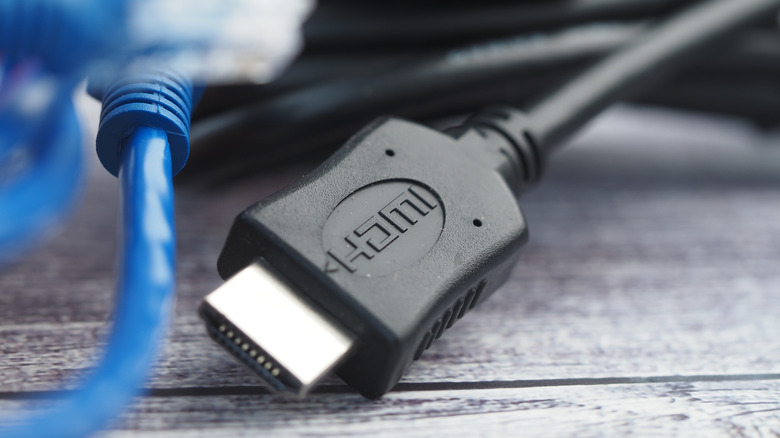
Cable manufacturers will try to convince you that expensive 4K cables are a necessity, but MOST OF THE TIME they're not. HDMI is just a digital signal; it either carries the data or it doesn't. Whatever you've read, a pricier cable will not enhance your picture because the signal has no way of carrying any alleged extra quality. Even if you dug out a dusty old cable from the back of a drawer, it would almost certainly deliver the same picture quality as a $50 cable you just pulled off the shelf at Best Buy.
It's also worth noting that HDMI cable "versions" don't actually exist. Whether it's HDMI 2.0 or 2.1, these numbers describe your device's ports. What actually counts when choosing the right HDMI cable is the speed category.
There are some (very old) HDMI cables that will not work properly with your brand new 4K television — but you'd need to head to the bargain in at a secondhand shop to find one these days. Even the cheapest cables on today's market are almost always "high-speed" or "premium high-speed," the latter of which can handle just about any 4K content.
Gold-plated connectors and signal fidelity are unnecessary, too. In fact, buying high-priced cables means you're just buying a brand name, gimmicky features, and possibly a fancy box. The one exception is next-gen gaming. If you have the hardware capable of pushing 4K at 120fps, treat yourself to an ultra-high-speed cable — but even then, these are often reasonably priced — we're talking less than $10; you don't need to fork over a fortune.
Myth: you need an extended warranty

The moment you buy a new TV, just wait for the extended warranty hard sell. But did you know that extended warranties are often far more profitable for retailers than the hardware itself? In many cases, they pocket more than half of what you pay for the plan. With the global extended warranty market projected to reach an incredible $286.4 billion by 2032 according to Allied Market Research, this is not an industry built on goodwill — it's a serious business. But the reality of a modern flat-screen TV is that they fail at a very low rate; we're talking single-digit percentage numbers here. And when something does go wrong, the repair cost is usually just marginally higher than what you would have paid for the extended warranty. Consumer Reports put it bluntly when they said, "You shouldn't have to pay extra to get manufacturers or retailers to stand behind their products."
The pricing is not arbitrary, either. Companies work out how many TVs in a given model are likely to fail and set their prices accordingly, which ensures they always come out on top. The reality is, you're not buying protection for your TV; you're subsidizing their profits. Even if you do make a claim on your extended warranty, the experience is seldom straightforward.
Repairs drag on, and a lot of the time they need more than one attempt to fix it. Most major credit cards quietly offer the cardholder a warranty extension as a free perk anyway, as long as you use that card to purchase the TV. The smart move is to keep your money or stash it in a repair fund. On a TV that is statistically very unlikely to need fixing, the odds are firmly in your favor.
Myth: TV contrast ratio specs are meaningful and important

Contrast ratio measures how deep a TV's blacks are against how bright its whites can get — and it is one of the most important factors in picture quality. However, if you've ever compared the contrast ratios of two TVs, you've probably been misled. That's because the numbers are not directly comparable across brands. Manufacturers are not required to follow any single testing procedure when measuring it, so every brand does it differently — and most measure it in whatever way produces the biggest number.
At the heart of this is the difference between native and dynamic contrast ratio. Every TV has a native contrast ratio — what the screen can physically produce. Many also have dynamic contrast, a feature that adjusts brightness in dark and light scenes to deepen blacks and brighten whites. Because the dynamic figure is often much larger than the native figure, manufacturers sometimes highlight it on packaging — and it cannot be trusted as a reliable guide to what you will actually see. The number on the box is not a standardized measurement; it's a marketing decision. With no standard benchmark, these numbers are essentially meaningless.
Myth: OLED burn-in is still a serious concern
Burn-in — the ghostly remnant of a static image permanently etched on an OLED screen. It has long haunted the OLED and spooked many buyers over the years. It's probably the main reason many people have opted for LCD TVs instead. But should you be worried about burn-in on OLED TVs?
Evidence suggests that fear is largely misplaced. Most people who think their screen has some burn-in symptoms are actually experiencing image retention. This is temporary and clears up on its own. True burn-in is permanent and was a legitimate concern with older OLEDs. But nowadays, it requires extreme conditions to happen. When it occurs, it occurs when the same static element, like a news channel logo, is left on the screen at high brightness for days on end.
RTINGS decided to put this one to bed when they conducted one of the most comprehensive TV longevity studies ever conducted. It was a 3-year accelerated test on over 100 TVs, accumulating more than 10,000 hours of usage.
In the end, every single OLED did eventually show burn-in, but the tech experts made it clear that this was the result of deliberately extreme conditions, and they do not represent normal use. In an earlier test, RTINGS ran six OLED TVs for over 9,000 hours, showing a mix of general TV — the same way people actually watch TV. Not one of them developed significant burn-in. Myth debunked.