

There's A Reason The Blue Angels Started Flying The A-4 Fighter Jet After The F-4
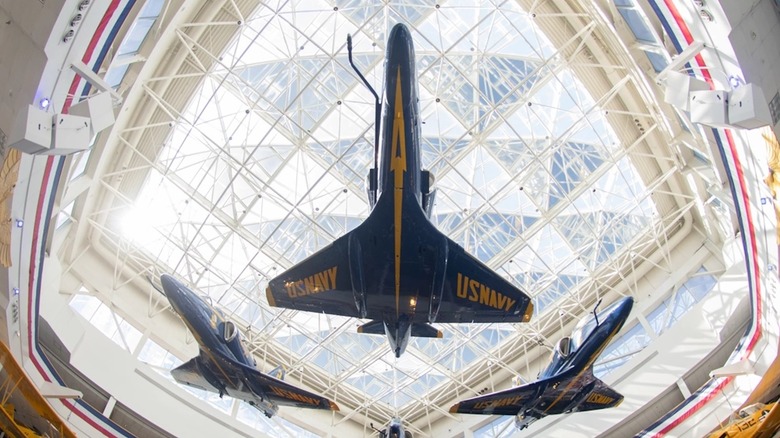
Today, the Blue Angels, the U.S. Navy's flight exhibition team, is well known for flying the aircraft carrier-based F/A-18 Super Hornet, a jet featured in Top Gun: Maverick and one that has a top speed of over Mach 1.8. The Super Hornet lets the Blue Angels perform stunts only thought possible in one of the "Ace Combat" games.
But long before the Super Hornets, the Blue Angels flew the McDonnell Douglas F-4 Phantom II, an aircraft notable for its heavy usage during the Vietnam War. The Phantom delivers in the horsepower department, with a top speed of 1,400 miles per hour from its pair of General Electric J-79 engines.
However, in the 1970s, the Blue Angels note, the team moved to the comparatively much slower and a little older Douglas A-4 Skyhawk. It's only fitted with a single engine and has a top speed of 673 miles per hour at sea level.
Smaller and more entertaining
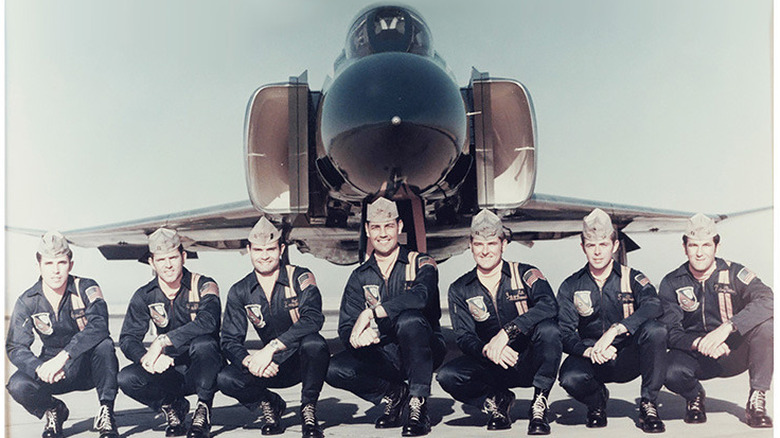
The Blue Angels made the switch not because the Phantom was a lackluster plane (quite the opposite). It was mainly to put on a better show. The A-4 is significantly smaller and lighter than the Phantom, and as a result, the Blue Angels found that it was more maneuverable for airborne stunts. The Blue Angels website says: "In 1974, we transitioned to the A-4 Skyhawk, a smaller and lighter aircraft with a tighter turning radius allowing for a more dynamic flight demonstration."
Breaking down the numbers a bit, the F-4 Phantom II is 58 feet, 2 inches long, with a wingspan of 38 feet, 5 inches. It weighs 58,000 pounds when loaded with fuel and is a two-seater aircraft. Comparatively, the A-4 Skyhawk is just over 40 feet, 1 inch long, and has a wingspan of 27 feet, 6 inches. It weighs in at 24,500 pounds loaded.
The F-4 Phantom II might be faster and newer, but the A-4 Skyhawk was more fun to watch, and that's a lot more important to the Blue Angels (and to the audience).