

Why The Mazda 3 Sedan Is More Than Just Mazda's Cheapest Model
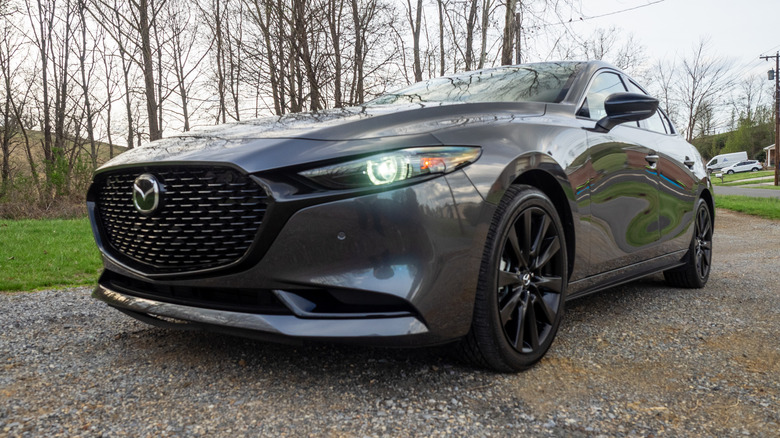
Do you remember sedans? A few decades ago, they were everywhere. Now, it's a sea of crossovers and trucks, dominating every automakers' lineup, if they haven't gone all-in on them like Ford and General Motors (aside from one performance sports car, of course). If you want something that is a car with four doors and a low ride height, the foreign showrooms are where you'll find them today, from Hyundai and Toyota to Mercedes-Benz and BMW.
With fuel prices climbing higher and higher with every passing day as of this writing, plus the rising average transaction price of a new vehicle overall ($49,275 as of March 2026, according to Kelley Blue Book), the sun may be rising upon the sedan once again, especially affordable, entry-level sedans. One such example is Mazda's 2026 Mazda3 Sedan, sibling of the Mazda3 Hatchback, though without quite as much utility as that model offers.
With all of that in mind, Mazda sent down a Mazda3 Sedan in its highest trim level, the 2.5 Turbo Premium Plus, draped in Machine Gray Metallic with blacked-out trim. Is this compact sedan one way out of the crossover/truck era? And what will consumers receive in exchange for leaving some (literal and figurative) baggage behind? Here's what I can tell you after spending a week with this zippy little guy.
A good deal on fun
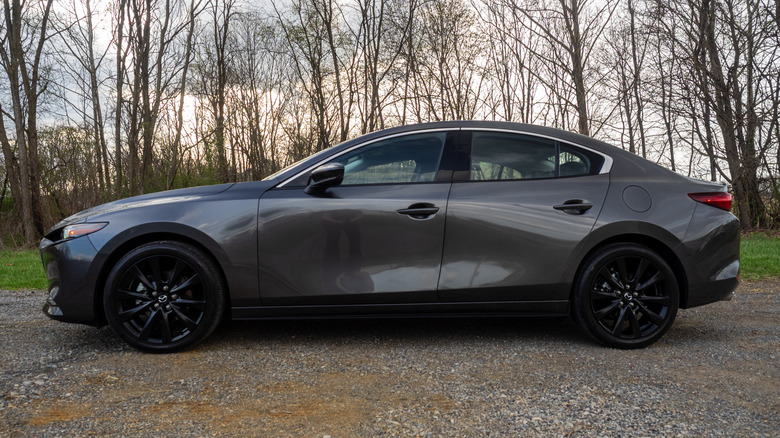
From the very beginning of its life in the 2004 model year (when it was based on the same platform as the European Ford Focus and Volvo S40), the Mazda3 has always been offered in both hatchback and sedan configurations. The current, fourth-generation pair debuted at the Los Angeles Auto Show in 2018 for the 2019 model year, and hit it off with the public in that model year, with 50,714 copies leaving the lot.
They've had their ups and downs on the showroom floor ever since; 29,266 units made the same journeys to their new homes in 2025, nearly 10,000 fewer than in 2024. Perhaps things will be different in 2026, but for now, here's what you can expect to pay for Mazda's cheapest model before the $1,235 destination charge:
- 2.5 S: $24,550
- 2.5 S Select Sport: $25,440
- 2.5 S Preferred: $27,090
- 2.5 S Carbon Edition: $30,210
- 2.5 Turbo Premium Plus: $36,740, $39,145 total sticker as-tested
The Mazda3's hatchback sibling offers one more trim compared to the sedan, though all trims of said hatch sell at a slightly higher starting MSRP ($25,550 to $37,890 before options and packages). Meanwhile, the Hyundai Elantra, Toyota Corolla, Kia K4, Nissan Sentra and Volkswagen Jetta all fall below $30,000 no matter how high up you go on trim levels (options will raise the bar, of course), and the Honda Civic's top trim begins just below $31,000.
Turbos bring out the zesty
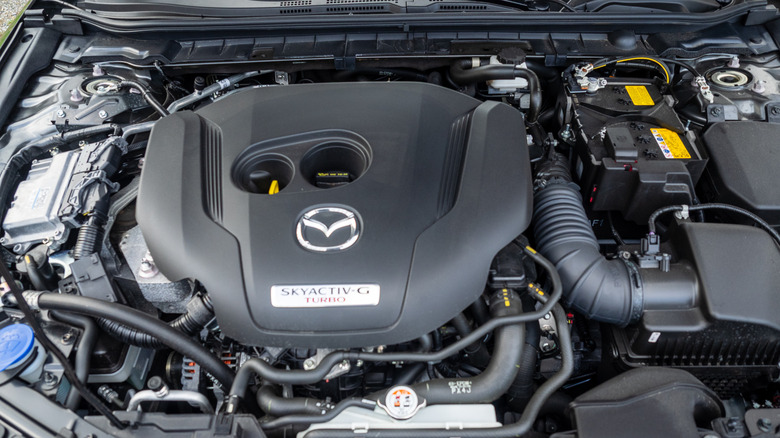
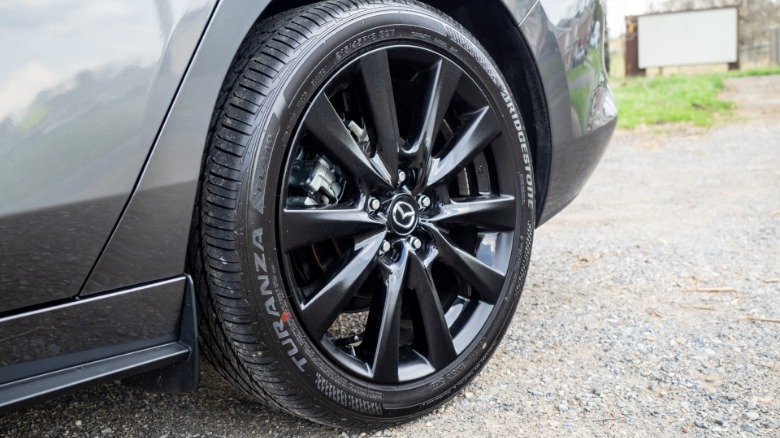
For most trims, a naturally aspirated 2.5-liter four-cylinder drives the front wheels (all four on the Carbon Edition trim). Tied to a six-speed automatic, a total of 186 horsepower and 186 lb-ft of torque reach the tarmac through a set of 16- to 18-inch alloy wheels. Not exactly the "zoom-zoom-zoom" most consumers think of when they think of Mazda, but that powertrain won't hurt your wallet at the pump, not with an EPA estimate of 30 mpg combined (27 city/36 highway) for the front-drive models, or 29 mpg combined (26 city/34 highway) for the all-wheel drive Carbon Edition.
 Cameron Aubernon/SlashGear
As for the 2.5 Turbo Premium Plus I tested for a week in my Southwestern Virginia home, the addition of a turbocharger brings the spice Mazda is known for to the same 2.5-liter four-cylinder. Maximum output is 250 horsepower and 320 lb-ft of torque through the same six-speed automatic to all four corners and their standard 18-inch alloys.
That output does require premium-grade fuel, mind, but the powertrain is built to also run on regular. Performance will take a hit as a result, but it's not so bad: 227 horsepower and 310 lb-ft of torque. As for fuel economy, the EPA gives it a rating of 27 combined mpg (23 city/32 highway). My final average was 22 mpg thanks to lots of short in-town trips, falling short of the combined rating but close to the city rating.
A time capsule of simpler days
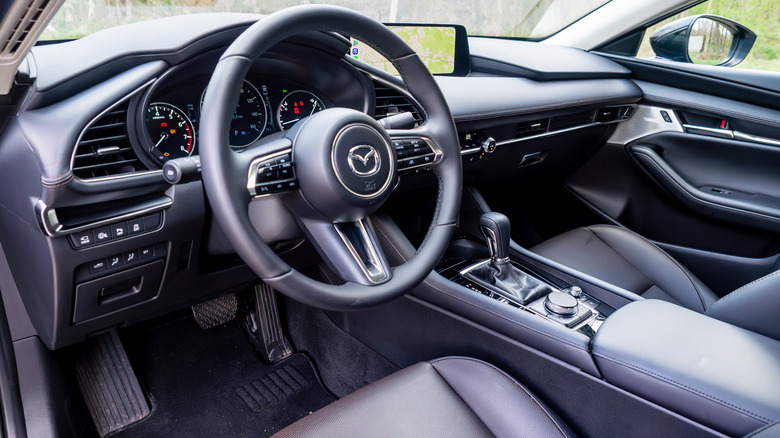
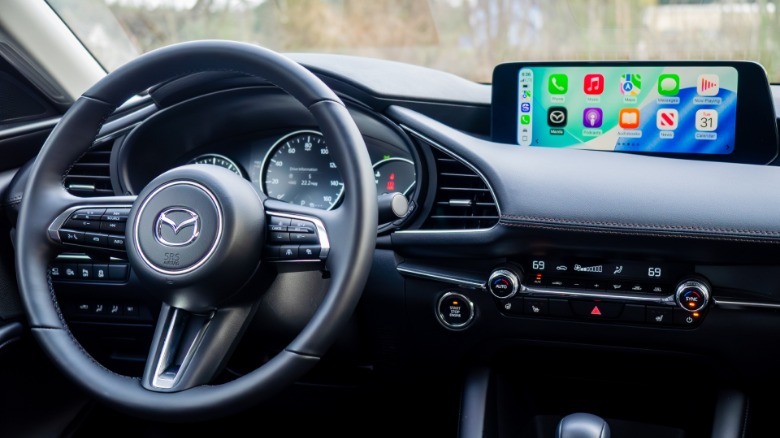
Slide into the driver's seat and you get the feeling you've returned to a time when technology didn't shape the driving experience, nor dominate every aspect of automotive life. It's not entirely analog, but it sure isn't an iPad, either. In front of you is a 7-inch LCD display with three separate gauges, mixing analog needles with digital information screens like it was 2019. There are also plenty of buttons, knobs and switches for controlling climate, audio, and assorted vehicle functions, adding to this nostalgia for an era one can only hope automakers will return to... some day.
 Cameron Aubernon/SlashGear
On the other side, there is a nod to the current technology era with the 8.8- (2.5 S through 2.5 S Carbon Edition) to 10.25-inch (2.5 Turbo Premium Plus) infotainment display, which is controlled via the dial on the center console behind the shifter. Wired Apple CarPlay and Android Auto are available on lower trims, while the Carbon Edition and Turbo Premium Plus trims go wireless. Wireless device charging is only available on the Turbo Premium Plus (the Carbon Edition only has it with the hatchback), as is SiriusXM satellite radio and a 12-speaker Bose premium sound system; the rest have an eight-speaker setup.
As far as safety goes, the Mazda3 Sedan has a good list of features to protect you and yours, including a rearview camera, forward-collision with automatic braking, blind-spot monitoring, rear cross-traffic alert, adaptive cruise control, and automatic high beams. Available features include a head-up display, adaptive headlights, traffic-jam assist, and a surround-view camera system.
Compact and cozy, yet premium than most
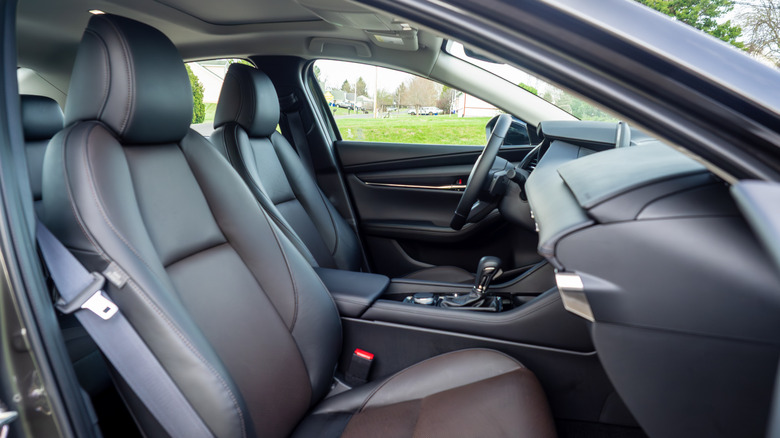
As for the rest of the cabin, that can be upholstered with cloth, synthetic leather or — as with this 2.5 Turbo Premium Plus — genuine leather. The whole interior brings a premium feeling not found in most of the compact sedan's competitors, with soft plastics mixing with piano black and chrome metallic trimmings. Moving up the spec ladder nets an eight-way power-adjustable driver's seat (the front passenger will have to adjust manually), heated and leather-wrapped steering wheel, heated front seats, heated power side mirrors, and a power sliding-glass moonroof.
There is seating for five, though four might be a more comfortable number for this compact sedan. Speaking of compact, the rear seat is more for the smallest occupants, as leg room amounts to 35.1 inches behind the driver, 34.1 inches behind the front passenger; both front occupants get to stretch out in comparison with 42.3 inches to work with. Head room varies, too, coming to 38 inches up front and 37.3 inches out back without the moonroof option, 37.6 inches and 36.7 inches with it equipped, respectively. It's a pretty cozy affair inside.
 Cameron Aubernon/SlashGear
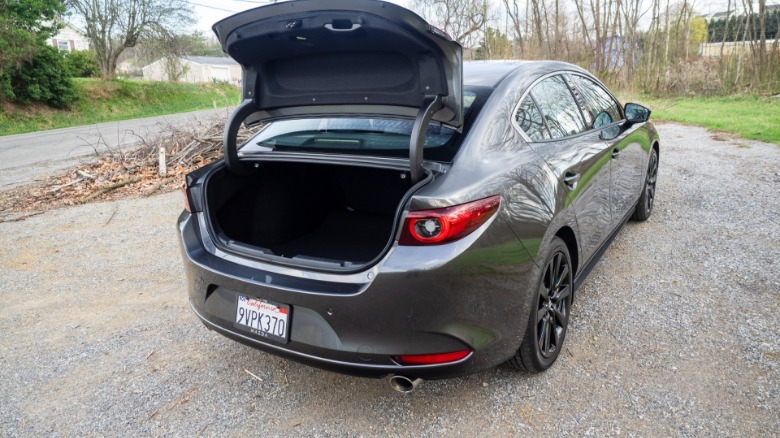
It's a similar story when it comes to cargo space, too. This is not the hatchback, after all: unlike the 20.1 to 47.1 cu-ft of space that offers, the sedan has 13.2 cu-ft. If more room is needed, the 60/40-split rear seat backs fold down for the longer items you might bring home on occasion, like a TV or a disassembled bicycle.
Hybridization could make this sedan truly compelling
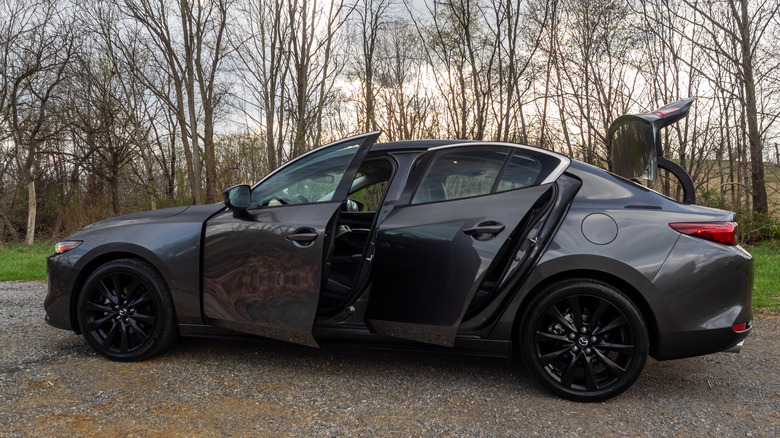
One major, welcome difference between this sedan and Mazda3 Hatchback is the lack of the big blind spot caused by the latter's thick rear pillar. The rear glass wasn't as narrow on the sedan as it was for the hatch, either; hooray for improved rear visibility! The Turbo Premium Plus trim's surround-view camera system was still a nice addition, especially in the tightest of parking spaces in my small Virginia town.
It was quite comfortable, too, over all of the roads and highways I traversed upon during the week; this may be a performance model, but the suspension soaked up all the bumps some streets threw its way. Of course, when it was time let it all hang out, the compact commuter made quick work getting up to interstate speed; that turbo does make all the difference. Coming 'round the mountain was where Mazda's athletic acumen showed up, with the all-wheel drive and suspension working together wonderfully to glide through those curves to the small town roads below.
The one main drawback was, of course, the fuel economy. Granted, it was the turbo model, but even if it weren't, it would be nice if there were a hybrid option to really make this sedan (and the hatchback, too) more of a compelling choice over the sea of crossovers taking up space. And it's not like such a thing couldn't be sold at a compelling price, either; the 2026 Hyundai Elantra Hybrid falls between the Mazda3 Sedan's price range ($25,450 – $29,800 before options), for example.
2026 Mazda Mazda3 Sedan verdict
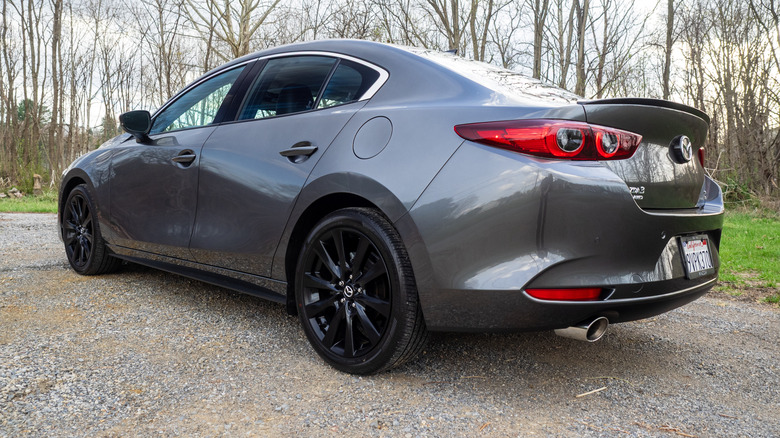
After a week with the Mazda3 Sedan, I can say this compact commuter is a safe bet as far as escaping the crossover/truck wave goes. While some might still want the tech extravaganza those big beasts offer, others will undoubtedly prefer the late-2010s era of infotainment tucked away inside. Not only does not having the modern bells and whistles help keep costs down, it keeps the focus on what truly matters: driving. Which is something Mazda definitely cares about throughout its range, including for its own set of crossovers.
I said back in 2025 that the current Mazda3 might be getting long in the tooth. It remains the longest-running generation of the Mazda3, standing at eight model years as of 2026. Competitors like the Kia K4, Honda Civic, and Hyundai Elantra are all newer, as far as amenities and styling go; some even have hybrid and plug-in options on the table.
Upon reflection, though, the Mazda3 is aging gracefully instead. The overall package is attractive and affordable, and the performance is there, even without the turbocharger to spice things up. That might help on the sales floor in light of the latter half of this decade's turbulence.