

5 Muscle Cars From The '70s That Look Even Cooler Today
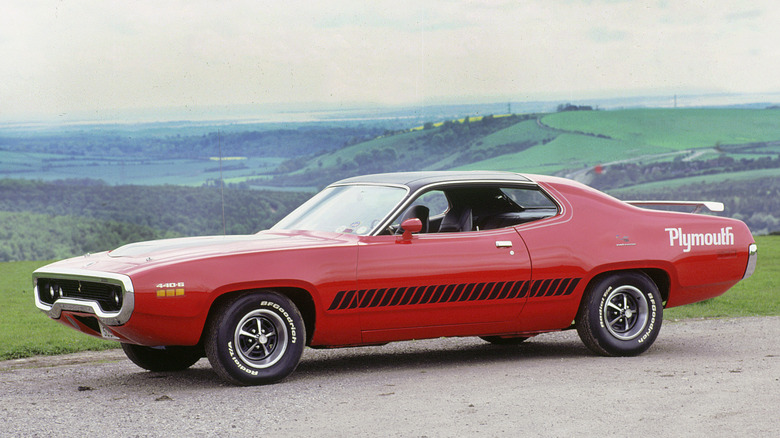
Despite the term muscle car being used so often by car enthusiasts, journalists, automotive historians, and industry marketing teams, the exact definition of what is or isn't a muscle car has always been a bit ambiguous. Is every two-door American coupe with a V8 engine a muscle car? Do V8 pony cars like the Camaro and Mustang also count as muscle cars? Can a true muscle car be from any era or only from a certain time period? Is there such a thing as a non-American muscle car?
You'll probably get differing answers to these questions depending on who you ask, but most agree that the original American muscle car era officially started in 1964 with the debut of the Pontiac GTO, and lasted for approximately one decade before tightening emission rules and the oil crisis brought an end to the party.
While V8 performance was a huge draw of those original muscle cars, cool looks and cool names were an equally important part of the formula that helped these cars win over the youth market. The 1960s were filled with cool-looking muscle cars that have gotten even better as they've aged. What about the 1970s? Even though this decade represents the tail end of the muscle car era, the cars from that period are just as cool. While looks will always be subjective, here are five 1970s muscle cars that we feel look even cooler today.
1971-1973 Ford Mustang Mach 1
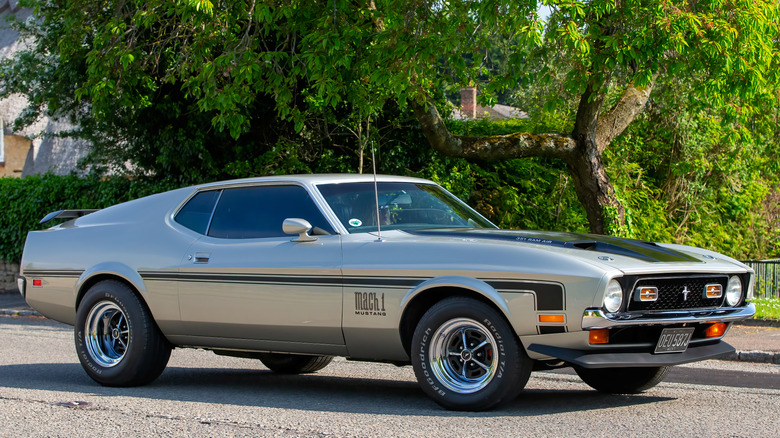
When most people picture a classic Ford Mustang, it's most likely a 1960s variant — maybe an early Mustang convertible, a '65 Shelby GT350, or a 1969 Boss 302. When they think of a 1970s Mustang, they might picture the controversial, and often-loathed Ford Mustang II. However, in between those aforementioned classics and the downsized Mustang II, sits one of the coolest and most muscular-looking Mustangs that Ford has ever built — the 1971-1973 Mach 1.
Beneath the bodywork, the '71-'73 Mustangs are still on the original first-generation Mustang platform, but Ford restyled the Mustang so significantly for 1971 that it basically looks like a new generation. Larger than the earlier cars, the 1971 Mustang has a dramatically long hood that, when combined with the fastback roofline, gives this generation less of a pony car feel and more of a macho, muscle car look.
Add in the Mach 1's scooped hood and spoilers, and you get a vibe that's quite far removed from the more svelte Mustangs of the 1960s. Ford would continue to sell this final iteration of the first-gen Mustang until 1974, when it was replaced by the completely redesigned and downsized Mustang II. This body style of Mustang would also earn silver screen fame as the star of the original, cult classic car chase film "Gone in 60 Seconds".
1971-1972 Plymouth Road Runner/GTX
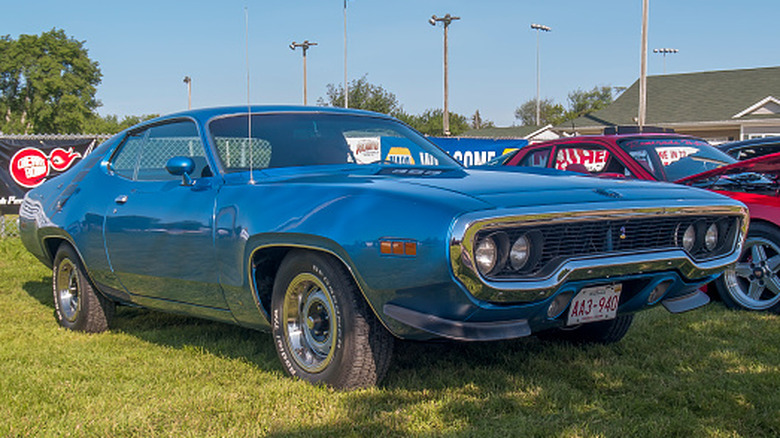
The Plymouth Road Runner is one of the most popular Mopar muscle cars of all time, not just because of its cartoon-derived model name, but for its budget-friendly price tag that won over tens of thousands of muscle car buyers upon its debut in 1968. For 1971, the Plymouth Satellite, which the Road Runner, and the more expensive Plymouth GTX were based on, got a dramatic redesign.
The new car had what was called fuselage styling, and the two-door Satellite, Road Runner, and GTX had a wider and more pronounced coupe look compared to the boxier models that came before. Other styling features that differentiated this distinctly 1970s design from the earlier cars was its dual-pronged bumper, which was integrated into the bodywork.
This same basic body style would continue through 1974, but the later cars would adopt a less distinct front-end design. When they came out, the styling of these early '70s Plymouth muscle cars was polarizing, but the early '70s Road Runner and GTX have proven to be desirable even for generations born long after the original muscle car era. A Plymouth GTX of this body style was even driven by one Dominic Toretto in 2017's "The Fate of the Furious".
1970-1973 Camaro
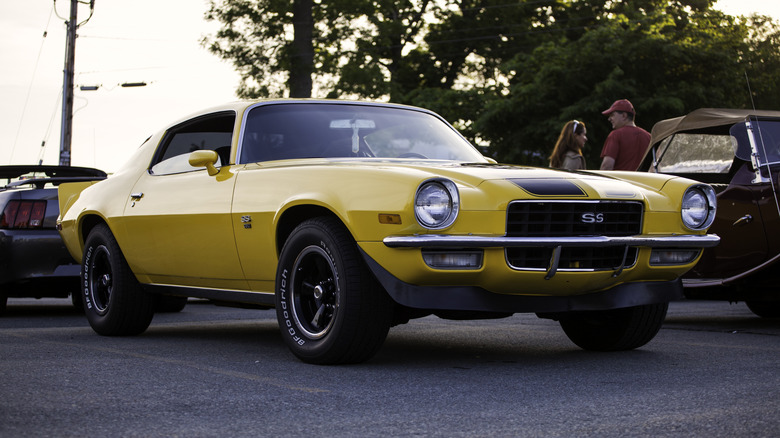
When it comes to classic Chevrolet Camaros, you can always expect the first generation 1967-1969 cars to rank among the best of the Camaro breed. However, the second-generation models, particularly the early '70s variants, are not to be overlooked. The second-generation Camaro arrived later in the 1970 model year and represented a significant change, especially in terms of styling.
The new Camaro was slightly larger than before, and had a fastback roofline compared to the more upright look of the first-generation car. It also had distinct new rounded taillights, and a stylish and unique split front bumper option that's long been a favorite of Camaro fans. As with most muscle cars, second-gen Camaro horsepower numbers had begun to decline from their peak, but early '70s Camaros still enjoyed potent engine options like the LT-1 small block in the Camaro Z/28, and through 1972, the iconic big block Chevy V8.
Chevy would give the second-gen Camaro several styling updates over its lifespan, and this body style of Camaro would continue all the way until the introduction of the third-generation Camaro in 1982. However, many enthusiasts prefer the classic look of the early '70s models along with their performance options that were truer to the original muscle car era.
1970-1973 Pontiac Trans Am
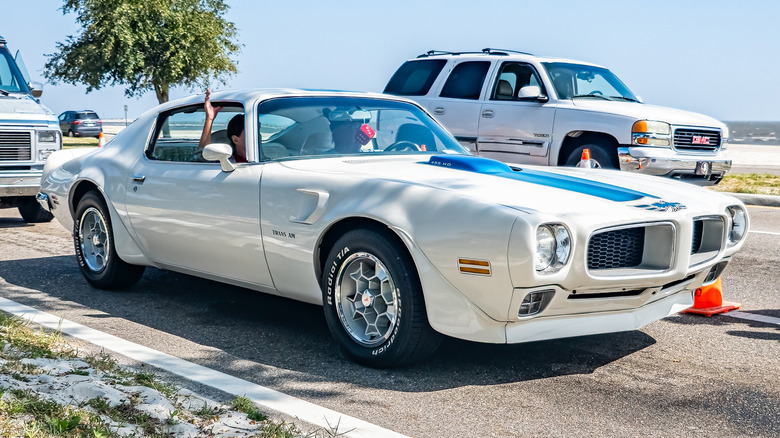
The Pontiac Trans Am first debuted during the 1969 model year as a special, limited production version of the Firebird, but it wasn't until the early '70s that the Trans Am became an American icon. Like the Chevy Camaro it shared its platform with, the second-generation 1970 Firebird arrived with a distinct new look — and the high-performance Trans Am variant took things even further.
Among the styling elements that arrived on the second-generation Trans Am was the iconic Pontiac shaker hood scoop and, later, the memorable hood decal. These options looked cool, but the early '70s Trans Ams also had the horsepower to back up their aggressive looks, first with Pontiac's Ram Air 400 cubic-inch V8s and then with the even larger 455 HO Pontiac V8 and its massive torque numbers.
The second-generation Trans Am would continue to evolve through the rest of the 1970s and into the 80s, reaching even higher levels of cultural stardom thanks to movies like "Smokey and the Bandit". Under the hood, however, later cars lacked some of the performance options that defined the earlier cars. When it comes to the combination of muscle and that iconic '70s attitude, it's the early second-generation Trans Ams that are king.
1971-1974 Dodge Charger
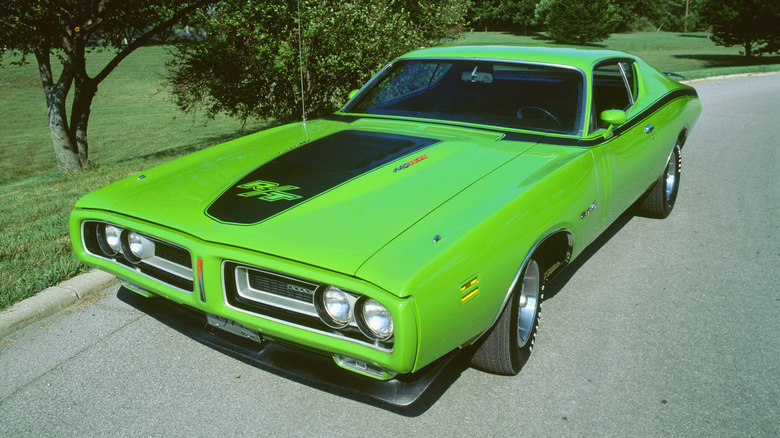
The Dodge Charger is a model that needs absolutely zero introduction for muscle car fans. The Charger first debuted for the 1966 model year and would go through many evolutions during its long history – but most would agree the second-generation 1968-1970 models are the most recognizable. Not to be overlooked, though, is the third-generation Charger sold between 1971 and 1974 — which has a unique muscle car vibe all its own.
When the new, long-hooded Charger arrived for 1971, it came with styling that was a big departure from the earlier cars, although its general Coke Bottle shape carried over, and options like concealed headlights were still available. Across the auto industry, muscle car performance had mostly passed its peak by 1971, but the third-generation Charger continued to offer engines like 440 big block and, in certain ultra-rare 1971 models — the 426 HEMI V8.
This version of the Charger also had a lot of success on the race track, including in NASCAR, where it was driven by the legendary Richard Petty. Sure, the third-generation Dodge Charger may not have the same widespread "Dukes of Hazzard" and "Fast and the Furious" fame that earlier Charger models enjoy, but that doesn't stop it from being one of the coolest muscle cars of the 1970s.