

5 Of The Largest US Air Force Bases Outside America
The United States first established a permanent military facility outside the U.S. in the late 19th century. While it would eventually go on to become the country with the most international air force bases, foreign military installations didn't play a major part in the country's global strategy until much later. World War II changed the world forever — it was the beginning of the nuclear era; it took women out of the home and into the workforce; it brought about major scientific and technological advancements; and it ushered in the Cold War.
If you're too young to remember the Cold War storylines that plagued 1980s television and movies, here's a brief recap: dubbed the Cold War because it never descended into conventional warfare, this was a conflict between the Soviet Union and Western democratic nations, including the U.S., that attempted to thwart the spread of communism. It's defined by the nuclear arms race, the space race, the Cuban Missile Crisis, and the fall of the Berlin Wall. It also changed how America operates abroad. While we established hundreds of overseas bases during World War II, those were never intended to be permanent. However, the Cold War prompted the U.S. to maintain and expand its presence internationally.
These bases, which support America's global defense posture, serve several functions. They house both personnel and equipment; they detect and defend against "adversary threats" to the U.S.; they maintain, repair, and overhaul equipment, including aircraft and ships; and they provide training and exercise for both American and allied soldiers. The U.S. Air Force maintains bases all around the world, including Guam, Norway, Singapore, Germany, and more. Here are five of its largest overseas bases.
Andersen Air Force Base
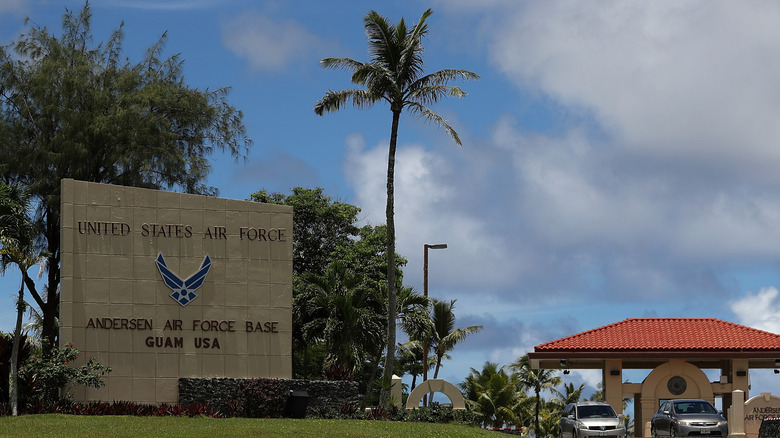
Originally established as a temporary base during World War II, Andersen Air Force Base is located on approximately 20,000 acres in Guam, an island in the Western Pacific. First dubbed North Field, it served as a hub for the massive and costly B-29 Superfortress during the war. While many airfields closed after the war ended, construction for permanent structures at North Field began in 1946. It was renamed North Guam Air Force Base in 1947, and then renamed Andersen AFB in 1949 in honor of Brigadier General James R. Anderson, who was lost at sea in 1945.
Andersen provided operational and organizational support during the Korean War, was pivotal during the Vietnam conflict, and also housed thousands of Vietnamese refugees after the war ended. More than 109,000 refugees eventually came to the United States aboard more than 500 aircraft that departed from Andersen AFB.
The base helped deploy and support aircraft during the Gulf War, and today it is part of the Pacific Air Forces (PACAF), supporting logistics for forces that are deploying throughout the southwest Pacific and Indian Ocean. The 36th Wing is the host wing for the base and supports 22 tenant units, and the base is home to dual runways and massive fuel and munitions storage facilities.
Al Udeid Air Base
Al Udeid Air Base may not be one of the largest bases in terms of square miles or acres, but it's the largest U.S. base in the Middle East, housing about 10,000 troops. Qatar constructed the base in the mid-1990s to help foster ties with the U.S. and help guarantee its own security. The U.S. was originally given access to the base in 2000, and it became a critical part of the Global War on Terror in the wake of the attacks on September 11, 2001. It now serves as the forward headquarters for U.S. Central Command (CENTCOM), which is one of eleven combatant commands of the U.S. Department of Defense. According to CENTCOM, it "directs and enables military operations and activities with allies and partners to increase regional security and stability in support of enduring U.S. interests."
The base was a key coordination point during the Iraq and Afghanistan wars, and was an evacuation point for thousands of refugees after the U.S. military withdrew from Afghanistan in 2021. Today, it houses the 379th Air Expeditionary Wing of the U.S. Air Force and is the home base for the 319th Air Expeditionary Group. It's also home to the Combined Air Operations Center (CAOC), which controls airpower across 21 nations.
Questions were raised about whether a missile from Iran could reach the U.S. after Iran targeted the base in March 2026 in response to joint U.S.-Israeli strikes. Satellite dishes were likely destroyed when it was hit by a ballistic missile, but no one was injured or killed. Also in March, American-made F-15 fighters were dispatched and downed two armed Iranian fighter jets.
Kadena Air Base
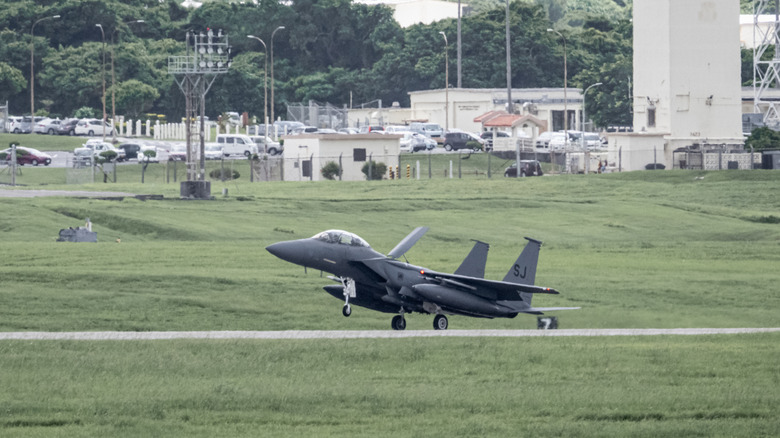
This base, located on the Japanese island of Okinawa, is described as "the hub of airpower in the Pacific" on its official Air Force website. Almost 20,000 Americans and more than 3,000 Japanese employees and contractors work on the base, which is another product of World War II. Its roots go back to a small airfield called Naka Hikojo, or Yara Hikojo, which was completed just before the invasion of Okinawa in 1945. It was captured by U.S. forces and became fully operational in support of the Allies only eight days later.
First used as a fighter and bomber base, Kadena AFB is now home to the 18th Wing and its associate units, including those from five other Air Force major commands, the U.S. Navy, other Department of Defense agencies, and direct reporting units. When looking at the number of aircraft assigned to the base, it's now the largest operational combat wing operating outside of the U.S. The 18th Wing oversees F-15 fighters; KC-135 Stratotankers, refueling aircraft that have been flying for more than 60 years; E-3 Sentries, or flying command-and-control centers; and HH-60s, combat search and rescue helicopters. The 18th Wing's mission is to defend "U.S. and Japanese mutual interests."
Ramstein Air Base
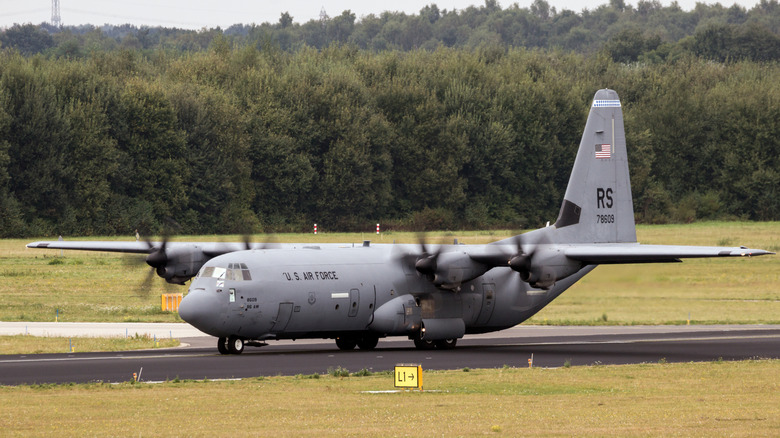
Ramstein Air Base in Germany houses the largest community of Americans outside of the U.S. It's played host to the 86th Airlift Wing, the 435th Air Ground Operations Wing, and the 521st Air Mobility Operations Wing. The base was constructed in 1951 by French occupational forces, and U.S. forces took over just a year later. There were actually two bases — Landstuhl Air Base, which is still home to the largest U.S. military hospital on foreign soil but originally supported flight operations, and Ramstein, with administration and support facilities. The two bases combined in 1957, and it was officially designated Ramstein Air Base in 1958.
Over the last 70 years, Ramstein has conducted significant airlift operations within Europe, Africa, and the Middle East. Missions included providing support for Operation Provide Comfort in Iraq between 1991 and 1993 and Operation Deny Flight in Bosnia-Herzegovina in 1993. It supported the Global War on Terror after the attacks of 9/11 and during the Iraq War. More recently, it provided support services during the largest humanitarian evacuation in U.S. history after the U.S. withdrew from Afghanistan in 2021.
Incirlik Air Base
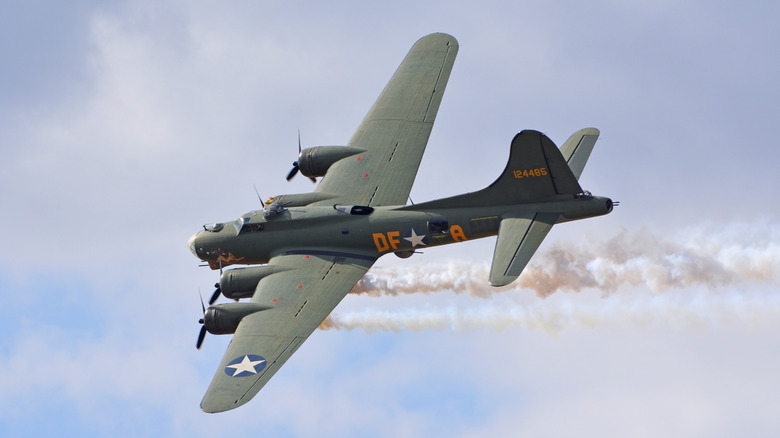
Incirlik Air Base in Turkey is jointly operated by the U.S. and Turkey. It was constructed in 1951 and was originally planned as an emergency staging and recovery site for bombers. It's home to the 39th Bombardment Group, which flew the B-17 Flying Fortress and the B-25 Mitchell during World War II and supported the invasion of Okinawa. In 1943, Allied leaders agreed to build a new air base in Turkey, and Congress approved aid to Turkey in 1947. Construction kicked off in 1951, and Turkey joined NATO in 1952. The U.S. Air Force and the Turkish General Staff agreed to jointly use the base in 1954, and it was officially named Adana Air Base. It was renamed Incirlik Air Base only four years later.
In 1976, the air base supported U.S. aid to Turkey after the Van earthquake. During Operation Provide Comfort in Iraq in the early 1990s, C-130s from Incirlik provided relief to Kurdish refugees via airdrops and delivered up to 600 pallets of supplies per day. In the late 1990s, the 39th Air and Space Expeditionary Wing was activated at the base to support Operation Northern Watch, which enforced a no-fly zone around Iraq. The base also supported relief efforts after back-to-back earthquakes in 1999.
In 2003, the 39th Wing was redesignated as the 39th Air Base Group, and today it provides support for numerous units throughout Turkey, including medical services, supply, security, communications support, and more.