

Riding Yamaha's New 2026 R7 Shows Just How Much Sport Bike You Get For Under $10,000
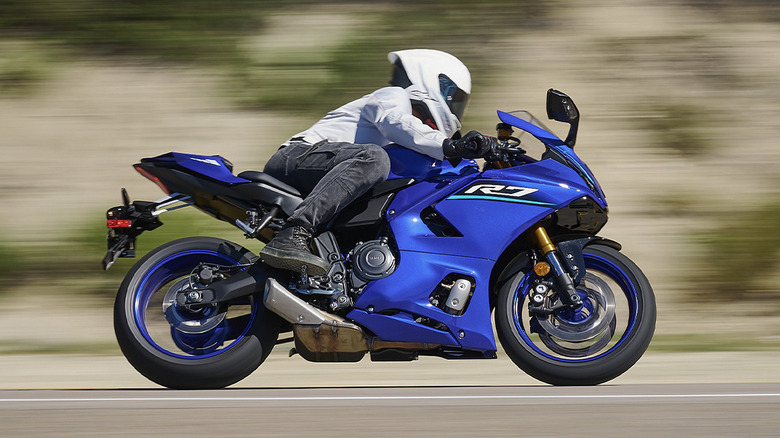
When Yamaha effectively replaced the R6 with the R7 for model year 2022, moto track rats the world over lost a beloved friend. Now of course, the track-only R6 Race survived all the way through to 2026, but for road-legal riding and occasional track use, an updated R7 hits the market this year as well. Sadly, the same parallel twin still powers the R7, rather than the R6's inline-four with that 16,500-rpm redline and triple-digit horsepower. But to help compensate, Yamaha improved just about everything else for the new R7.
A subtle yet significant design makeover adds noticeable presence to this middleweight—and that's saying something, because the original R7 already looked pretty good. And the impressively tractable engine, for a twin, at least somewhat matches the aggressive angularity. But most importantly, onboard tech leaps forward by a huge step, bringing the R7 right to the forefront of any modern sport bike, much less one that stickers for under $10,000.
Rather than dropping the new R7 right onto the racetrack, Yamaha brought select media out to Palomar Mountain in Southern California for a gorgeous sunny day of twisty mountain roads on a lean-happy sport bike. Pinch me, I'm dreaming. But of course, no day is ever quite perfect and by the end, I knew a few details on the R7 still needed a bit more ironing out.
Style points galore
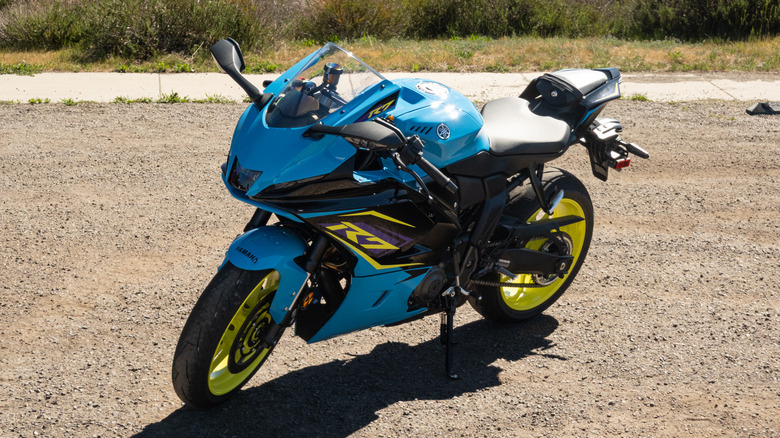
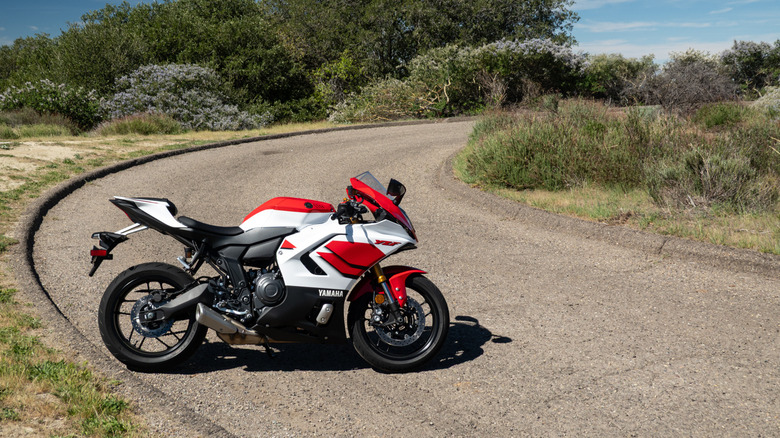
I first rode the outgoing R7 at Sonoma Raceway, on another wonderful day out of the office. Yet the R7 paled in comparison to the R1 I kept swapping onto and off. Fittingly, then, the updated R7 borrows plenty from Yamaha's top-spec superbike, starting with that perfect design. Level lines and crisp edges, with ample aero considerations short of full-on winglets, nail the modern sport bike aesthetic from any angle.
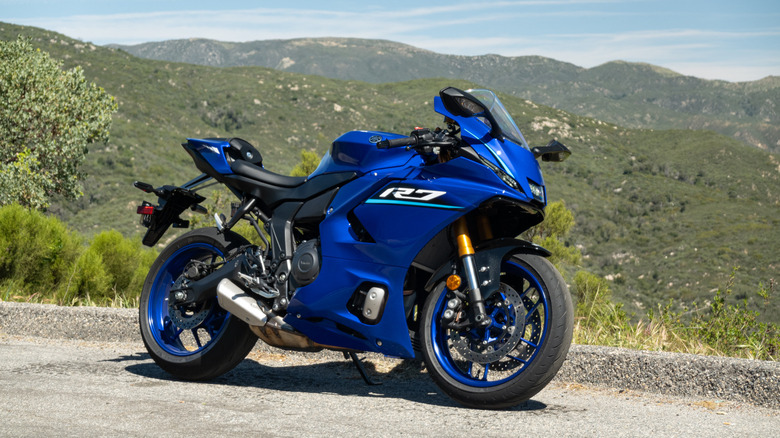
A Miami Vice paintjob (technically known as Breaker Cyan/Raven) amps up the styling, though the red-white-and-black 70th Anniversary edition definitely accentuates the dashing design best. I rode a quintessential Team Yamaha Blue bike, on blue forged wheels with gold forks and a blue rear spring, so I spent the day checking out the more eye-catching colors as we ripped around at top speed.
Measurable improvements for comfort's sake
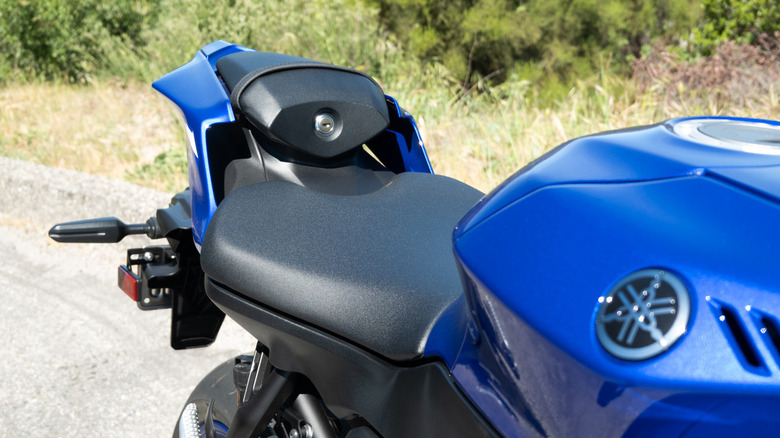
Yamaha prioritized more comfortable ergonomics despite the racier styling, to better bridge the gap between sporty and approachable. The handlebars scoot 8.4 millimeters rearward (one-third of an inch) and 3.6 millimeters higher (one-eighth of an inch) than the outgoing bike, while the seat drops five millimeters to 32.7 inches. Those figures might sound minuscule, but at six-foot-one with long limbs, I never struggled with hunching over too low and my knees never quite started aching despite a long day in the saddle.
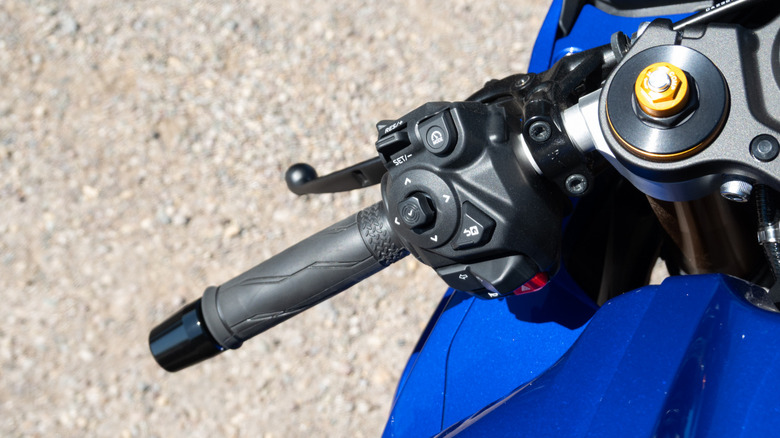
We started out in San Diego, where I needed to adjust to a whole new suite of controls and tech while trying to escape rush-hour traffic as quickly as possible. As part of a new six-axis IMU sensor system that runs traction control, ABS, launch control, and more, Yamaha decided to harvest some of that data for automatic self-canceling turn signals. I struggled to feel out the new turn signal switch's rocker design, though, even in my thin hot weather gloves broken in over probably thousands of miles. And really, after I got ahold of how the light detent action worked, the automatic self-canceling probably worked only five times over the course of the day anyhow.
Surprisingly punchy for a tiny twin
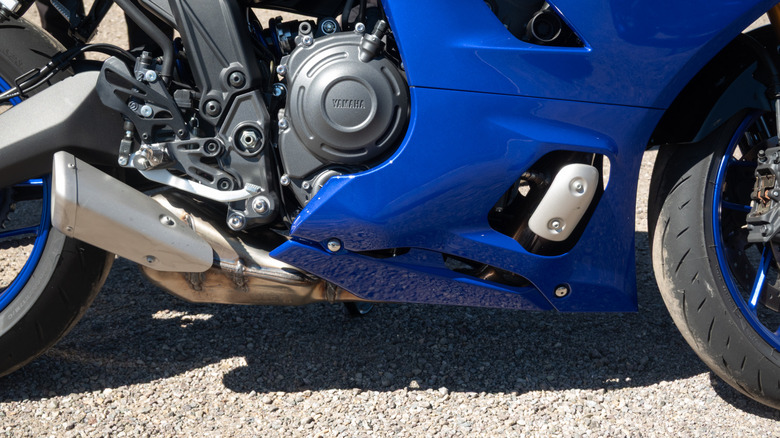
Luckily, the R7's 689cc parallel-twin helped me make up for a few moments of frustration looking down at my left hand. As usual, stats on paper fail to do this sport bike justice. Claimed output of 74 horsepower and 50 lb-ft of torque at 417 pounds wet sounds fairly minimal in the modern era of 200-plus horsepower superbikes, but the area under the dyno curve matters much more here. I lugged the engine in high gears plenty, but the little twin delivered grunt all over the rev range.
The first few times yanking on the throttle while pulling away from cars legitimately jerked me rearward on the seat. And rolling off too quickly brought on some borderline disconcerting nosedive until my right hand started feathering in juice with a bit more finesse. I soon stopped playing with the clutch lever, too, instead relying on the up-down quickshifter at all times other than stops. In Street mode, though, as with so many smaller-displacement engines, the quickshifter lurched somewhat roughly at times. Typically on upshifts, perhaps while trying to negotiate gearing that dropped the engine back down into the torque band.
Finding flow on the new Yamaha R7
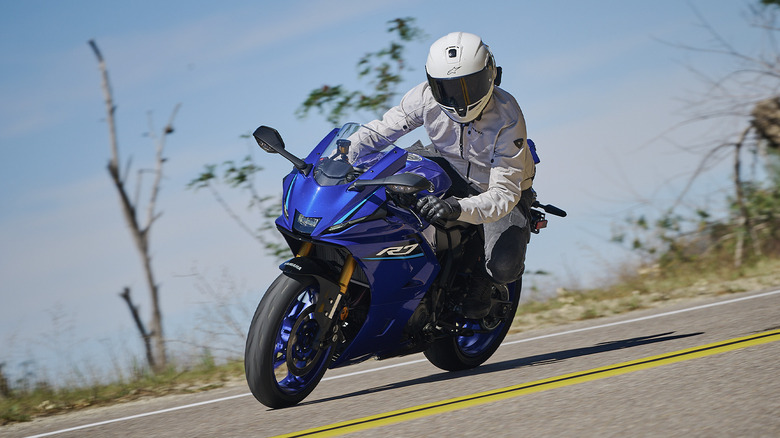
Once up into the winding roads near Palomar Mountain, though, the far smoother downshifts became more important anyway—as they might on a racetrack. But first, after whipping through a few minutes of lanesplitting that revealed the R7's nimble and narrow character, the crew blasted out onto the 15 freeway and quickly started cruising at 80 miles an hour. Here, the light weight and modest aero caused some twitchy responses to bursts of crosswind and grooves in the road, but nothing too terrible.
Though the freeway stint only lasted a few minutes, I took the opportunity to play with the newly added cruise control switchgear on the left grip. The buttons make activating and adjusting speed a cinch, and as we boogied north I realized just how much cruise control reduces wrist, forearm, and shoulder tiredness on a sport bike. The fact that Yamaha includes this on the budget-friendly R7 surprised me, since I typically only see cruise control on expensive cruisers and ADV bikes. Throttle-by-wire for this generation explains the ability to add cruise control, versus the old R7.
Easy to ride, and easy on the eyes
At the exit offramp, despite relaxing in cruise mode, my out-of-shape limbs caused some slow wobbles coming to a stop with a bit of weight on the bars. Time to wake up and switch over to Sport mode before the going gets tough! In Sport, really, the entire powertrain seemed much happier—and so did my whole body, once my blood started moving again. The on and off-throttle lurching settled down, the quickshifter started working smoothly for up and downshifts alike, and even the engine braking felt more predictable. From here on, I barely used the clutch again for a solid 45 minutes.
That light clutch action and shifting allowed by adding more gear drive dogs in first, second, and third gear reveals some of Yamaha's goals for the new R7, though, namely carrying the torch along with every other bikemaker these days in trying to make life easier to attract more riders. I personally prefer a bit more weight to every control—clutch lever, but also throttle twist, brake lever, gearshifts. At the very least, the R7's nimble manners match the ease of use.
Pushing harder reveals the R7's true character
Finally out onto the tight switchbacks and long sweepers, I found the R7's happy groove. The relatively high center of mass that led to some of the twitchiness at highway speeds transformed into eagerness to tip in and start leaning over with barely a pound of my weight shifting, knee hooked into the perfectly squared side of the tank. The inverted 41-millimeter KYZ forks, another addition for 2026, smoothed out the bumpier sections where weather tore up asphalt, and let me focus on prioritizing my body position.
Ripping up through gears, then hauling down on the brakes made for some fun, but at wide-open throttle the R7 only just scratches that old need for speed. Instead, this bike rewards riding position, hanging off low as much as possible. Part of that impression likely arises from the relatively narrow tires—at 120 and 190 millimeters , front and rear—but I also wondered whether burning through some fuel in the one liter larger tank helped to improve responsiveness.
Nerding out in the name of science
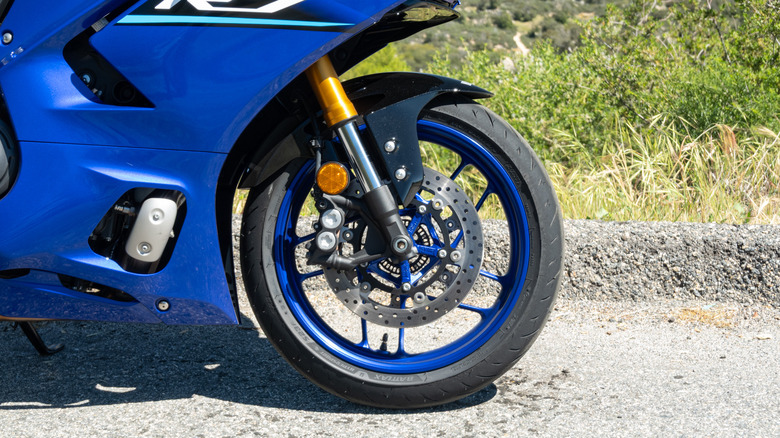
Yamaha will happily point out the 12% increased rigidity, a new center frame brace for the swingarm pivot, and the beefed-up engine mount reinforcement plates. New forged wheels save another four percent of rotational mass, and Bridgestone's next-gen Battlax Hypersport S23 tires make for a perfect spec, at least theoretically.
Once that rubber warmed up a bit more seriously, though, I noticed a slight anesthetizing element in the steering and suspension feedback loop. Bridgestone sent me the Hypersport S23s for my own Honda CBR954RR, which weighs less and puts out more than double the power. But more importantly, my CBR on the same tires adds a level of grainy texture that the R7 lacks. If I owned an R7, I might try to stiffen up the adjustable forks with a bit more preload to help compensate for my size, which likely challenges the limits of an almost delicate ride quality.
Chasing an AMA superbike champion
I let the group continue on ahead while I stopped to shoot a few more photos, which also gave me a chance to then ride solo with multiple AMA superbike champion Josh Hayes—pinch me again. Hayes took those few minutes easy on me, obviously, but also taught me how to play with the R7's configurable track modes in the five-inch gauge cluster. Four presets, from one to four with one being the most radical, make for similar incremental adjustments as the "normal" ride modes. Again, Yamaha made fiddling with the settings highly intuitive, no mysteries about which button to push as on many of the more exotic (read: Italian) bikes that I typically test.
Eventually, I stuck with Track 1 and tried my darnedest to stick on Hayes' tail. Surely his bike's frame sliders must add a few horsepowers, since he kept dropping me before slowing down to let me catch up. This surprisingly smooth session without having to worry about other cars and the usual soiree of moto journalists let me reach a new level of comfort with the R7's capability, largely switching off my brain and allowing instinct to guide my actions as I traced the lines Hayes carved ahead of me.
The engine puts in work, eventually hitting some semblance of bursting acceleration up near 10,000 rpm, and the brakes can fully rein in overexuberances deeper and deeper into turns without too much strain. But I wound up treating the R7 like a momentum car, just trying to hold speed and lean lower through corners rather than blattering around on throttle all the time.
Techy app(s) for even more connectivity
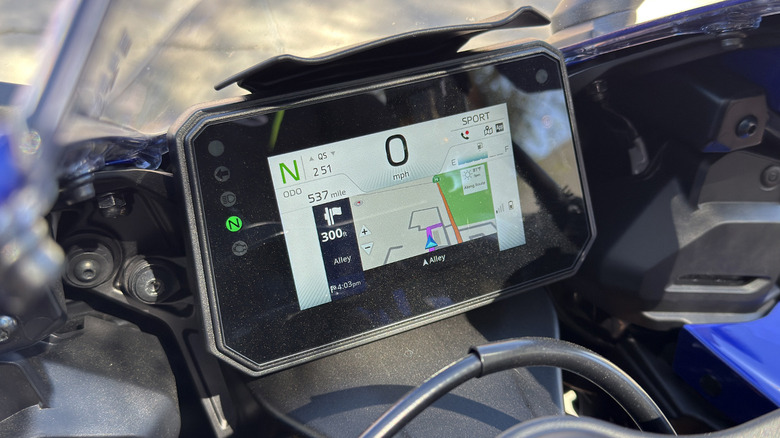
At a stop, Hayes also showed me how he uses the Y-Trac Rev app for testing days, which accesses the CAN bus data to show data logging in similar fashion to the best superbikes on the market. I never tried out the similar Y-Connect app that allows for smartphone functions to pop up on the gauge cluster, in addition to 40 different ride setting adjustments, but I watched our group leader pull up onboard navigation through Garmin's StreetCross app.
The fact that Yamaha never integrated all these functions into one single app likely comes down to development costs—and keep in mind, including all this tech on a bike that starts just over $9,000 is pretty wild. But some of the R7's other details play into that price point, as well. The plastics look nice and plasticky, the ignition stop/start switch already looked a bit worn, and the hilarious opening on the fairing with a cheap exhaust slider barely covering access to a lambda sensor looks less than fully developed.
2026 YZF-R7 verdict
I also wished for a louder exhaust with a bit more twin-cylinder thump, especially on the ride back into San Diego at the end of a long, hot day and without the rasping buzz of bees more typical of an inline-four as on the R6 or Honda's CBR600RR. Admittedly, though, I purposefully took off my helmet at a break to listen as a few other riders in our group passed by, and the little mill undoubtedly sounds bolder with bare ears exposed.
The decision not to launch the new R7 with a track ride probably involved some arguments about fun versus potential disappointment of gut-punching acceleration, or the lack thereof. Without another generational step in engine development—unlikely due to increasingly stringent emissions regulations—the R7 might fall short anywhere other than smaller kart tracks.
Track rats will undoubtedly start swapping on components to transform the R7 into something more hardcore. Very obviously not an R6, instead the R7 reminds of somewhere between an Aprilia RS660 and Tuono 660, in the best way possible—but likely with a bit of exoticism traded out for presumed reliability. For street riding and weekend canyon carving, I still struggle to imagine a better bike that combines just enough power with a huge step up in capability and tech. Somehow, Yamaha only added $200 to the outgoing R7's pricetag, and bikes already hit dealers with a starting sticker of $9,399. That two-tone 70th Anniversary does add another $300 for the paintjob and tank badge, and yet, I'd still call the most expensive of R7 options a screaming sport bike deal given everything that money buys in the modern era.