

4 Of The Weirdest Charging Ports Phones Used Before USB-C
We may receive a commission on purchases made from links.
Today, if your phone suddenly runs out of power, and you ask someone to borrow their charger, there's a good chance you'll get one that fits your device. However, things were pretty different in the early 2000s. If your phone died suddenly, asking to borrow a charger usually resulted in someone pulling out a plastic brick with a cable connector that probably wouldn't fit your device. Unlike today, when we have USB-C as the standard connector — now even on iPhones — years ago, there used to be no such thing. Every manufacturer wanted to create the ultimate connector, resulting in ports that were uncommon, confusing, and outright bizarre.
While we certainly miss the charm of old-school flip phones and slide-out keyboards, we definitely do not miss the nightmare of keeping them powered. Some of these ports required rubber bands just to maintain a connection, while others secretly demanded separate, expensive proprietary adapters for basic features like headphones.
We have gathered five of the weirdest, most frustrating, and downright perplexing charging ports from the pre-smartphone and early Android eras, when engineers were still experimenting with connectors. The limitations of these adapters paved the way for the sleek, reversible, and near-universal USB-C standard we take for granted today.
Siemens Slim-Lumberg
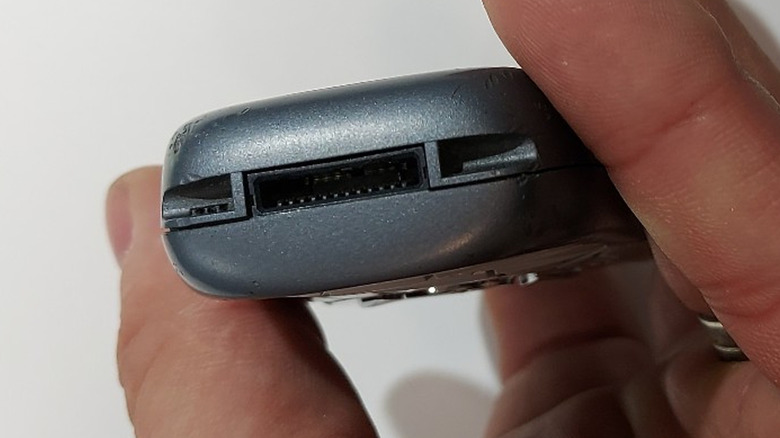
If you owned a Siemens mobile phone in the early 2000s, you likely have traumatic memories of the Siemens Slim-Lumberg connector. Replacing the original, chunkier Lumberg port in 2002, this 12-pin proprietary standard was super wide but thin.
The connector used to handle power charging, USB data transferring, and even stereo audio, all through one flat interface. However, its ambitious design was also its potential fatal flaw. Because the plug was so wide and extended so far out of the bottom of the device, it acted like a lever.
So, if you made the mistake of leaving the phone plugged into a portable accessory and putting it in your pocket, simply sitting down could possibly put immense torque on the cable. The main issue was that the Slim-Lumberg port was a Surface-Mount Device (SMD). This means that, unlike connectors that use metal pins anchored deep into the circuit board, the SMD ports are simply soldered flat onto the surface. So, the wide plug acted like a lever, and the resulting stress could potentially lift the tiny solder pads right off the logic board, resulting in a destroyed connection. It was an engineering misstep that prioritized thinness over structural integrity.
Sony Ericsson FastPort
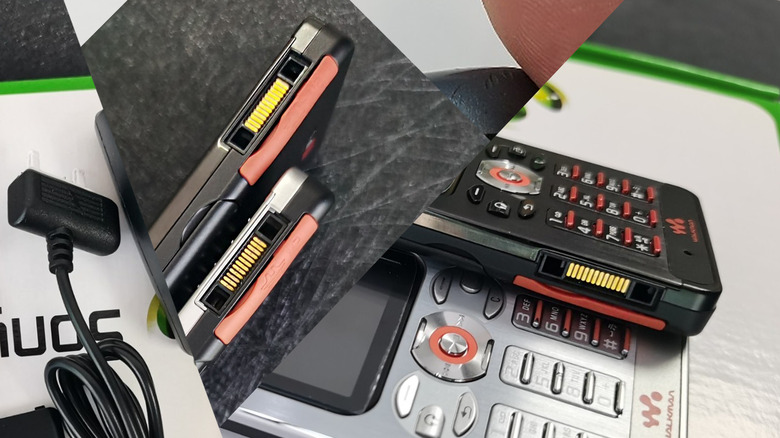
Introduced around 2005, the Sony Ericsson FastPort was designed to be a "do-it-all" interface that handled data transfer, charging, and headset connections. While the concept was solid, the physical execution was a nightmare of flimsy plastics.
Instead of plugging deeply into a secure socket like modern cables, the FastPort essentially sat flush against the edge of the phone. It relied on two tiny, double-sided plastic hooks on the plug that snapped into matching holes on the device to keep the 12-pin connection safely in place. Unfortunately, these plastic hooks were notoriously brittle.
Just after a few months of use, as some users remember, one or both of these hooks would often snap off. Once the hooks broke, the port lost all tension, and the heavy plug would just fall out of the phone. Users were forced to resort to desperate DIY solutions just to keep their batteries alive. Some users on various forums claimed that they had to tightly wrap thick rubber bands or hair ties around their entire phone and charger assembly just to maintain the required pressure for the pins to make electrical contact.
Samsung USB 3.0 Micro-B
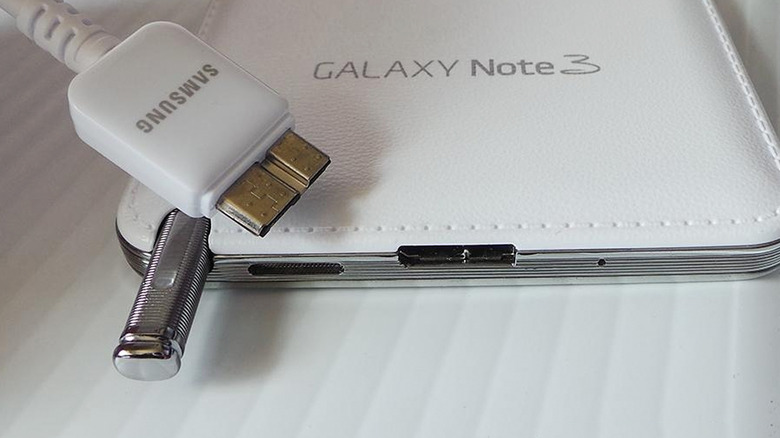
When Samsung released the Galaxy Note 3 and the Galaxy S5, the company decided to equip its flagship phones with the USB 3.0 Micro-B port. Visually, it was an absolute monstrosity. It looked like two different ports awkwardly mashed together into one giant, asymmetric, ugly plug.
This wider port was essentially a standard Micro-USB connection with an extra set of pins grafted onto the side to allow for faster USB 3.0 data transfer speeds. While it made sense for transferring massive files, it looked ridiculous on the bottom of a sleek smartphone.
The weirdest part of this hardware experiment was the backward compatibility. You could just take a normal, ubiquitous Micro-USB cable and plug it directly into the right half of the oversized port to charge the device at standard speeds. However, if users lost the giant, specialized cable that came in the box, the port's visually confusing design meant that some consumers were completely unaware that the standard Micro-USB cable sitting in their junk drawer was backward compatible and would have worked perfectly fine to charge the device. Samsung quickly abandoned the experiment, returning to standard ports on subsequent models.
HTC ExtUSB
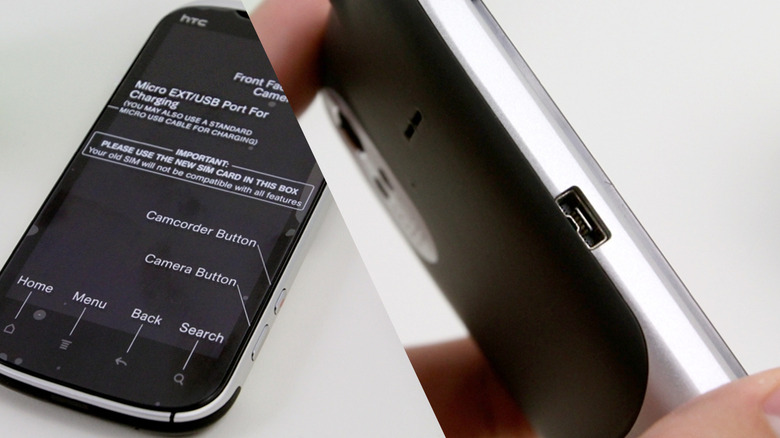
Before the industry rallied behind Micro-USB, the very first Android phone, the HTC Dream, used a clever but frustrating port known as ExtUSB. At first glance, this port played a deceptive trick on consumers. It looked almost exactly like a completely normal Mini-USB socket, and thankfully, standard Mini-USB chargers worked perfectly fine for juicing up the battery.
However, HTC's ExtUSB could transmit audio and files alongside power. It achieved this by hiding a set of secret, proprietary pins tucked away in the corner of the slightly modified port geometry. Because the phone lacked a standard 3.5-millimeter headphone jack, these hidden audio pins were the only way to listen to music or use a wired hands-free kit.
This meant that while you weren't locked into buying HTC's specific wall chargers, you were absolutely forced to buy their special ExtUSB adapters if you wanted to plug in a normal pair of headphones. It was a classic "razor and blades" business model hidden inside a seemingly universal port, forcing early smartphone adopters to carry around easily lost dongles years before Apple controversially removed the headphone jack from the iPhone — which is only one of the features we want back.
Nokia Pop-Port
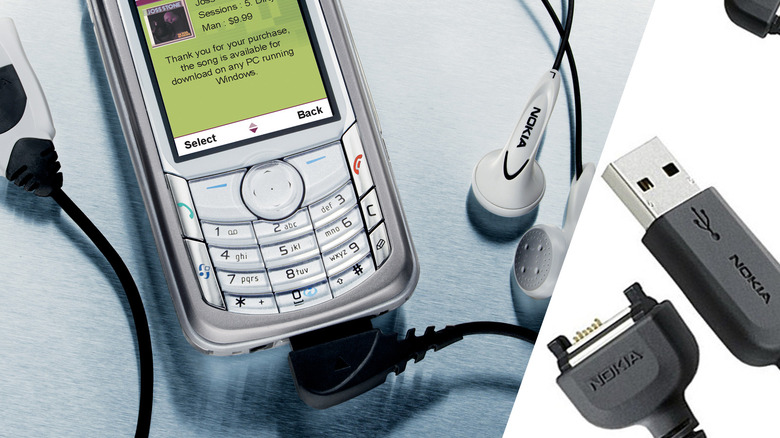
For much of the 2000s, Nokia was the undisputed king of mobile phones, but the company's proprietary Pop-Port interface was a royal pain. Introduced around 2002, this connector handled everything from basic charging and USB synchronization to FM radio antennas and stereo headphones. However, its physical design was pretty fragile.
Unlike ports that insert securely into the chassis of a device, the Pop-Port barely plugged in at all. It featured a long, 14-pin plastic tab that essentially just rested against the exposed contacts on the bottom of the phone. It was held in place by basic plastic clips and a small hooking mechanism that tended to lose tension over time.
Because the contacts were highly exposed and the seating was so shallow, the port was extremely sensitive to environmental interference. If a single piece of pocket lint, dust, or dirt got between the pins, the connection would instantly drop. If you tried to listen to music with the phone in your pocket, the slight wiggling of your leg was enough to break the connection, causing the phone to constantly pause your audio.