

How The Detroit Diesel 2-Stroke Engine Got Its 'Screaming Jimmy' Nickname
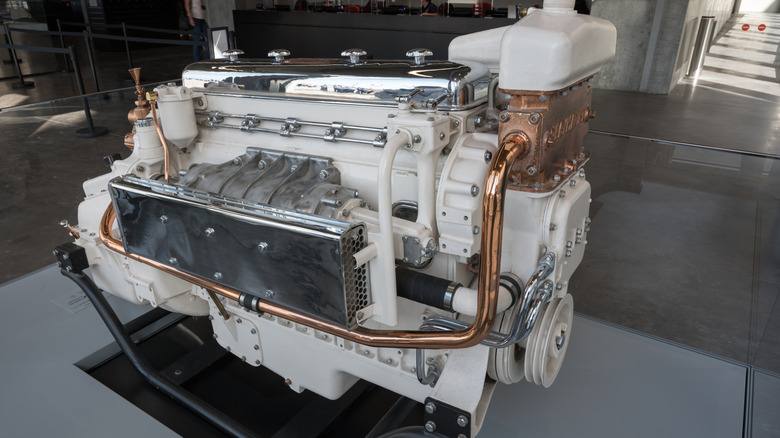
The modern diesel engine arguably advanced the might of the American logistics industry more than any other device in history, revolutionizing how we transport goods over long distances. And today, the technology is refined and mature enough that we have a pretty solid idea of what we'll find under most truck hoods: a large, economical turbo diesel, with modern tech such as variable geometry turbos. But back in the early days, automakers experimented with radical ideas to extract more power and efficiency (and thus more profit) from their commercial trucks. Enter the Detroit Diesel 71 "Screaming Jimmy," an interwar two-stroke engine that became synonymous with America's 20th-century expansion.
Where did the "Screaming Jimmy" nickname come from, though? The second part is likely more mundane, with "Jimmy" sounding like the "GM" in "GMC." The "Screaming" part is more interesting — that part comes from the sound it makes. Because the engine is a two-stroke, it produces twice as many power strokes as an equivalent four-stroke — what sounds like 2,000 rpm for a four-stroke will sound like 4,000 in a two-stroke. Moreover, the engine was equipped with a Roots-style blower, which produces a whine at high revs. Coupled with the engine's power band favoring higher RPMs, you end up with an engine that sounds like it's screaming during normal operation.
The sound, while distinctive, was always just a byproduct; these engines were designed as two-strokes for many reasons. Let's discuss how this engine operates and why the Screaming Jimmy is so significant.
How the Screaming Jimmy works
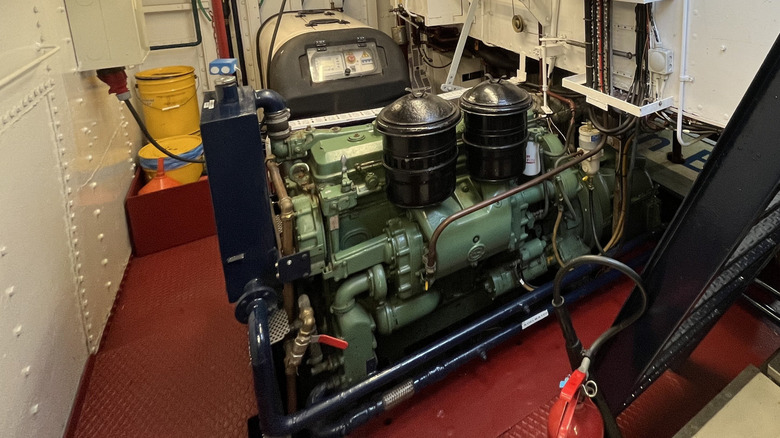
Being a two-stroke, the GMC 71 operates more like a dirt bike engine — its fuel even needs an oil mixture. It's also incredibly simple in concept: a two-stroke engine, functionally, has a power stroke every time the piston goes down, instead of every other time in a four-stroke. This theoretically doubles the engine's power potential for a given RPM (though it won't actually be double in practice).
Two-stroke engines like the Screaming Jimmy start like normal combustion engines — the fuel ignites and pushes the piston down. However, there's a hole halfway up the cylinder wall. Once the piston starts moving up, it pushes exhaust gases out of this hole and into the exhaust manifold. The piston then passes the hole, sealing it and allowing the fresh fuel/air mixture to enter the cylinder. Combustion occurs once the piston is in position, and the process starts again.
In totality, then, the GMC 71 draws in air and compresses it with the Roots blower (which is much like blowers you see mounted on muscle cars, except the 71's is on the side and functions as an air pump, not a supercharger). This air is mixed with diesel fuel and shot into the piston, where it ignites via compression. Exhaust gases exit via the cylinder wall, and that's it. The general lack of complex moving parts works to the engine's favor, sacrificing optimal fuel efficiency for reliability. But, appropriately for the engine's nickname, two-stroke engines have that distinctive, loud engine sound. That said, they're also more polluting than four-stroke engines due to the burnt oil in the exhaust.
Why the Detroit Diesel 71 is so significant
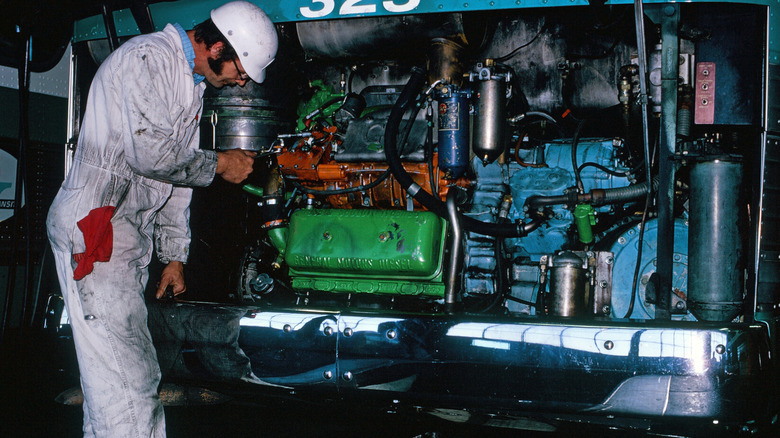
The Detroit Diesel 71 (or 6-71) is one of the most iconic names in engine technology, and unquestionably the longest-lived diesel engine ever produced. The first part of the code indicates the cylinder count, and the second specifies the cubic inches per cylinder. The 6-71, then, is a six-cylinder engine with 71-CI cylinders. The engine was built from 1938 to 1995 and powered an astonishing number of vehicles, from WWII tanks to modern construction equipment and marine applications. Detroit Diesel manufactured the 71 in various configurations, from single-cylinder engines to V24s.
These engines came before modern metallurgy allowed for reliable four-stroke designs with similar power and torque figures, meaning the Jimmys powering GMC trucks represented the best of their era, producing respectable torque figures of around 525 lb-ft. Coupled with the engine's scalability, you had an engine that could be assembled to order that was powerful enough to drive loaded commercial trucks at highway speeds. Sure, it's not the most powerful Detroit Diesel out there, but by 1930s standards, the engine was incredibly versatile.
The Screaming Jimmy's popularity soared during and after WWII, with the post-war growth in America's highway infrastructure demanding more robust logistics networks. Many early examples of 71-series advertisements prominently featured construction equipment and trucks hauling oversized loads. The 6-71's compact size and high torque rating also made it great for other uses, including watercraft. One example was the "Quad" setup: four 6-71s linked to a common shaft, which was also used for power units.