

Every Electric Car Discontinued In 2026 (So Far)
Sales of electric vehicles in the U.S. are way down for numerous reasons, leading to some being discontinued. Foremost among them is the September 30, 2025 end of the $7,500 federal tax credit, which reduced the size of the EV market, leading to fewer sales. Another factor is ongoing uncertainty around tariffs that affect imported EVs, which also increases their cost.
For some EVs, it is simply a matter of too few sales to justify keeping them in a manufacturer's model range any longer. This can be a result of a given EV having spent a significant number of years on the market, or it can just be due to slow sales of that particular EV, causing its removal from the lineup. For all of these reasons, carmakers are culling their EV selections, cutting out individual vehicles that either no longer justify their presence or can't be sold at a profit in the current marketplace.
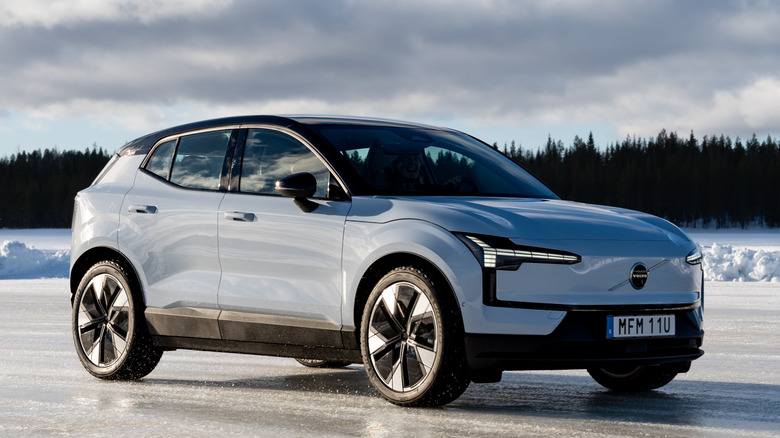
We will start with the latest EV casualty, which was just recently announced. The Volvo EX30, which our review found looked great but compromised on space, will be discontinued at the end of its run as a 2026 model. The EX30 came to our market in 2025, lasting just two model years. The Volvo EX30 was initially made in China, but high tariffs on China-made vehicles led to it being produced in Volvo's Belgian plant — until 25% tariffs that applied to all imported cars took effect. Sales for October 2025, the first month without the tax credit, saw only 184 EX30s sold.
Ford F-150 Lightning
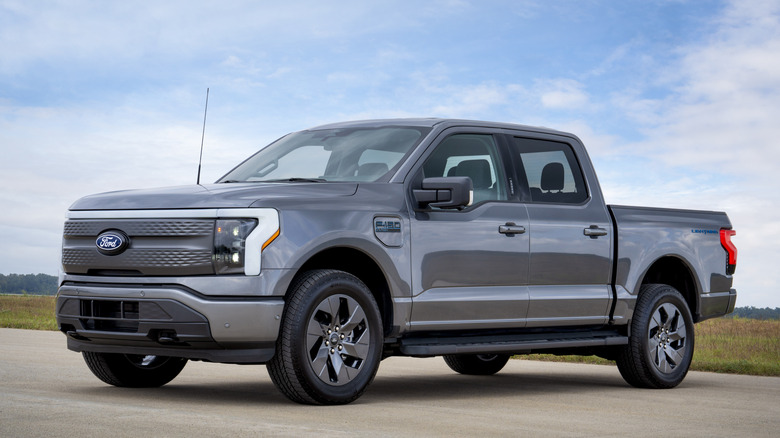
The Ford F-150 Lightning, Ford's electric-powered, full-size, half-ton pickup truck, stopped production as of December 2025. Instead of taking a clean-sheet approach, Ford adapted its gas-powered F-150 platform for use as an EV. Unfortunately, the F-150 Lightning never made any money for Ford, even at prices much higher than original estimates, so the company will no longer be producing it. Our review of the Ford F-150 Lightning discovered that it is not only a great EV but it's a great truck in general.
The Ford F-150 Lightning is powered by two electric motors providing all-wheel drive. There are two different battery sizes, with the standard range battery combined with motors that give a 452 horsepower output, while the extended range battery ups the output to 580 horsepower. According to the EPA, the Lightning can travel a respectable 320 miles on a charge.
While Ford has promised the eventual return of the F-150 Lightning, it will be in a different form. Instead of a full battery EV, the F-150 Lightning will return as an extended-range electric vehicle, or EREV, incorporating a gasoline-powered engine that functions as a generator to recharge its battery. The objective of this more complex powertrain is to provide additional range for towing and hauling heavy loads, with a range estimated at over 700 miles.
Tesla Model S and Model X
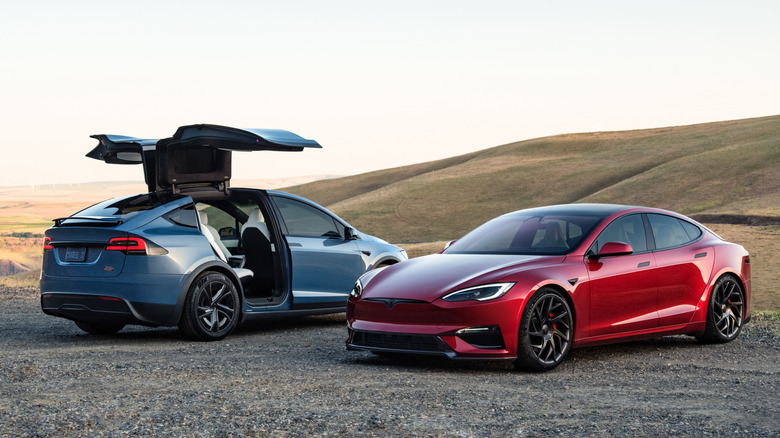
The long-running Tesla Model S and Tesla Model X will both end production in 2026, according to Tesla CEO Elon Musk. The Model S sedan first debuted in 2012 and was Tesla's first EV to be produced completely in-house. Fully 14 years later, the Tesla Model S is still able to hold its own in the power and range departments. In fact, a Model S earned Consumer Reports' first-ever perfect score. The current standard Model S offers 410 miles of range on a charge, while the high-performance Plaid version provides some blindingly quick acceleration with its 1,020 horsepower from three electric motors on tap. Car and Driver performance testing resulted in a 0-60 mph time of 2.1 seconds and an amazing quarter-mile time of 9.4 seconds at 151 mph. Skidpad roadholding was measured at 1.02g.
Tesla's Model X hit the scene in 2016, with its complex, problematic, production-delaying, but attention-grabbing falcon-wing doors. As Tesla's largest and most expensive SUV, the Model X offers 15 cu. ft. of space behind the third row, 35 cu. ft. of space with the third row folded, and 88 cu. ft. of space with the second row folded.
While sales of these two Teslas have been steadily dropping, they are not being replaced by new models of Tesla vehicles. Instead, the space formerly devoted to the production of the Model S and the Model X in Tesla's Fremont, California factory will be converted to mass-produce Tesla's Optimus humanoid robots.
Hyundai Ioniq 6 - Standard model
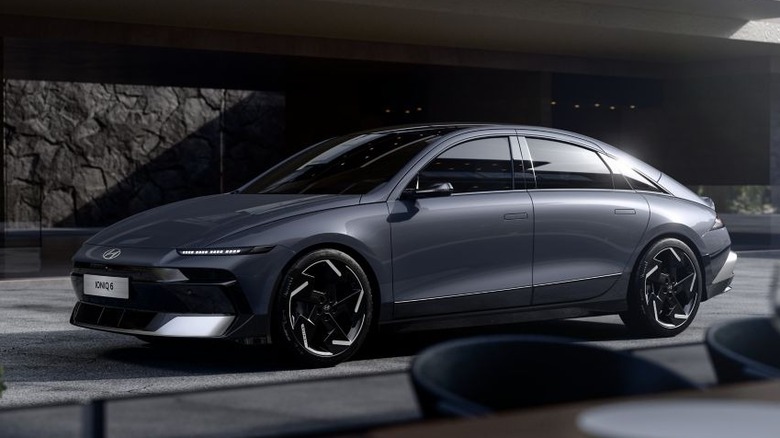
Another EV that will be dropped in 2026 is the Hyundai Ioniq 6 — but this only applies to the standard model, as small quantities of the high-performance Ioniq 6N version will still be imported. This is thanks to the Ioniq 6 sedan's poor U.S. sales, which never came close to those of its crossover-styled Ioniq 5 sibling, built on the same platform. This can likely be chalked up to the trend of increasingly poor sedan sales, compared to increasing crossover and SUV purchases. Our review of the Ioniq 6 appreciated its head-turning style, smooth ride, and refined EV powertrain. Attention Canadian readers — you can still buy one in Canada.
The EPA-estimated range came is 361 miles, which is pretty fantastic. While the swoopy fastback styling is good for range, cargo capacity is not the Ioniq 6's strong suit, measuring out at just 11 cu. ft. of trunk space.
There could also be a tariff-avoidance angle going on here as far as Hyundai is concerned. Because the Ioniq 6 is assembled in South Korea, while the Ioniq 5 and Ioniq 9 are both assembled in the U.S., Hyundai should be very happy to sell more American-made vehicles that don't have tariffs levied on them, while eliminating the need to pay tariffs on any Ioniq 6.
Kia Niro EV
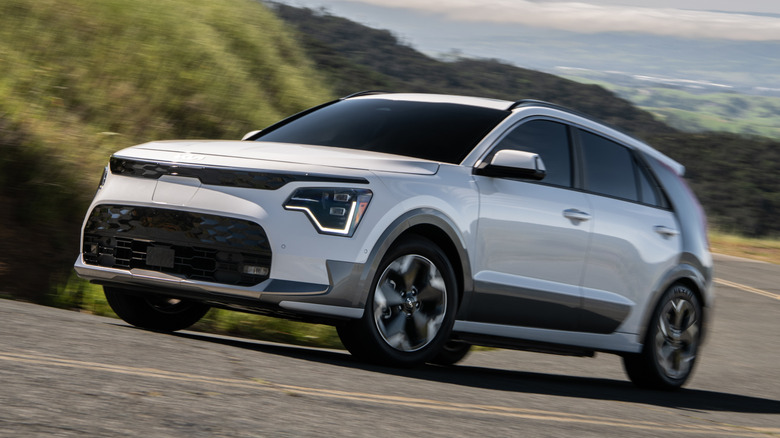
The Kia Niro EV is another recently-announced EV casualty. While the hybrid version of the Kia Niro will continue with a refreshed model, the battery electric-powered Niro will sell out its current inventory and disappear from Kia's lineup. The reason given by Kia is that the company plans to concentrate on its EVs that were designed to be electric vehicles from the ground up, like the EV6 and EV9.
The Niro EV is powered by an electric motor in the front that produces 201 horsepower and drives the front wheels through a direct-drive transmission. Our review of the Kia Niro EV revealed that it was affordable and well-equipped with decent range, specifically an EPA-estimated range of 253 miles. Its cargo capacity is 22.8 cu. ft. behind the second row and 63.7 cu. ft. with the second row folded.
The 2026 Kia Niro EV also found itself in an odd position relative to its pricing. With a price that starts at $41,195, the Niro EV was $4,595 higher than the entry-level Hyundai Ioniq 5. Add to that the tariffs added to the Niro EV due to its South Korean manufacture, while the Ioniq 5 is made tariff-free in the U.S., and it's easy to see why the Kia Niro EV is leaving the Kia lineup for good.