

5 V8 Engines More Powerful Than The Ford 5.0 Coyote
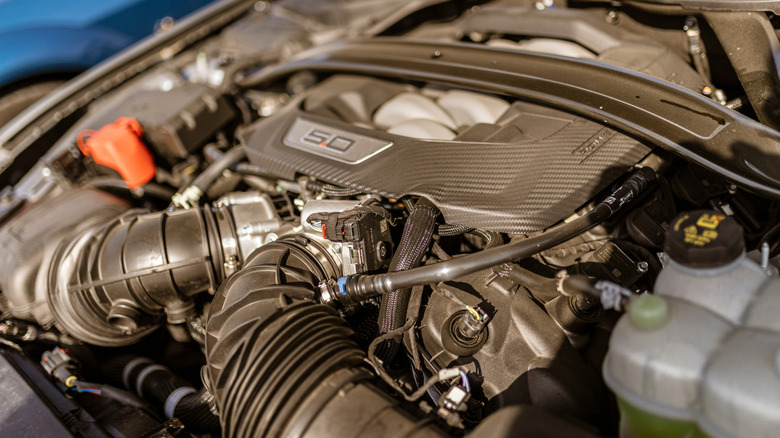
Ford's modular naturally aspirated 5.0-liter V8, better known among enthusiasts as the Coyote, is considered one of the world's great modern V8 engines for many reasons. It's powerful, refined, and has helped make the last few generations of Ford Mustang GT one of the fastest and most entertaining performance cars on the market for the money.
The Coyote is impressive from a technical standpoint as well, and Ford has performed numerous updates and improvements to the engine over its lifespan. Given its relatively low displacement compared to the American V8s it competes against, the Coyote has always punched above its weight: In the 500-hp Ford Mustang Dark Horse, the engine makes an incredible 100 horsepower per liter, without any turbocharging or supercharging.
With that said, when it comes to horsepower, the Coyote has faced some stiff competition from competing V8s over the years. Below, we've rounded up five rival V8s from both domestic and import manufacturers that have produced more peak horsepower than the Coyote. Of course, there are lots of forced-induction V8s that easily out-power the Coyote, but we've limited our selections only to naturally aspirated engines here to keep a level playing field. Additionally, because Coyote output has climbed over the years, we'll compare the horsepower figures that each competing engine produced during the equivalent model year or generation.
Dodge 6.4 HEMI V8
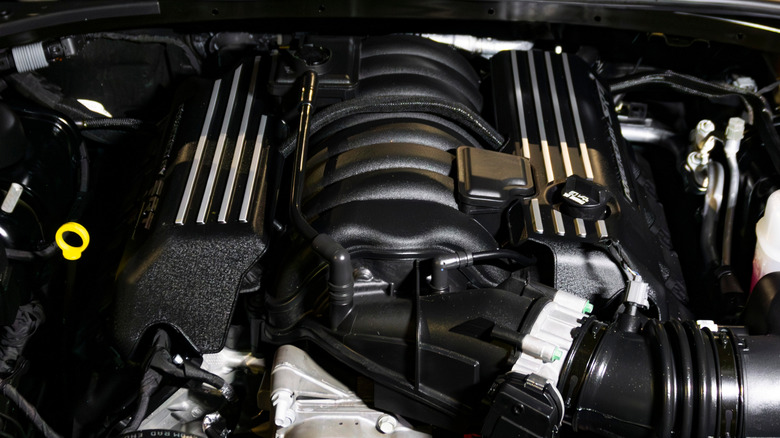
The modern Dodge HEMI does a lot to support the age-old mantra that there's no replacement for displacement, and the 6.4-liter, 392-branded HEMI significantly outmuscles the 5.0 when it comes to raw displacement. There are also significant differences in the design of the two V8s, as the Dodge 6.4 is an overhead-valve design with a single camshaft, while the 5.0 Coyote has four overhead cams.
2015 is a good model to compare these two V8s. This was the first year of the S550-generation Mustang, with the 2015 GT's Coyote being rated at 435 hp and 400 lb-ft of torque. That same model year, Dodge debuted the R/T Scat Pack version of the Challenger, powered by the ever-potent 6.4 HEMI, making 485 hp and 475 lb-ft of torque.
Engine-to-engine, the HEMI's figures outgun the 5.0 by a significant margin, but in the real world, the Challenger was handicapped by its extra weight and size when compared to the Mustang GT (which was no lightweight itself). In real-world tests, the two modern muscle cars' raw acceleration and quarter-mile figures were quite close. Today, with the Challenger (as well as the Camaro) discontinued, the comparison is a reminder of how mid-2010s muscle car buyers had so many flavors of V8 performance to choose from.
BMW 4.0 S65 V8
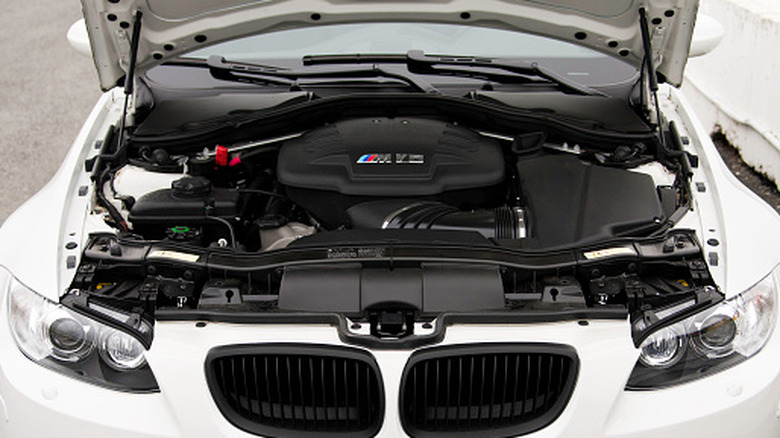
2011 was the first year Ford put the 5.0 Coyote in the Mustang, and, with a rated output of 412 hp, it elevated the 2011 Mustang GT to a new level of performance. It was such a stark upgrade that Motor Trend, for example, raised eyebrows by comparing the 2011 Mustang GT head-to-head against the 2011 BMW M3.
At the time, the M3 was powered by BMW's S65, a 4.0-liter naturally aspirated V8 that made 414 hp, giving it a narrow win over the Mustang's larger 5.0-liter in horsepower. With its larger displacement, though, the Ford had a significant torque advantage, with 390 lb-ft compared to the M3's 295 lb-ft. Despite the Mustang being a significantly cheaper car than the M3, the first-gen Coyote helped give the 2011 GT comparable performance to the M3, not just on paper, but on the race track as well. This helped establish the Coyote's reputation as a world-class V8 in any price range.
Unfortunately, the Ford-BMW V8 wars were short-lived, as BMW moved to a turbocharged inline-6 engine for the next-generation M3. Today, the V8-powered E90-generation M3 is known as one of the best-sounding BMWs ever, and this exotic, high-winding 4.0 V8 has helped make the E90 into a certified future classic.
Chevy 6.2 LT1 V8
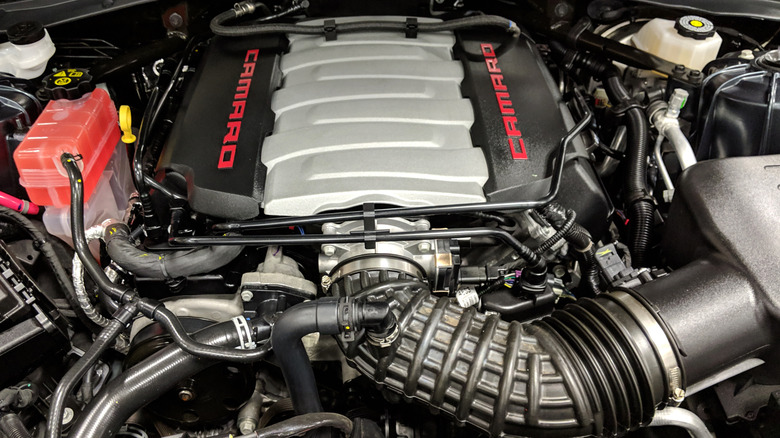
Though the battle may currently be on hiatus, the rivalry between the Ford Mustang and Chevy Camaro will always be one of the greatest in automotive history. After seeing what Ford was doing with the Coyote-powered Mustang, Chevrolet fired back in the mid-2010s with a new V8 engine for the sixth-generation 2016 Camaro SS. Known as the LT1, the Camaro's overhead-valve V8 displaced 6.2 liters and made 455 hp and 455 lb-ft of torque.
Compared to the 5.0 Mustang GT of the time, the larger Chevy V8 made an additional 20 hp and an even more substantial 55 lb-ft of torque. It's that second figure that made the real difference, with the LT1 having noticeably more low-end pull than the smaller, but higher-revving Ford V8. This more potent V8 gave the sixth-generation Camaro SS an edge in most performance comparisons, though the Mustang typically earned higher marks for comfort and refinement.
Subsequent improvements and updates to the Mustang GT's Coyote V8, first in 2018 and then again in 2024, helped Ford close the gap and eventually overtake the Camaro's LT1 in terms of horsepower. By that point, though, GM had made the decision to pull the plug on the Camaro, leaving the Mustang GT and the Coyote as the last American V8 pony car standing — for the time being, at least.
Toyota 5.0 2UR-GSE V8
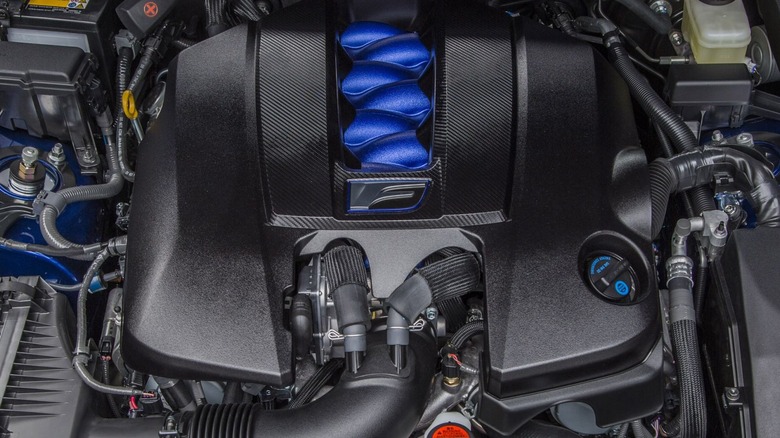
It's interesting and a little unexpected that the V8 that most closely matches the Ford Coyote's specs is found not in a Chevy or Dodge product, but under the hood of Lexus vehicles. The engine in question is the Toyota 2UR-GSE V8, which actually debuted a few years before Ford introduced the Coyote.
Displacing the same 5.0 liters as the Coyote and using the same DOHC, 32-valve layout, the 2UR-GSE first appeared in the 2007 Lexus IS F sedan, and, for most of its life, had an edge over Ford's 5.0 when it came to horsepower. In 2015, when Ford debuted the new S550 Mustang GT with its 435-horsepower Coyote, Lexus introduced the RC F Coupe, which made 467 hp from its updated 2UR-GSE – easily giving the Japanese engine the win in the battle of the naturally aspirated 5.0-liter V8s.
At the moment, the 2026 LC 500 is the only Lexus still powered by this V8, which is rated at 471 hp. This means the Toyota V8 has finally been edged out by the latest Coyote, which makes 480 hp in the 2024 and newer Mustang GT. Though its days appear to be numbered as of 2026, the 2UR-GSE will go down as one of Toyota's most powerful engines ever – and about as close as you can get to a bona fide Japanese muscle car engine.
Chevy 6.2 LT2 V8
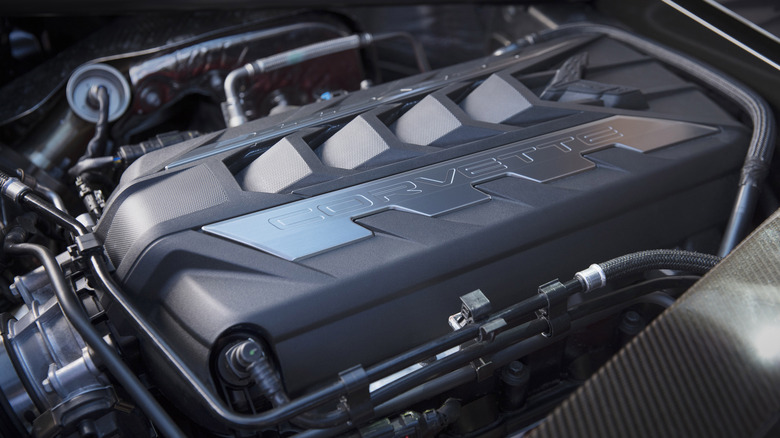
The current iterations of the Coyote V8 are the most powerful they've ever been, with the 2026 Mustang GT rated at 480 hp (or 486 hp with the optional performance exhaust). So what is GM's answer to this engine? Since Chevrolet no longer offers the Camaro, you need to go up to the C8 Corvette Stingray to find GM's entry-level performance car V8, known as the LT2. Though they're both 6.2-liter naturally aspirated, overhead-valve Chevy V8s, the LT2 differs from the old LT1 in a few ways.
How does the LT2 stack up to the latest Coyote? Rated at 490 hp (or 495 with performance exhaust), the Corvette's LT2 outguns the Mustang GT's 5.0 by a relatively modest 10 horsepower. The Corvette's torque advantage is more substantial, though, at 465 lb-ft compared to the Mustang's 415 lb-ft. If you opt for the more track-focused Mustang Dark Horse, the Coyote narrowly claws back the horsepower lead with its 500-hp output, though the Corvette still has a substantial advantage when it comes to torque.
When compared simply as engines, the Chevy-Ford battle between the LT2 and the current Coyote is very evenly matched. But that's not so much the case with the cars they come in. That's because the 5.0 Coyote powers a front-engined, four-seat coupe that starts around $47,000, while the LT2 is only available in a mid-engined, two-seat sports car with a much higher $70,000 starting price.