

7 Sweet '70s Muscle Cars That History Sadly Forgot
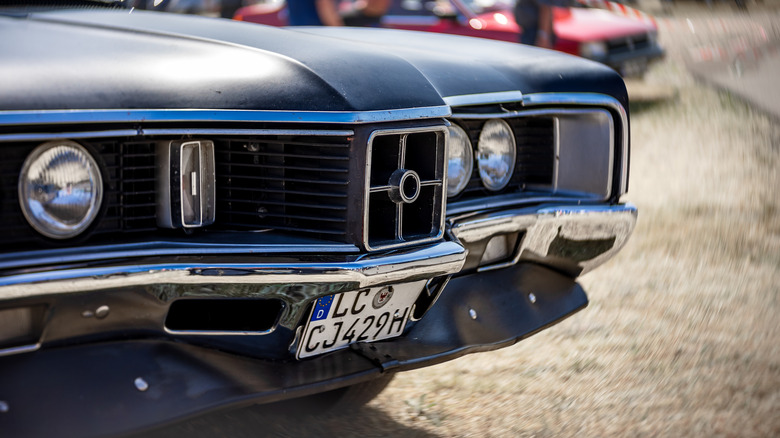
The 1970s were horrible years for the American automotive industry. A gas crisis hit, just as it was transitioning from fantastic beasts like the Plymouth Road Runners, Ford Mustangs, and Pontiac GTOs of the late '60s. And by the end of the decade, even the legacy brands like Ford, GM, and Chrysler were somehow making 300-plus cubic inch engines that barely made any horsepower.
However, that's not to say there aren't any good cars from the era. These years gave us the Chevelle SS 454, the Dodge Charger of "Fast and Furious" fame, and of course, the legendary Pontiac GTO. And, for those who don't know; the letters "GTO" on Pontiac's classic muscle car stand for "Gran Turismo Omologato", or grand touring homologation. These '70s cars dominate every discussion about great automobiles of the decade, and justifiably so. But they also tend to overshadow many of the truly unique machines that simply lacked the marketing, racing success, or screen time of more famous models.
These forgotten legends worked brilliantly. Some combined unlikely platforms with even less likely engines. Others were brief cameos by brands not known for muscle cars at all. All of them deserve better than the historical obscurity they've achieved. Here are seven of them.
Chevrolet Kingswood Estate 454
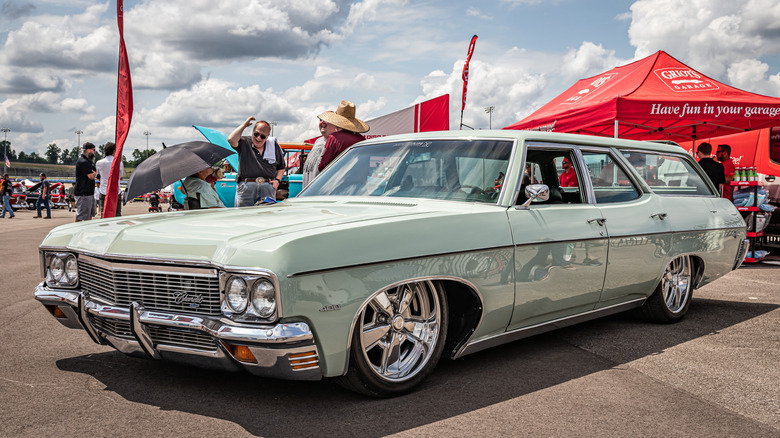
A low-riding, mega-long, box-shaped wagon with a massive engine, riding on 15 inch tires will never not be cool, and that's just what the Chevrolet Kingswood Estate 454 offered. Many examples finished in two-tone paint options (especially contrasting colors) tended to mimic the classic look of wood-paneled wagons that we all love. As the name hints, the engine in this behemoth was a 454 cubic inch V8 — 7.4 liters for us modern folk — mated to an automatic three-speed transmission, though other options were available, such as a two-speed automatic, and a three-speed manual.
When equipped with the three-speed automatic box though, the Kingswood Estate 454 would make an impressive 345 hp at 4,400 RPM, along with 500 lb-ft of torque, where peak torque came about at 3,000 RPM. Furthermore, despite its gargantuan weight of 4,696 pounds, the car managed to rocket to 60 mph in just 7.9 seconds; and it could run the quarter-mile in 16.4 seconds. At the end of the standing quarter mile, it would clock a speed of about 87 mph on the dash — pretty impressive for the time.
Then, there were the aesthetics and proportions of the thing; the Kingswood Estate screamed 1970s in a way few other cars could. The weirdly designed rear passenger doors only added to its charm, and the front bumper reminded one of the old Mercury designs that everyone used to love. It's a shame this car didn't get more love.
Dodge Monaco
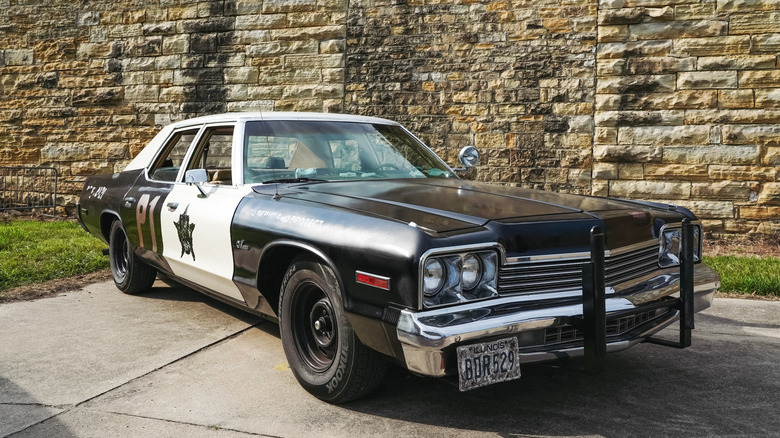
In a world where the Ford Crown Victoria gets all the love, we often forget the shoulders it stood on. In production from 1965 to 1978, the Dodge Monaco walked so that the Ford Crown Vic could run. There's little, if any relation between the two vehicles, other than that they were both large-displacement, fairly reliable land yachts and both used (extensively) by police departments — in fact, the Ford Crown Vic is still used by police today.
In the 1970s, the biggest-engined Dodge Monaco shipped with a 440 cubic inch, or 7.2-liter V8 engine, and owners had a choice of speccing either a three-speed automatic transmission, or a two-speed manual version to go with the car. Power output was impressive,, coming in at 350 hp at 4,400 RPM, along with 400 lb-ft at 2,800 RPM in terms of torque.
For readers old enough to remember crowding into the living room to watch "Saturday Night Live," allow us to jog your memory by mentioning the 1980 film, "The Blues Brothers," based on an episode of SNL. It was in this film that a Dodge Monaco starred, and caught the attention of everyone who watched the movie. However, today, this road-going, highway-pounding barge has largely been confined to the memories of only the most die-hard gearheads.
Chevrolet Laguna
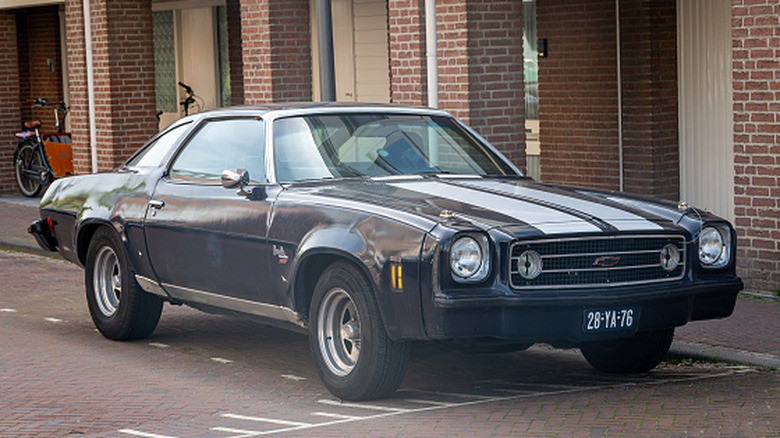
You'd be forgiven for mistaking the humble Chevy Laguna for a Plymouth GTX. The classic two-door silhouette, specifically known in the industry as a "Colonnade" design, funkily shaped rear quarter windows, and mustache grill all combine to give the Laguna a "borrowed" look, and we're being diplomatic there. That aside, the Laguna had a serious business end under the hood — it shipped with a big block 454 cubic inch (7.4-liter) thumping V8, mated to a three-speed auto gearbox.
Other engine options included a 400-cubic inch (6.6-liter) V8, and other transmissions were also available, such as a three-speed manual, and a four-speed manual. Power output for the 454 cubic inch sat at 235 hp and 360 lb-ft of torque, while the 400 cubic inch version made slightly less, at 180 hp along with 290 lb-ft of torque. Standing to 60 mph for the 454 came about in an okay-ish 11 seconds, and the car would run the standing quarter mile in 18.1 seconds, with the speedometer showing a speed of 79 mph at the end.
And of course, we'd be remiss if we failed to mention this car's racing achievements. To start with, the model got a slight redesign that made it even more aerodynamic, after which it went on to win several victories in motorsport, including a slew of NASCAR podiums throughout the decade. Not bad for what was basically a Chevelle masquerading as a Camaro.
Mercury Cyclone Spoiler 2
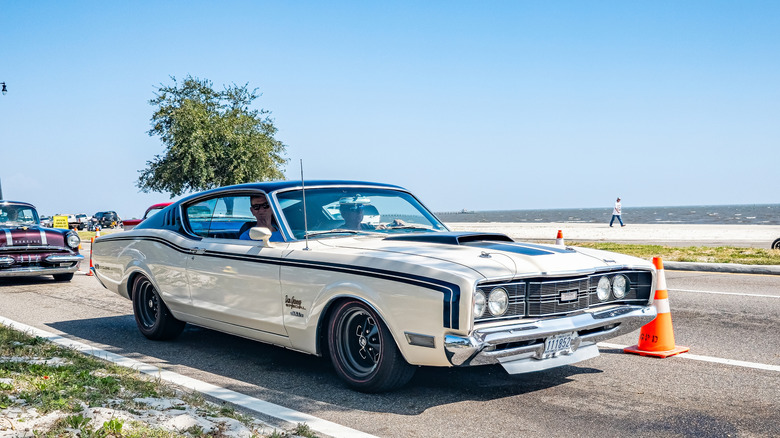
Next up, we have the racing-focused Mercury Cyclone Spoiler 2, a homologation special for stock car racing. Die-hard Ford fans may already be hammering out angry emails or tweets to us, saying that the car was actually the Mercury Cyclone Spoiler "II" and not 2. And while they'd be right, we should bring up the much lesser-known fact that none of these vehicles ever shipped with the words "Spoiler II" anywhere on the bodywork. Even Mercury was inconsistent with the naming, often swapping Roman numerals for regular numbers.
Regardless, this was an amazing car, built for NASCAR alongside the Ford Talladega, and complete with exhaustive modifications in order to homologate the car for competitions. Key changes included a longer body, more aggressive front end, and the whole thing rode an inch lower than the standard Cyclone.
The engine in the car was a 352 cubic inch (5.8-liter) V8 with quad-barrel carbs, mated to a three-speed transmission, which delivered 290 hp. Eagle eyed readers will notice that this was not, in fact, a homologation engine for NASCAR – race cars had 429 engines. It's also worth mentioning that Mercury shipped its special Cyclone II cars with only one tick-able option box, a car stereo. All of that combines to make the Mercury Cyclone Spoiler II one of the most underappreciated Mercury muscle cars of all time.
Holden Torana
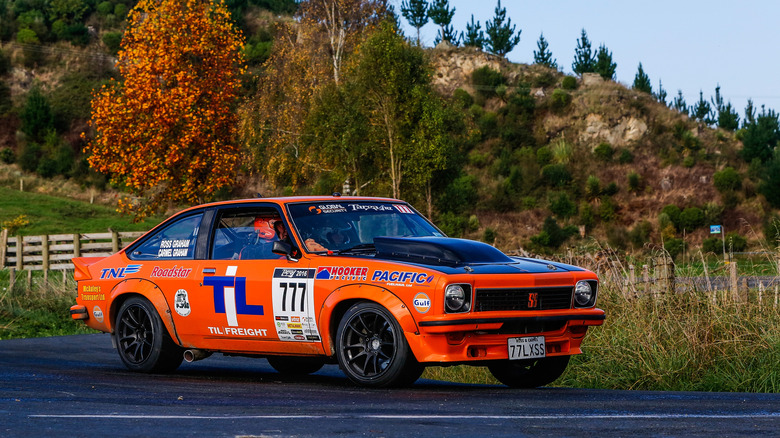
In the 1970s, the Aussies got into muscle cars with a vengeance. Ford had already seen decent success with the Falcon GT, and GM wanted to get in on the fun too. It launched two main models in Australia, the Morano and the Torana, though we'll focus on the Torana. At 158 hp, it was only half as powerful as the Monaro, which was the Ford Falcon GT's main competitor, but it was also light.
Additionally, and this was going against the grain of muscle car wisdom at the time, the Torano had a six-cylinder engine instead of a big thumping V8. The laws in Australia were quite restrictive at the time, so this decision made sense; although Holden and GM later caved and made a V8-powered, 240-ish hp Torana in the middle of the 1970s.
The six-cylinder first-gen Torana actually had decent racing chops, but the entire muscle car industry in Australia soon came to an end. Laws were soon passed that banned cars that could go over 130 mph, and that was the end of it. There was a brief period where it seemed that the Monaro and Torana could make a comeback – this was in the late 90s and early 2000s – but it never came to be. Holden continued to be a company until 2021, when GM dissolved it.
Plymouth Duster 340
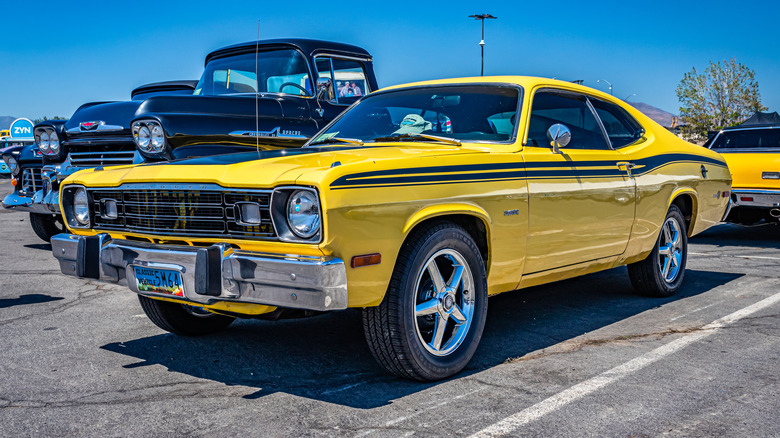
Long before Dacia/Renault turned the Duster Nameplate into a laughingstock, Plymouth was stuffing a 340 cubic inch engine into the body of a chopped-up Valiant. The Plymouth Duster was the Chrysler group's catch-up attempt to the phenomenon that was the Ford Mustang, and it was truly a Frankenstein project.
Much of its interior (and exterior) was borrowed from the Plymouth Valiant. Though it was introduced in the 1960s – when the Mustang was taking off – the Duster was sold through the 1970s. About halfway through the decade, its main engine option was dropped, as American legislation got stricter. This engine was namely the 340 cubic inch (5.6-liter) V8 that made 275 hp and 340 lb-ft of torque. After 1974, the biggest engine available on a Duster would have been the 360 cubic inch (5.9-liter) V8 making 245 hp.
Through its production cycle, three other engine options were offered (318, 225 and 193 cubic inches), making 230, 145, and 125 hp, respectively. The car (at launch anyway) was also quite competitively priced; with early base models coming in at around $2,600 — and yes, that included the massive 340 engine — though there were many, many trim levels offered that could easily make the price skyrocket on the higher end. For those wondering, $2,600 in 1970 works out to about $21,795 today, accounting for inflation — still not a bad deal.
Dodge Super Bee
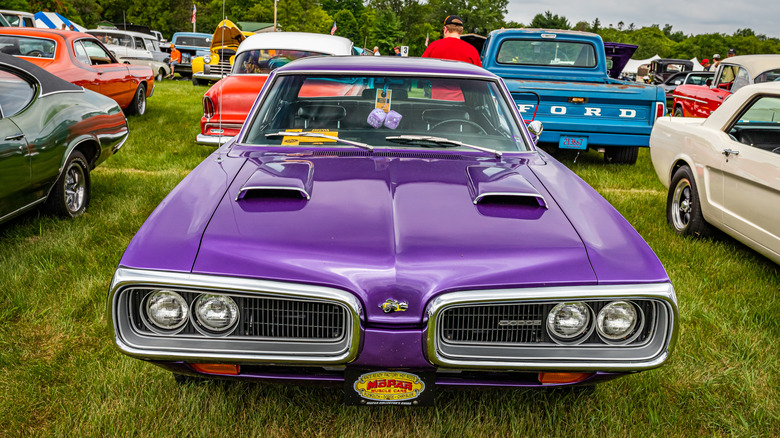
Here in the U.S., the basic muscle car formula was always to shove ever-bigger engines into platforms not designed for them, and work around any "minor" issues that came up. Stuff like like frame torsion, drivetrain stress, and sending pistons to the moon from overfed cylinders — none of it mattered if the car went fast and looked good. As such, it's no surprise that the Dodge Super Bee was a winner.
Initially introduced in 1968, the Super Bee was one of the few muscle cars of the era not affected by the gas crises. It ended production before they happened, so its reputation never petered out.
By the end of manufacturing, the Super Bee was shipping with a 440 cubic inch (7.2-liter) engine paired to a three or four-speed gearbox. This powertrain would end up making 390 hp; though the legendary 426 HEMI was also an option. No one really knows where the name "Super Bee" originated, but there's been speculation that since the chassis used a "B-body" configuration, that's where the name came from. Whatever the case may be, even though this particular muscle car had a production run that lasted under half a decade, the Dodge Super Bee left an indelible mark on the auto world, and it's sad that it, like the others on this list, has been largely forgotten.