

5 Of The Strangest Places Automakers Have Stored A Spare Tire

One of the most important factors when it comes to automotive design is how you use the space. Every car takes up a specific footprint, and everything must fit inside it — powertrain, running gear, interior, cargo space, and so on. It's not exactly something we think about often, but how do you actually fit a spare tire in that space when so much of it has to be used for, say, expanding interior volume or for EV batteries?
There are a few issues with spare tires: they're heavy, cumbersome, and take up a lot of space due to their shape. It's not like you can just fold them up, obviously, so you (as the automaker) instead have to figure out where to put this big, awkward donut that barely ever gets used but is nevertheless a necessity (unless you cheap out and use a factory puncture sealant). Most automakers these days compromise by using space-savers hidden under carpeting in the trunk or hung on the undercarriage, where it's not intrusive. Others, like Jeep, hang spares on the back or on the side of the trunk. Generally, though, we all have a good idea of where to find our spare tires – unless the automaker doesn't include spare tires at all, of course.
But what if the manufacturer had something else in mind? Maybe their car had a weird design or not enough space, or perhaps the designers just dared to be different instead? Let's take a look at some of the strangest places spare tires were fitted from the factory.
Honda Ridgeline: under the bed
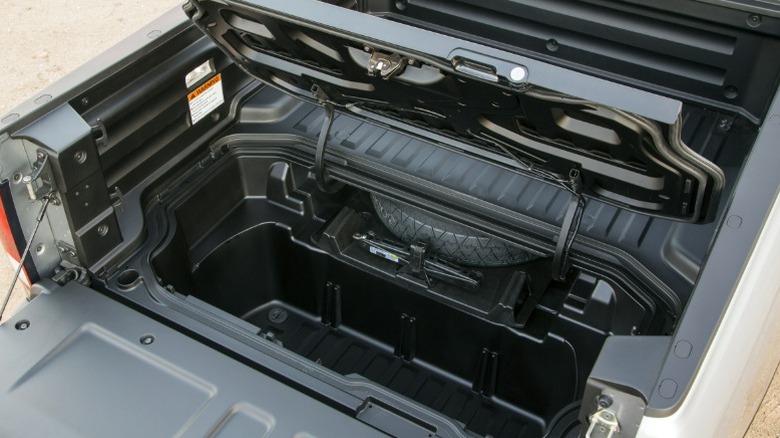
The Honda Ridgeline stores its spare tire under the bed, and how inconvenient this is depends entirely on how much stuff you're carrying. If you have, for instance, a load of lawn equipment or some dirt bikes or loose mulch, you're about to have a fun time changing your spare on the side of the highway.
While the Ridgeline has a cool tailgate, one problem is that the bed height isn't the greatest; this is a unibody compact truck, after all. So, how do you get more space for cargo without having awkward lumps for the drivetrain components? The solution Honda came up with was to effectively put a cubby beneath the bed, accessible by a handle at the rear of the bed, near the tailgate. Open it up like a chest, and you'll find 7.3 cubic feet of extra room. It's a great place for storing smaller items, but not so great for the spare.
The spare tire is pushed far forward within the cubby, located roughly at about the mid-point of the pickup bed. It's a space-saver, squeezed just above where the rear axle sits, with the factory toolkit housed in recesses within the floor. It's both counterintuitive to its purpose as a truck, requiring one to empty the bed enough to open the cover before changing a tire, and a bit hidden for the unknowing user. But if you own a Ridgeline, you've likely seen the spare tire before when using the in-bed trunk and would at least be familiar with its location, which is one of the only plus-points that can be said here.
Classic Subaru models: under the hood
If there's one thing that's held Subaru aloft all these years, it's the company's insistence on the boxer engine. A boxer engine, named for the resemblance to two boxers punching back and forth, is an engine with both cylinder banks opposite one another — one is pointed straight left, the other straight right. Boxer engines come with several pros and cons, and the pro we're concerned with today rests with the engine's dimensions. Boxer engines are also known as flat engines, and as this name suggests, they are indeed flat.
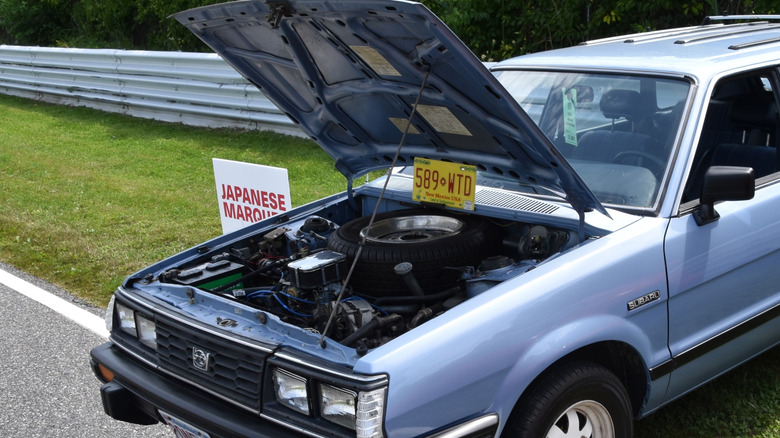
In fact, older boxer engines were so flat that you could even fit items under the hood, such as a toolbox, spare parts, or a factory-installed spare tire. No doubt helped by the relatively thinner width of the 1980s-era tire, these classic Subarus would sneak the spare into the engine bay, just behind the carburetor's air filter. This was the typical setup for a couple of Subaru models, such as the Leone and BRAT — yes, that's the truck with the rear-facing seats in the pickup bed.
This setup actually makes sense from an ergonomics standpoint. You have a high hood line because of the air filter, yet you have all the space behind it because you don't have cylinder heads and accessories getting in the way. Various cars, most notably air-cooled Volkswagens and Porsches, placed spare tires in the front because they're rear-engined, but typically you don't see the tire occupying the same space as the engine. This is both clever and space-saving.
Bristol Motors: inside the passenger-side fender
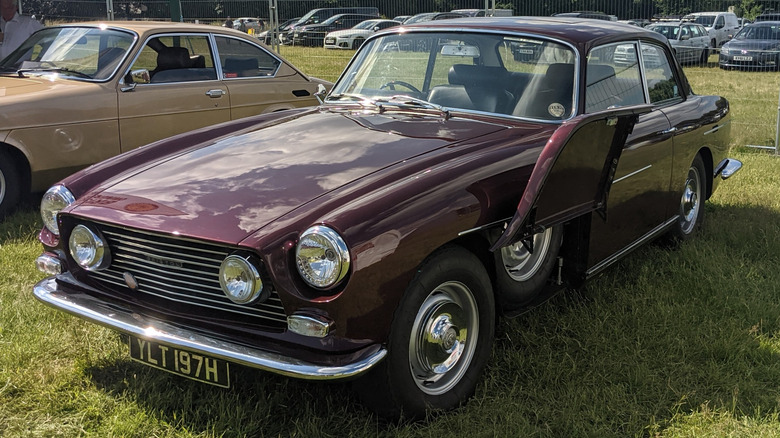
Bristol is a lesser-known automaker, certainly in the United States, with its vehicles generally eclipsed by more mainstream marques. But what Bristol's vehicles lack in notoriety, they make up for in clever design. Chief among these becomes apparent when you get a puncture. In such a small car, where on Earth do you put the spare tire?
The answer lies just behind the passenger-side front fender. On the right (driver's) side rests the battery compartment, and on the left sits the spare, each tucked away behind a hinged door that opens up from the bottom. As far as spare tire locations go, this one is among the easiest to access, even by today's standards. You don't need any special equipment or to empty out your trunk, and there's no fiddling around on the ground.
The main downside here is legroom. In a car that's smaller than a full-size body-on-frame vehicle, having a full-size spare tire (as opposed to a donut) mounted vertically just behind the dashboard means it's intruding on the passenger's legroom. The passenger footwell had this massive, rounded-off bulge sticking out of the left side. Not exactly ideal, but these were more specialized vehicles, and space was at a premium. This was largely a company-wide trend for Bristol, and it was quite essential considering the engine bay of something like the 1980s Beaufighter had a Chrysler V8 — good luck getting a spare tire under the hood of that.
Tatra 603: in a hidden compartment at the front
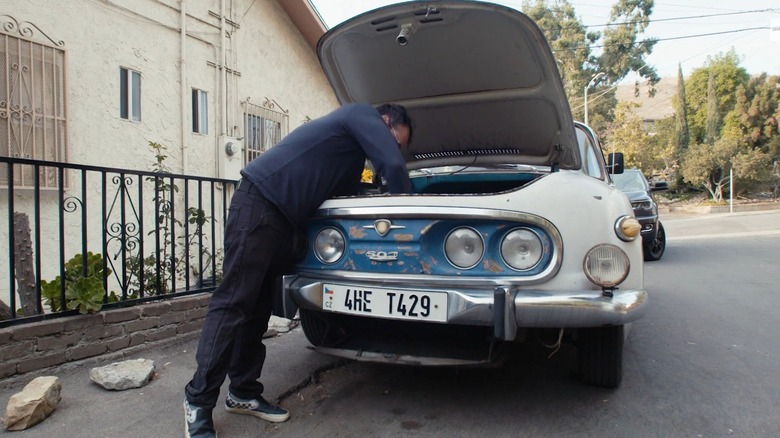
The Tatra 603 has, without question, one of the most eccentric vehicle designs of all time. You want weird? How about a Soviet-era Czech 4-door luxury car with an air-cooled V8 mounted in the back — one of the V8s that time forgot. Believe it or not, it's actually not the only vehicle to use this template; Tatra built these cars starting in 1934, beginning with the Tatra T77. The 603 and its derivatives were particularly renowned as high-quality, exceptionally well-appointed vehicles, driven by (the chauffeurs of) high-ranking party officials.
But what if you needed to change the tire? Naturally, the first thing you do is walk up to the front end and tell the Tatra to open wide and spit the tire out — no, seriously. There's a hidden compartment located just behind the front bumper that the driver can access by pulling a lever on the inside of the frunk. This drops down the compartment containing the spare, much like a mouth opening wide, giving this humorous impression of a surprised look on the Tatra's face.
This is actually an incredibly novel idea that's seldom been seen before or since. The spare tire doesn't intrude on the cargo or passenger compartments at all and is normally raised behind the bumper, affording ground clearance. Moreover, despite being technically mounted under the car, you never have to get on the ground to retrieve it, nor do you need special tools. You just take out the spare and install the spare.
Chrysler minivans: beneath the dashboard
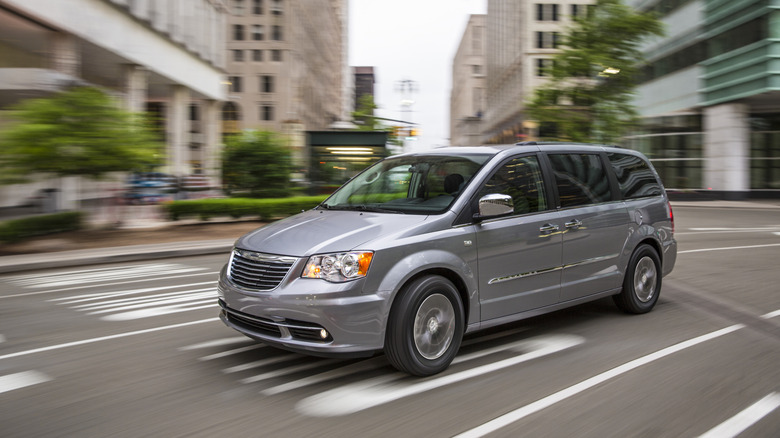
This one is quite possibly one of the worst ways to access a spare tire. Chrysler minivans from the 2000s onwards are well-known for their broad, flat floors, affording cargo space and plenty of legroom for all three rows. That doesn't leave much room for a spare tire, though. It takes some searching, but eventually you will find the spare tire located under the car, positioned in between both front seats and held aloft by a retention system.
Accessing this mechanism requires the driver to retrieve the toolkit from the trunk, then assemble the ratchet to undo its retainer. On higher trim levels, the driver will then have to pull out the second-row center console, then open the front cubby and empty that out. That cubby has a false bottom; you'll remove that component and expose the mechanism, which you can then unwind using the ratchet. This loosens the spare tire, which is tied to the car via a long cable that you disconnect once you retrieve the tire from beneath the minivan. Easy, right?
Imagine being a mother of four children, trying to figure this out on the side of a busy road. This would be a nightmare for anyone without easy access to the user's manual as well, but that's the price you pay for having all that cargo space in the rear. Also, be sure to get the spare tire out from the driver's side, lest you burn yourself on the exhaust — all while ignoring the obvious dangers of lying down on the hard shoulder, trying to retrieve a heavy spare tire from beneath the car. Clever? No. But certainly strange.