

5 Hyundai Engines You Should Steer Clear Of
Hyundai isn't a manufacturer known for constructing poor engines — quite the opposite, in fact. The Korean corporation's automotive division actually built a solid reputation on good quality, even winning multiple awards for reliability in the past. The number of reliable engines Hyundai has built vastly outweigh the negatives in terms of sheer statistics, but that certainly doesn't exempt the company from making the occasional mistake — sometimes to disastrous consequences. While it's not uncommon to see Hyundai models on the road after several decades of service, there are a few that cannot seem to stay away from automotive shops.
Hyundai engines encompass three major manufacturers: Hyundai, Genesis, and Kia, the latter of which has fallen under the Hyundai banner since 1998. As such, we'll be addressing not just cars bearing the Hyundai badge but any car equipped with a Hyundai engine from the factory — and there are quite a few Kias with poor engines out there, for example. Genesis, by comparison, is a relatively recent player on the world stage and many of its engines underwent teething issues in the 2010s; we'll be looking at those as well.
We'll be seeing some common themes among these engines — namely, bottom-end issues like rod knock. Genesis especially seems particularly susceptible, with several powerplants guilty of this. We'll discuss what causes these issues and why they're so crippling, with some engines being so egregious that the company had to issue massive recalls amidst lawsuits. Is it a deal breaker when shopping for a new car? Absolutely not — in fact, many of these issues have since been ironed out thanks to these recalls. But for older models especially, it's buyer beware. Let's have a look.
Hyundai/Kia 2.0L and 2.4L Theta II
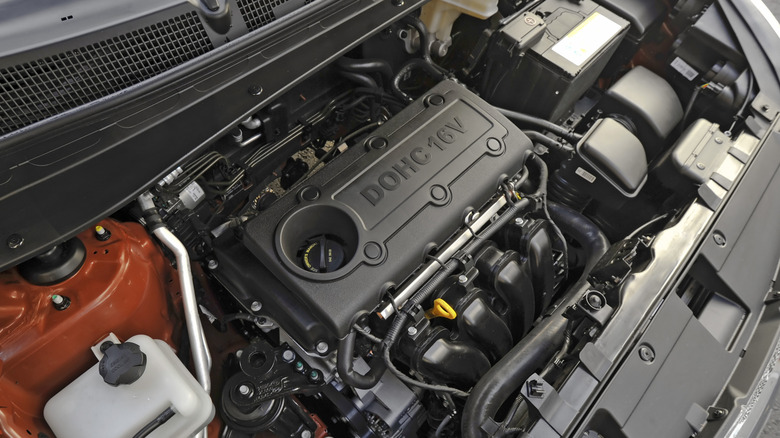
We're getting the most egregious engine out of the way immediately; this is the powerplant most people are referring to when discussing Hyundais exploding. The Theta II has a fairly long list of problems, but the most relevant here rests in manufacturing defects and poor quality control, leading to oil starvation and subsequent rod knock. In fact, the problem got so bad that there was even a series of court cases revolving around an engineer whistleblower, who told the NHTSA about his various concerns with the engine's poor reliability.
All of this led to various customer complaints until Hyundai issued several recalls addressing the oil problem, which could lead to catastrophic failures including total engine seizure or even engine fires. In total, over 1.6 million vehicles were affected by these recalls, with total combined penalties sitting at around $210 million USD. Part of this relates to Hyundai inaccurately reporting information to the NHTSA regarding the Theta II, which only further mudded the waters as far as customers were concerned.
What exactly was the problem, though? In short, during the manufacturing process, the engines weren't thoroughly cleaned during machining stages, leading to metal shavings in the oil. Metal-on-metal contact wears out parts like bearings and other working surfaces and the shavings could clog oil elements, leading to a combination of oil starvation and excessive friction. This led to catastrophic failures such as thrown crankshaft bearings and conrod damage, the telltale sign of which is rod knock — so called because of the loud knocking sound emanated from the engine bay. Affected vehicles include Hyundai and Kia models from 2011-2019 equipped with either the 2.0L GDI or 2.4L GDI, namely the Hyundai Santa Fe, Sonata, and Tuscon; and Kia Optima, Sorento, and Sportage.
Hyundai/Kia 3.3L GDI Lambda II
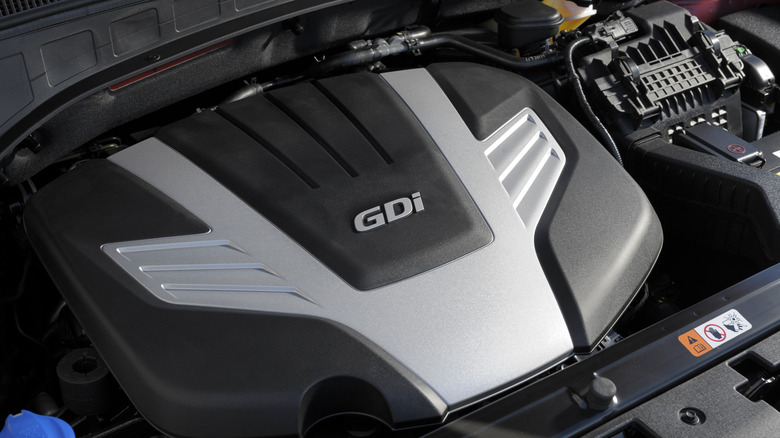
The Lambda II represents the other black spot on Hyundai's reputation, an engine with eerily similar issues to the Theta II and equipping many of the same models from the same 2010s era. Controversies and cases regarding the Lambda II are still ongoing, but the crux of it is this: owners of Hyundai and Kia models equipped with the 3.3L V6 GDI have reported catastrophic engine failures related to faulty manufacturing processes resulting in thrown bearings and damaged connecting rods (sound familiar?) and that their cars are dying well beneath six-figure mileage territory. Moreover, Hyundai has concealed extended warranty coverage and even refused repairs for affected owners.
Much like the Theta II, the issues all began with metal shavings within the engine block during the manufacturing stages, resulting in contaminated oil and, eventually, everything up to and including complete engine failure. To put in perspective just how severe something like this can be, failures such as these can lead to components punching holes in the block itself or its elements, effectively detonating the block from the inside out. Such repairs, by their nature, require a completely new block or engine, and they don't come cheap. Coupled with the shady warranty practices, and owners have reported needing to go back to the dealership two or three times to even get their car approved for servicing.
Further complicating these engines is the fact that some are actually among the most reliable Kia engines, so if you get a good 3.3L, it'll last you a while. But it's certainly a buyer-beware situation, especially with the new lawsuits shining light on Hyundai's business practices regarding these engines.
Hyundai/Kia 2.0L Nu
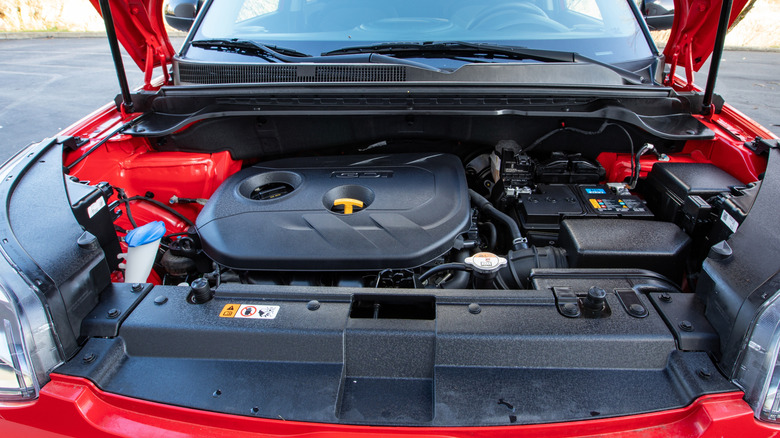
While not as prolific as the Theta II or Lambda II, the Nu nevertheless carries on the tradition of bringing oil-related issues to the table for Hyundai. Found in either 1.8L or 2.0L flavors, the one we're concerned with here is the latter, the subject of yet another series of recalls. The first (and, arguably, most serious) relates once again to issues with manufacturing processes that can cause connecting rod failures; this isn't exactly the best tradition to hold. Moreover, aside from just bricking the engine, it could also cause a fire if, for instance, oil got out through a puncture in the side of the block and landed on a hot surface.
But that's not all: the Nu engine underwent a second recall for using oil piston rings out of specification. The piston rings act as a seal between the cylinder wall and the piston, keeping the top and bottom segregated; consequently, piston rings must be tightly fit but also well-lubricated to prevent metal-on-metal contact. Compromised piston rings can cause scuffing on the piston walls and allow oil to enter the combustion chamber, leading to the car burning oil.
While certainly not as catastrophic, having an oil-burning engine comes with various secondary issues as well. For instance, the particulates in engine oil can clog up your car's catalytic converter, meaning you'll have to clean it to restore your car's normal emissions levels. Luckily not too many vehicles are affected by these faults, namely the 2019-2021 Veloster and Kona, 2019-2020 Elantra, 2021 Kia Seltos, and 2020-2021 Kia Soul.
Kia/Genesis 3.3L twin turbo
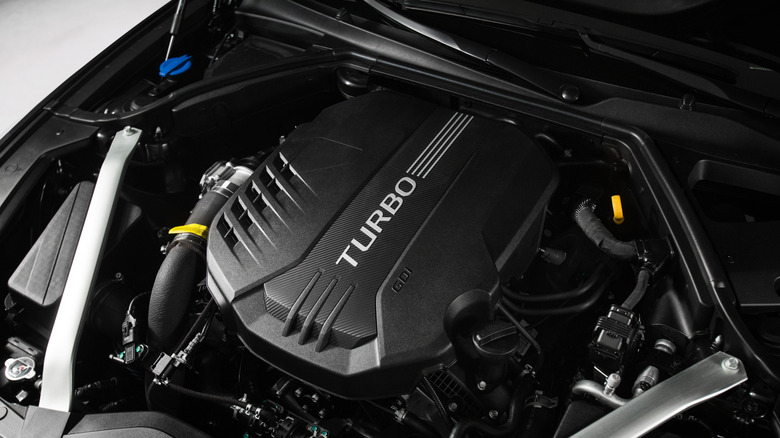
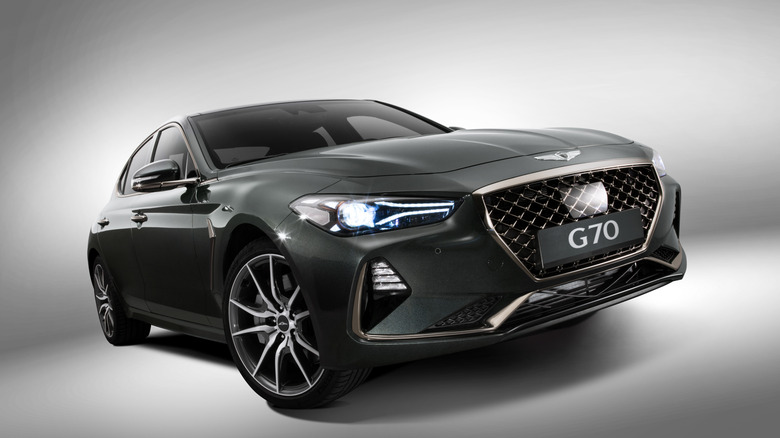
The 3.3L V6 twin turbo found in cars like the Genesis G70 and others is the first engine on this list which is genuinely not that bad and certainly not that expensive to fix in comparison to the others if a defect does arise. And, according to the current recall notices, there is one specific recall present on this engine, one of which could cause a fire if left unattended: an issue with the left turbocharger.
Turbochargers are precision instruments that face incredibly violent forces; the turbines inside a turbocharger can spin upwards of 200,000 RPM in some models, and they're constantly exposed to fluctuating heat cycles with engine exhaust temperature. A twin turbo setup (not to be confused with a twin-scroll turbo) like the one present on the Lambda II requires oil to keep the components cool and well-lubricated. The problem here rests with a defective oil feed pipe, which may leak onto the left turbo; engine oil plus hot surface can lead to a fire.
Genesis vehicles are generally more reliable in terms of sheer statistics, at least when it comes to engines; there are only two other engine-related recalls currently active with Genesis vehicles, the more major of which being a faulty fuel pump potentially causing fuel starvation. However, when it comes to the internals themselves, the only truly defective component rests with the left turbocharger oil feed pipe, so overall these engines are quite good. It's a marked improvement over its older, naturally-aspirated variant that we looked at earlier, albeit with a few remaining teething issues.
Hyundai 1.7L CRDi

This engine represents the baseline diesel one would find in a Hyundai vehicle, as seen under the hood of cars like the Kia Sportage and Hyundai i40. These vehicles were never sold in the United States but are relatively commonplace among European and Asian countries, with the Sportage built in Slovakia, for example. The acronym means "Common Rail Direct Injection," and the engine itself boasts a middling reputation if for one main reason: timing issues.
The 1.7L CRDi (and other derivatives of varying displacements) uses a timing chain to maintain precise engine timing, a well-known and understood method, the other typical systems being timing belts or gear drives. The timing chain rides on corresponding sprockets, like a conveyor belt. If the chain "jumps," the sprockets can fall out of alignment, resulting in the engine's top-end no longer being in sync with the bottom, potentially leading to catastrophic damages.
Timing chains are metal and are subjected to constant heat cycles — in the case of the CRDi family, these cycles can loosen the chain enough to cause inaccurate timing and even skipping. Typical symptoms for this include rough idling at startup, uneven engine notes, and persistent rattling noises. Repairs for this type of failure can be costly, with anything from a timing chain replacement up to and including entire valvetrain teardowns being on the table for severe cases.
Our methodology

Because the vast majority of these engines are still regularly in service and less than a decade old, ample data exists online in terms of both owner testimonials and official accounts. We relied more heavily on the latter, focusing on specific engine-related physical defects to eliminate any customer bias as much as possible.
We used various sources from a number of periodicals and accredited journals, such as Consumer Reports, Kelley Blue Book, and news sources; plus official documentation from the National Highway Traffic Safety Administration (NHTSA) and Hyundai itself. These include NHTSA recall reports, dealership advisory bulletins, and insider news.
Because most of these physiological issues have since been resolved or have active extended warranties connected to them, these engines may or may not present these issues. Furthermore, many other secondary problems exist, such as electrical and accessory failures, which can indirectly affect the powertrain; we chose to eliminate these and focus merely on quantifiable data related to engine defects.