

Skip The Steam Machine And Build This Better Alternative That May Save You Money
We may receive a commission on purchases made from links.
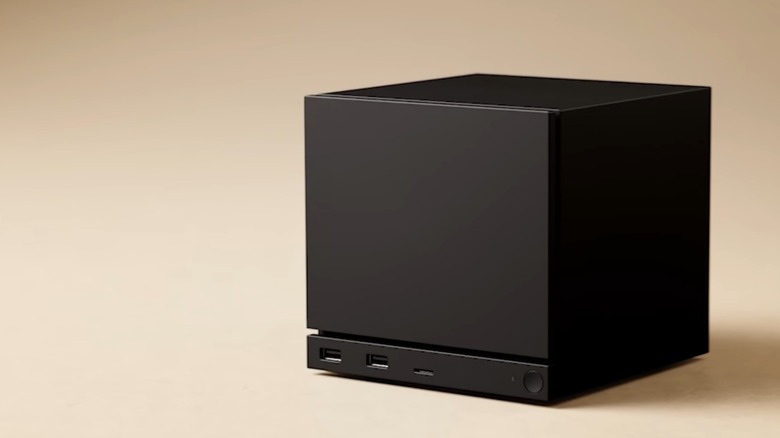
The Steam Machine promises to be an interesting gaming console, delivering the flexibility and performance of an entry-level gaming PC without the complexity of Windows. Note that isn't the first time that Valve made a Steam Machine, as this console's first iteration arrived in 2014. Unfortunately, the first-generation console flopped hard, and the gaming company pulled the last of the Linux consoles from its platform in 2018.
One of the reasons that the original Steam Machine didn't take off was the lack of gaming developer support for the Linux-based SteamOS that it used. This has changed, however, with the arrival of the Steam Deck and the Proton compatibility layer, which allows non-Linux native titles to run on the handheld console. This meant that, slowly but surely, gamers can ditch Windows (which has its fair share of bugs and other issues) while enjoying titles primarily made for PC.
Steam Deck's success led Valve to announce a second-generation Steam Machine in late 2025, with the console originally expected to arrive in early 2026. Unfortunately, the company announced that it will delay the launch of the gaming PC console. So, if you cannot wait for the new Steam Machine to arrive and instead want to build your own, these are the components that you should look at.
A comparable CPU
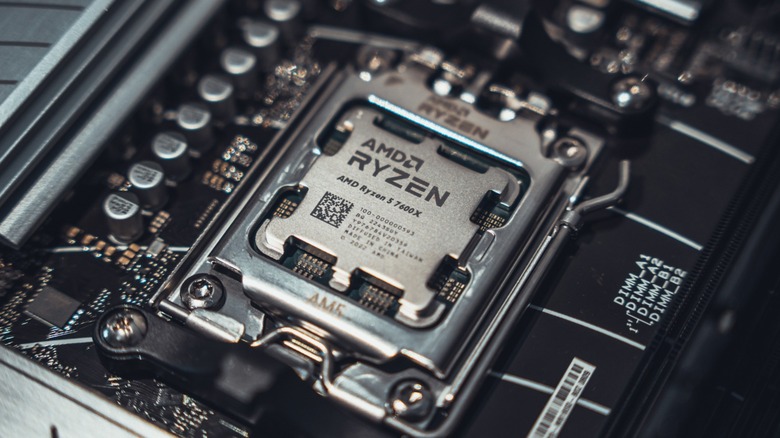
The Steam Machine will come with a 6-core AMD Zen 4 x86 processor that can hit up to 4.8 GHz and comes with a 30-watt TDP. This means that it won't be based on the newer Ryzen 9000 series, which uses the newer Zen 5 architecture. So, we will look at processors that use the older Zen 4 architecture without an integrated GPU, have six cores, and has a boost clock speed of around 4.8 GHz that you can purchase from Amazon or Newegg.
That limits us to the following options: the Ryzen 5 8400F, the Ryzen 5 7500F, and the Ryzen 5 7400F. These chips all have 6 cores (12 threads), have a 4.7 GHz boost clock (except for the Ryzen 5 7500F which can hit 5.0 GHz), and 32 MB of L3 Cache (except for the Ryzen 5 8400F which only has 16 MB). All of them also have a TDP of 65 watts, which is the lowest that we could find. The Ryzen 5 8400F is currently priced at $143.92 on Amazon, making it the cheapest option. The Ryzen 5 7400F, which was initially launched as a China exclusive, is now available on Newegg for $147.59, while the slightly faster Ryzen 5 7500F costs $163.99.
Given these options, we suggest picking up the Ryzen 5 7400F, which is priced at the middle of the pack. It only has a slightly lower boost clock than the 7500F while costing about $15 less. And even though the 8400F is more affordable, you're going to appreciate the 32 MB L3 Cache of the 7400F, which helps improve minimum frame rates to deliver smoother gameplay.
Which AMD GPU should you get?
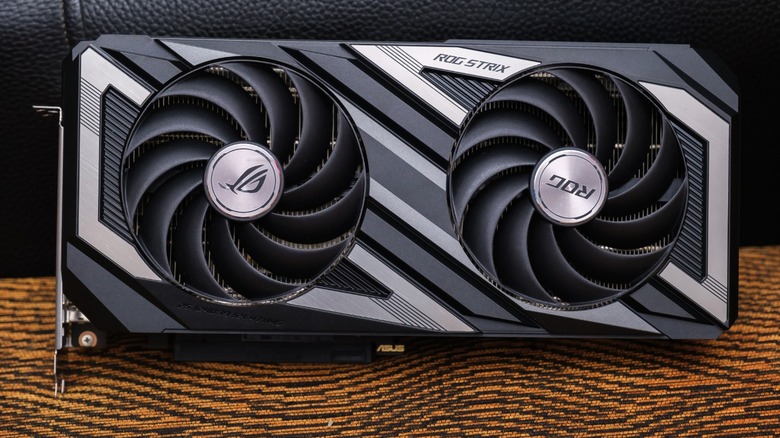
Valve said that its latest gaming PC console will come with a semi-custom GPU, meaning we won't be able to find a 1:1 analog for it. Nevertheless, the company specced the Steam Machine with an AMD RDNA 3 graphics card with 28 CUs (or Compute Units), 8GB GDDR6 VRAM, a maximum sustained clock speed of 2.45 GHz, and a 110-watt TDP. Since Valve uses an RDNA 3 GPU, that means we're limiting our options to AMD Radeon RX 7000-series GPUs.
If we look at all the discrete GPUs under the 7000 desktop series family, there are two models that are close to Valve's specifications: the AMD Radeon RX 7600 and the RX 7600 XT, both of which have 32 CUs. The latter has a 2.47 GHz Game Frequency, nearly matching what the Steam Machine has, but has a maximum memory size of 16 GB. On the other hand, the non-XT version matches the semi-custom GPU's 8 GBs of VRAM but has a much lower 2.25 GHz Game Frequency. Both GPUs also require a higher TDP — 190W for the RX 7600 XT and 165W for the RX 7600.
However, the 7600 XT is quite expensive, with the cheapest model we can find costing well over $500. Because of this, we're picking the $274.99 Asus Dual Radeon RX 7600 EVO OC GPU on Amazon, which has a similar 8GB of VRAM and a lower TDP. While it's possible that Valve will choose a laptop GPU, we're not going to go in that direction because most consumers cannot purchase that as a standalone unit.
Finding compatible memory, storage, and motherboard
Valve said that the Steam Machine will come with 16 GBs of SO-DIMM DDR5 laptop memory, although it's unclear if it will have one or two RAM sticks. But because we're using desktop components, we will just stick with two 8GB DDR5 RAM sticks. Since memory modules are prohibitively expensive at the moment, we'll get the most affordable unit we can find — the Patriot Viper Venom 16 GB (2 x 8 GB) DDR-6000, which costs $199.99 on Newegg.
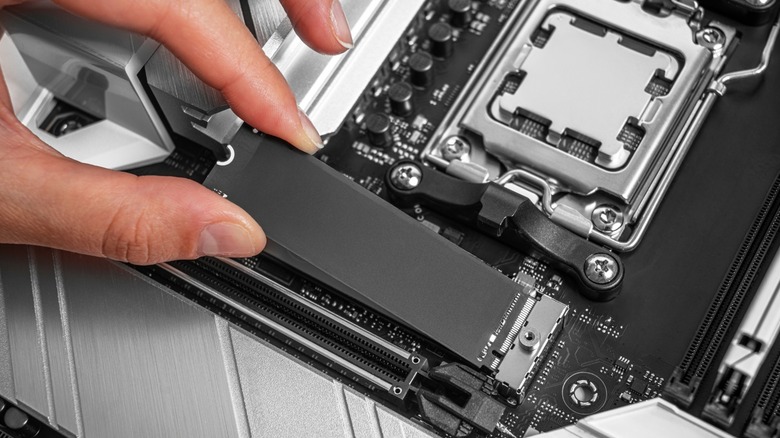
For storage, the Steam Machine is available with either a 512 GB or 2 TB SSD — since we're trying to keep our costs down, we'll stick with a 512GB SSD. The console also uses the smaller 2230 form factor for its storage, but we're going with the larger 2280 instead, because it's cheaper. So, for our storage, we picked the Patriot P400 Lite M.2 PCIe Gen 4 x4 500 GB SSD, which will set us back $80.99 on Newegg. If you can afford to spend a little bit more, it's wiser to get at least 1TB so that you don't run out of space for installing all your favorite titles.
Finally, we need to get a motherboard that will accommodate all our chosen components so far. Unfortunately, the smaller Mini ITX motherboards are out of our budget, so we'll stick with the most affordable compatible Micro ATX motherboard instead. But even though we're on a budget, we're avoiding the most basic chipsets like the A620 because we're still building this for gaming. For that reason, we're picking the ASRock B650M-HDV/M.2, which costs $99.99 on Amazon.
Which PSU, case, and cooler should we get?
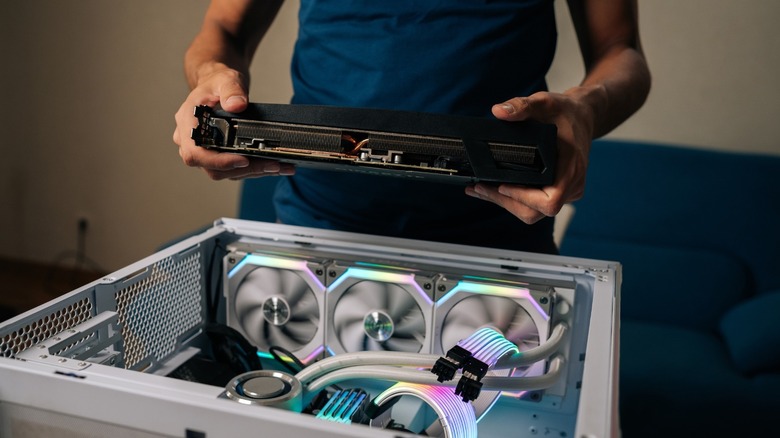
AMD recommends a minimum 550-watt power supply for the AMD Radeon RX 7600, so we'll stick with that for safety. Even though we want a compact build, SFX power supplies built for small form factor (SFF) PCs are quite expensive and will cause us to go overbudget. So, we'll instead go for the MSI MAG A550BN, which is a cheap but reliable PSU, costing only $54.99.
Now that we have power, we need to put everything inside a case. While we'd love to stick with an SFF case, these are just too expensive. So, we're going one size up with the Cooler Master MasterBox Q300L, which just costs $39.99 on Amazon and Newegg. It can accommodate a PSU up to 160 mm, ensuring that the MSI MAG A550BN will fit inside it. It also gives us the option to install a 240mm radiator for an AIO liquid cooler, but since we don't want to spend too much on any component, we're sticking with air cooling.
Speaking of cooling, we still need to get a CPU cooler because the AMD Ryzen 5 7400F is a tray processor, meaning it doesn't come with a stock cooler. We also deliberately kept it last so that we know how much clearance we need with the PC case. Cooler Master says that the MasterBox Q300L has 159 mm of space for an air cooler, meaning one of the best air coolers on the market, the Thermalright Peerless Assassin 120 SE, with its 155 mm height, would fit in the system. More importantly, it's quite affordable at just $38.90.
How much will the full build cost?
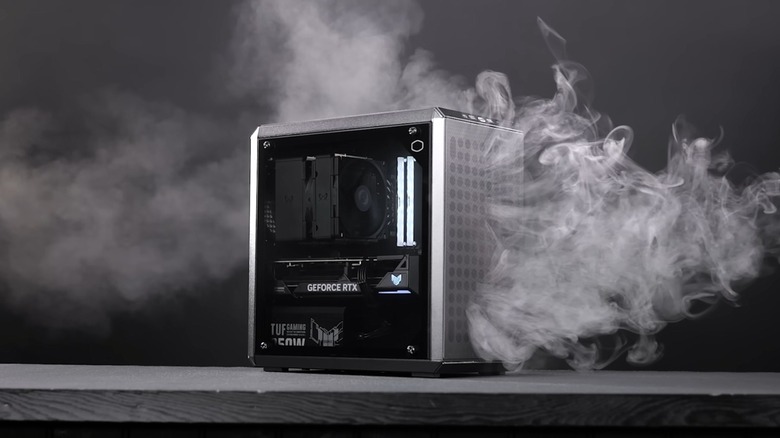
Our build comes out at a total of $937.43. This might surprise you, especially as we tried to keep our costs down, but that is difficult with the current cost of RAM and storage. In fact, PCPartPicker shows that our RAM module's price increased by 300% since 2025, while our SSD's cost doubled in the same period. If we bought these components at their original prices, our cost would just be around $750. Nevertheless, you can still get some savings if you catch a sale on all the other parts. Alternatively, you can buy some of these PC parts in the used market to save money, as long as you know what to look for when doing so.
Valve said that it will not subsidize the cost of the console (unlike PlayStation and Xbox), but it claims that it's aiming for "great value" on "the entry-level side of things." This will be difficult, though, with RAM and SSD prices out of control. Leaks from third-party retailers suggest prices from $949 to $1,070, although some analysts have suggested a lower price. The company still hasn't confirmed what the final cost of the console will be, but we expect it to be higher than early estimates.
Although the savings you get when you go through the DIY route is quite small, it still offers a couple of advantages. For one, you can set your own specs — if you have extra cash, you can opt for more powerful components that will allow you to enjoy faster frame rates and play more demanding games on your living room TV. Another bonus of a custom build is that you can update it later, allowing you to enjoy your DIY Steam Machine for longer.