

5 Hemi Engines That Didn't Come From America
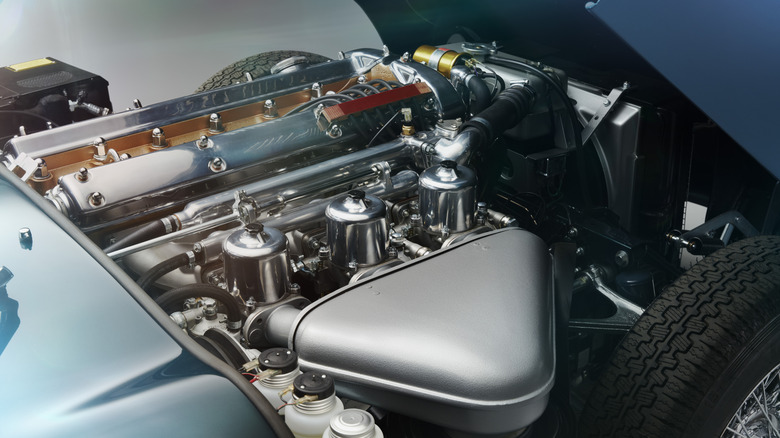
If someone says the word "hemi," what most often comes to mind is Chrysler's family of HEMI engines. Dating back to 1951, the HEMI found its way under the hoods of dozens of vehicles, including family cars like early Desotos, Dodge and Plymouth trucks, and infamous muscle cars. But the Chrysler HEMI isn't the end-all, be-all of hemi engines; quite a few other manufacturers dabbled in the configuration. Even Ford had its very own hemi V8, namely the 429 cubic-inch big block found in the Boss 429. But there were also many non-American engines with hemi heads, such as the ones we'll discuss here.
What, then, is a hemi head, exactly? Firstly, there are two different kinds: a hemi and a "semi-hemi." Modern Chrysler HEMIs are the latter; they're not true hemis, but rather semi-hemis. But the basic concept is the same: the engines use a rounded combustion chamber, allowing for more complete fuel burn at high revs, reducing heat loss by optimizing surface area, and providing room for larger valves. This principle remains at the core of the modern Chrysler HEMI, though it's by no means exclusive to the American company.
Because it's simply a cylinder head configuration, other companies may use hemispherical-shaped designs, though only Chrysler can use the trademarked "HEMI" name. So you won't find any special badging on non-Chrysler cars with hemi engines, though the hallmarks tend to be the same: sports-oriented production cars that excel at spirited, high-RPM driving, with a couple of exceptions. Let's have a look at some of these engines and the vehicles they powered, some of which were in production for decades.
Aston Martin V8
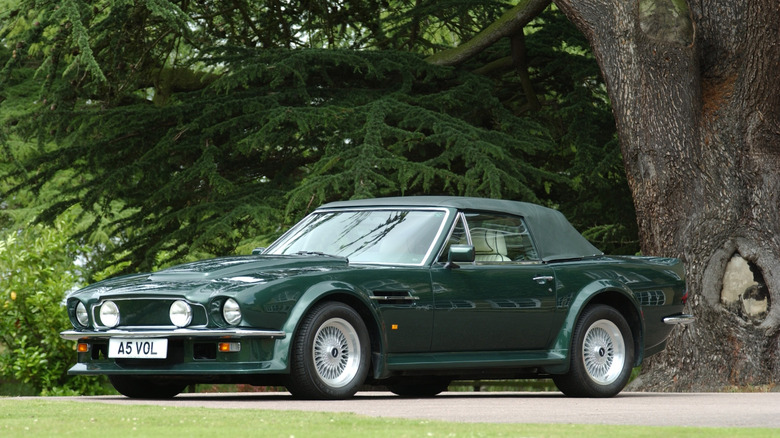
The Aston Martin V8 is inexorably linked to the car that shares its name. The British company developed the V8 during a soft hiatus from motorsports spanning the early 1960s to the 1980s, when it focused on producing world-class powertrains that could compete with and surpass European rivals like V12-powered Ferraris, nimble BMWs, and technically-advanced Mercedes.
Aston Martin's entry into this arms race was arguably Great Britain's first ever true supercar: the 1977 Aston Martin V8 Vantage (no, not the modern Vantage — though that's also an extraordinary beast). And, yes, it's a hemi, featuring the traditional two-valve-per-cylinder hemispherical combustion chamber design of its American counterpart. The V8, crafted by legendary engine designer Tadek Marek (who also designed the Aston straight sixes), actually predates its titular supercar, first entering production in 1969 with the DBS V8 and ending in 1989 with the original V8 Vantage.
These engines saw virtually continuous development over their 20-year run, starting from a traditional carbureted design and evolving into the 5.3-liter fuel-injected V8 that powered Aston's 1980s flagships. These were grand tourers, designed as two-door coupes with ample power for lazy highway driving at speed, as well as excellent performance. The engines produced some 380 hp in top trim, shy of the infamous 426 HEMI's 425 horses, but potent nonetheless. By the end of its production run, a V8 Vantage could easily approach 170 mph and accelerate to 60 in 5.2 seconds, making it the fastest four-seater in the world at the time.
Alfa Romeo Busso V6
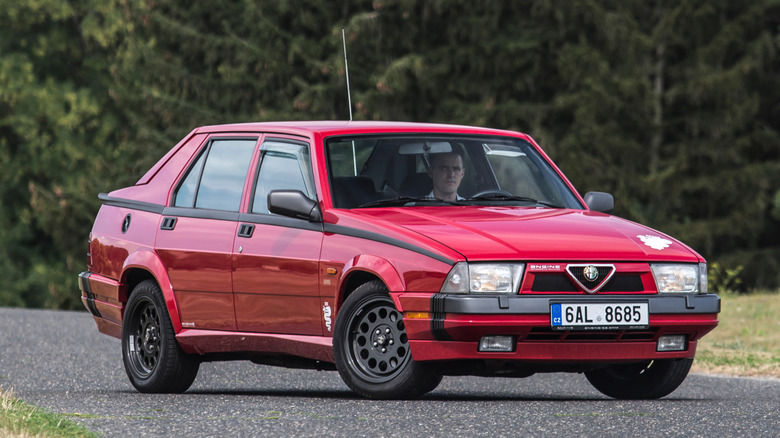
Sometimes known as Alfa Romeo's Violin, the Busso debuted in 1979's Alfa 6 before gaining a reputation as one of the best-sounding engines of all time. The engine's common nickname came from its designer, Giuseppe Busso, featuring either a single- or double-overhead cam configuration with, you guessed it, hemispherical heads. Unusually, while most hemi head designs only accommodate two valves per cylinder, the Busso actually featured either two or four valves per cylinder, as seen in cars like the Alfa Romeo GTV V6 24V.
Unlike the grand touring-oriented Aston Martin V8, the Busso was more of a sporty engine, featuring an aluminum block that could easily make north of 300 horsepower in higher-displacement models. It was more modest, though, with a hybrid SOHC pushrod design that used the latter to operate the exhaust valves. This basic configuration lasted from its debut in 1979 to 1993, when the Alfa 164 debuted with a proper DOHC valvetrain. They were modestly powerful for the time, making between 156 and 247 hp, depending on trim, but their sound and presence made a lasting impression on the enthusiast community.
Interestingly, the Busso was built primarily as a road-going engine; Alfa Romeo had an incredible racing V6 with a similar architecture, but it was not a Busso. That engine, seen in the infamous Alfa Romeo 155 DTM touring car, featured a 90-degree V6; the Busso was a 60-degree unit, one of the reasons for its distinctive sound signature. The Busso V6 was an outstanding engine, albeit one that doesn't have as much recognition in mainstream culture as some others on this list.
Toyota V-series V8
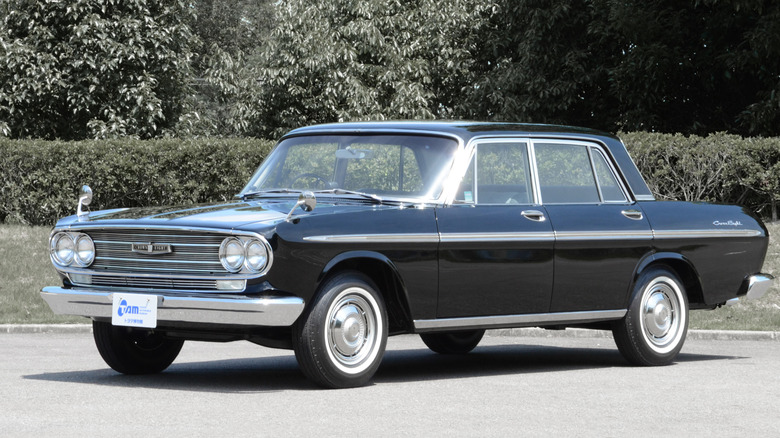
Our sole entry from Japan marks a departure from the typical hemi head powerplant in more ways than one. While we normally associate the hemi head with high-performance applications, Toyota proves that some clever engineering allows it to serve the ultra-luxury segment as well. Enter the V-series V8, the Toyota hemi that seemingly flew under everyone's radar. This unassuming powerplant was a compact, lightweight, modestly-powered V8 powering some of the most prestigious cars that money could buy in Japan, not exactly something that screams "hemi."
At the time, a lot of Japanese public sentiment leaned heavily into American motoring; many designs directly riffed on American cars from the '50s to '70s. From the sportier Prince/Nissan Skyline to the high-end luxurious Toyota Century, one can find echoes of early Westernization throughout this time, and that includes under the hood. In 1963, Toyota launched a new flagship model, the Crown sedan, with a curious new engine. Inspired by the Chrysler FirePower HEMI, this engine was a 2.6-liter all-aluminum block built for comfort, smoothness, and reliability — much like American luxury cruisers of the time, just smaller.
Early engines were relatively modest despite the status that the Toyota Crown commanded, with initial powerplants producing just 114 hp. But the design proved extremely reliable, lasting until 1997 in the same platform and configuration. It had received many upgrades by then, with the final one in 1983 bumping it up to 4.0 liters and 188 hp.
Jaguar XK straight-six
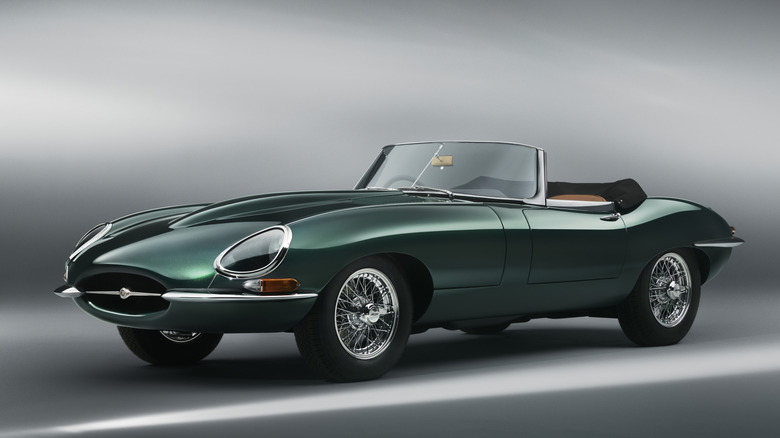
One of the most famous (and arguably best-sounding) straight-sixes of all time, the Jaguar XK — featured in cars like the E-Type – is a hemi engine. Not only that, but it actually predates the Chrysler HEMI by about five years; the Jaguar XK-6 debuted in 1947, and the engine graced its first sports car, the XK-120, the following year. The XK-120 was so named for its 120 mph top speed, an impressive feat for its day. In fact, this engine was so special that it went on to a massive winning streak in Le Mans throughout the early 1950s, cementing Jaguar's racing prowess.
The XK-series straight-six evolved substantially after its introduction. Originally, the engine was actually two separate blocks married together, a common technique for inline engine development, only becoming a solid piece with the 4.2-liter variant found in Series 1 E-Types. The 4.2, arguably one of its most famous configurations, boasted 265 hp, the same as its previous 3.8-liter displacement. It was the torque curve that changed, with its 283 lb-ft of torque giving it better low-rpm grunt.
This engine was the gift that kept on giving for Jaguar. While it first entered production shortly after World War II, the XK block lasted in one form or another all the way until 1992, an astounding run of 45-odd years. And it received substantial modifications over that timeframe — different displacements, fuel injection, and so on. The hemi XK was replaced by the AJ-6 (Advanced Jaguar 6) XK engine, which had traditional pentastar combustion chambers, in 1984.
Porsche air-cooled flat six
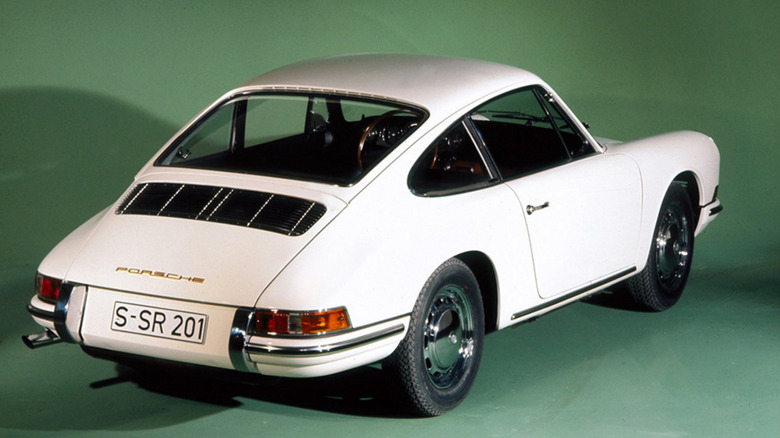
While Jaguar's XK straight-six is certainly a famous and long-lived engine, it's tough to beat Porsche's flat-six in terms of sheer provenance and longevity. Unlike most engines, the flat-six is a boxer design, meaning the cylinder banks sit opposite each other — it's a "flat" engine, hence the name. Originally designated the 901 after the pre-production 911 that housed it, this is possibly the most successful performance engine of all time, and yes, it too is a hemi.
Designed by Hans Mezger and developed in the early 1960s, the air-cooled Porsche flat-six saw countless iterations across the 911 timeline, boasting road and racing variants, forced induction, and even receiving water-cooled heads in Porsche's 935 series of race cars. Its lightweight design and relative simplicity, thanks to the lack of a radiator, launched the 911 into the stratosphere of sports car design, with the engine remaining in continuous production from 1963 to 1996, until the water-cooled 996 debuted in 1997.
As for specs, that largely depends on the era and application; these engines varied wildly, ranging from 148 to well over 800 hp. They were used for virtually everything 911-related, with the core engine remaining effectively unchanged into the 1990s. The final 911 Turbo produced a startling 400 horsepower in road trim from its twin-turbo 3.6-liter flat-six. Porsche's six-cylinder is widely considered one of the ultimate driver's engines, and one that commands immense respect in high-power applications — see the infamous Porsche 930 Turbo known as the Widowmaker for an example.