

5 Used Honda Motorcycles You Should Steer Clear Of At All Costs
For the most part, anything mechanical that comes out of Japan is considered highly reliable, chief among them vehicles. Honda, a company that built its reputation on bulletproof reliability and (relatively) good prices, is certainly no exception. That's what makes its occasional failures all the more surprising. These occasional slip-ups are magnified precisely because they are so rare.
Think about it: in so many decades of producing vehicles, when's the last time someone recommended not buying a Honda bike? When these "failures" (as we're calling them) happen, every disappointed owner will feel personally betrayed.
Buyers would be expecting the same old Honda reliability, fuel economy, and most importantly, riding joy that they had come to expect, and would get a basket of problems instead. It's worth noting that not all the bikes on this list are problematic on reliability or durability grounds, but in all cases, it just doesn't make sense to own that particular model or range of motorbikes. There are bikes with supply chain issues with regard to parts, there are ones that lack experienced labor, and some just have a high risk of having been abused and causing headaches down the line. Some are just plain unreliable. One of these models was an ambiguous experiment that failed spectacularly in the real world. With all that said, here are five used Honda motorcycles that buyers should avoid, unless they really know what they're getting into.
CBR900RR and CBR1000RR
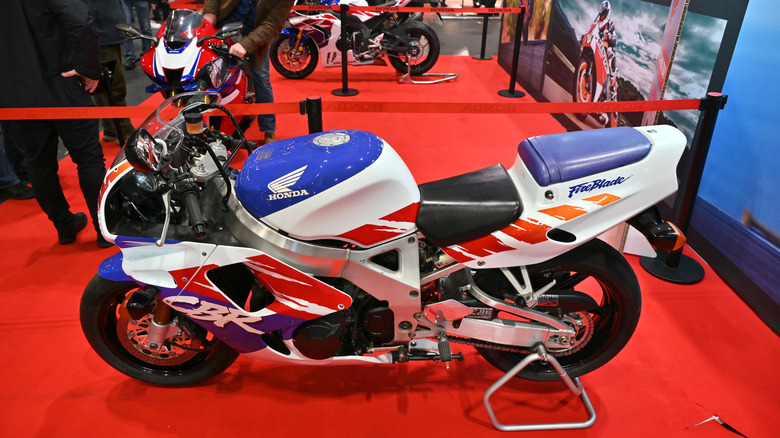
We start this list off controversially, with the legendary CBR900RR and its newer, larger, and more powerful sibling, the Honda CBR1000RR. The 900RR had a displacement of 893 cc, or 55 cubic inches across four cylinders. It achieved this displacement via a bore of 70 millimeters, and a stroke of 58 millimeters, and had a six-speed transmission with chain final drive. This powertrain came together to give CBR900RR a total output of 122 horsepower at 10,500 RPM, and 65 lb-ft of torque at a screaming 10,000 RPM.
For its part, the larger 1000RR had a four-cylinder engine that displaced 998 cc, or 61 cubic inches; mated to a six-speed gearbox that ended up making 172 horsepower at 11,250 RPM, and 85 lb-ft of torque at 10,000 RPM. As for the problems: the duo was, at heart, meant to zip around race tracks, pushing engines and mechanical components to the limit. The fact that the two bikes remained road legal is nothing short of witchcraft; and therein lies the rub.
Over the many years that the 900RR and 1000RR have been out, there's too much of a chance of something going wrong after just a short period of ownership. As with any specialized vehicle, parts, documentation, and labor will be extremely hard to come by. Buyers who are eyeing up one of these should take any claims of the bike having been "babied" with a grain of salt.
DN-01
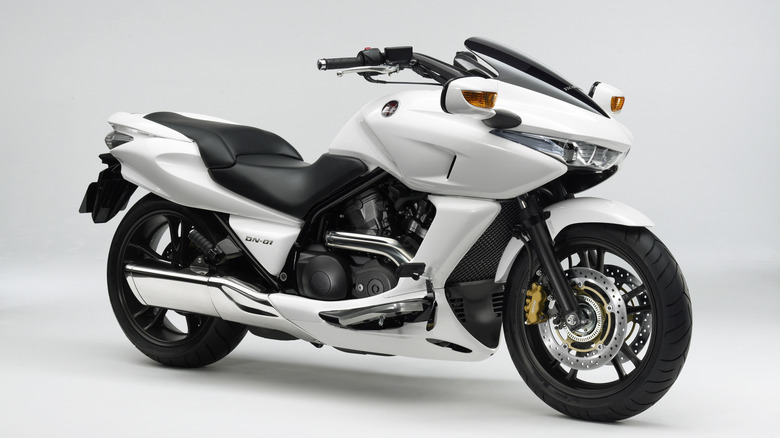
The name stands for "Dream New," with 01 being the first concept within the Dream New line of bikes from Honda. At the time when it was first unveiled in 2009, it came with something new called an "HFT," or human-friendly transmission, that was basically a CVT with some bits and bobs attached. For the uninitiated, a CVT, or Continuously Variable Transmission tends to drop traditional cog gears for a belt that can vary its width, and this tech has continuously, pun intended, proved to be unreliable. Reputations of CVTs aside, if and when a DN-01 comes up for sale (since not very many were sold to begin with), good luck finding parts, and more importantly, labor that knows how to work on these things.
Not only are CVTs more complicated than regular transmissions, Honda only put the HFT in one other model, which was a four-wheel ATV bike. That means there's basically no chance of cross-populating spare parts from junkyards or other models. The design was bad too, looking more like a scooter with large wheels than a bike, which was just another con of owning one of these. In terms of the actual engine itself, it was a 680 cc, or 42 cubic inch twin-cylinder liquid cooled unit with overhead cams. It made 60 horsepower at 7,500 RPM, along with 47 lb-ft of torque at 6,000 RPM.
CR450R
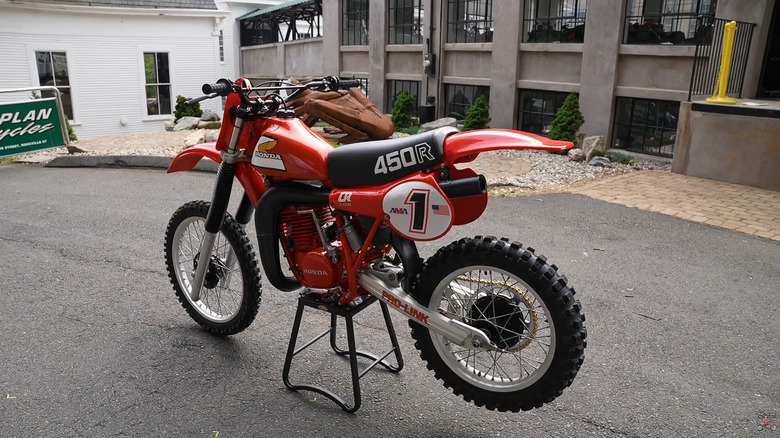
Next up, we have the CR450R, which is one of those legendary 1980s Honda motorcycles that was quite the looker. Sadly, it was also the first bike that was offered in the open category (of motocross racing) by Honda, to the public. It debuted in 1981 at a time when motocross and motorcycle racing was all the rage and had a 431 cc one-cylinder engine. This would be mated to a four-speed transmission, and made 52.9 horsepower along with 42.6 lb-ft of torque, and featured 14-into-54 toothed chain final drive. Honda bikes, like the RC450 and N500, had been absolutely dominating in their respective championship series.
It's safe to say that the world was waiting with bated breath for this bike. However, it flopped– not least because Honda had been lazy with the design and engine. Remember that the alleged 450 cc engine was actually 431 cc, and was actually just a bored out block from the CR250 range of bikes.
The engine would stall quite frequently, and the time it took for gears to change(because of the weird transmission ratios used on the CR450R) would often result in problems for the rider. As a result of all that, the CR450R was a terrible bike to have overall, and is best to be eschewed in favor of something else, such as the fairly-improved (but still average) CRF450R or Honda CRF450RL.
GL1500 and GL1800 Honda Gold Wings
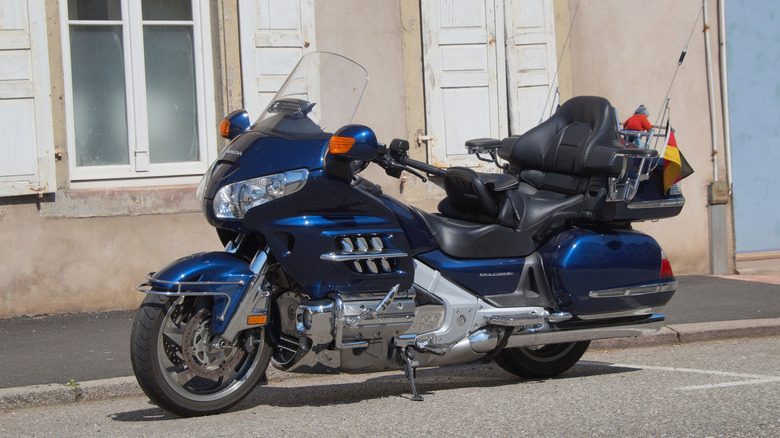
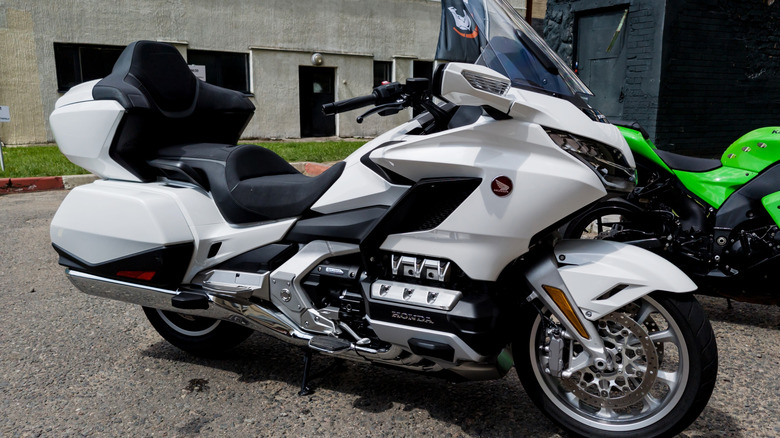
The Honda Gold Wing really showed the rest of the world, and most importantly, showed the U.S., that Japan could very well keep up with the products from Harley-Davidson, Indian, and other big American brands. However, while undoubtedly a legendary motorbike, the Gold Wing can be compared to the Range Rover of bikes. It's big, luxurious, and expensive, but also exorbitant to maintain. Certain model years and generations are to be avoided at all costs. Chief among those are the GL1500 and GL1800 generations, with the main problems on the older GL1500s being related to the carbs, failing gears, instrumentation, shot alternators, and most electronics.
Furthermore, all Honda Gold Wings that were manufactured at any point after 2018 were also recalled at least once for replacement of a bolt that could come loose and wreck the engine. There was also another recall for many GL1800 Gold Wings made after 2020 because a fuel pump impeller was acting up and not letting fuel into the engine. That is not to say that every single Gold Wing will turn out to be a lemon; it can be a very rewarding bike, but only if buyers know what they're getting into, and the things to look out for. For those wondering, a modern 2025 Honda Gold Wing would come with a 1,833 cc six-cylinder engine that makes 120 horsepower and 126 lb-ft of torque, and ships with an MSRP of $25,500. There is also a $775 destination delivery charge.
Anything from the early VF range
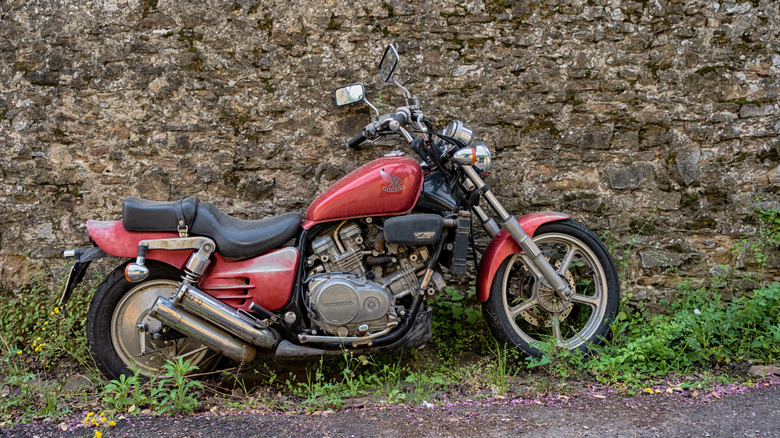
The VF series of bikes are also particularly problematic, and for a number of reasons. First and foremost, some readers will (unfortunately) be familiar with the term "chocolate cams," which is the perfect metaphor for this bike. The key issue was that, on bikes like the VF750, the camshafts would be prone to premature and frequent wear, leading to them failing.
Among the many components that can cause issues with the cams, owners report having the most trouble with the tappets and the cam chains themselves, and there were also several instances of the valve adjusters playing up too. This is a pity, because the VF750 that we're using as an example shipped with a fairly performant 748 cc four-cylinder engine that had a bore of 69 millimeters and a stroke of 48 millimeters.
This would be slotted in with a six-speed transmission with shaft final drive, making 79 hp and 49 lb-ft of torque; all figures for the debut 1982 model year. There can realistically be no real solution to improper camshaft design, at least no solution that is cost-effective for the owner or buyer. This necessitated expensive, frequent fixes that would have probably been out of pocket for the unfortunate owner. The only other option would have been to ride the ostensibly sporty VF range bikes like they were commuter scooters, which is not a very desirable outcome at all. As such, readers are advised to steer clear of any VF-range motorcycle unless an experienced mechanic is within one's circle.
Methodology
We approached this article by asking, "What could make so-and-so Honda bikes a pain to own?" – which turned out to be a simple question with a complex answer. When we'd shortlisted motorbikes for our initial research, we first looked at in-depth expert reviews, such as those from MotorTrend and CycleWorld, before moving on to YouTube.
More often than not, we found valuable information in YouTube videos about repairing that particular model, such as parts that tend to fail together or hard-to-find parts. We also took a long, hard trawl through online owner forums, and readers would be surprised by how many are tailored to a particular model or generation with found pain points that needed addressing. Finally, we put all of this together, and, where needed, we looked at reliability data from trusted websites like J.D. Power and ConsumerReports; before making our observations.