

5 Of The Best TVs That Buyers Loved In 2025
We may receive a commission on purchases made from links.
Back when CRT tube TVs were all we had, technical details like nits, local dimming zones, and refresh rates didn't matter much. You just needed to pick a set that could fit into your entertainment cabinet, check the price, and figure out a way to haul it home without breaking your back. Today, things are more complex. Technical details have become important features to look for when buying a TV.
The upside is that evolving tech has made TVs much wider, lighter, and better. You can almost simulate a cinema experience in your living room with the right one. However, the challenge of finding right one means reviews are almost as important as specs these days. Some TVs check all the boxes on paper with over 1,000 nits, full-array dimming, and 120 Hz, but the moment you hop on a forum like Reddit to see what others who've bought it think, the threads are discouraging.
Suddenly you're back to square one, trying to find another model that people who've used it actually like. To help you avoid the back and forth, we've rounded up the very best TVs that buyers loved in 2025. Some of them are pricey, but their buyers confirm good value — don't worry, we've also included budget options that don't compromise on quality either.
Samsung S95F
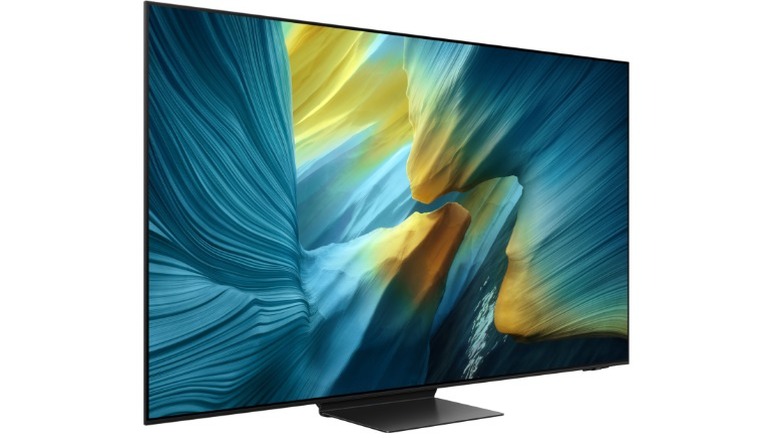
OLED TVs have become increasingly popular over the years because of how well they handle black levels, contrast, and color. But while these arguably offer the best way to simulate a cinema experience at home, the moment there's ambient light — whether from sunlight through the blinds or overhead lights — most OLEDs struggle with reflections.
That's where the Samsung S95F stands out. It uses a matte anti-glare screen many buyers confirm allows you watch a show in the middle of the day with the blinds open or lights on without squinting or adjusting your position on the couch. So, if you've been looking for the best TVs for a bright room, here's one. For the gamers, the S95F equally delivers 4K resolution at up to 165Hz refresh rate across all four HDMI ports. Pair that with the OLED's naturally vibrant colors and an input lag of around 9.5ms, and you've got a setup that one Amazon reviewer calls a "gamer's dream." According to them, the TV was "tailor-made for both console and PC gamers."
That said, there are two things you should know before you add this item to cart. First, Samsung still doesn't support Dolby Vision. Instead, you get HDR10 and HDR10+. The other thing is Samsung's AI processor, which can occasionally over-enhance colors. However, you can customize it or simply switch to Filmmaker or Movie mode for more accurate picture quality. The S95F is available in 55-inch, 65-inch, 77-inch, and 83-inch models, with prices ranging from $1,800 to $4,400 depending on size.
LG G5
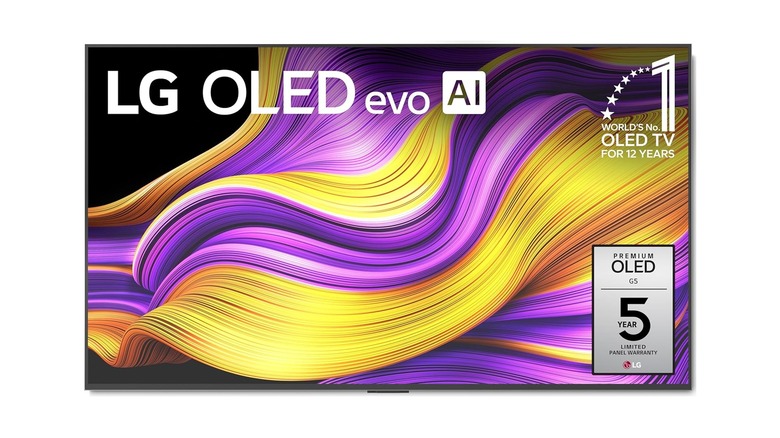
If you're spending over $2,000 on a premium TV, you'd rightfully expect it to support every major HDR format. After all, when studios produce content for streaming platforms, they master it in specific HDR formats. However, Dolby Vision has become one of the preferred standards for much of today's premium content. A TV that supports Dolby Vision can automatically adjust brightness and contrast in each scene so you see it exactly as the creator intended. Without it, the TV falls back to HDR10, which can still look excellent, but it's more static.
Since the LG G5 supports both Dolby Vision and HDR10, you won't have to worry about things not looking as great as they should. The LG G5 also supports major gaming technologies like Nvidia G-Sync and AMD FreeSync, VRR, and full HDMI 2.1 across all four ports. The TV's glossy screen preserves the perfect black levels OLED screens are known for. Glossy screens typically don't handle reflections particularly well, so LG's solution was to dial the brightness up with its new Primary RGB Tandem OLED panel.
By doing this, LG created the brightest OLED TV on the market. It doesn't completely get rid of the mirror effect, but it helps the screen remain vivid in the ambient light. Some buyers appreciate this as well as the fact that the TV ships with a slim wall mount. Notably, the lineup has expanded to include a 97-inch model. Of course, that means you could end up spending anywhere from $1,500 to $20,000.
Panasonic Z95B
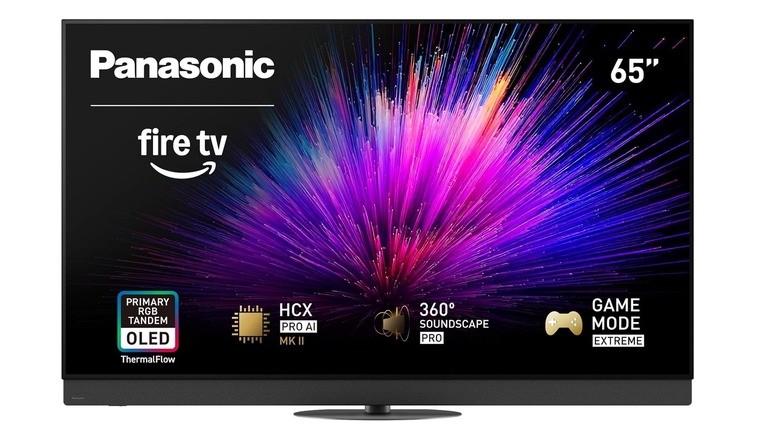
In recent years, Panasonic hasn't placed very high among the biggest smart TV brands when ranked by customer satisfaction. However, the Panasonic Z95B has scored points with buyers that took the gamble. According to one Amazon review: "If you want the latest screen technology, tandem OLED, and incredible sound, get this TV." That's a strong claim, but it checks out. For starters, the Z95B uses the same RGB tandem OLED tech as the LG G5. And unlike many OLEDs in the same class, it supports both Dolby Vision and HDR10+.
However, the one thing that stands out to most buyers is the audio. It's designed with a Dolby Atmos sound system tuned by Technics, and features with a subwoofer built directly into the chassis. Combined with Panasonic's Sound Focus feature, which allows directional audio control, you get an immersive experience streaming sports, movies, or even YouTube DJ sets, from nearly every angle. After hearing it, some users have reconsidered bothering with a separate soundbar.
The Z95B also includes a built-in game bar, support for Nvidia G-Sync and AMD FreeSync, 4K at 144Hz, and variable refresh rate. But you only get two HDMI 2.1 ports. Similarly, the TV is only available in three sizes: 55 inches, 65 inches, and 77 inches, with prices starting from $1,800. Each model runs on Amazon's Fire TV interface, which is one of the few polarizing features. Some people appreciate the deep integration with Prime Video and Alexa, but others find it cluttered and ad-heavy, compared to Google TV or Roku.
Hisense U8QG
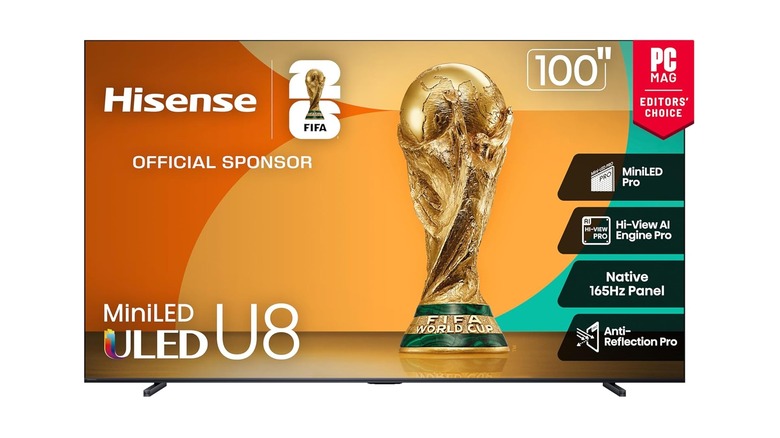
Now, the very best TVs money can buy all happen to be OLED displays with pretty expensive price tags. However, there are great experiences to be found in cheaper territory. If you're looking for a TV with impressive performance under $1,000, start with the Hisense U8QG. It's a mini LED TV available in five sizes ranging from 55 inches to 100 inches, with pricing between $750 and $3,250.
Given the difference in price between this and a high-end OLED, it'd be easy to think you're missing out on a lot. But most buyers never feel that way, because the U8QG is versatile enough for streaming, sports, and gaming. It runs on Google TV, which means easy access to all major streaming platforms along with Google Cast, Apple AirPlay, and built-in Google Assistant. It also supports all the major HDR formats as well. As for picture quality, that's where you start to feel like you're getting good value for your money.
The display is extremely bright, the colors are vivid, and skin tones look natural. Although some reviewers have pointed out that it occasionally crushes shadow details in darker scenes, it's not so bad that it renders the streaming experience unenjoyable. Besides, there are settings you can change to get around it. For console gaming, the U8QG includes three HDMI 2.1 ports that supports 4K at up to 165Hz, along with VRR and AMD FreeSync Premium Pro. There's also a separate USB-C DisplayPort input for PC gaming, but it doesn't support VRR or HDR.
TCL QM7K
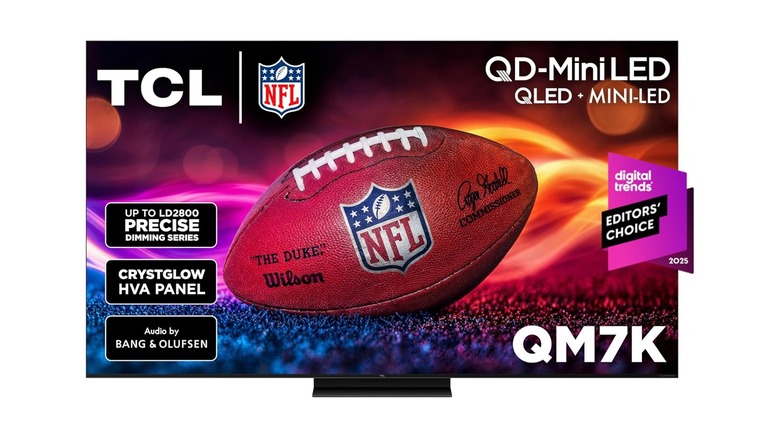
The TCL QM7K is a mini LED TV that IGN describes a mid-range that feels high-end. And if you go through the reviews on Reddit and Amazon, buyers seem to agree. TCL offers this model in practically every size you could want: 55-inch, 65-inch, 75-inch, 85-inch, 98-inch, and even a massive 115-inch model. Prices start at $570, and even the largest screen stays under $10,000.
At that price, you get a seriously bright display. The QM7K's mini LED panel delivers luminance levels that rival, and often exceed, many premium OLED TVs. That makes it a suitable choice for bright rooms. It also supports Dolby Vision IQ, which automatically adjusts brightness based on your environment, along with Dolby Vision and HDR10+. For most viewers, the picture quality feels excellent for the price, with punchy highlights and solid contrast. It's no slouch in the gaming department either. You get 4K at 144Hz and it can even push up to 288Hz if you're willing to drop the resolution to 1080p.
What you won't get is ATSC 3.0 support, and although the audio is powered by Bang & Olufsen, it's not exactly a substitute for a dedicated sound system. It's perfectly clear for dialogue, but you'll likely still want a soundbar to match the scale of the picture. If you do have a bit more wiggle room in your budget, the QM8K or QM9K models are worth a look. they offer marginally better performance, but when it comes to value for money, the QM7K is hard to beat.
Methodology

We reviewed lab tests and reviews from trusted tech publications, including RTINGS, CNET, Tom's Guide, TechRadar, Digital Trends, and What Hi-Fi, paying close attention to brightness, contrast, color accuracy, motion handling, input lag, and overall ratings. However, we didn't want to get bogged down in technical details — what matters most is how these results translates into utility in your home. So, we crosschecked those expert evaluations against feedback from users on Reddit, YouTube, and Amazon.
We do understand that no TV is perfect, no matter how novel the technology or how expensive it is, and even the models highlighted above have received their fair share of complaints. However, if the TV checks a few essential boxes, it's usually good to go for most people. With that in mind, we weighed price against performance to identify the models that, for most buyers, consistently delivered the most value.