

A Snowy Week With The CX-30 Showed Where Mazda's Cheapest AWD Model Shines
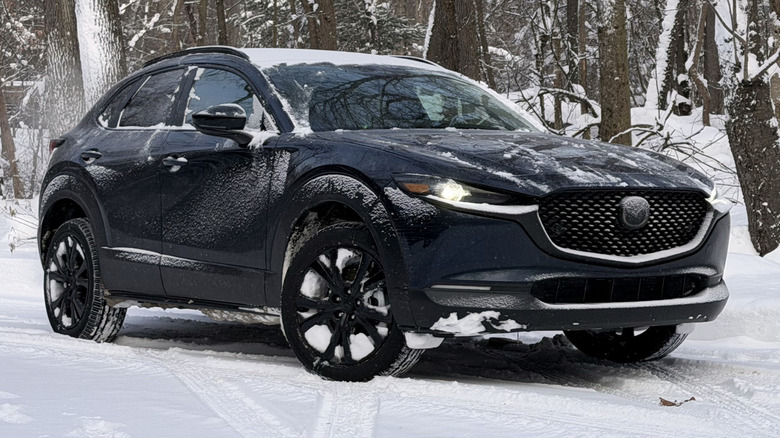
I wish I could tell you what the 2026 Mazda CX-30 is like on dry roads, in sunny weather. After all, the Japanese automaker's smallest SUV certainly looks the sporting part, with hints of MX-5 Miata and echoes of the now-retired-but-still-appealing "Zoom-Zoom" ethos. Unfortunately, Midwest weather was not playing ball.
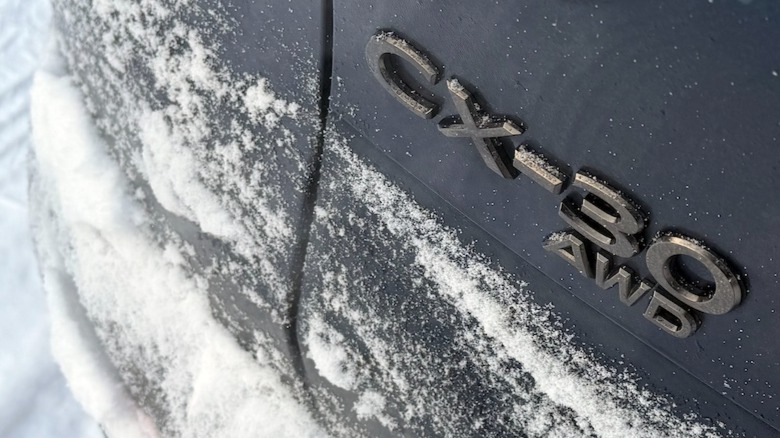
Instead I had ice, snow, and a set of Bridgestone Turanza EL440 all-season tires to go with the CX-30's standard all-wheel drive (AWD). I also had the optional turbocharged engine. Ownership kicks off at $27,470 (including $1,495 destination) with Mazda's naturally-aspirated 2.5-liter inline-four, good for 186 horsepower and 186 pound-foot of torque.
 Chris Davies/SlashGear
However, from the 2.5 Turbo Aire Edition (from $35,905) and up, Mazda slots in its 2.5-liter turbo-four. Supplied with 93 octane gas, and that's good for 250 hp and 320 lb-ft; restrain yourself to mere 87 octane, and those numbers dip to 227 hp and 310 lb-ft. Regardless of engine, there's a six-speed automatic transmission.
Looks good, lacks practicality
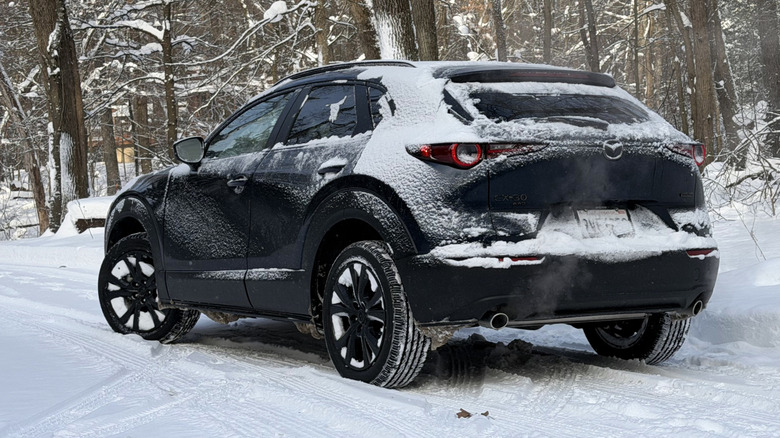
The CX-30 may be five inches longer than the CX-3 it effectively replaced, but it's still on the small side for a crossover. In fact, it's almost three inches shorter than the Mazda3 Hatchback, and exactly the same width, though several inches taller.
 Chris Davies/SlashGear
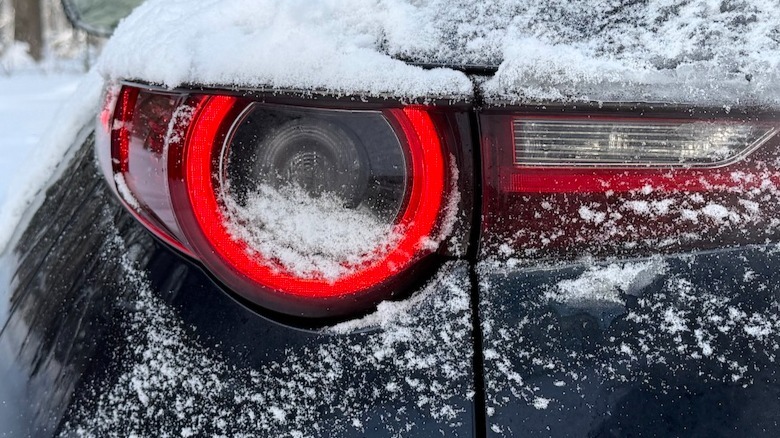
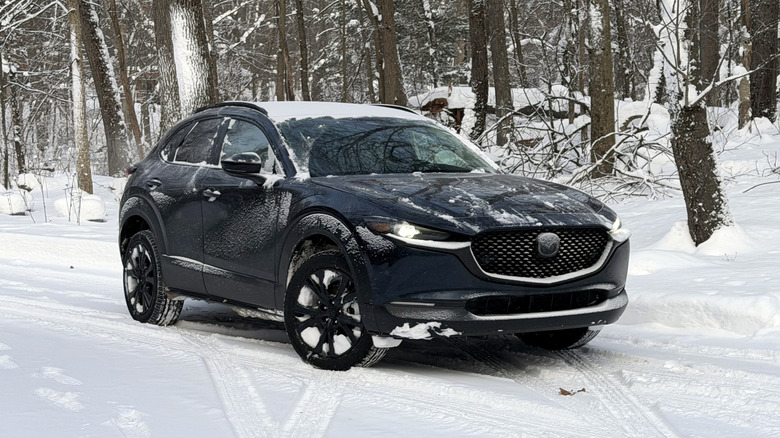
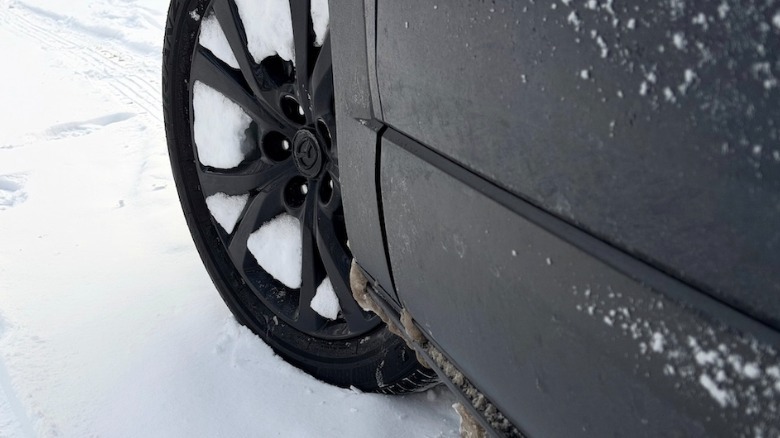
Even crusted in winter crud, it's a good-looking car. Mazda's sheet metal flirts effectively with creases and swoops, while the black cladding around the lower body and wheel arches — though extensive — stops the CX-30 from resembling a puffed-up Mazda3. While the base trim gets 16-inch wheels, the rest kick that up to 18-inches with a variety of designs and finishes. For this new-for-2026 Aire Edition, that means black metallic.
 Chris Davies/SlashGear
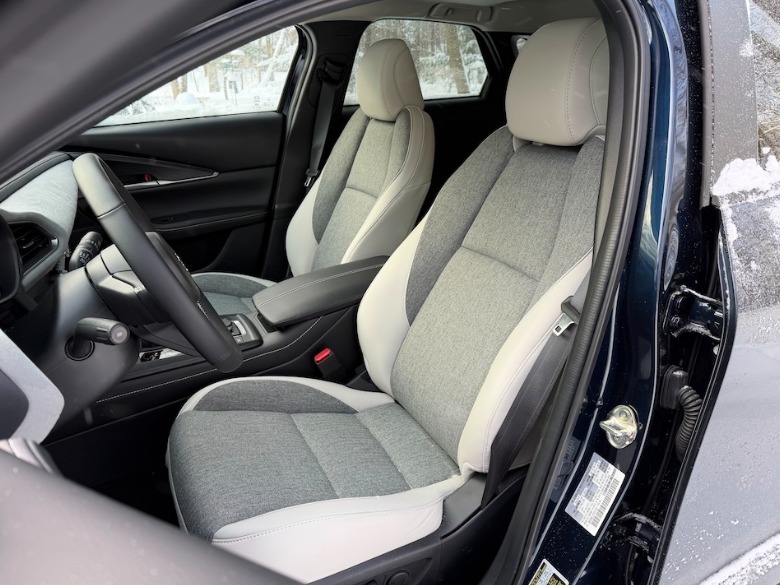
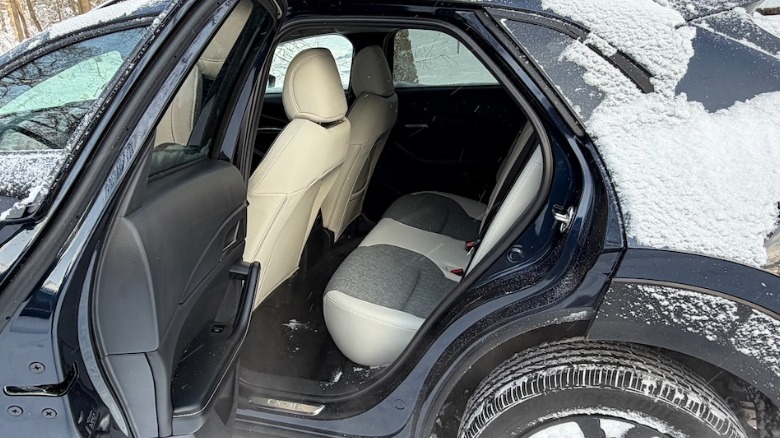
Inside, the diminutive dimensions bite as expected. Space in the front is fine, but the 36.3 inches of rear legroom are decidedly snug (even if you do get slightly more than in the Mazda3 Hatchback). Kids, yes; if you want to transport teens or adults on the regular, you'll want to look to at least the CX-50 (which has 3.5 inches more leg space in the back). The same goes for trunk space, with the CX-30 offering a compact 20.2 cubic-feet with the rear seats upright.
A cabin that punches above its class
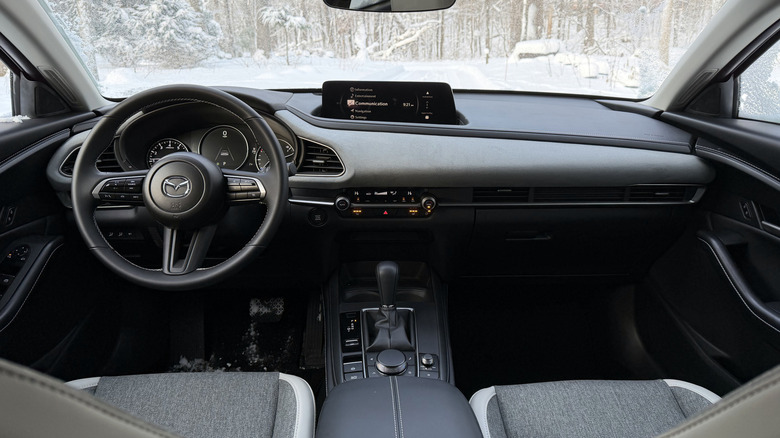
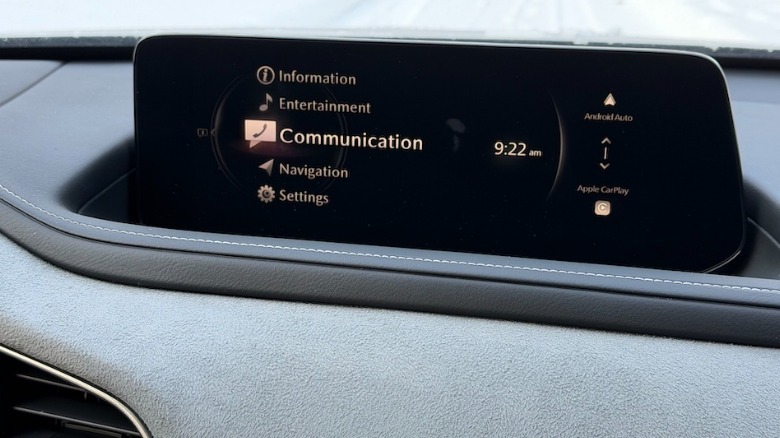
Compact, then, but there's no denying Mazda's cabin is a pleasantly designed place to find yourself. Only the base model misses out on dual-zone climate control and makes do with cloth seats along with wired Apple CarPlay and Android Auto for its 8.8-inch infotainment display; trims above that get wireless smartphone projection, with a wireless charging pad on the Preferred and above. From the non-Turbo Aire Edition up, there's a larger, 10.25-inch display, leatherette trim, and heated front seats.
 Chris Davies/SlashGear
Beyond the non-Turbo Carbon Edition there are leather seats and a 12-speaker Bose audio system, while a heated steering wheel arrives on the S Premium and up. All trims get a 7-inch driver display; only the flagship 2.5 Turbo Premium Plus enjoys SiriusXM satellite radio.
 Chris Davies/SlashGear
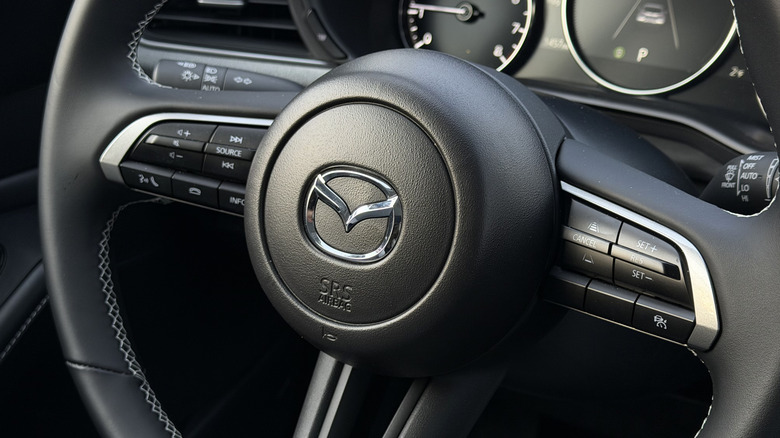
In this non-turbocharged Aire Edition (from $31,345 including destination) my chilled hands missed the steering wheel heating, but they did enjoy stroking the gray faux-suede on the dashboard. It's a little like petting a very patient hamster. You can't argue with Mazda's switchgear, either: knobs that are tactile and firm; buttons with a precise, premium action; and a general sense of competing with cars in the price segment above.
The non-turbo engine is fine, but nothing more
Setting impressive 0-60 times was not my goal, given the road conditions for most off my time with the 2026 CX-30. Then again, the naturally-aspirated engine isn't exactly built for speed. It's perfectly adequate for city driving but gets noisy on the highway — a seventh gear definitely wouldn't hurt, here — and overtaking requires more pre-planning than in Mazda's turbocharged alternatives.
 Chris Davies/SlashGear
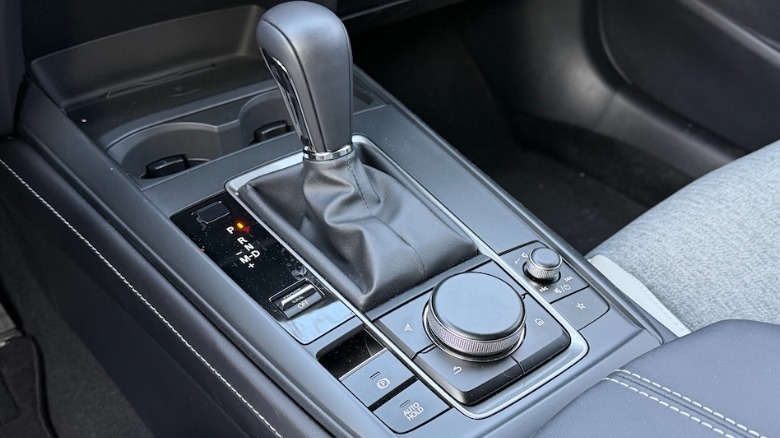
There's a Sport mode — which impacts throttle response — but no setting for snow or low-traction conditions. Happily, though, the little crossover handled the snow and ice with aplomb, and while I'd always recommend actual winter tires rather than all-seasons if you live in a cold weather state, the combination of AWD and the Turanzas proved surefooted. Only paddle shifters for sticking with lower gears would've been welcome; instead, you have to do that with the shifter's manual mode.
 Chris Davies/SlashGear
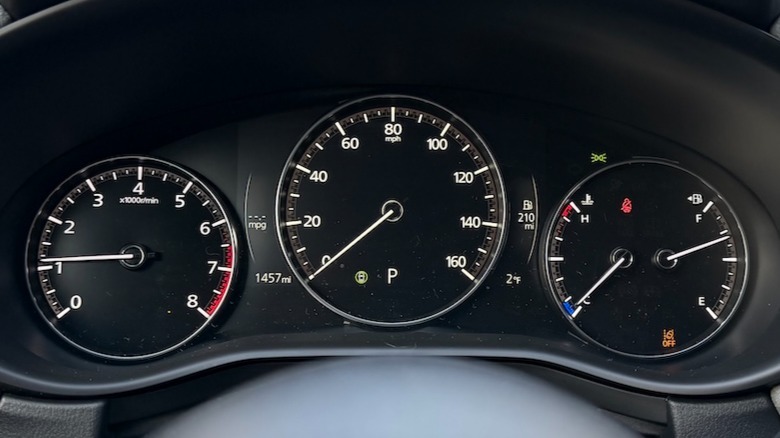
My more-cautious right foot likely helped with economy. Officially, Mazda and the EPA rate the non-turbocharged CX-30 at 24 miles per gallon (mpg) in the city, 31 mpg on the highway, and 27 mpg combined; the turbo version dips to 22, 30, and 25 mpg respectively. My own, mixed driving came in at 29 mpg. Unlike with the CX-50 Hybrid, Mazda doesn't offer an electrified version of the smaller crossover.
2026 Mazda CX-30 verdict
A lot gets said about the shift of American drivers to SUVs, and a general sense of people buying more car than they truly need. Certainly, the Mazda3 Hatchback is ever so slightly cheaper, and has an (excellent) manual transmission option, but if your requirements include all-wheel drive — which only lands once you're just north of $32k in the hatchback — then the CX-30 is a cheaper way to attain it. It's also slightly more spacious inside.
Regardless, the larger CX-50 is probably a better choice for families, albeit a costlier one. And come spring's thaw, I suspect I'd definitely be missing the turbocharged engine in the CX-30. More power in this little crossover definitely makes it more pleasant to live with day-to-day, and in those moments where you've got time to take the slightly longer route via the backroads.
 Chris Davies/SlashGear
For AWD on a budget, without sacrificing style and with a cabin experience above the class, though, the CX-30 hits a lot of highs. You'll trade some practicality for the design, but it's a compromise I suspect plenty of drivers would be okay with for a crossover with more personality than its peers.