

I Don't Like Tech In My Cars, But This Solar-Assisted Dash Cam Changed My Mind
We may receive a commission on purchases made from links.
I love cars and have for as long as I can remember. My ideal ride is a sharp-dressed station wagon of some ilk with a manual transmission. And, as it turns out, something that is decidedly analog. Cars from the 1960s are certainly in that vein, but require a bit too much effort when it comes to my daily life as a dad of three. Which is where my 2016 Mazda6 comes in. It's new-ish, has a 6-speed stick, comes with zero driver aids, and — crucially — lacks a giant touchscreen.
That lean into analog simplicity largely centers around my preference to just drive, and skip the tremendous array of high-tech distractions so prevalent in the modern automobile. Some of the most mammoth screens found in higher-end cars are impressive, but they're not for me. I'm not a complete luddite — I do carry a smartphone — but when I'm behind the wheel, I feel a desire to be disconnected, so to speak.
Hence, my general disinterest in a tech-heavy ride with all the latest vehicular gadgets. Plenty of driver engagement and a thumping stereo is more my jam. So, when given the opportunity to put a fairly high-tech Baseus dashcam (provided by Baseus for this test) through its paces, my initial thought was, "Nah." But even analog-only drivers have to try something new every once in a while — and I'm glad I took the plunge.
The solar-powered parking surveillance selling point
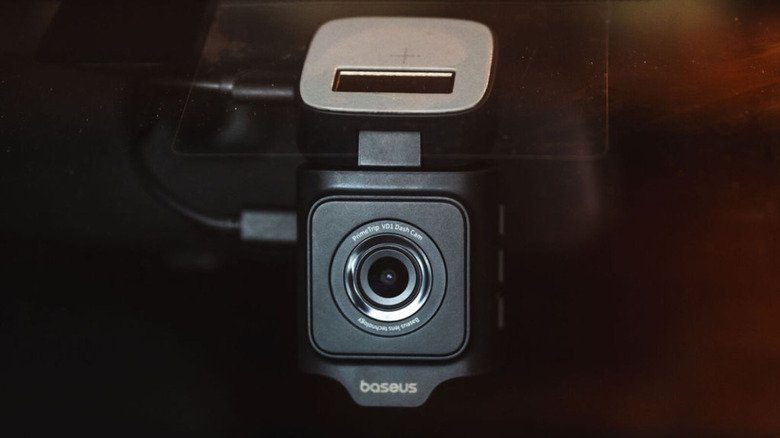
Baseus' big selling point for its PrimeTrip VD1 Pro dash cam is the parking surveillance system powered by the sun. Not exactly up to snuff on the dash cam industry, I have recently learned that this type of dash cam feature tends to require a hard-wire installation among competitors. The general idea is that when someone hits your car hard enough to trigger an integrated G-sensor, the camera activates and captures what's going on outside the car. This, obviously, only works if the dash cam has power.
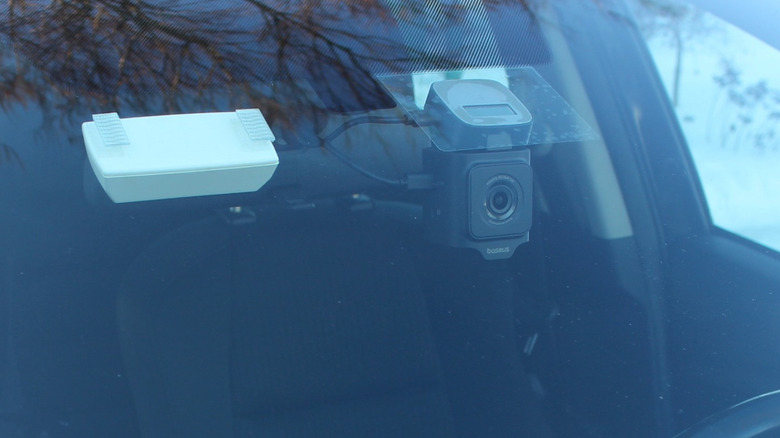
In the past, this meant running a wire to your car's fuse box, which is perhaps not something everyone is comfortable figuring out. So, Baseus offers a clean workaround by fitting a small solar panel atop the VD1 Pro front camera. Given its mounting location, when you're parked outside, that panel can keep the built-in battery pack charged. Frankly, I thought having a dashcam would be interesting and entertaining to simply capture all the terrible driving witnessed on the road every day.
But, as any driver can no doubt relate, there's nothing worse than finding your car scratched, dinged, or seriously damaged in a parking lot. Thankfully, I did not experience such an incident while testing this Baseus dashcam. However, I can tell you that slamming the trunk hard enough will trigger the parking surveillance mode, so I feel confident it would work as advertised, and I appreciate the peace of mind that comes with it.
Installing a dash cam is more fun (and easier) than I expected
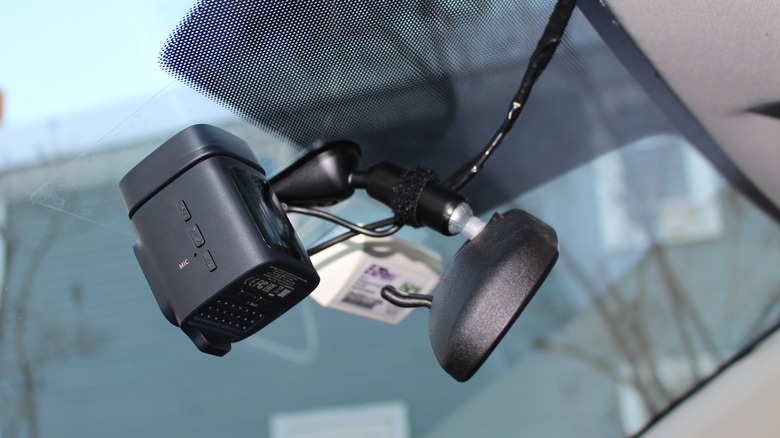
Though I may not be a fan of most new tech in my cars, I do have a long history of audio installations, and as my fellow car nerds will attest, this is a good time. Something about carving out a few hours on the weekend to carefully test fitment, route cabling, and perform the final touches of car-based electronic installs is, well, fun. To be clear, one could just stick the Baseus dash cam to the inside of the windshield, connect it to the USB-C power cable at one end, and dangle the other end down to the nearest 12-volt port.
This would be the simplest way to get your cool new car gadget up and running. It would, however, cause great distress to those who find themselves clutching pearls when an unsightly wire is seen within the cabin. Baseus caters to these folks by including a robust trim tool, specifically designed to gently lever trim panels out of the way just enough to lay in the power cord. The PrimeTrip VD1 cam also comes with a rear-facing camera and a cable that must be plugged into the front-facing unit.
Interestingly, there was too much cabling for the backend cam, to the point that I had to bundle it up and bury it under the headliner. Meanwhile, I had just enough up front to route the wiring around my windshield, under the glove box, and into the bottom part of the Mazda's center stack. And that's in a mid-size sedan, so I'm not sure how someone driving a Chevy Tahoe would fare on this front.
What this Baseus camera can (and can't) do
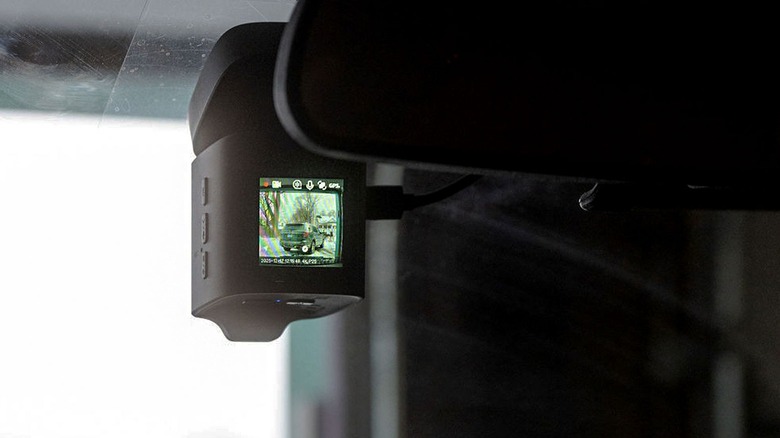
After several weeks of hands-on time spent using the Baseus PrimeTrip VD1 dash cam, I can safely say it works as advertised. With the included 32 GB microSD card, the camera will record four hours of footage before starting an automatic overwrite. The front-facing cam does so in 4K UHD HDR over a 140° field of vision, while the rear-facing unit records in 1080p across 120°. Looking over footage, I can clearly read license plates on vehicles at both ends, and the wide-angle vantage delivers ample coverage of two-lane roads and the shoulders.
Baseus touts the Sony STARVIS night vision technology used in this dash cam, and while I can't pretend to know what an IMX335 sensor is, I can tell you it works great at night, even in sloppy conditions. The 2024 Red Dot award it received for industrial design and smoothly damped hinges should please fans of well-built tech. The only real downside I found with this Baseus cam was accessing recorded footage. You can see it via the Baseus app, which does make it easy to adjust settings. However, viewing the clips requires squinting at tiny images and trying to guess at the right file.
Plus, you can only do so when the system is on and your phone is connected. It's possible to download these files to your phone, but I found it tediously slow. My workaround was buying an SD card reader for a few bucks from Staples so that I could view the files on my laptop. Considering the $180 list price, it'd be nice if this card reader were included as an added convenience.
Why I'm keeping the PrimeTrip VD1 Pro plugged in
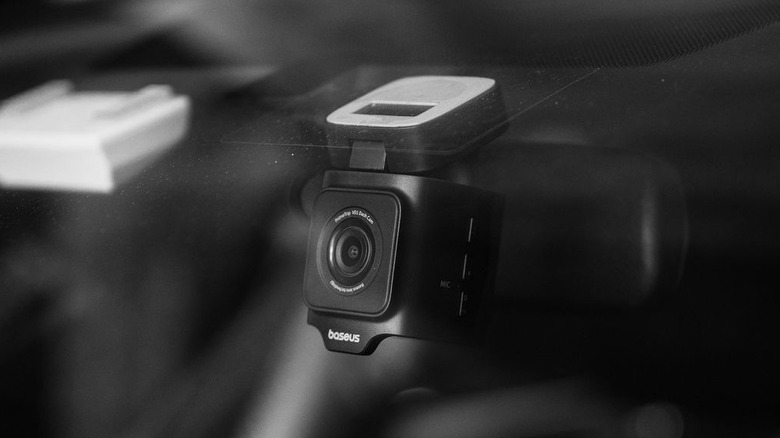
The state of driving skill on the road today is appalling. You see it every day: People staring down at their phones while waiting for the light to turn green and while hurtling along two-lane roads. Or just driving poorly for no apparent reason. But the reasons are irrelevant. The point is, should I end up in a fender bender, or worse, with someone out to lunch behind the wheel, it would be nice to have footage of what actually happened.
Which is why I'll be keeping a dash cam of some sort (maybe even this same model Baseus VDI Pro) plugged in from now on and potentially preaching about dash cams being a must-have car upgrade. I like how it disappears into the background, just humming along while I'm driving, which is partly due to being hidden behind the rearview mirror. Most importantly, it's not distracting me. I may not gravitate towards the latest automotive gizmos, but this system from Baseus has convinced me that some car dashboard accessories are actually useful.