

Driving The 2026 Subaru Outback Wilderness, I Found A Problem Subaru Didn't Expect
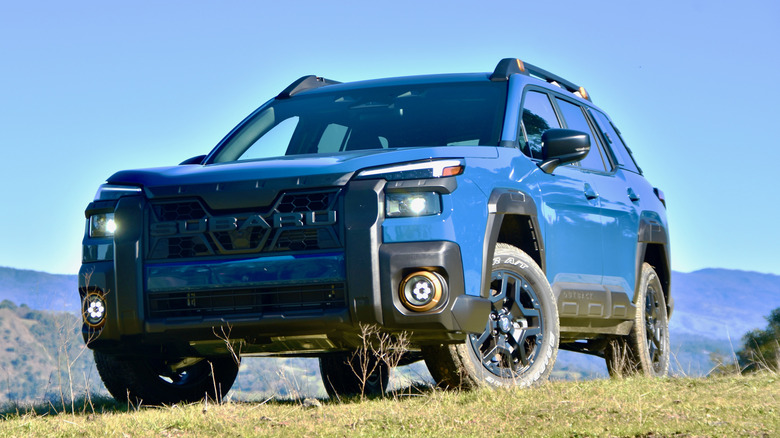
The 2026 Subaru Outback Wilderness completes a transformation of Subaru's rugged wagon that's as surprising as it is inevitable. Since its launch in the 1990s, the Outback has been marketed as an SUV alternative, using standard all-wheel drive and generous cargo space to justify that claim. And while it's always had the distinctive low-and-long profile of a wagon, a raised ride height and prominent plastic cladding have given it a more brawny feel.
But with Subaru—and the auto industry in general—doubling down on rugged vehicles, that was no longer enough. The seventh-generation 2026 Outback adopted SUV-like proportions that make the perfect canvas for the new Wilderness model. The Subaru Wilderness badge signifies greater off-road capability and styling that aims for even more nods of approval in the REI parking lot.
Subaru did a Wilderness version of the previous-generation Outback, but this new model looks dramatically different from any Outback that's come before. However, that difference is only skin deep.
It's cosplaying as a truck
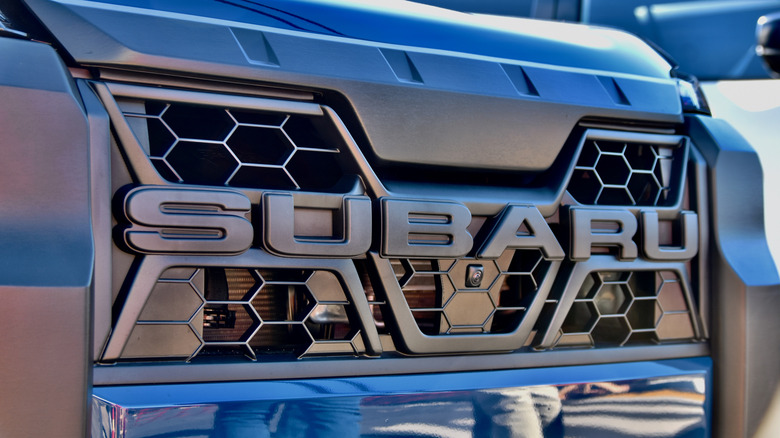
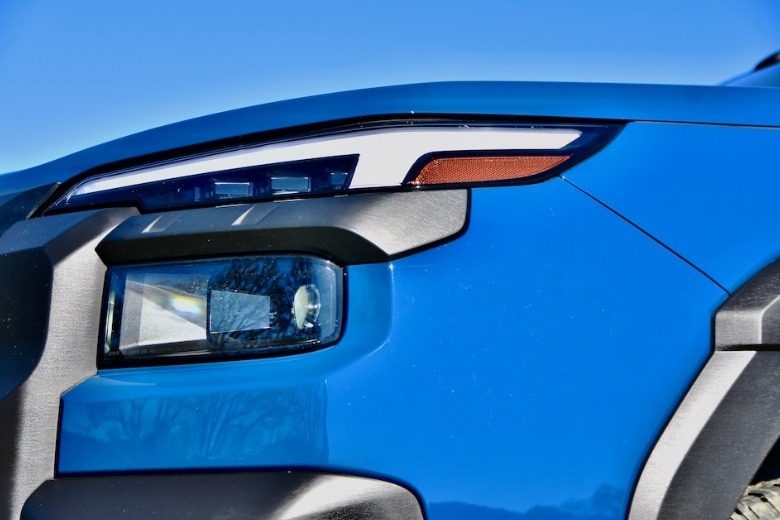
The styling might represent a logical evolution for the Outback, but it's still hard to reconcile with Subaru's cuddly image. This car looks like it wants to punch you, which isn't something one would expect from a brand whose ads are full of love and puppies.
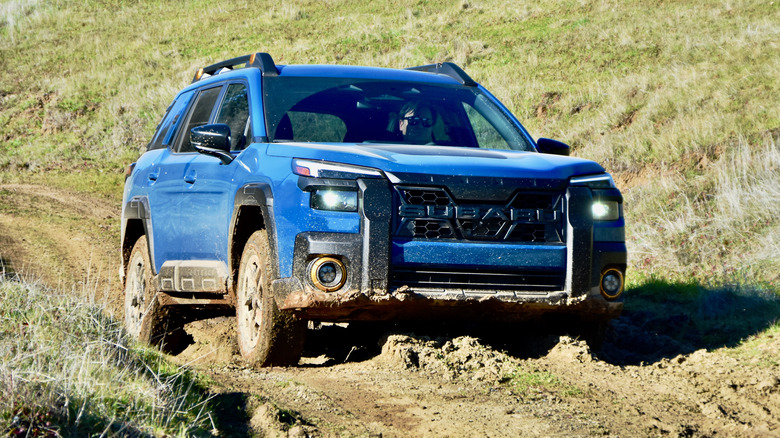
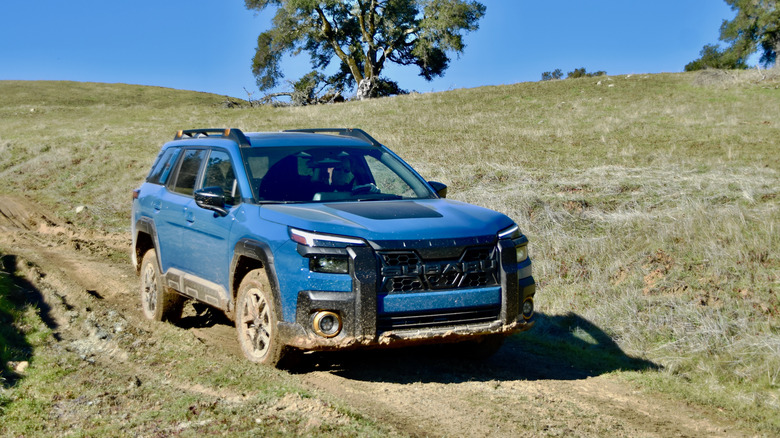
On Wilderness models, the new Outback's more upright front end is filled with an unpainted plastic grille with embossed "SUBARU" lettering. Flanked by scowling headlights, the grille is a derivative piece of truck-like styling ripped off from other brands. Two large vertical elements resemble the push bars on police cars, but don't serve any actual function beyond making the Outback Wilderness look more intimidating.
 Stephen Edelstein/SlashGear
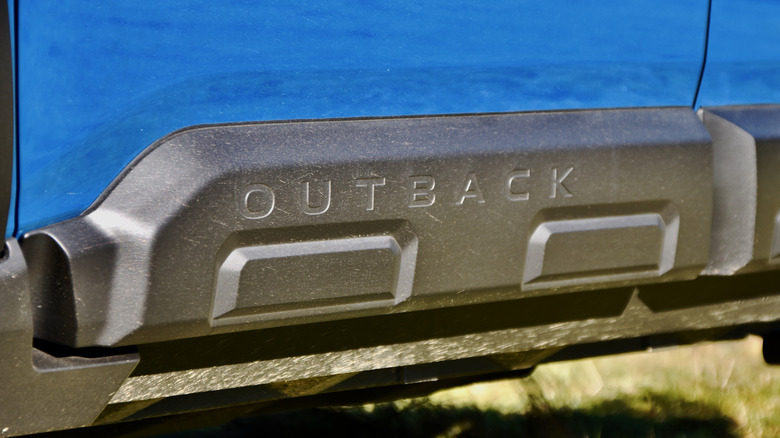
A thicker layer of plastic has accumulated around the rocker panels. It likely won't survive full contact with off-road obstacles, but its sacrifice should at least preserve more-expensive sheetmetal. Fog lights are embedded in the plastic front and rear, as well as on the tailgate, which makes the Wilderness look like it always has its reversing lights on. The redesigned bumper no longer needs to be cut to accommodate a trailer hitch, at least. Towing capacity is unchanged from the standard Outback, at 3,500 pounds.
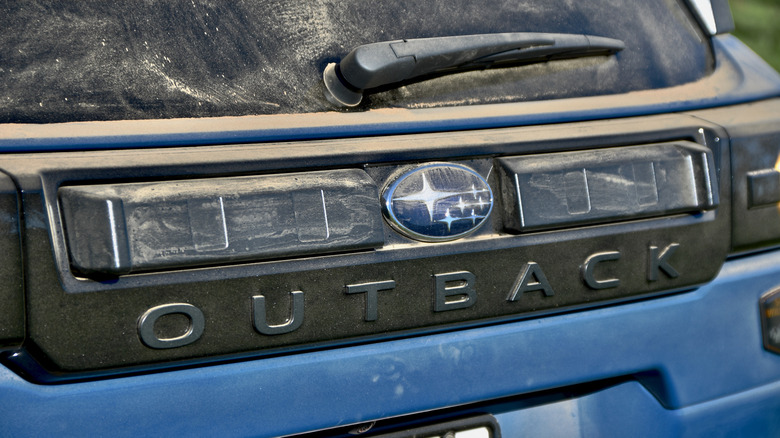
As in the standard Outback, there's embossed "SUBARU" lettering on the rear bumper as well, with large vertical reflectors jutting out from either side. The Wilderness also carries over a wrinkled, sharkskin-like texture for the front and rear cladding that helps reduce aerodynamic drag, Subaru claims.
The changes are more than cosmetic
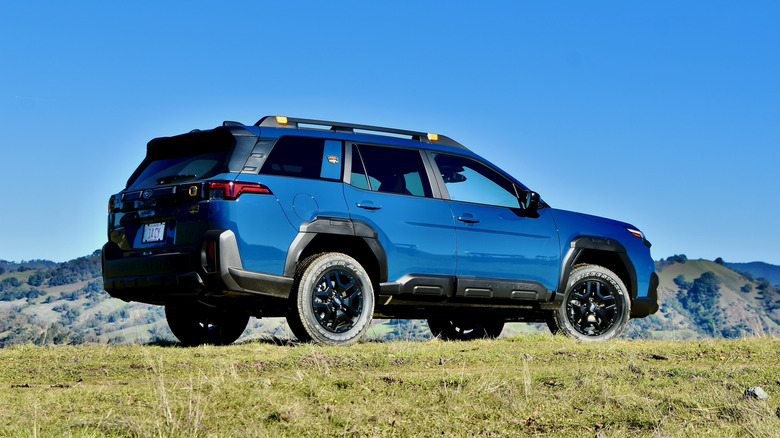
It might be a visual downgrade from the standard Outback, but the Wilderness does at least provide some functional upgrades. It has 9.5 inches of ground clearance compared to 8.7 inches for the standard Outback, along with improved approach, breakover, and departure angles. The approach angle increases from 18 degrees to 20 degrees, the breakover angle increases from 19.4 degrees to 21.2 degrees, and the departure angle increases from 21.4 degrees to 22.5 degrees.
The Wilderness is also the first Outback with adaptive dampers that automatically adjust firmness to keep the body as level as possible. It also comes standard with Bridgestone Dueler all-terrain tires (mounted on 17-inch wheels) that offer more grip on loose surfaces than the standard Outback's all-season tires. Subaru's X-Mode drive-mode selector carries over from other Outback models, in this case with Normal, Snow/Dirt, and Deep Snow/Mud options.
Also carried over is Subaru's trademark all-wheel drive system, although Wilderness models get a slightly shorter final drive ratio (4.11:1 vs. 4.44:1) for more low-end motivation. The Wilderness is only available with the more powerful turbocharged 2.4-liter boxer-four, which channels 260 horsepower and 277 pound-feet of torque through a continuously variable transmission (CVT).
The all-terrain tires knock 1 mpg off combined and highway fuel economy compared to other turbo Outback models. That leaves the Wilderness with an unremarkable EPA-rated 23 mpg combined (21 mpg city, 27 mpg highway). Subaru could once call the Outback a more-efficient alternative to SUVs, but not anymore.
It still drives like a car
On the road, the Wilderness still drives more like a car than the truck it's pretending to be. Subaru arranged an off-road excursion on a ranch in California's Sonoma wine region, but getting there involved some delightfully twisted roads. This generation of Outback is still no WRX, but owners will find it pleasant enough on equivalent drives to campsites and hiking trails.
The stars here are the adaptive dampers. Subaru used a "skyhook" tuning protocol aimed more at arresting pitch on uneven surfaces, but the dampers still gave the Wilderness excellent body control on pavement. The steering keeps drivers at an emotional distance, but it's at least precise enough to exploit that well-tuned suspension.
Ride quality wasn't exactly hush, but nor was it overly harsh. The all-terrain tires likely give up a bit of grip on tarmac, but at least they didn't howl as much as those on other off-road specials like the Kia Sportage X-Pro or Honda Passport TrailSport. Wind noise was also fairly tame considering the Outback's standard roof rack and overall boxy shape.
The turbo-four engine seems to play nicer with the CVT than in the previous-generation. It was much easier to keep the engine on-boost and in its powerband without triggering a fake shift from the gearless transmission and losing all momentum. CVTs remain the bane of driving enthusiasts for a reason, but Subaru has improved them to the point of tolerability.
It's good off-road, but so is the standard Outback
That Subaru didn't ruin the Wilderness' on-road ride and handling in the pursuit of greater off-road capability is an achievement. But this new model also isn't that much more capable than a standard Outback.
Despite the increased ground clearance and improved approach angle, we scraped the front end a couple of times while driving out of muddy divots in the trail. The Bridgestone Duelers likely did a better job of churning through that mud than the all-seasons other Outback models are equipped with, but they're also less aggressive than other all-terrain tires, leaving some capability on the table.
Adaptive-damping suspension did wonders on the road but, because of the suspension's relative lack of articulation, those dampers really only come into their own when you're traveling relatively fast down a dirt road, not crawling over obstacles. And if you're going faster than cycling pace, you won't be able to use X-Mode or the Wilderness' 360-degree camera system, the latter of which comes in handy if you don't have a spotter. The maximum speeds for those features are 25 mph and 12 mph, respectively.
The Wilderness never came close to getting stuck, but nor did it perform any feats I couldn't imagine matching in other Subaru models. Unfortunately for Subaru's product-planning department, its engineers baked so much capability into the base Outback that there isn't much headroom for the Wilderness. More extensive changes are needed to truly differentiate this model.
More practical in some ways, less practical in others
Interior dimensions match the standard Outback. The key figure is a roof that's two inches higher than the previous-generation, which opens up the tailgate aperture by an inch for easier loading and unloading, and adds two cubic feet of cargo space. That brings the totals to 34.6 cubic feet with the rear seats up and 80.5 cubic feet with them folded.
With the rear seats in place, the Outback Wilderness has less cargo space than some compact crossovers, including the Honda CR-V TrailSport and Toyota RAV4 Woodland. But with the seats folded, available space is about the same as in the midsize Hyundai Santa Fe XRT. That makes the Outback Wilderness ideal for carrying longer items like skis and fishing poles, as does the pair of plastic bumps on the tailgate, which lets you such those items against it without scratching the paint.
As a wagon, the Outback has always been better at carrying items that are long, not tall. But with this redesign, Subaru compromised another wagon plus. At 68.3 inches tall with its standard roof rails, the Wilderness is about as tall as a Subaru Forester (and 0.8 inch higher than a standard Outback). So taking advantage of the rails' 800-pound static load capacity (220 pounds dynamic) is a bit more difficult for shorter people. The rails do include helpful tie-down points, and can also serve as an anchoring point for hammocks.
The redesigned interface is a major improvement
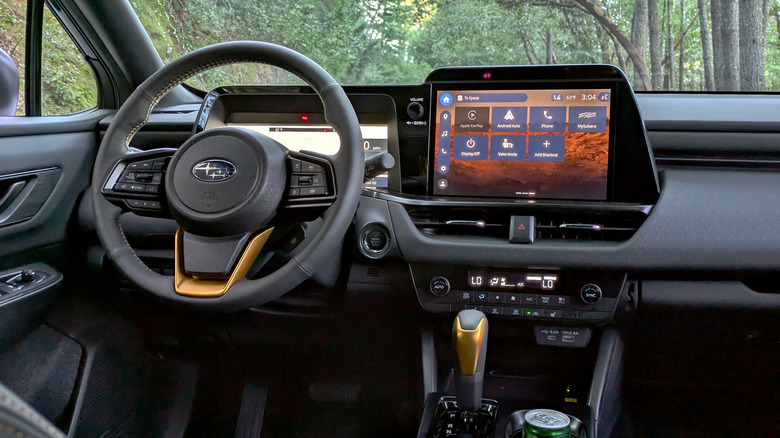
There isn't much to distinguish the interior of a Wilderness from other Outback models. Anodized trim and Wilderness badging on the front head restraints and rubber floor mats are the only callouts. Standard StarTex artificial leather upholstery is water resistant, making it an appropriate choice for this active-lifestyle model. Nappa leather is also available as an option for the first time on the Outback Wilderness.
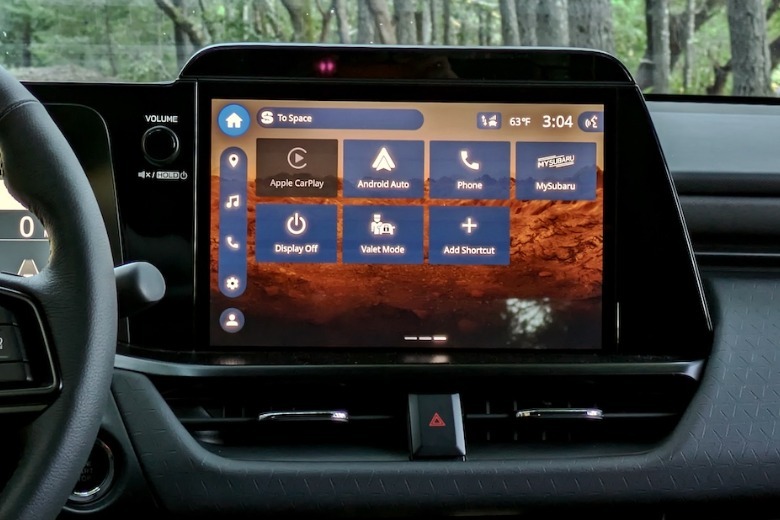
The standard 12.1-inch touchscreen and 12.3-inch digital instrument cluster, shared with other Outback models, are big improvements over the previous-generation interface. The new touchscreen retains the only good part of the old one—big icons that are easy to find quickly—but makes room for more analog controls. Wireless Apple CarPlay and Android Auto remain standard, now with a full-screen option. The instrument cluster also includes a map view that doesn't crowd out other information.
 Stephen Edelstein/SlashGear
An optional 360-degree camera system includes a low-angle front view and side views that are very helpful off-road. You can also toggle between views by repeatedly pressing the button. Subaru switched the X-Mode controller from a rotary dial to a steering-wheel button, which is fine, but we could do without the intermittent beeping that comes every time you exceed the off-road modes' 25-mph speed limit and then drop back down below it.
2026 Subaru Outback Wilderness verdict
Pricing starts at $46,445—$3,315 more than the 2025 model—with two option packages available on top of that. One adds a power moonroof, the 360-degree camera system, and built-in navigation for $2,045. The other adds Nappa leather, driver's seat memory, ventilated front seats (heated seats are standard on all 2026 Outback models), and power-folding mirrors for $4,090. So you're looking at $50,535 all-in.
The Wilderness is well equipped for its price, but it's also more expensive than a Hyundai Santa Fe XRT and the off-road variants of many compact crossovers. The Subaru makes a bolder styling statement than most, but not a better one. Subaru isn't known for stylish designs, but the new Outback Wilderness is a derivative pastiche of tropes conveying a faux toughness that's at odds with the automaker's brand image. The Wilderness is practical, but so are other similarly-priced crossovers. And unlike Outbacks of old, Subaru can't claim an efficiency advantage over more traditional SUVs.
Aside from a couple of notable features—adaptive dampers and those clever paint-protecting tailgate bumps—the Wilderness also doesn't move things on from the standard Outback. You don't have to get a Wilderness to enjoy a more powerful turbocharged engine, a well-designed roof rack, or Subaru's much-improved infotainment system. The standard Outback is also more than capable enough to suit most owners' needs. That leaves a vehicle with the same issues as the SUV-ified base Outback, but without any meaningful improvements.