

5 Of The Rarest Firebird Models Ever Made By Pontiac

The Pontiac Firebird is a pony car legend. Introduced by General Motors in 1967, it was half of GM's one-two punch response to Ford's iconic Mustang (the other being the Chevrolet Camaro). The Firebird garnered instant recognition, fueling an already blazing performance competition in the muscle car world.
Production of the Firebird continued without cease until 2002, when both it and the Camaro were dropped from the lineup after 35 years and four generations. The Camaro received the Lazarus treatment between 2010 and 2024, introducing the fifth and sixth generations, but the Firebird didn't get that chance due to the dissolution of Pontiac as a brand.
Nevertheless, the Firebird's storied career has left us with some gorgeous, historic, and ultra-rare iterations of Pontiac's pavement pounder. Though primarily considered entry-level sports cars for the everyman during their production, these classics are only getting rarer and more expensive as the heyday of muscle's golden era falls further into the rearview mirror.
Forget the salvage yard — we scoured the auction block and the annals of automotive history to track down some of the rarest Firebird models ever made by Pontiac.
1969 Trans Am
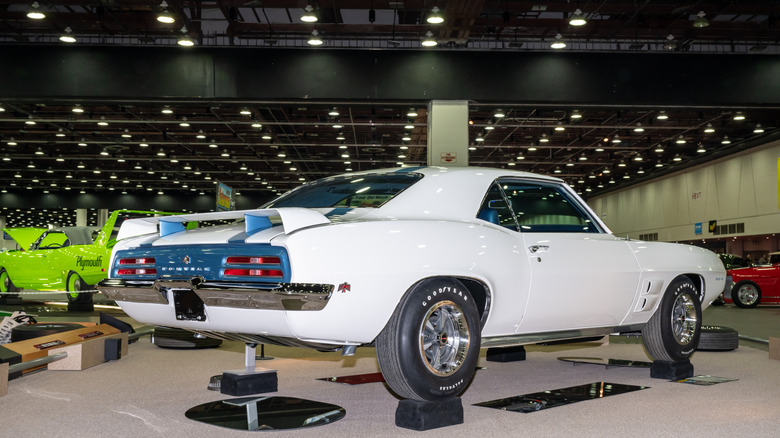
The Holy Grail of Firebirds may well be the 1969 Pontiac Trans Am. It was the first year of a designation that would become legendary, a pugilist entering combat with the likes of Boss 429s and Z/28s. The Firebird was always the little sibling to the Camaro, as it was based on the Chevy design and introduced slightly later. But car builders don't like playing second fiddle.
A couple of years into production, Pontiac decided the Firebird needed to be beefed up with its own special model designation, not unlike the Pontiac Tempest-turned-GTO that helped ignite the muscle craze a few years earlier. Executive John DeLorean tapped Herb Adams of Pontiac's Special Projects to make it a reality.
The 1969 Pontiac Firebird Trans Am received a 335-horsepower Ram Air 400 V8, improved suspension, and special tires. With its limited budget, the Special Projects group wasn't exactly building a Corvette killer, but when it debuted in 1969, the Trans Am was more than a match for the stock Camaro of the time. With an extra focus on handling and road-feel absent from many American performance cars of the era, you would expect the $725 upcharge to Trans Am status to be a slam dunk on the sales floor. But while the Trans Am is a bona fide legend these days, its first iteration was met with a shrug in a jam-packed market.
Only 697 1969 Pontiac Trans Ams were ever ordered. Each one came with the same blue-and-white paint job, but only eight of those vehicles were spec'd as convertibles — making the '69 Trans Am convertible an ultra-rare find. Of course, even the hardtops are classics these days, with an average secondary-market price of about $160,000, according to Classic.com.
1973 SD-455
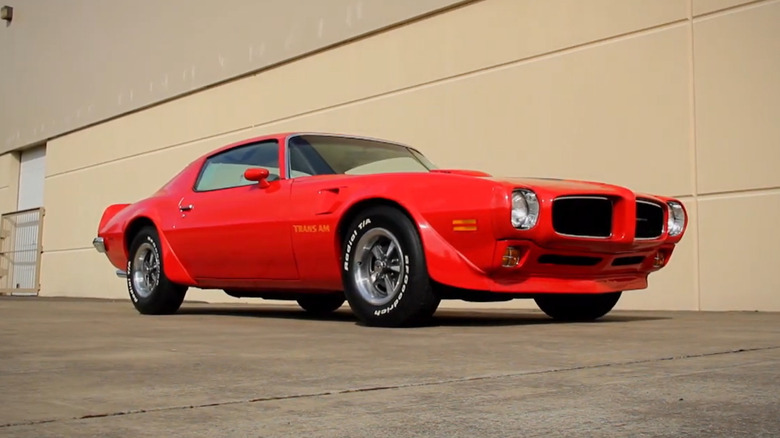
The words "Super Duty" might call to mind burly work trucks, but Pontiac fans will remember it from the NASCAR and NHRA racing Catalinas and Venturas of the 1960s. By 1973, the pure gas-guzzling, no-replacement-for-displacement ethos was on its way out thanks to emissions and gasoline issues. But that didn't stop Pontiac from offering a monstrous 455-cubic-inch race-oriented V8 option for Trans Ams and Formulas. The option was called the SD and was available only in 1973 and 1974 for an additional $521.
The engine was the definition of overbuilt. A cast-iron block, four-bolt main, forged rods and pistons, high-pressure oil system with a baffled pan, and modified heads were all part of what made the SD so super. With just around 300 horsepower and 390 lb-ft of torque, it was respectable. It blew that year's Camaro out of the water, as the SD's Chevy cousin topped out at 245 horsepower. For a second, it looked like the glory days weren't gone after all.
Pontiac built just under 1,300 SD-455s during that period. Of those, only 101 were optioned on Formula Firebirds. The rest were Trans Ams (which, incidentally, debuted the now-famous Screaming Chicken logo that same year). Pontiac built 43 Formula SD-455s in 1973, compared to 252 Trans Ams. That makes the 1973 Formula SD-455 very rare and highly appealing to collectors. But the real money is in finding one with a manual transmission. Despite its performance-car positioning, only 10 buyers opted for the four-speed, three-pedal setup. The rest were automatics. If you can find one, consider picking it up if you have a spare $250k burning a hole in your pocket.
1977 Type K
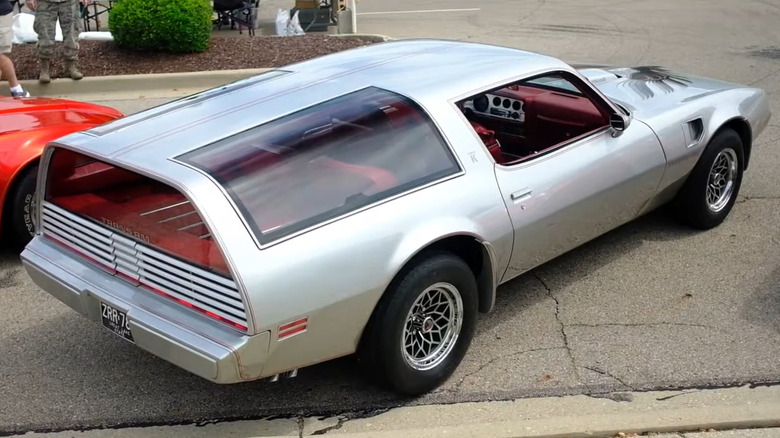
It was the late '70s, and the gas crises and emissions standards had largely taken the teeth out of America's once gloriously unrestricted muscle mavens. The Firebird had been around for about a decade, and some inquiring minds began to wonder what would happen if they turned the pony car into a shooting brake, something that's led to more than a few vehicles with truly striking looks, as in this collection curated by Slashgear. Unfortunately, the 1977 Firebird Type K (for "Kammback") didn't make the list.
Kammback design developed in the '50s and '60s as an aerodynamic boost. Eschewing sloping rear decks for an abrupt end to the vehicle smoothed airflow and offered performance benefits. General Motors had experimented with Kammback tails before in the 1971 Vega and 1970 Camaro, and GM design head Bill Mitchell commissioned a pair of concepts to see how it would work on a Firebird.
Legendary design firm Pininfarina, known for its styling on some of Italy's most gorgeous vehicles, built a pair of working prototypes using 1977-model-year Firebirds. There was no rear hatch; instead, it had a pair of gull-wing glass windows that opened on either side. Under the hood, a 403 cubic inch V8 made a disappointing 185 horsepower, but that was par for the course during the Malaise Era. The prototypes even got the famous screaming chicken logos, though neither qualified as a Trans Am.
Only two Type K Firebirds were ever made. One appeared on an episode of "The Rockford Files" in 1979, sparking public interest in regular production. Alas, it was not to be. Pontiac's studies concluded that an eye-watering $25,000 price tag (the top-spec 1978 Trans Am started at $5,799), and the nameplate coming due for a generational refresh, made the project impractical. The silver prototype (with a '79 front end) sold at Sotheby's in 2007 for $154,000.
1992 SLP Formula Firehawk
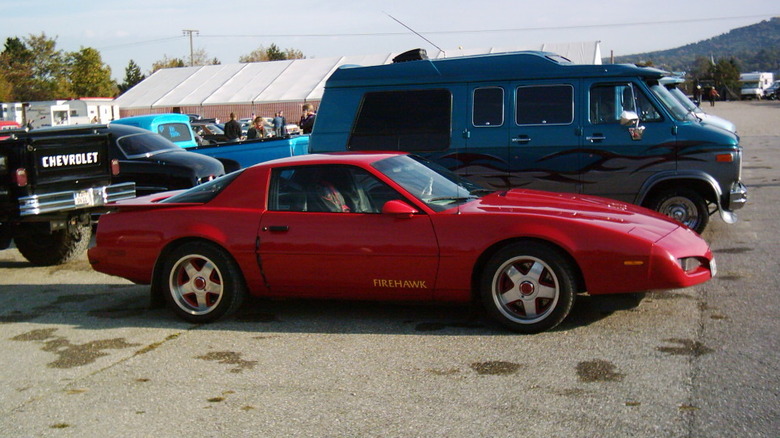
It's not uncommon for American pony cars to get some aftermarket love from performance shops. Yenko famously did it with Chevrolet for years, and Roush Mustangs demand a well-earned premium. With Pontiac planning a new Firebird for the 1992 model year, New Jersey-based street shop Street Legal Performance (SLP) decided to have a go.
Race driver and SLP founder Ed Hamburger developed a Firebird version of the Corvette ZR-1. He began with a factory Firebird Formula and started upgrading. Bonus equipment on the SLP included four-piston Brembo brakes with 13-inch rotors — same as on the Ferrari F40. An aluminum hood concealed a 350-cubic-inch V8. The block remained stock but was filled with components, including a forged-steel crankshaft, performance connecting rods, and pistons. The result was 350 horsepower and 390 lb-ft of torque, compared with the stock V8 Firebird's 175 horsepower. It was available at the time for $39,995, though other additional trim levels (and the so-called luxury tax) could drive the cost upwards of $50,000.
Despite these impressive numbers, the Firehawk retained a rather benign, almost stock aesthetic that belied a sub-5 second zero to 60 mph run and a top speed of 158 mph. Pontiac, or rather individual Pontiac dealers, took notice. The plan called for SLP to build 250 Firehawks. Customers could leave a $5,000 deposit with participating dealers and get one in any color they wanted — as long as it was red.
Alas, the best laid plans of engineers and marketers can go wrong. In the end, only 25 Firehawks were built in 1992 (including four oddballs finished in Dark Green Metallic Paint), making them some of the rarest Firebird models out there.
1997 Firehawk LT4
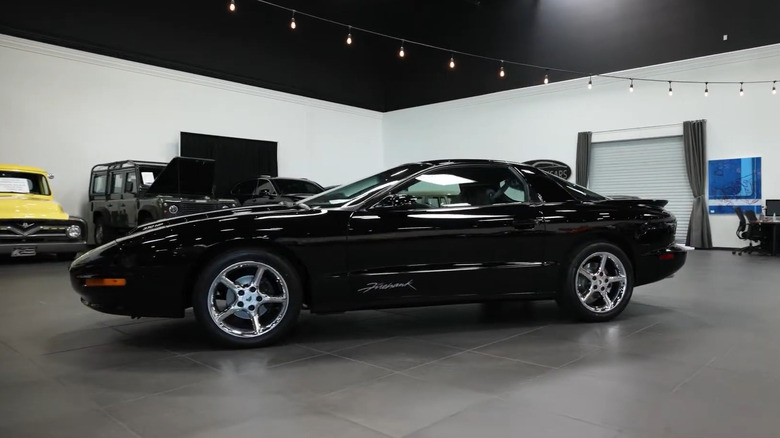
"This will be a very rare bird." That's how Motor Trend's contemporaneous review of the 1997 SLP Firehawk begins. SLP kept up its Corvette-hunting ways with the fourth-generation 1997 Firehawk LT4, this time adopting an "if you can't beat 'em, join 'em" strategy that saw the little-produced Corvette LT4 engine stuffed under the hood of Pontiac's sports car.
The LT4 — a 5.7L (350 cubic inch) V8 first showed up in the '96 Corvette. Good for 330 horsepower at 5,800 RPM and 340 lb-ft of torque at 4,500 RPM, it was an upgunned version of the 300-horsepower LT1 then found in the Corvette. SLP put about 100 of these unusual engines into 30th anniversary Camaros, but some were set aside for — you guessed it — the Firehawk LT4.
Buyers were not disappointed. The Firehawk blew to 60 mph in a hair over 5 seconds, and it could hit the quarter mile in 13.7 seconds. That might sound quaint by today's standards, but it was more than respectable for the time. And let's face it, 1997 is officially antique territory these days, making these rare builds even more special. SLP only built 29 '97 Firehawks and none in 1998, though they did return for the last few years of the Firebird's existence before going the way of the dodo in 2002.