

Where Are Cruise Ships Built? These Countries Create The Most
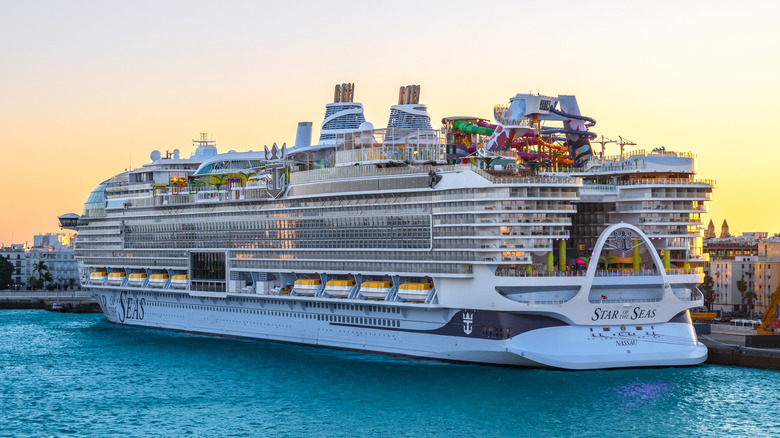
Cruise ships, which are different from ocean liners, are built in many different locations, but most of these places are found within Europe. This is largely due to the technology required to build cruise ships, as well as the type of workforce required to build these vessels. Located in several different countries, these cruise ship shipyards build from scratch what these ships' designers have planned. But competition is coming from other parts of the globe. In October 2024, the China State Shipbuilding Corporation announced a partnership with Carnival to build mega cruise ships, while South Korea's Samsung initiated a project that same year to build cleaner, LNG-powered cruise ships.
The process for building a cruise ship is largely the same, regardless of which shipyard is performing the construction of a given cruise ship. First the ship's steel parts are cut, which can be a months-long process that happens before the actual construction begins. The actual building process then commences with the laying of the keel, which forms the central spine of the cruise ship. Once the hull is finished, the ship comes into contact with water for the first time. Certain parts of the ship, like the passenger cabins and other elements, are built off-site and installed into the cruise ship.
But for now, Europe has the upper hand in the cruise ship shipbuilding arena. Let's focus on one of these European countries at a time, focusing on their unique cruise ship building facilities and revealing the particular cruise lines that have their ships built there.
Italy - Fincantieri
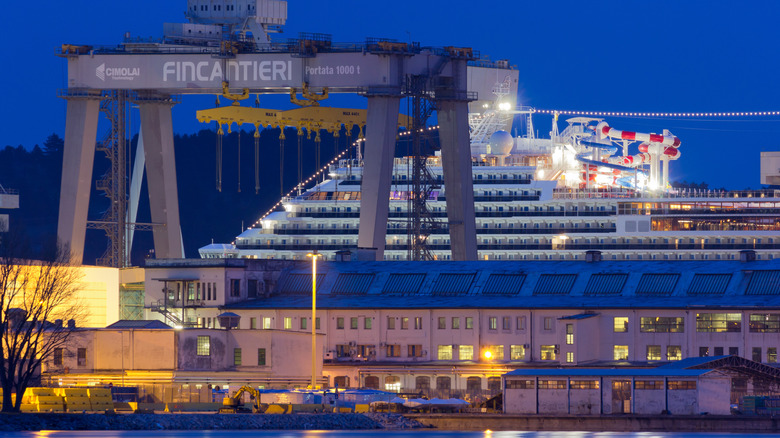
Italy is home to Fincantieri, the world's biggest builder of cruise ships, which are slower than classic ocean liners. It started out as a shipbuilder during the early years of the 20th century. Some of its earlier shipbuilding milestones include the biggest ship launched in the Mediterranean, the first super ocean liner in Italy, the first ship with an swimming pool outdoors, the first ship to have air conditioning, the first ship to be equipped with stabilizers, and the fastest ocean liner.
Since 1990, Fincantieri has built more than 130 cruise ships for 25 different cruise lines, claiming that one in every three cruise passengers travels on a Fincantieri-built ship. Their most recently built cruise ships include the Star Princess, Norwegian Aqua, and TUI Cruises' Mein Schiff Relax in 2025, preceded by the Queen Anne, Explora II, Viking Vela, and Sun Princess in 2024. Cruise lines that are customers of Fincantieri include Princess, Holland America, Carnival, Costa, Viking, Cunard, Seabourn, MSC, Disney, Virgin, and Norwegian. In terms of cruise lines that have purchased the most ships from Fincantieri, the company has produced 21 ships for Princess, 17 ships for Holland America, 15 ships for Carnival, 13 ships for Viking, and 12 ships for Costa.
In addition to its cruise ships, Fincantieri also builds naval vessels, offshore oil and gas exploration vessels, ferries, ship interiors, and components. Fincantieri has shipyards that are located in various parts of Italy, including two in the Gulf of Genova, one in Palermo on the Mediterranean, and one in Trieste on the Adriatic.
Germany - Meyer Werft
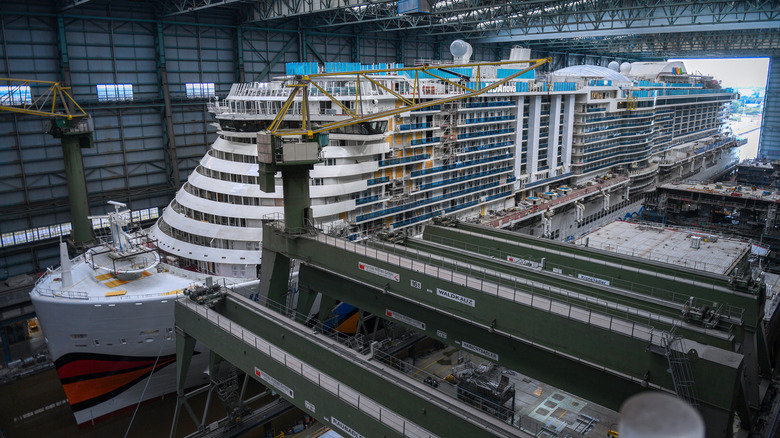
Meyer Werft in Papenburg, Germany, traces its history back to 1795, when it began by making smaller wooden sailing ships. It made the transition to iron ships by specializing in boats that could go through narrower waterways.
Its first cruise ship, the Homeric, was completed in 1986 and has been succeeded by an additional 60 cruise ships constructed to this point. Its most recently delivered ships are the Disney Destiny and the NZK Azuka III in 2025, plus the Silverseas Silver Ray in 2024. Other notable ships built at the Meyer Werft shipyard include Royal Caribbean's Spectrum of the Seas, Odyssey of the Seas, and Ovation of the Seas, along with Disney's Wish, Dream, and Fantasy, plus Norwegian's Encore, Bliss, Joy, and Escape. Meyer Werft has become very well known for its expertise in crafting cutting-edge cruise ships, which tend to have a leisurely top speed.
Meyer Werft is focused on climate-neutral operation of its ships, which has started with the Silverseas Silver Nova, launched in 2023. This innovative cruise ship runs its engines on low-emission LNG, while a hydrogen fuel cell system with a battery backup provides the power to operate the rest of the ship. The fuel for the fuel cell is methanol, which will ultimately be produced from renewable sources. In addition, a Micro Auto Gasification System turns onboard organic waste materials into heat, boosting the overall efficiency of the ship. The Silverseas Silver Ray, delivered in 2024, continues the use of this energy-efficient, low-emissions system.
Finland - Meyer Turku
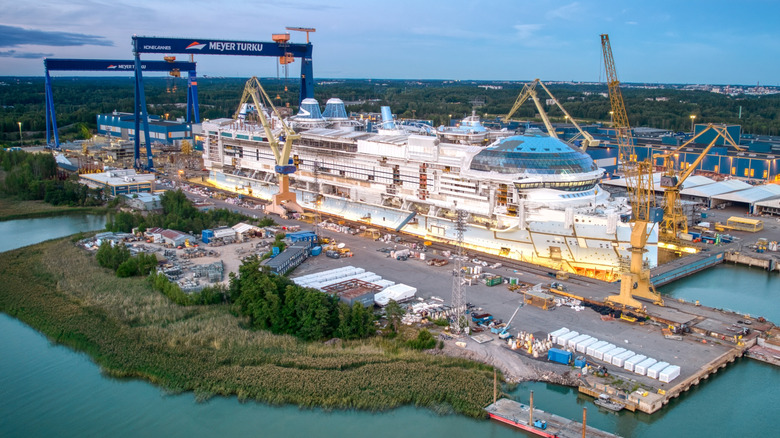
Meyer Turku of Turku, Finland, holds the crown as the builder of the largest cruise ships ever made. We are talking about the two sister ships made for Royal Caribbean, the Icon of the Seas and the Star of the Seas, shown above under construction. Each of these ships holds 7,600 passengers, is 1,196 feet long and is 219 feet wide at its widest point. The Star of the Seas features 27 dining venues, 18 bars, six waterslides, the largest pool found at sea, and a two-story theater. While both of these ships are structurally identical, a number of stylistic differences set them apart from each other. Two more Icon-class ships are slated to be built for Royal Caribbean by Meyer Turku, planned for delivery in 2026 and 2027. Over time, these cruise ships will age out of their fleets and likely end up in the largest cruise ship graveyard in the world.
The original Turku shipyard was founded in 1737 when two men by the names of Heinrich Remgean and Esaias Wechter built wooden ships in this location. Over time, new shipyards were built in the area and a period of mergers and consolidation followed. By 1971, the Wärtsilä Turku shipyard had become Finland's major employer, boasting a workforce of 5,300. A period of Korean ownership took place between 2008 and 2014, after which Meyer Werft acquired the Turku shipyard. This makes Meyer Werft and Meyer Turku sister shipyards.
France - Chantiers de l'Atlantique
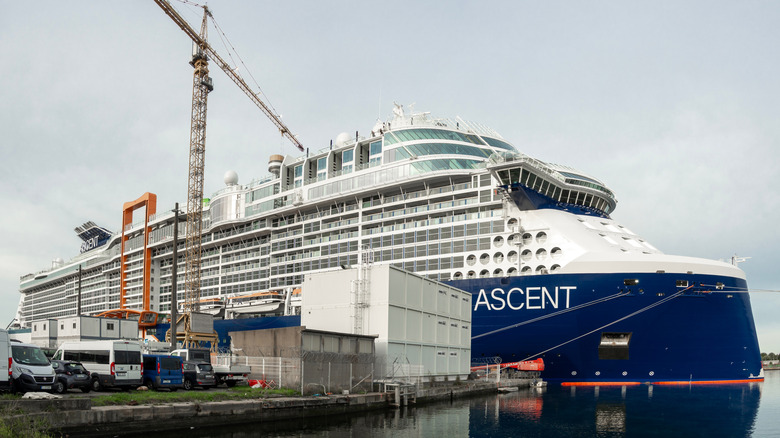
Chantiers de l'Atlantique, as it has been known since 1955, is the French powerhouse of the cruise ship-building industry. It operates in an area where ships have been constructed since 1835. After the creation of a shipyard in Saint-Nazaire, a paddlewheel cruise ship was produced there in 1864. The shipyard's next achievement was the production of the Normandie in 1932, which won the 'Ruban Bleu,' an award given to the ship with the fastest transatlantic crossing time from England to North America. Next came World War II, during which the Germans occupied France and placed a submarine base near the shipyard. The Allies struck the base repeatedly, destroying around half of the shipyard.
After a post-war rebuilding, the shipyard produced the France, a popular cruise ship that was once a fading ocean liner, launched in 1960 by General Charles deGaulle. Cruise ships would be built once again starting in 1980, when Holland America placed an order for two small ships, each with 600 cabins. They would be named the Nieuw Amsterdam and the Noordam. This was followed in 1985 by Royal Caribbean's Sovereign of the Seas.
Meanwhile, the Finns took control in 2006, followed by the Koreans in 2008. A period of modernization followed, which brought in an order for Royal Caribbean's Harmony of the Seas in 2012. After a few name changes during the period of Finnish and Korean ownership, the yard returned to its previous name, Chantiers de l'Atlantique, in 2018.