

Honda Barely Changed The 2026 Ridgeline, And That Might Come Back To Bite It
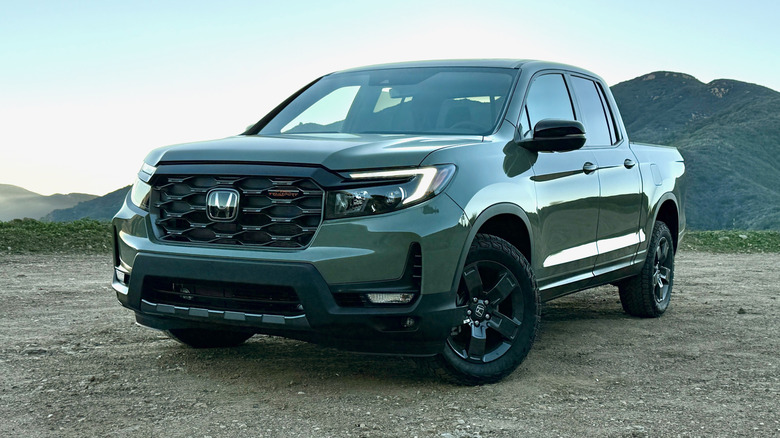
The second-generation Honda Ridgeline was last redesigned in 2017. There were some styling and equipment updates to the pickup back in 2021, and there have been some tech updates over the years, but it's mostly the same truck underneath that it has been for nearly a decade now. It's still a spacious, crew-cab-only, unibody pickup truck, powered by a V6, offering a unique set of virtues compared to most other mid-size pickups. Its utilitarian design, comfortable ride, spacious interior, and impressive handling characteristics continue to shine through, but the 2026 Ridgeline lives in a very different world.
When the second-generation Ridgeline launched in 2017, there was no Ford Maverick. The plush Hyundai Santa Cruz didn't exist yet, either. The hybridization of popular midsize pickups like the Toyota Tacoma hadn't hit the market yet, and the Ridgeline made sense for buyers who wanted a friendly approach to truck ownership without the comfort drawbacks typically associated with pickups. Small and mid-size pickup trucks have become much more competitive in the nine years since the second-gen Ridgeline was introduced.
 Travis Langness/SlashGear
The 2026 Honda Ridgeline gets a new paint color and an available black roof on the top-trim model, but no changes elsewhere. The Ridgeline's platform-sibling, the Passport, got a new look and lots of changes for 2026, so maybe the Ridgeline is next, but those are changes we're still waiting for. For now, the Ridgeline has to compete with an ever-advancing and expanding field of competitors.
Old-school V6 power comes at a cost
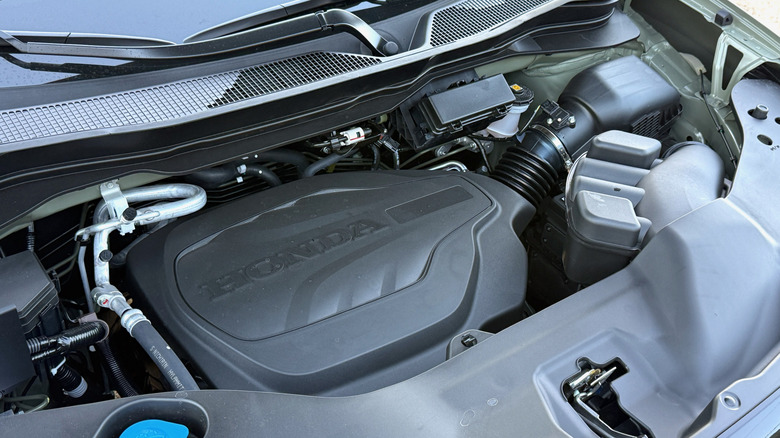
The Ridgeline is one of the few midsize trucks that's still powered by a naturally-aspirated V6 instead of a turbocharged four-cylinder engine. Specifically, the 2026 Ridgeline packs a 3.5-liter V6 that produces 280 horsepower and 262 lb-ft of torque. It's paired with a 9-speed automatic transmission, and all-wheel drive is standard. To put it plainly, the Ridgeline's engine feels adequate. It's strong enough to keep up with other midsize pickup trucks, but not particularly exciting or lively. Acceleration is robust, but not hurried, and the upshifts from the 9-speed are smooth.
According to the EPA, the standard Ridgeline will return 21 mpg combined (18 city/24 highway), with the TrailSport dropping by 1 mpg in the combined estimate. That's a few mpg's less than most versions of the Toyota Tacoma or the Ford Ranger, but about the same as the V6-powered Nissan Frontier. The cost of a V6 powertrain in a midsize truck is a noticeable loss in fuel economy. The middling fuel consumption becomes a bit tougher to accept when you look at smaller trucks like the Ford Maverick, which offers a hybrid powertrain and fuel economy as high as 38 mpg combined – double that of many mid-sizers.
 Travis Langness/SlashGear
Looking at the other available powertrains in Honda's lineup, and what they've done with the Pilot/Passport siblings, it's also probably unlikely we'll see a hybrid four-cylinder in the Ridgeline's future. The Pilot and Passport both currently use an updated DOHC V6 paired with a 10-speed automatic, but that powertrain is essentially an even numbers match for efficiency with the current Ridgeline.
Trucks don't usually handle this well
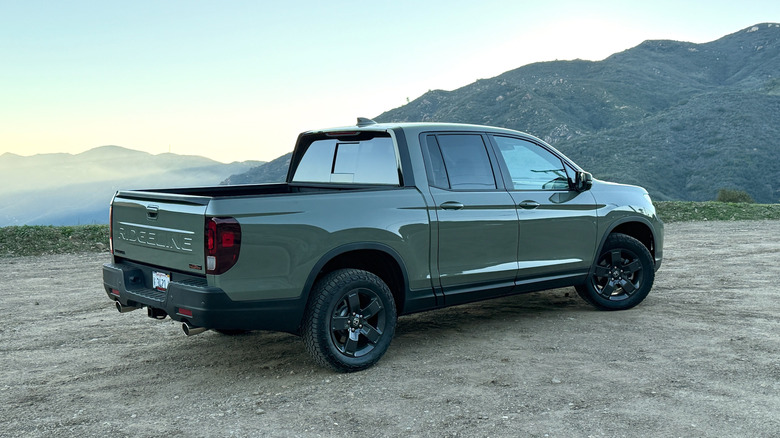
It isn't the most efficient truck in the class, but being built on a unibody platform has some big benefits for the Ridgeline. For starters, when it comes to handling and comfort, it's simply better than most other pickups. Around corners, it feels better than every other midsize rig I've driven recently. It moves between curves in a hurry, without much body roll and with well-weighted steering.
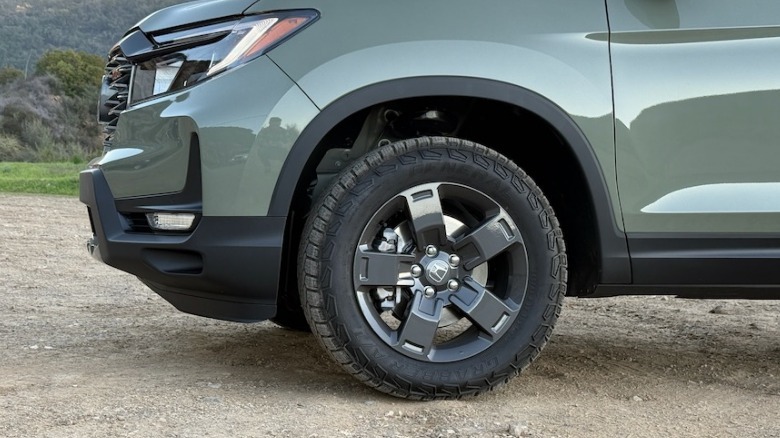
The TrailSport's all-terrain tires make the Ridgeline feel somewhat less agile and stable during corners, but they don't ruin the experience entirely. Then, there's overall comfort.
Over rough highways and broken asphalt, the Ridgeline feels relatively unbothered. It soaks up the majority of small bumps too, and the seats are properly comfortable in both the front and back. The all-terrain tires fitted to the TrailSport add a bit of humming at highway speeds, but nothing a bit of music can't drown out. Otherwise, the cabin is quiet and generally isolated from the outside world.
Spacious and well-built
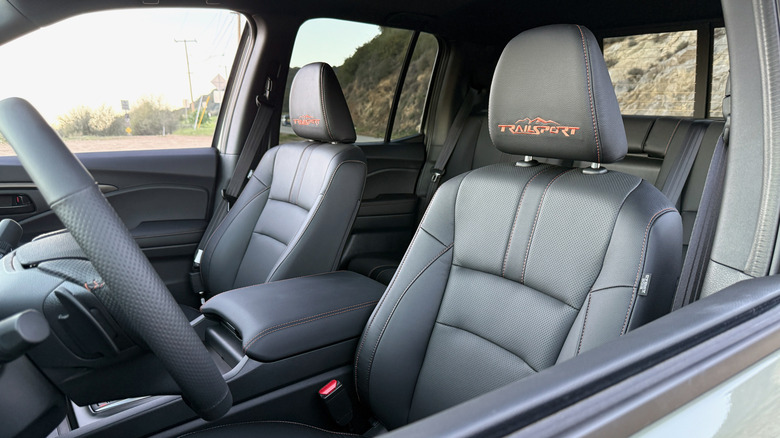
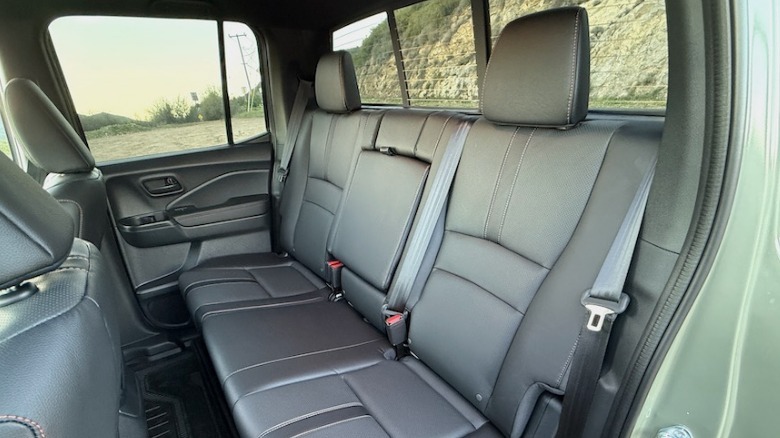
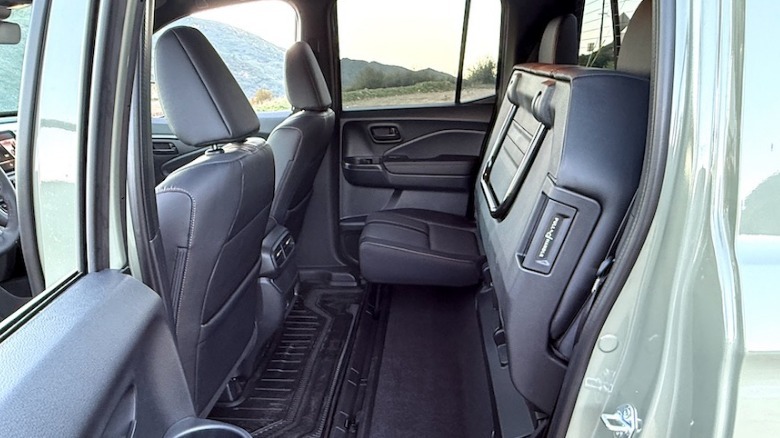
The Ridgeline's cabin is plenty spacious for adults of all shapes and sizes, with lots of leg, head, and hip room. The back seat, in particular, is large enough that you can seat three adults without much of a squeeze — a real rare occurrence amongst mid-size pickup trucks. The rear seats aren't particularly well bolstered or supportive, but they are astonishingly easy to flip up for loading and transporting of big-box items, too.
 Travis Langness/SlashGear
The front-seat center console offers a significant amount of storage space for large items like purses, plus there are all sorts of places for small items and large items fit just as well, including some pretty sizable door pockets. A rarity amongst vehicles of any size, the Ridgeline's front cupholders were able to accommodate my extra-large 32oz water bottle.
 Travis Langness/SlashGear
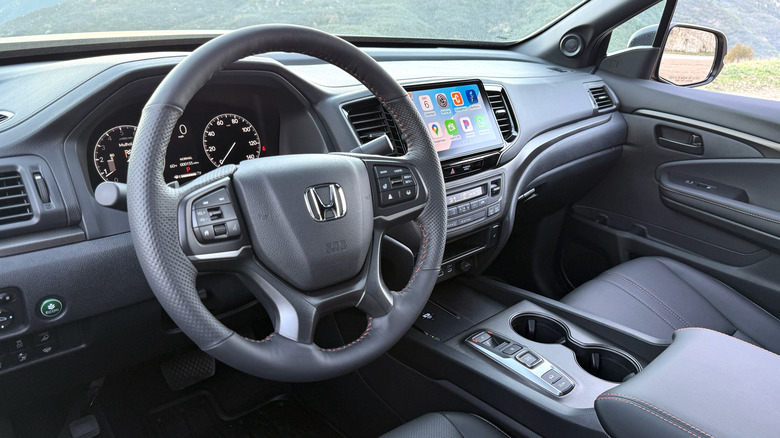
More than just roomy, the Ridgeline's cabin is well-built and well laid out. There were no squeaks or rattles during my test, and for the mid-level version of the truck, the TrailSport felt pretty premium. All the important controls were easy to reach and clearly labeled. Getting used to the Ridgeline was easy, even if it had been a few years since the last time I was behind the wheel of one.
Hauling is part of truck ownership
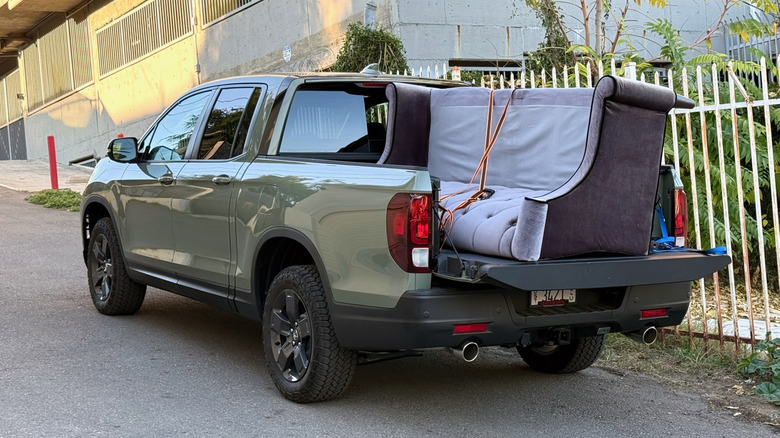
Like a living, breathing manifestation of Murphy's Law, it's an immutable law of nature that if you have a truck, your friends who have couches will need them moved. That just so happened to be the case with me and mine during the week Honda loaned me a Ridgeline; a few friends of mine needed two couches moved, and I was happy to volunteer as tribute. Loading, securing, and moving the couches couldn't have been easier.
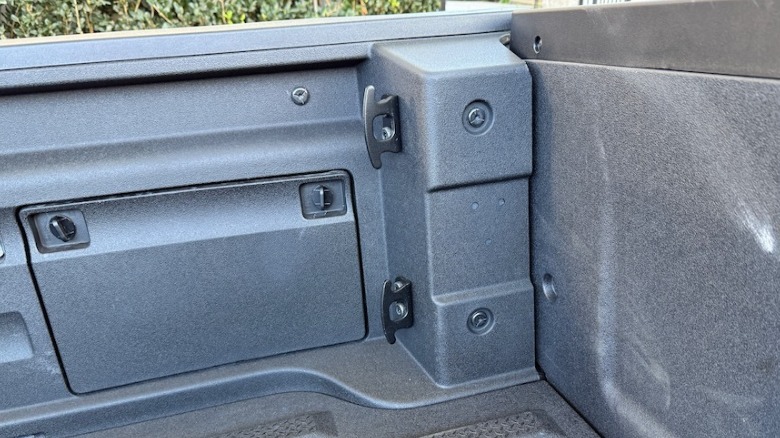
Every trim level of the Ridgeline has a maximum payload capacity of over 1,500 lbs, which means a couch and two (or four) passengers is no issue. The Ridgeline also has eight in-bed tie-down points that offer different heights at each corner for securing whatever it is that you're hauling.
 Travis Langness/SlashGear
The bed sides of the unibody Honda are low enough that you don't have to reach very far to attach a tie-down, and the attachment points are large enough to easily slip in a rope or ratchet strap hook. I'd happily use a Ridgeline to haul around a pair of motorcycles on the weekend, especially because the utilitarian bed makes that such an easy task.
Benefits of a unibody bed
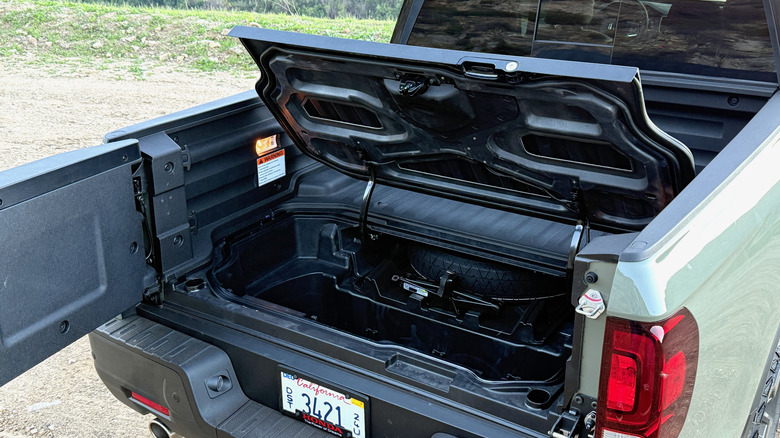
With the tailgate up, the Ridgeline's bed measures 64 inches, but with it down, it lengthens by 19 inches to a total of 83, giving you plenty of space for most couches. The bed is also nearly flat, with only the tiniest humps for the wheel wells. And with a width of 50 inches, the Ridgeline's bed is wide enough and flat enough for you to carry all the 4x8 sheets of plywood you can muster up.
Popping open the tailgate like a side-swinging door is an option, too, one that will allow you to load smaller items towards the front of the trunk without having to lean over the folded-down tailgate.
 Travis Langness/SlashGear
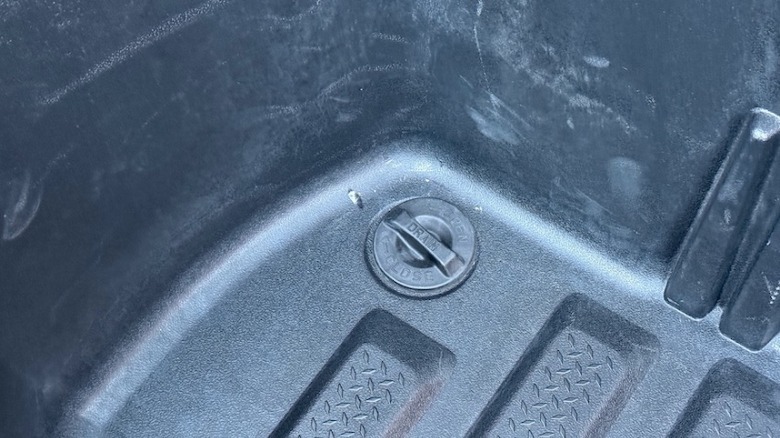
Then, there's the Ridgeline's in-bed trunk, which is a true bit of packaging and functionality genius. When you're not using the bed for hauling large items, the in-bed compartment is available for storage with 7.3 cubic feet of cargo space. It has a removable drain plug at the bottom, so it can be used to hold muddy or wet gear, and left to drain as you drive along (or in your driveway at home). There's also the potential of using the in-bed storage as a take-it-with-you cooler of sorts, but I wouldn't recommend it. The in-bed trunk is near a lot of the Honda's drivetrain components, and since it's uninsulated, ice doesn't last very long down there.
You can tow if you want to
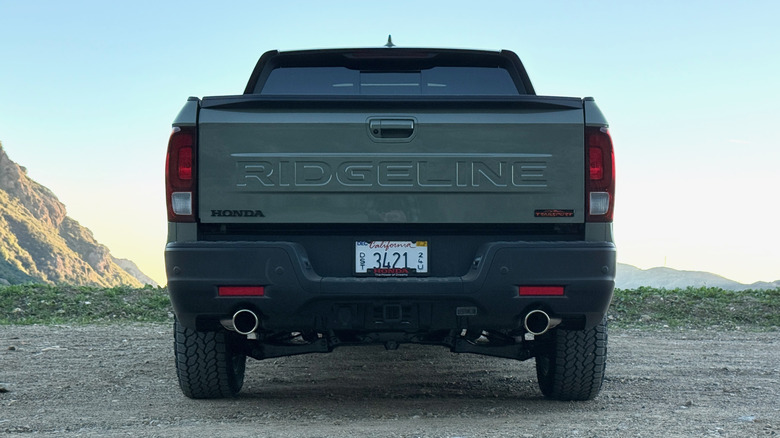
Max towing for the Ridgeline is an acceptable 5,000 lbs, right in-between the maximum numbers for smaller compact trucks and more robust mid-sizers. That number carries across all trim levels, and there's no need for an added towing package, regardless of which trim you choose. Basically, every midsize body-on-frame rival can tow more on their top trims, but on some lower trims, that's not the case.
The Tacoma, for example, can tow as much as 6,500 lbs, but on the base SR trim, it can only pull 3,500 lbs. Which tow rating you get depends on engine and trim-level selections, but there's no need for that with the Ridgeline.
With 5,000 lbs of pulling power, the Ridgeline should have no problem with most small utility trailers and even some ultra-lightweight car trailers. It comes standard with a Class III trailer hitch and a seven-pin connector. If you tow more than that on a regular basis, you should probably take a closer look at something like the Chevrolet Colorado or the Ford Ranger: trucks that can tow as much as 7,700 and 7,500 lbs, respectively.
All the requisite tech
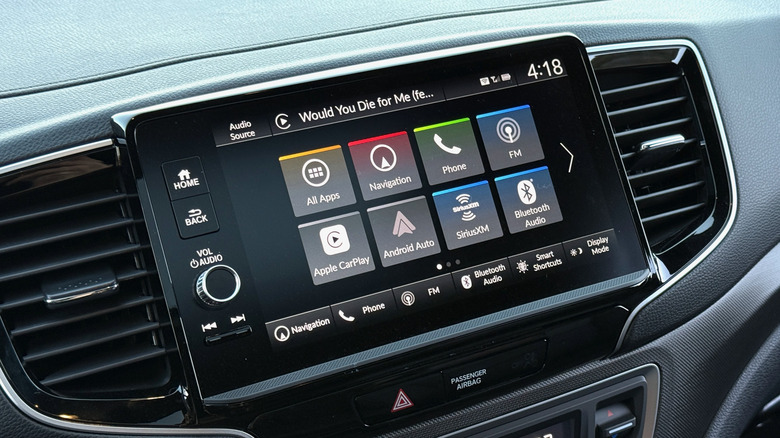
Every trim level of the Ridgeline gets a 7-inch driver display and a 9-inch center touchscreen, both of which are easy to read and easy to use. They do, however, feel a bit utilitarian in nature. The screens lack the high-resolution that's now standard on a lot of competitors, which makes the Ridgeline feel a bit downmarket, and there's no available extra-large 12- or 14-inch screen either.
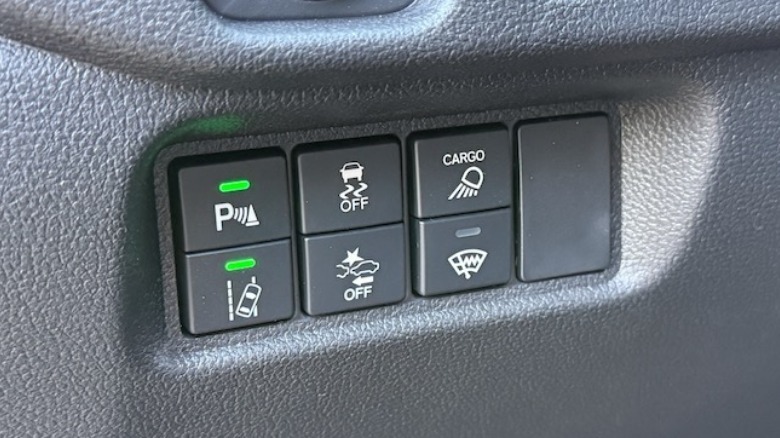
Wireless Apple CarPlay and Android Auto are both standard and they connect quickly when the Ridgeline starts up, so it has that going for it. There's also a full suite of standard safety features like adaptive cruise control, lane-keep assist, forward collision warning, and blind-spot monitoring. The Ridgeline's driver aid systems were a bit conservative for my liking, with habits like leaving too much following distance when adaptive cruise control was engaged, but otherwise they performed well during my test.
 Travis Langness/SlashGear
The standard stereo on the Ridgeline is a 7-speaker, 215-watt system which includes a small subwoofer. That stereo is equipped to the TrailSport as well, which unfortunately doesn't have access to the more-powerful premium sound system with 8 speakers and 540 watts. In terms of both audio quality and overall volume, the standard stereo is underwhelming, and audiophiles will definitely want to upgrade.
The pricing spread
Without a base four-cylinder engine or an upgraded ultra-powerful version, the Ridgeline has a relatively narrow range of prices. The base Sport trim has an MSRP of $42,090 (including $1,495 destination fee). Standard equipment across all trim levels includes LED exterior lighting, the in-bed tie-down points mentioned earlier, the 9-inch touchscreen, and tri-zone climate control. The RTL climbs a bit to $44,890 all-in, offering a power-sliding rear window, satellite radio, leather upholstery, heated front seats, and a power moonroof.
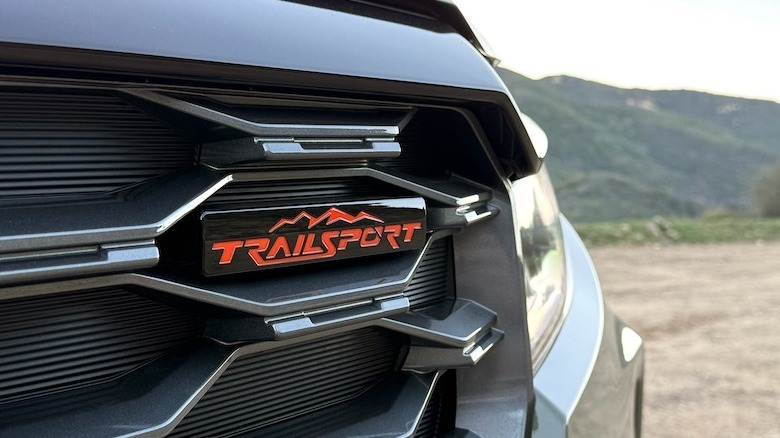
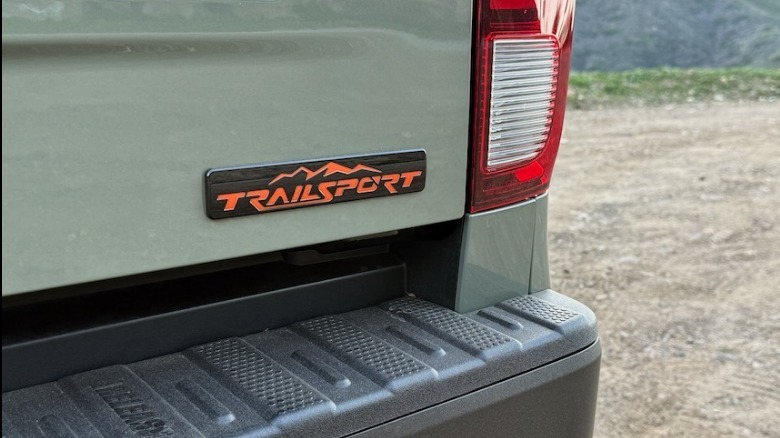
The rugged TrailSport will set you back $47,290, and it adds off-road tuned suspension, all-terrain tires, extra underbody protection, all-season floor mats, special interior lighting, unique orange stitching, and a heated steering wheel. It's nowhere near the off-road prowess of something like a Tacoma TRD Pro or a beastly Colorado ZR2 Bison, but it should be enough off-road capability for most rough roads.
 Travis Langness/SlashGear
The top-trim Black Edition checks in at $48,690 and adds features like ventilated front seats and heated rear seats. There are all sorts of available Ridgeline accessories, too. My favorite is the in-bed tent that perfectly fits the Ridgeline's bed; it's just under $400, and it can be set up in a few minutes at the campsite. Pair it with an inflatable full-size mattress from your local outdoor outlet, and you've got a pretty swanky camping setup for your pickup truck that doesn't take up much space when packed away; much better than a full-time rooftop tent in my opinion.
2026 Honda Ridgeline TrailSport verdict
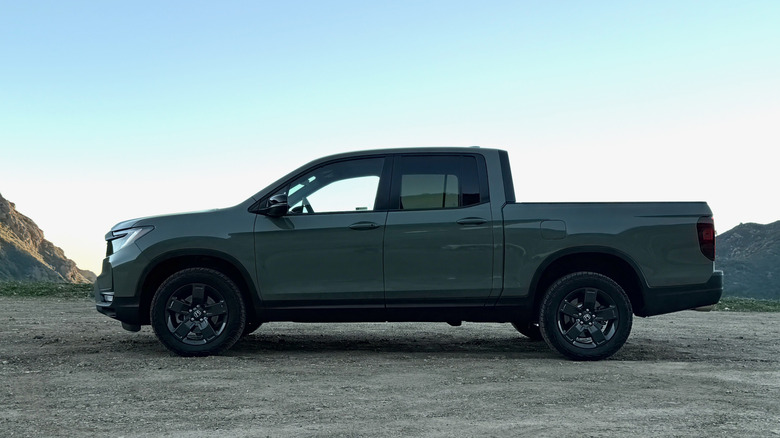
For nearly the entire decade it's been on sale, I've believed that the Honda Ridgeline was plenty of pickup truck for most people, and that's still the case. It has enough towing and hauling power for average truck duties, and it'll get you far enough off-road to enjoy the splendor of nature, even if it doesn't have the capability to go rock-crawling through Moab. The bed is usable and large, the interior is comfortable and spacious, and there are all sorts of unique features to help the Ridgeline feel particularly utilitarian.
In the last few years, however, the Ridgeline's competition has gotten considerably tougher and more attractive for buyers. Midsize pickup trucks like the Chevy Colorado and Toyota Tacoma have been recently redesigned and offer lots of appeal, especially for buyers that want real off-roading capability.
Then there's the Ford Maverick, which doesn't have the same towing power as the Ridgeline (the Ford tops out at 4,000 lbs), and nor is it as spacious on the inside, but it's considerably more efficient and costs much less upfront. The Maverick is also seriously fun to drive with the new Lobo trim. The Ridgeline is still a strong choice amongst midsize pickup trucks, but it continues to lose ground to more-efficient and more-capable trucks as the years go by.