

Common Problems You May Experience With The Toyota Tundra (According To Owners)
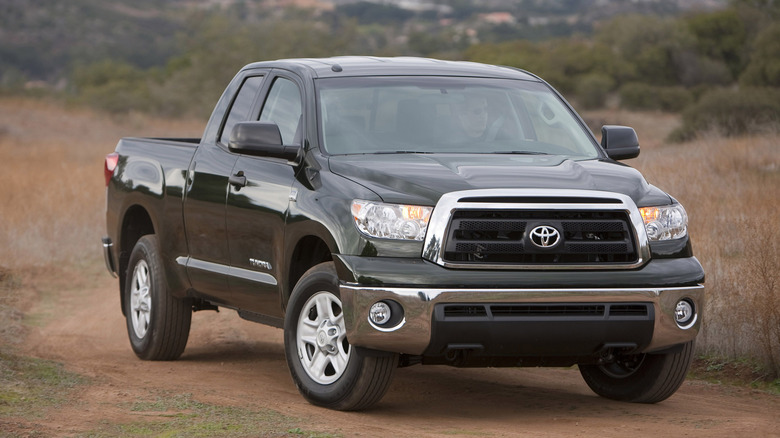
If you're buying a truck in the U.S. today, you've got more than just a few choices. Of course, there are the time-tested American options, such as the famous F-Series and GM options, but Toyota is also up there, with a good selection of capable offerings. Chief among them is the Tundra, Toyota's full-size effort, which first arrived in 1999.
It's been around for a good while now, over a quarter of a century, but compared to the nation's favorite – the F-Series — it could still be considered the new boy on the block. However, in those years, the Tundra has managed to build a solid reputation as one of the most reliable, durable, and dependable options in the full-size segment. This reputation has not only been built on the backs of the Toyota engineers, but also on the backs of owners such as Vic Sheppard. Vic not only took one Tundra past the million-mile mark, but he did it again, too, proving to the world that Toyota knows how to build a truck just as well as the Big Three.
Nothing is ever perfect, though, and with 25+ years of Tundras, there have undoubtedly been a few issues that have slipped past the quality control team at Toyota HQ, from inherent engine issues to a rust-prone chassis. In an effort to help out prospective Tundra buyers, we've decided to highlight the common problems you might come across when shopping for Toyota's flagship full-size truck. We've also stated the model years and generations you'll most likely come across such issues, so you'll know exactly what to keep an eye out for when checking out potential purchases.
Problems with the twin-turbo V6 engine
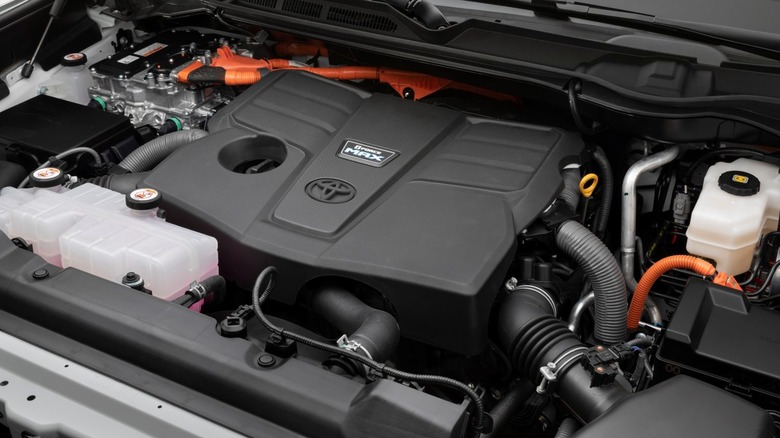
You might assume that, as cars age, they become more troublesome. For the most part, you'd be absolutely spot on. New cars come with warranties, zero mileage, and everything's, well, new. So, naturally, fewer issues generally occur on brand-new models. However, the Tundra is an unfortunate exception to the rule, as the third- and current-generation models swapped out Toyota's dependable, naturally aspirated V8 engines for an all-new twin-turbo V6. The thought process here is easily understood, as the new V6 is more powerful and cleaner than its predecessor, but time has proven that it's far from being a dependable unit.
In fact, there are many common problems with the Toyota Tundra's twin-turbo V6 engine, and these issues aren't small little niggles either. The engine frequently suffers from stalling, knocking, and even total engine failure, with Toyota citing manufacturing debris being left within the internals as the cause. These issues have led to many prolific recalls, with over 200,000 Toyota and Lexus models now subject to the recall — the majority of which are Tundras.
So, although it might seem to go against the grain, the best advice when shopping around for a dependable Toyota Tundra would be to shop for something older, and by older, we mean not a third-gen model. Sure, the latest 2025 models aren't subject to a recall right now, but this was the case for 2024 models until recently, so we wouldn't bet on 2025 model years being a safe buy just yet.
Early Tundras are famously rust-prone
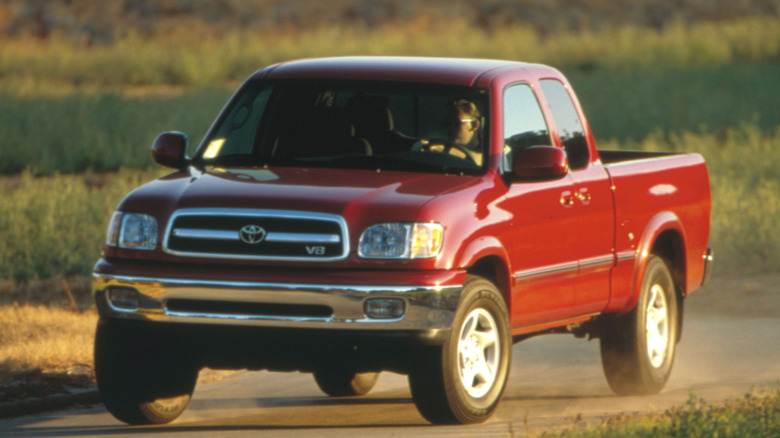
This isn't an issue explicitly linked to just Tundras, but rather a whole host of older pickup trucks, so it's something to be wary of, whether you're a Toyota fan or not. The problem is that, when exposed to harsh winters, rough weather, and particularly road salt, the chassis of these old trucks simply begins to rust and disintegrate, significantly weakening the structural rigidity and therefore effective strength of the entire truck.
It wasn't just the first-generation Tundra trucks that were affected by this issue; second-gen trucks were too. The issue got so bad that Toyota even agreed to replace entire Tundra frames, in addition to extending the corrosion warranty coverage on certain model years. If we look on CarComplaints, a site where owners can leave feedback relating to concerns and issues they've had, we can see that a good number of Tundra owners have found frame rust to be a serious issue.
From the first model year (2000) through to 2004, the most frequently reported complaint from owners is in relation to rotted-out frames. While the issue certainly can be hard to combat, particularly once rust has started to find a home, it can be tackled. Welding in new metal is the best way to fight rust once it's present, but rust can be prevented by using a high-quality underbody coating. This is of particular importance if you live in an area that salts the roads during winter.
So, when looking at an old Tundra truck for sale, don't just satisfy yourself by looking over the bodywork. Be sure to get on the floor and take a good look at the chassis from underneath, and walk away if excessive rust and rot can be spotted.
Toyota transmissions weren't always built to go the distance

In days gone by, transmission options were fairly simple. You would typically choose from a four- or five-speed manual or opt for a three- or four-speed automatic. There were no fancy double-clutch, paddle-shift options, and generally speaking, they were fairly robust. Now, though, complex transmissions are frequently a source of pain, which is particularly true for later Tundra trucks.
The second half of the second-gen run is where the issues really started, with most issues stemming from 2019 onward. It was at this point that Toyota decided to remove the oil cooler from the transmission, which means temperatures can quickly soar. Failed transmissions from this generation are rare, but the lack of a cooler is still a concern among owners for long-term reliability.
What is more common, though, is transmission issues among third-gen owners. Owners of the latest generation Tundra have complained about aggressive, jerky shifts from the 10-speed automatic that's fitted, with many unable to narrow down the actual source of the issue, while others blame software for the problems. Recalls have been issued to tackle the latter, as it may also lead to unexpected vehicle movement.
The extent of the problem is especially concerning, given how new these trucks are. Owners of nearly-new trucks are dealing with hesitation, delayed shifts, untoward noises, and issues with torque delivery. Such issues might be forgivable on a 10-year-old high-mileage truck, but for anything of this age, transmission problems are far from what's expected.
Secondary air injection pump failure is a frequent gripe of Tundra owners

This is a common and known weak point for the 2007 to 2013 Toyota Tundra, in which the secondary air injection pump fails. What the pump does is inject air into the exhaust system to help with cold starts, improving efficiency and helping cars to pass emissions checks. When this fails, emissions will be worse, and more annoyingly, a check engine light will appear.
Fortunately, due to the widespread knowledge of this very common issue, there are numerous options. Most will probably just replace the pump when it fails; fortunately, the cost of replacements isn't sky-high. Typically, expect to spend between $60 and $80, although parts purchased directly from Toyota will likely carry a premium, as is typical for manufacturer-supplied spares. There is also labor to consider if you aren't fitting this yourself.
In order to permanently eradicate secondary air injection pump-related issues, a number of owners are instead fitting delete kits. Such kits are not permissible under federal, state, or local emissions laws, so they are typically sold for off-road use only, with owners opting to take the risk when fitting for on-road use. They do work, though, bypassing the system entirely and enabling owners to bypass limp modes and check engine lights that might otherwise crop up when the system is faulty. Commonly used kits cost around $400, so it's not a cheap solution, but it does buy Tundra owners peace of mind that the problem won't crop up again.
Infotainment glitches can be common and frustrating
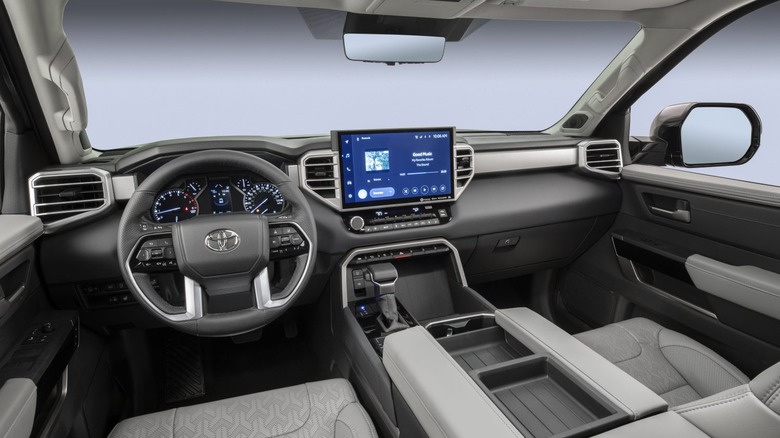
While engine and transmission issues may make you wish you'd never purchased a Tundra in the first place, infotainment glitches are more frustrating and likely to just put a dampener on your morning rather than ruin the ownership experience.
Nevertheless, these are not cheap trucks, and glitchy infotainment systems are not really something owners are happy to experience. The issues are cropping up on third-gen Tundras, which does make sense, as these have much more advanced and complex infotainment systems than older models. Some owners complain that it looks as if dirt is embedded within the screen, although the more common complaint is that the screen freezes and unfreezes randomly, which can make completing even the simplest of tasks annoying. It's also been reported by some that directing the A/C at the screen can help to keep it cool and operating better, although this is far from an ideal scenario on a new or nearly new truck.
Owners can always check if software updates are available for their systems, but the long and short of it is that many are still suffering from these annoying problems. If it sounds like something that would become too frustrating for you, perhaps consider a late second-gen Tundra instead, or factor in the cost of an aftermarket infotainment system.
Methodology
This article is neither intended to unfairly shine a light nor cast a shadow on the Toyota Tundra, but aims to inform interested parties and potential buyers on what issues most frequently aggrieve Toyota Tundra owners. To get an accurate image of specifically which issues are most common, we consulted owners' forums and other such spaces online to see what real owners are struggling with.
We also consulted sites such as CarComplaints and the NHTSA. These third-party, unbiased sites allow us to see exactly what issues owners are reporting, and how many owners are battling such concerns, allowing us to separate common problems from isolated mishaps and low-frequency problems.
It is worth noting that the Toyota Tundra seems to be an impressively reliable vehicle. However, some research is necessary to avoid the more troublesome model years when purchasing. Seeking out comprehensive history and evidence of all recalls being carried out is advised on used trucks to give the best chance of future longevity.