

5 Of The Most Powerful Military Air Defense Systems In The World
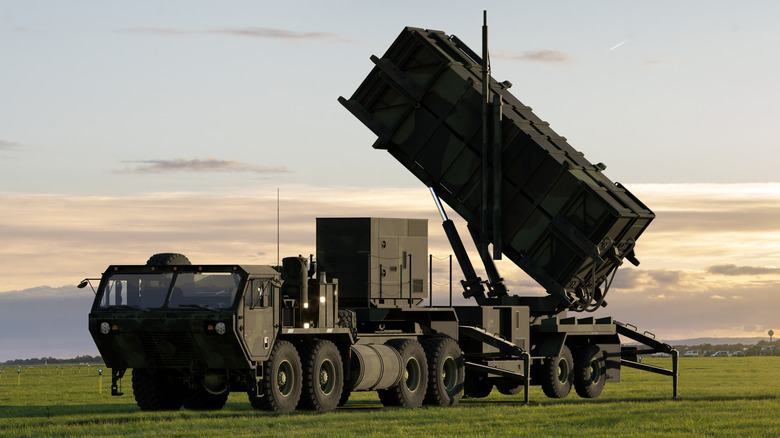
Ever since people hopped inside hot air balloons for reconnaissance missions and later, bombing missions, air defense has been on the minds of militaries around the globe. While there were several methods to opposing airborne threats, it wasn't until World War II that they evolved into wide-area ground-controlled systems. The first was the United Kingdom's Dowding system, which aided in the protection of the nation during the Battle of Britain, helping to secure the island from constant Nazi bombing missions.
Modern options, like the MIM-104 Patriot Air Defense system, are considerably more advanced than those that came before. They employ complex radar systems to find and fix targets. Once acquired, they dispatch surface-to-air missiles that fly at incredible speed to intercept and destroy or disable the target. There are many different kinds of these systems, including close-in weapons systems like the U.S. Navy's Phalanx, which are most often used on ships for point-defense. These are excellent at taking out drones, incoming missiles, and aircraft, but they're not the most powerful.
Of course, determining power in an air defense system isn't entirely objective. Just because a weapon has the largest warhead or fastest speed doesn't make it the most powerful. Power in air defense stems from a system's ability to find and take out a threat, which puts mission effectiveness far above considerations of range, speed, and power. These five military air defense systems are considered among the most powerful and have been arranged in no particular order, though only one system per country is explored.
S-500 Prometheus
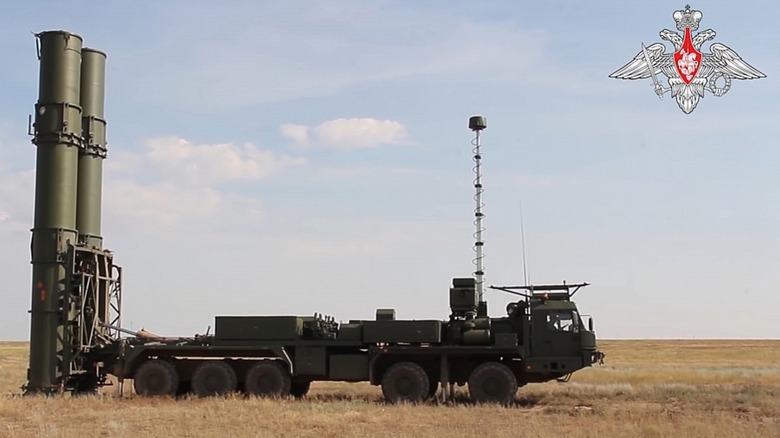
The Russian Federation's S-500 Prometheus air defense system is designed to take out airborne threats, including ballistic missiles. It's a new system that was first introduced in 2021 and works in concert with Russia's S-300, S-400, and A-235 anti-ballistic missile systems – the latter is currently in development, as of this writing. The S-500 is a significant upgrade to these systems. Once the devices are fully fielded, they'll join the S-400 and S-350 to theoretically cover the entire country with 800 launchers spread across 100 battalions.
The S-500 entered development in the early 2000s, and Russia planned to construct two facilities to produce them. There are concerns in the West that the S-500's capabilities will make it a threat to the F-35 Lightning II due to its range and other specifications. Reportedly, it can detect targets up to 373 miles away. Once targeted, it can fire a missile to intercept when it's within 311 miles of the launcher, and it can target medium-range missiles as well as low-orbiting satellites.
Anti-satellite weapon systems are being developed by Russia and China, and represent a considerable threat, making the S-500's ability to target Western satellites concerning. Russia deployed its first S-500 unit in mid-December 2025, and it poses a threat to a wide variety of Western aircraft. The system is mobile, can engage hypersonic airborne threats, and utilizes interceptors capable of reaching targets at 120 miles above sea level. Therein lies the threat to satellites and everything else between the launcher and the Troposphere.
THAAD (Terminal High Altitude Area Defense)
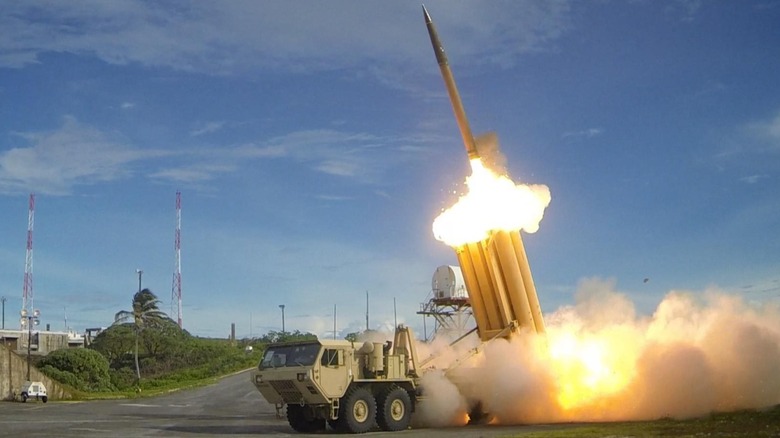
While the United States employs a large number of Patriot missile systems, there's another air-defense system with considerably more power. The Terminal High Altitude Area Defense (THAAD) is an anti-ballistic missile system designed to intercept and destroy incoming ballistic missiles. THAAD was developed from the U.S. military's experience fighting during Operation Desert Storm, where Iraq launched a large number of SCUD missiles at U.S. and allied targets.
The system is ground-based, mobile, and able to reach targets at higher altitudes than the Patriot. THAAD is primarily meant to defend large areas from intercontinental ballistic missiles (ICBMs), which are notoriously difficult to shoot down. Ideally, a battery, which consists of six launchers and 48 interceptor missiles, can find and track an inbound missile, launch an interceptor, and hit the target during its terminal phase. This is the most challenging time to hit an inbound ICBM, as they travel incredibly fast.
The terminal phase involves deploying warheads as they reenter the Earth's atmosphere, and it lasts less than a minute. This makes intercepting and hitting them successfully complex and challenging. Regardless, that's precisely what THAAD is designed to do, and it's succeeded in intercepting targets in several demonstrations. THAAD has been deployed to various U.S. allies around the world, and in 2022, the system made its first operational interception of an incoming medium-range ballistic missile that was fired by Houthi militants at an Emirati oil facility near Al-Dhafra Air Base, UAE.
David's Sling
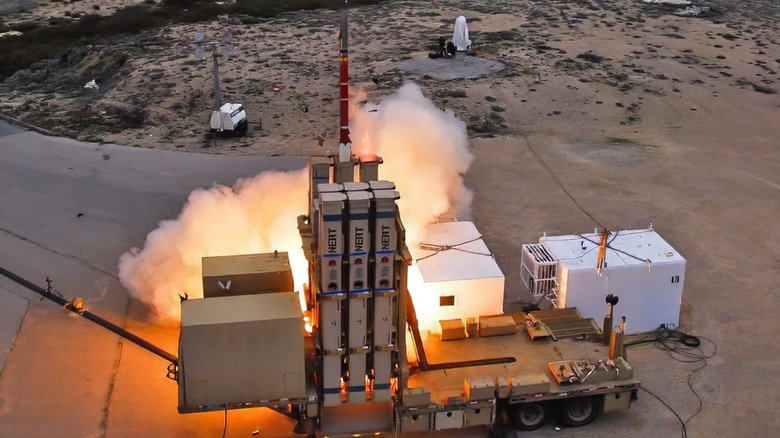
Israel has invested a lot of time, money, and effort into air defense, and for good reason. It's often attacked with a variety of airborne threats, and it successfully employed the MIM-23 Hawk and Patriot systems for several years. David's Sling is its latest upgrade to the nation's air defense, which represents several improvements over previous options that make up Israel's so-called "Iron Dome." David's Sling is designed to intercept a much larger array of threats, including aircraft, drones, cruise missiles, tactical ballistic missiles, and long-range rockets.
It represents the middle tier of protection in Israel's layered air defense network, and is capable of taking out targets at a range of between 25 and 186 miles. The Stunner, its interceptor, is a two-stage missile lacking a warhead capable of striking targets as close as nine miles. It can reach speeds of Mach 7.5 (5,755 mph). Not having a warhead may seem surprising, but they aren't entirely necessary in modern air defense systems because their kinetic energy is often more than enough.
The system is mobile and consists of a multi-mission radar, which functions for both air surveillance and fire control. Each firing unit holds up to 12 missiles, each of which reportedly costs $1 million, and is manufactured in the United States by Raytheon in conjunction with Rafael. Another option is the advanced SkyCeptor interceptor, which costs only a fraction of that of the Stunner, and is used primarily to strike short-to-medium-range ballistic missiles, cruise missiles, and other threats.
HQ-9C
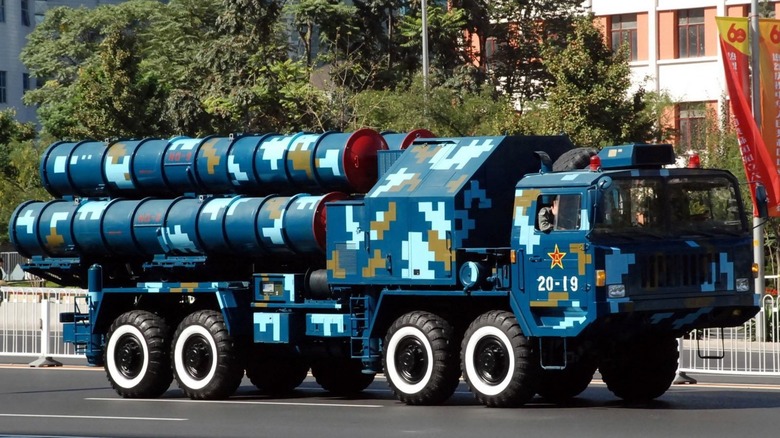
China's HQ-9 air defense system began in the 1970s, so it's comparatively old. Like most military weapon systems, though, it has gone through a variety of upgrades throughout the years. There's a naval variant, the HQ-9B, which can strike all manner of targets when fired from a variety of ships, but the most powerful version is likely the HQ-9C, which became active in 2025. It's a mobile ground-based system designed to strike inbound ballistic missiles during their terminal phase. The world got its first look at the HQ-9C missile system during Beijing's military parade on September 3, 2025.
However, China isn't in the habit of revealing the technical specifications of its weapons, leaving Western analysts to surmise their capabilities. The HQ-9C is believed to be part of China's upper layer of defense, meaning it's capable of intercepting high-flying targets. This would include striking satellites in orbit, as well as hitting ICBMs during their terminal phase. The system has a range that likely exceeds 186 miles with a maximum speed of at least Mach 4.2 (3,223 mph).
That said, given its purported anti-ballistic missile capabilities, the speed could be much greater. The HQ-9C's mobile launch system consists of at least four launch tubes per vehicle. Additionally, previous HQ-9 systems included interceptors with high-explosive warheads weighing just shy of 400 pounds affixed atop its two-stage missile, so it's likely that China will similarly arm its HQ-9C interceptors.
SAMP/T and SAMP/T NG
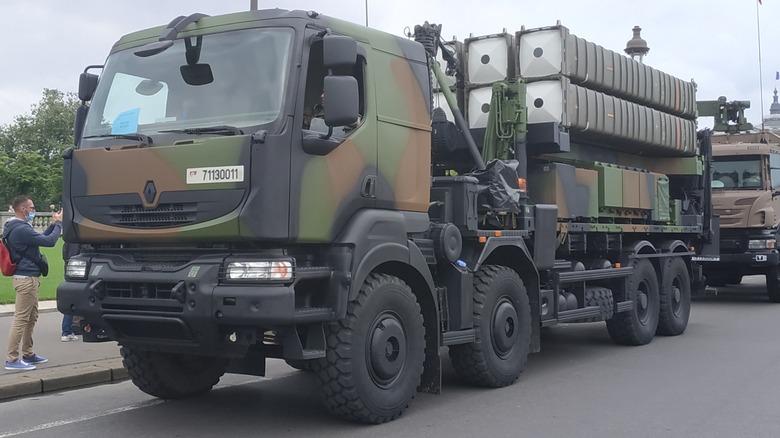
The SAMP/T is a mobile air defense system developed jointly by France and Italy. It entered production in the 1990s, when various European nations' integrated it into their layered air defense systems due to its ability to strike inbound cruise missiles, tactical ballistic missiles, and aircraft. It's a mobile system that utilizes the ASTER family of missiles, each of which weighs between 685 and 1,000 pounds. The Aster 15 has a range of 19 miles, while the Aster 30 can reach targets up to 75 miles from the launch vehicle.
In September 2025, Denmark chose the SAMP/T over the U.S.-made Patriot missile system for its forces. The Patriot has a long history of proven reliability, but the Danish decision to acquire the Franco-Italian SAMP/T is indicative of its capabilities. An upgraded model, the SAMP/T NG, will be available in 2026, improving the range, altitude performance, and anti-tactical ballistic missile capabilities of the current system. The SAMP/T NG features full 360-degree protection and the ability to locate targets at over 218 miles.
Once identified, engagement can begin at 93 miles, though this is for air-breathing targets like cruise missiles and airplanes. When targeting ballistic missiles, the SAMP/T NG has a range of at least 373 miles. It can be deployed rapidly with a small number of personnel and is integrable into air-defense networks used by NATO allies. A single battery has 48 Aster missiles, a multi-function radar, an engagement module, and six launchers capable of firing eight missiles each.