

5 Classic Cars From The 1970s With Sky High Resale Values
At the end of each decade, we can look back through the list of cars released throughout the years to see which ones made the biggest impact on the industry. Whether it's through jaw-dropping designs or technical innovation, there are a few ways that a car can leave its mark to be remembered in the future. Each decade has its batch of these cars, but the 1970s, without a doubt, has some of the best. There were plenty of setbacks during this era, specifically during the 1973 oil crisis, but manufacturers still managed to put out some of the most influential cars of all time.
It's safe to say that because of these crises, a lot of the most sought-after cars were released in the first half of the decade, before the industry had to navigate the situations in front of them. The golden age for the muscle segment was still rolling over from the 1960s. American brands were competing on speed and power, putting some of the largest and most iconic engines ever created into their muscle cars in hopes of being the fastest of them all. There were also plenty of nimble European sports cars that laid the foundations for those that followed, with collectors and enthusiasts alike now wanting a taste of that history. Financial appreciation isn't a guarantee for older cars, but the influence they had have led to the sky-high resale values that the following five cars from the era now demand.
1970 Chevrolet Chevelle SS 454
The late 1960s and early '70s offered up some of the best and most influential cars in American automotive history. Moving past the luxury focus of the '50s, manufacturers turned to building cars that could hold massive engines, constantly trying to one-up each other on pure power. Out of all the brands competing at the time, very few were as active as Chevrolet. The Camaro was the smaller model to go against the likes of the Mustang, leaving the Chevelle as the heavy hitter in the muscle car golden age.
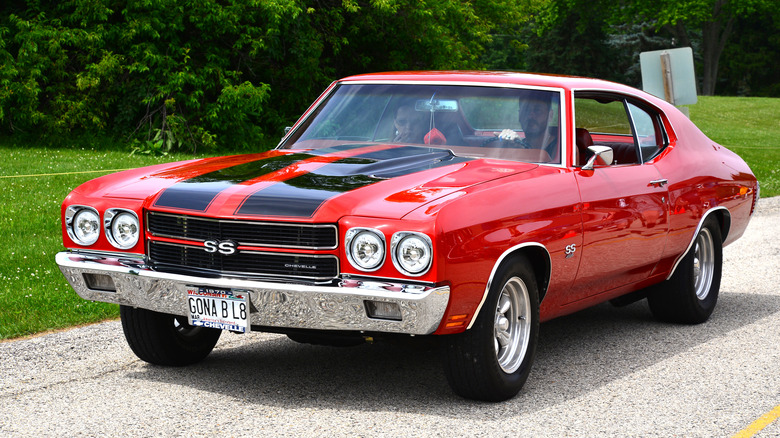
Introduced in 1963, the Chevelle truly hit the ground running after the second generation was released in 1968, peaking with the 1970 model with a specific engine under the hood. GM gave the green light to put a 454 cubic-inch monster into the Chevelle SS in 1970, which still makes it one of the most powerful muscle cars ever produced. You had the choice between the LS5 and LS6 versions of the big block V8, but the latter was considerably more powerful, producing 450 horsepower and 500 pound-feet of torque.
More than 50 years later, and the 1970 Chevelle SS fitted with the LS6 engine is still unsurprisingly sought after. For the convertible version, Hagerty reports an average sale price of $234,000. Elsewhere, hardtop examples have sold for figures over $150,00 in recent years at auctions hosted by the likes of Bring A Trailer.
1970 Ford Mustang Boss 429
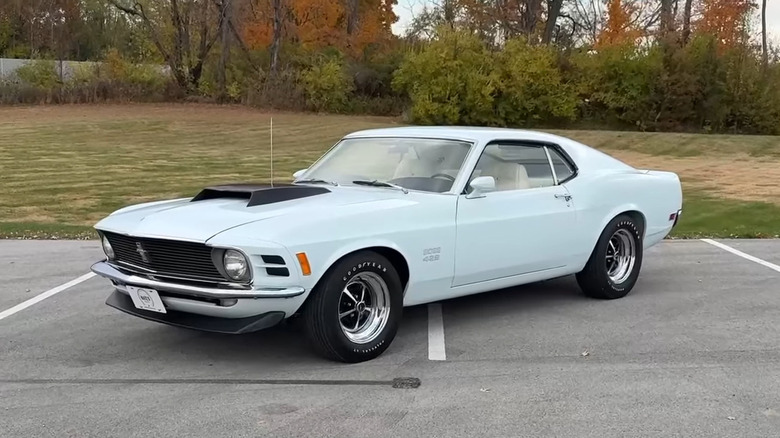
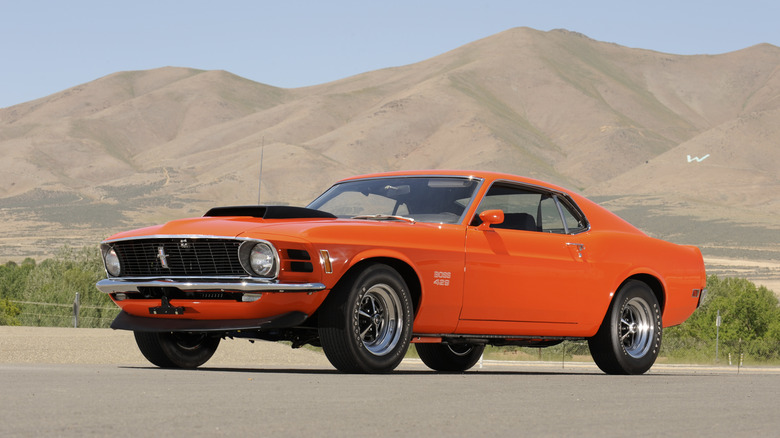
It's incredibly hard to choose just one model to be considered the best of them all, but what you should know about the 1970 Mustang Boss 429 is that it was one of the most powerful examples of the pony car ever made. While the Mustang wasn't as brash as others in the muscle scene during the late '60s, it was an industry benchmark, putting just as much focus on driving dynamics as on straight-line speed. Something important to remember with some cars from this era is that they were specifically created to compete in NASCAR due to the homologation rules in place at the time. By 1969, the Mustang was already much bolder than the first iteration, but the Boss 429 went even further, developed to put the brand at the front of the grid.
Only 499 1970 Mustang Boss 429s were built, making the current resale value no surprise. While the car featured plenty of drivetrain enhancements to improve the handling, the headline feature was, of course, the 429 cubic-inch engine. This V8 produced 375 horsepower and 450 pound-feet of torque, which was actually a bit of a pain point for some drivers who didn't think it was very well-suited to the road. Still, the history and rarity of the Boss 429 put it at the top of many collectors' lists, with Hagerty reporting an average resale price of $190,000 in good condition. At Monterey Car Week 2025, though, one sold for $252,000.
1973 Pontiac Firebird Trans Am
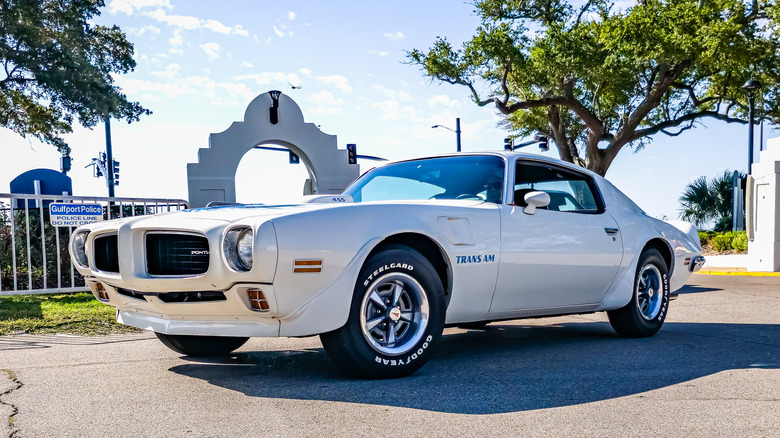
Keeping on the topic of pony cars, another one of the Mustang's closest rivals was the Pontiac Firebird. Released in 1967, the original Firebird followed a similar design style to the likes of the Camaro, but it truly came into its own with the second generation in 1970, featuring a smooth, aerodynamic shape. The early 1970s were an incredibly tough period for the muscle car scene due to the Clean Air Act of 1970 and the oil crisis in 1973, but some cars did their best to keep the segment alive to the fullest extent. One of them was the second-generation 1973 Firebird Trans Am, a car SlashGear has ranked as the very best Firebird ever produced.
You had the choice between a handful of engine options for the 1973 model year, but the 455 cubic-inch Super Duty V8 is the one that has stood the test of time better than all. Producing 290 horsepower, the difference between this top-spec model and muscle cars released only a few years earlier is pretty substantial, but the '73 Firebird Trans Am was one of the last muscle cars from the golden age. As such, a lot of people went to get their hands on one of the Super Duty models, paying figures as high as $260,000 at auction.
1973 Porsche 911 Carrera RS
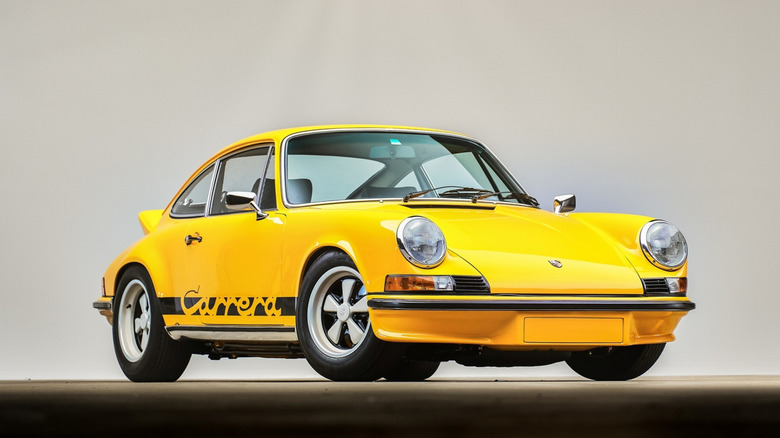
While the most expensive Porsche models sold at auction are ones with real racing history, some of the earlier road-going models don't trail far behind with incredibly high resale values. Out of all the road cars that Porsche has produced over the years, this model (badged "911" because of a naming dispute with Peugeot) is undoubtedly the most important, setting the standard for driver-car synchronization ever since 1963. As the German manufacturer continued to enhance the car throughout the decades, some specific models, like the 911 Carrera, managed to define an era.
Originally developed in 1972 and featuring the now-iconic ducktail rear spoiler, the 911 Carrera helped Porsche secure a huge presence in GT racing in the 1970s. The German manufacturer produced 500 examples of the 911 Carrera RS 2.7, which was based on the 911S to compete in Group 4 racing. In the rear of the car sat the 2.7L flat-six producing 210 horsepower and 188 pound-feet of torque, which was more than enough to shift the lightweight shell to full effect.
Due to unprecedented demand for the Carrera RS, Porsche ended up making 1,580 units worldwide, with a mixture of variants among that number. You had the Touring version, which made up most of the pack, which now sells for an average of $445,000 according to Hagerty. A stripped-back Sport option was also available, with one selling for a massive $1.875 million at auction.
1973 Ferrari 365
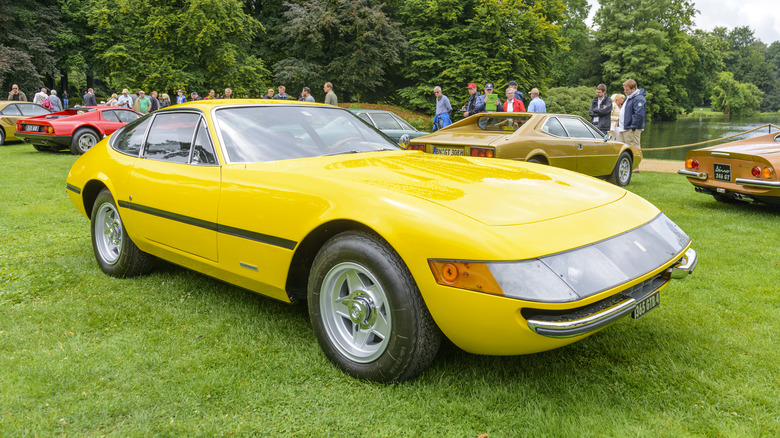
Ferrari wasn't on top in the major racing series in the latter half of the 1960s, but the command that prancing horses had on the road was very much still there. In 1966, Ferrari released the 365 nameplate, becoming the flagship grand tourer for the brand. As do quite a few other Ferrari cars from that period, the 365 was available in a plethora of versions, which were released periodically moving into the '70s.
What now stands as one of the most illustrious models in Ferrari's history, the 365 GTB/4 Daytona (getting its name after the 1-2-3 finish at the 1967 24 Hours of Daytona) is the pinnacle of the specific body style. While models like the GT4 BB opted for a mid-engine layout, the GT4/B Daytona kept the Colombo 4.4L V12 engine up front. This engine produced 362 horsepower, which made it the fastest car of the decade by the end of the 1960s.
Production ran from 1968 to 1973, with the final model year being understandably sought after. Hagerty pins the price at around $515,000 for a '73 Daytona, while on auction sites like Bring A Trailer, the coupe version has sold for prices such as $477,500. The ragtop version, however, named the GTS/4 Daytona Spider, is much rarer than the coupe, with Hagerty reporting an average sale price of a whopping $1.9 million.