

5 Of The Worst-Looking Cars From The 2000s We Wouldn't Be Caught Driving Today
The new millennium may have arrived without much in the way of disruption from the so-called Y2K bug, but the decade that followed would prove to be quite pivotal for the automotive industry. GM, Chrysler, and Ford suffered greatly from the global financial crisis of the late 2000s, leading to these companies facing bankruptcy, relying on federal loans just to stay afloat, and the shuttering of iconic brands such as Pontiac.
At the same time, that first decade was also the period that saw many technologies we now take for granted initially debut. The U.S. made more accurate GPS available to civilians, paving the way for the satellite-guided in-car navigation systems. In-car Bluetooth also debuted in the 2000s, as did other conveniences such as massaging seats and rear-view cameras.
These years of upheaval and progress gave birth to some great cars, and, predictably, to some ugly ones. For every eye-catching modern classic like the C6 Corvette — a model we classified as near the top in our list of the best Corvettes ever, for the record — or the Honda S2000, we got eyesores like the SsangYong Rodius or Chrysler PT Cruiser. It's the latter cars we're taking a look at here, reliving some of the curious design missteps the auto industry made during this fateful decade.
Ssangyong Rodius
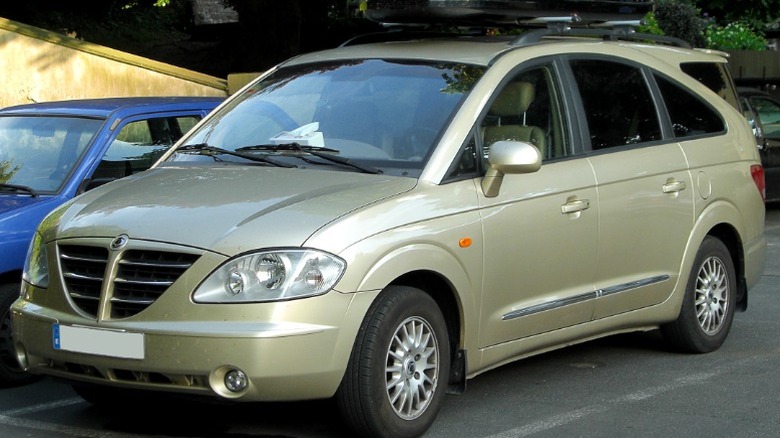
Korean automaker Ssangyong may not be a household name in the U.S., but the company's vehicles were something of a regular sight in other parts of the world in the 2000s and 2010s, including Southeast Asia and the U.K. Unfortunately, its vehicles weren't always visually appealing, and there is perhaps no better example of Ssangyong's questionable design prowess than its Rodius minivan.
First, the good stuff: The Rodius was, generally speaking, a decent minivan. It was spacious enough to fit 11 people, had niceties like tables and swiveling seats, and higher trim levels saw those same seats heated and wrapped in leather. You could even remove most of them as well, upgrading the cargo space of the Rodius substantially. Of course, the Rodius' impressive carrying capacity wasn't magic: It was quite a large vehicle by the standards of a 2000s minivan, measuring some 5,125 mm (201.77 inches) long and 1,820 mm (71.65 inches) tall. It's this lumbering size, combined with its looks, that make it such an eyesore.
It's commonly said that the Rodius' design was inspired by superyachts of the time, but the result is less "yacht" and more "trainwreck," if you ask us. There's the front fascia's unappealing, characterless-European-luxury look, for one, but then your eyes will likely also take offense at the Rodius' ugly side profile with the clumsy-looking box extension for the cargo area. The wheels also look comically small and give it a toy car look, and it all makes for a smorgasbord of visual calamities. Is the Rodius a bad car? No, probably not. But it certainly earns its place SlashGear's list of the ugliest cars ever designed.
Dodge Nitro

The late 2000s were dark days for Chrysler, which ended up having to declare bankruptcy in 2009 despite receiving $4 billion of loans from the U.S. government. And while Chrysler, later Fiat Chrysler Automobiles, managed to weather the storm and claw its way back into profitability, some of the cars that it produced during that spell continue to leave a bitter taste in the mouth.
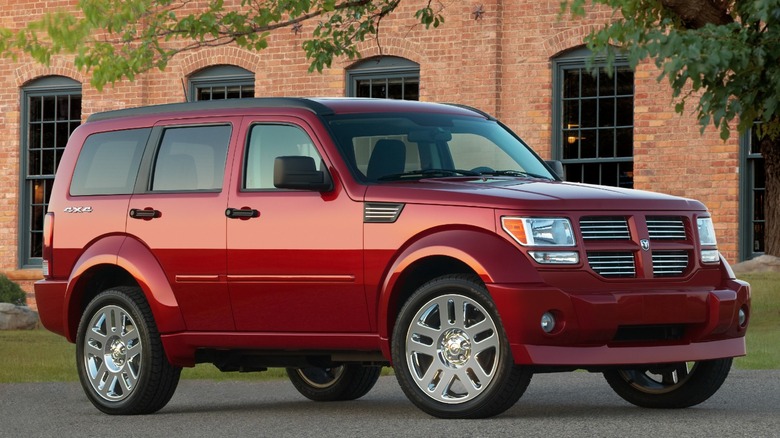
Case in point: the Dodge Nitro. Now, to be clear, Chrysler's designs of the time weren't necessarily all that stellar anyway, with offerings like the revived 2006 Charger combining a somewhat ostentatious take on the classic Dodge crosshair grille with body lines that made an elephant look svelte and sleek. But that Charger, for all its faults, was nothing compared to the disaster that was the 2007 Dodge Nitro.
Hailed in a press release as an example of Dodge's track record of leveraging innovation in creating vehicles, the mid-size SUV had styling that Dodge called "bold and aggressive" but which we, nearly two decades on, think of as garish and tasteless. Sure, one could argue that an ugly SUV at least has more personality than a bland one (and there were plenty of those in the 2000s), but we say that too much character is just as misguided as a lack of it, and that describes the Nitro perfectly. This model combined mid-size SUV proportions, disgustingly exaggerated wheel arches that flow into an overly-chunky front bumper, and a particularly graceless implementation of the brand's signature grille is distinctively unappealing. The result made for an SUV that we're glad time has mostly forgotten — even if some of our writers believe that the Nitro is one of the many vehicles Dodge should never have discontinued.
Chrysler PT Cruiser
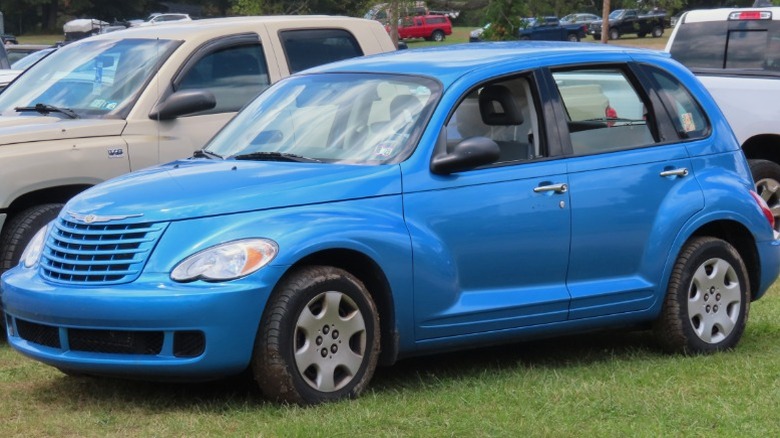
Retro-informed designs were all the rage in the 2000s. Some, like the 2005 Ford Mustang's nearly pitch-perfect evocation of '60s and '70s design cues, were an unqualified success that would inspire future revivals in turn. Others, however, were less successful — or, at least, dated much more quickly. The Chrysler PT Cruiser is a perfect example of the latter.
Now, to be fair, the PT Cruiser was not exactly a bad car. It was Motor Trend's Car of the Year in 2001, with the publication hailing its surprisingly fun drive, impressive practicality, distinctive styling, and excellent value (it started at $15,935, which works out to a still-decent $29,180 in 2025 money). These traits made it quite popular, and Chrysler sold more than a million units globally before it retired the design in 2010. As for why why Chrysler discontinued the PT Cruiser, its lack of adaptation over time was likely a major contributor. The PT Cruiser's positives are mostly all still true now, admittedly, but the vehicle's looks, which stood out for all the right reasons in 2001, are now distinctive for all the wrong ones more than 20 years on.
The issue is that fellow retro-minded 2000s offerings like the S197 Mustang and 2008 Dodge Challenger still have fundamentally good proportions to make up for the fact that their designs are around 20 years old now. The PT Cruiser's (admittedly practical) tall sedan body, on the other hand, doesn't. Thus, what you end up with is a very dated body shape dragged down by even more dated hot-rod-inspired curvy bodywork. It's both generally ugly and slightly dull — the worst of both worlds.
Subaru Tribeca

Subaru seems to have a knack for missing the mark on aesthetics. The Tribeca SUV, for example is just one of many of the worst-looking Subaru vehicles the company has made over the years. First breaking cover at the 2005 North American International Auto Show, the Tribeca — or B9X as it was first known — was Subaru of America's first seven-seater SUV and also the largest model in the automaker's lineup up to that point.
While attempting to court the American SUV market was a logical and perfectly understandable move (it had, after all, been a strong market since historical lows in 1998), Subaru's design choices are a bit harder to fathom — or have any sympathy for. The Tribeca's design, especially the front fascia, was not universally loved even when it debuted for the 2006 model year — CNET called it "an unhappy combination of current fads and ungainly proportions," for example — and it arguably looks even worse now, a victim of the inevitable passing of time and shifts in design trends.
The main issue, really, is all about that front. Sure, there were defenders, with admirers likening it to Alfa Romeo models of the time due to the central triangle grille and two "wings" to the side. The issue, of course, is that these Alfas — such as the 8C Competizione, one of the best Alfa Romeos of all time — weren't tall, seven-seater SUVs. Sure, the building blocks were the same, but the results were worlds apart: The Alfas were broadly sleek and classy, whereas the Subaru Tribeca was just a chunky SUV with an unappealing snout up front that we think is too ugly even for irony.
Citroën C3 Pluriel

Ah, Citroën. There are plenty of reasons to think of the French automaker fondly, from radical concept cars like the Citroën Karin to the thoroughly ahead-of-its-time technologies like the hydropneumatic suspension in the classic 1955 Citroën DS. But cutting-edge genius and lofty ambitions often go hand in hand with the risk of a high-minded flop, and that's exactly what we have with the C3 Pluriel.
This particular model debuted in 2003 and was produced until 2010, with 115,097 units made over its production run. Citroën's entire concept was that of modularity, with the Pluriel offering an admittedly novel take on drop-top motoring. It was a hatchback by default, with a fabric roof between two chunky roof rails, but that was just the start: One could retract (or fully lower) middle fabric roof for open-air motoring with the rails intact, ditch the rails and turn it into a full convertible, or even fold the back seats down (with the roof off) to turn it into a mini pick-up.
It was novel, yes, but also impractical: The rails were difficult to remove, heavy, and were too large to store in the Pluriel — leaving a driver with no recourse were it to rain on the trip. Thus, while it isn't without charm, it's also silly. And then there's the looks, with its proportions that don't sit quite right to our eyes and a design language that's a bit too busy to be sleek, but also not quite possessing enough detail to be memorable. The flared wheel arches look out of place, the front is just a bit awkward, and we think it looks very ungainly with the top down and roof rails up.