

14 Of The Coolest Pieces Of Tech We've Sent To Space
Humanity's love affair with the stars dates back to the thousands of years before B.C., when the first building blocks of astrology were laid in the ancient city of Babylon, Mesopotamia. In the millennia since, our relationship has continuously evolved from one of adoration of the pretty night lights to walking among them when we sent a man to the moon in the 1960s.
From the Space Race era until today, different pieces of tech have been launched from Earth into outer space for a variety of reasons: We've tried to understand other worlds, to explore terraforming those worlds, and even to communicate with aliens (if at all they exist). Perhaps unintentionally, some of these devices have influenced the tech and the culture we have here on solid ground. You're likely familiar with the "Star Trek" franchise; the billion-dollar television and movie series was born out of the curiosity of what really lies out there.
On the tech side of things, we've discovered new ways to purify water, developed a better understanding of black holes, and found ways to combat muscle loss. But that's enough of the evolution that's come from space; we're looking at the coolest things we've sent there. From dogs to spacecraft that were ahead of their times, some impressive engineering feats have left our stratosphere to experience the outer limits. Without further ado, let's look at a few of them.
Spacecraft
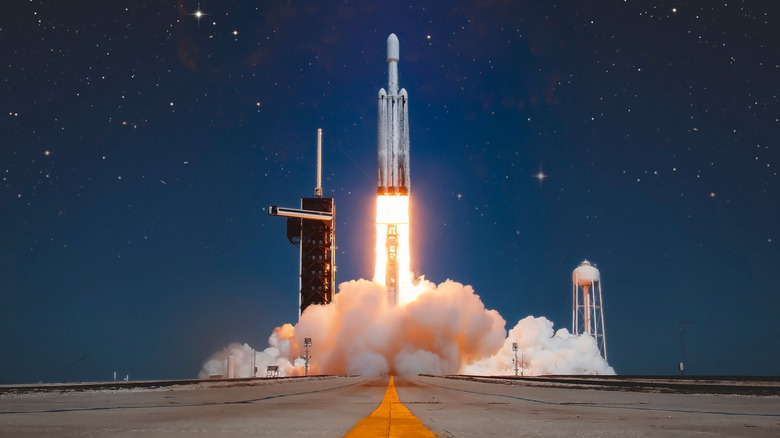
A list of cool tech that has left the confines of our world wouldn't be complete without the very vehicles that got us there, and spacecraft are one of the most impressive bodies of work that humanity has ever put together. If you've ever been fortunate enough to stand in the presence of one of these scientific titans, you're likely to ponder how humanity transitioned from making arrows out of wood to inheriting the stars.
It's that storytelling of the indomitable human spirit that makes spacecraft so incredible. For the casual observer, there's something exhilarating about watching the flame and smoke clouds rise from the launchpad as the announcer counts down to liftoff. That explains why NASA launch events still draw the heavy viewership numbers they do — a joint launch between NASA and SpaceX in 2020 hit 10.3 million viewers. It's impossible to list every single rocket that's left our atmosphere, but SlashGear has a list of the 15 most groundbreaking missions that NASA either spearheaded or was involved in.
In terms of evolution, a lot has changed since the Space Race voyages. While some parts of space shuttles were reusable, SpaceX recently changed the game with the Falcon 9's reusable first-stage booster — and more reusability is in the pipeline. That means space travel won't be nearly as expensive in the future, and with SpaceX competitor Blue Origin taking paying customers out among the stars for brief periods, perhaps spacecraft could become accessible transportation in the future.
Satellites
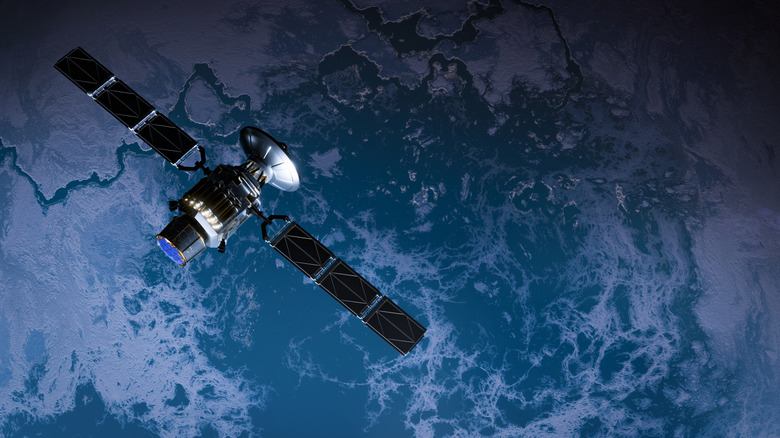
Just as with spacecraft, it wouldn't be fair to discuss cool tech if satellites were omitted. That's because they have a hand in the workflow of almost everything considered cool on the planet. From GPS navigation to weather forecasting, broadcasting, and other applications, satellites play a key role in our day-to-day lives.
The satellite story began with the Space Race voyages of the late 1950s and early 1960s, with the first satellites primarily used for data collection. For instance, Sputnik-1, the first successful artificial satellite, gathered data on the Earth's atmosphere while orbiting. The spotlight shifted away from the satellite scene with the Apollo missions, but that doesn't mean they're any less important today.
As of 2025, there are about 13,700 satellites in orbit around the Earth. Each of these functional satellites serves a purpose; be it for providing internet like Elon Musk's Starlink, streamlining financial transactions, or coordinating disaster management, if you can think of something related to communication, satellites are probably involved.
Hubble Space Telescope
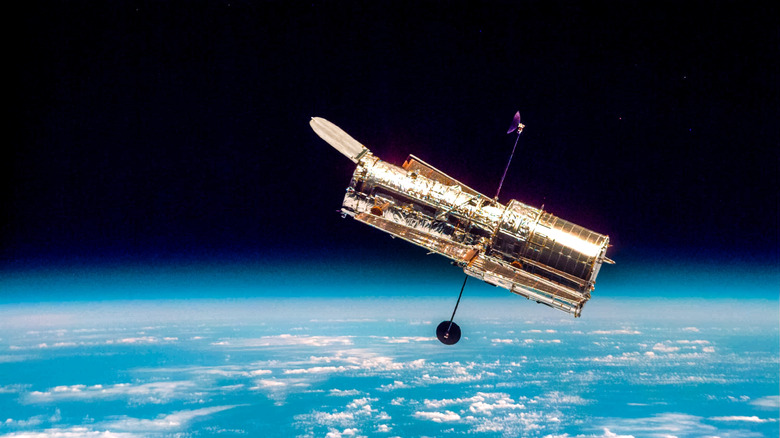
Humanity is a curious species at its core, and our desire to understand the vast nothingness that is space didn't stop when Neil Armstrong took his famous steps on the moon. Instead, it bloomed, and the Hubble Space Telescope was born out of that curiosity in 1990. Standing 43.5 feet tall and weighing over 10,000 kilograms, it was designed to capture astronomical images even at great distances to deepen our understanding of the galaxy.
It's been more than three decades since its launch, and the Hubble has recorded more than 1.7 million events — many of which have unearthed information we had no idea about before. It's watched a comet collide with Jupiter and even peered beyond the curtain of the past by studying locations 13.4 billion light-years away from Earth. That level of exposure is only possible due to the intense magnifying capabilities; it can zero in on a target's location without deviating by more than seven-thousandths of an arcsecond. That's the equivalent of pinpointing a strand of human hair with a laser beam from a mile away.
Parker Solar Probe
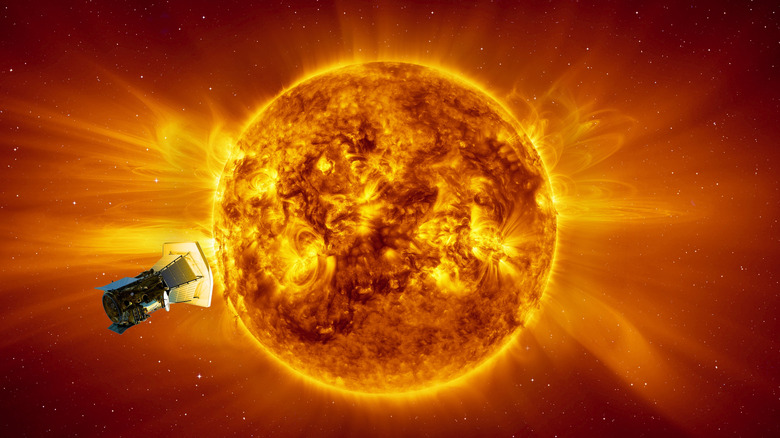
Like the rest of the stars in the sky, the sun has long been a subject of curiosity and even reverence in some cultures. The most powerful deity of the Egyptian Pantheon, for instance, was Ra, the Sun God, who was believed to have created the world and the cosmic order. While the Sun may not be a mythological figure in our current understanding, it does give us life via gravitational pull and sunlight.
To actually explore the Sun may be beyond our abilities since its heat is, in simple terms, capable of disintegrating just about anything we can make. That hasn't stopped explorers, though, and the Parker Solar Probe became the first spacecraft to fly through the Sun's corona in 2021. It's completed more than 10 close solar approaches since then.
Now, you might be wondering how that's possible. After all, the temperature of that corona is a smoldering 1.8 million degrees Fahrenheit. Well, there's a genius solution that lets the Parker Solar Probe go on this voyage unscathed. There's a heat shield that protects it from direct sunlight, and very few plasma particles actually penetrate the probe's material to transfer heat from the Sun to it.
The probe's speed is another remarkable engineering product — it flies around the Sun at speeds reaching up to 430,000 miles per hour. For context, you could fly from New York to Tokyo (a trip of at least 14 hours by plane) in under one minute at those speeds.
James Webb Space Telescope
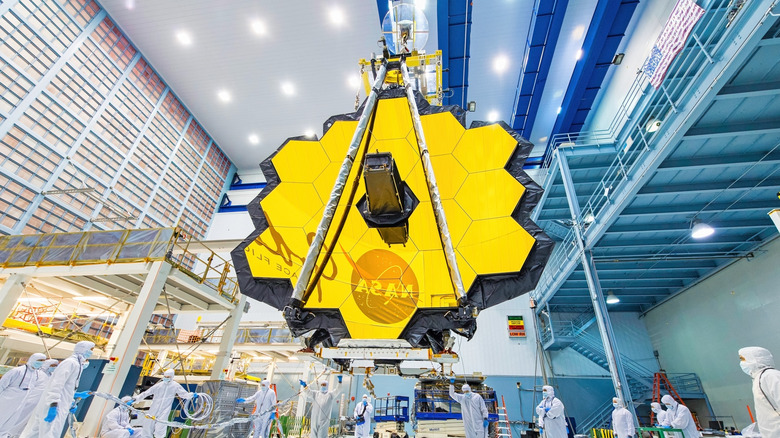
Shortly after the Parker Space Probe entered active duty, the James Webb Space Telescope joined the Hubble as one of humanity's high-profile observatories. There are quite a few differences between the two in terms of technological prowess and orbit. For instance, where the Hubble Space Telescope revolves around the Earth, the James Webb Space Telescope orbits the Sun almost a million miles away from us.
That placement is actually strategic; it effectively uses the Earth as a shield from the Sun's heat and light. Tech-wise, there's a 30-year gap between the two telescopes, so it makes sense that the James Webb Telescope is much better equipped. The difference in quality shows up in infrared viewing — the James Webb can see farther than 13.5 billion light-years. In fact, in March 2024, the telescope located a galaxy situated about 33.8 billion light-years away.
Scientifically, on paper, such a view shouldn't be possible, as the universe itself is currently thought to be 14 billion years old as the oldest. However, the expanding nature of the universe, coupled with the deeper infrared view of the telescope, allows us to understand the secrets of the galaxy. SlashGear has also covered how the James Webb has shown us the birth of a new solar system; that's how powerful this telescope is.
Mars Rovers
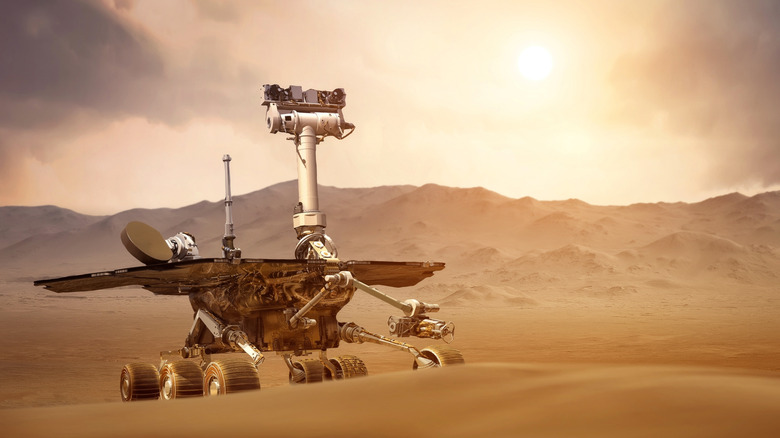
The Red Planet, Earth's neighbor, has been the subject of terraforming interest for quite some time — it's almost like humanity's contingency plan in case something happens to our home planet. That's why people like Elon Musk have brought up the topic in the past, although it's pretty obvious our current technology can't support such plans on a large scale. However, that hasn't stopped us from trying to gather as much data from our close planetary neighbor as possible.
Those trials have certainly been difficult; it's commonly considered that roughly half of all Mars missions have failed — some burned up, others failed due to technical reasons, and still others went missing. We haven't perfected the tech for getting there either. The first successful missions to get a feel for Mars' ground profile came in the mid-70's via the Viking Landers. Five of the next six missions to Mars, whether launched by the U.S., the U.S.S.R., or by the European Space Agency, would fail in one way or another.
The context of the failures sheds a different light on just how special NASA's five successful Mars Rovers are, though; they not just landed on a hostile planet against the odds but survived long enough to send back critical information about its environment. Of those five, only two, Curiosity and Perseverance, are still operational today.
International Space Station
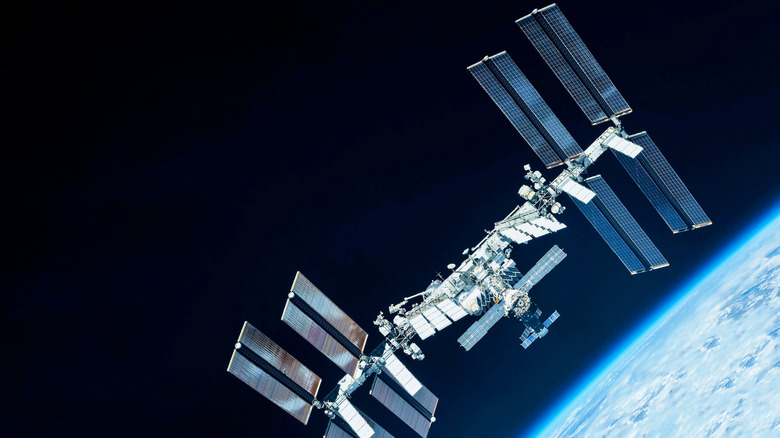
One of the most symbolic pieces of human collaboration in any field, the International Space Station is humanity's most prominent outpost in space. No single country can claim "ownership" of the International Space Station; Europe, the United States, Japan, China, and Russia all contributed to its construction through several missions. Other countries, such as the United Arab Emirates, also contribute to its upkeep.
In terms of size, it's the largest structure we've ever sent into space — although it wasn't nearly so neatly put together on Earth. We didn't rocket it out of our atmosphere as one holistic unit. That's because the ISS is larger than a football field and weighs 930,000 pounds; the physics would've been nearly impossible.
Instead, we built the ISS bit by bit like a Lego set while it was in orbit. Assembly began in 1998, and although the main construction wasn't completed till 2011, humans started inhabiting the station in 2000. It costs roughly $3 billion to maintain annually, but the research significance of the first human outpost in space cannot be overstated.
Tesla Roadster
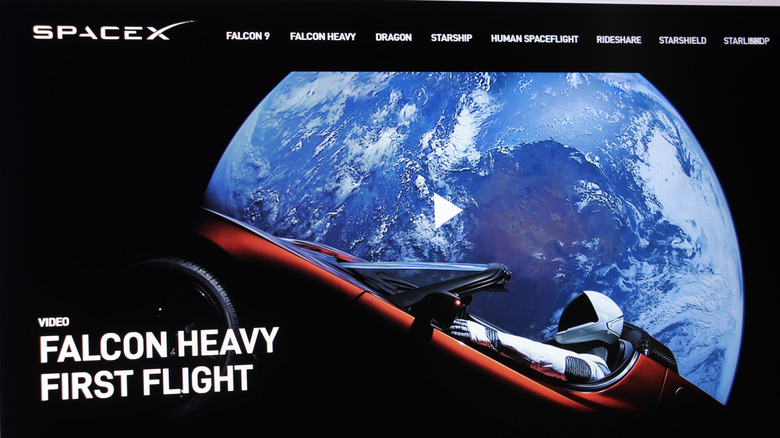
This one will probably raise a few eyebrows. We've already name-dropped Elon Musk above with his discourse on terraforming Mars and how his SpaceX is one of the leading private ventures in the rocket industry. Given all the complex physics calculations involved in sending any type of tech into orbit, you'd be forgiven for assuming a full-sized car wouldn't be on the list of things we've sent to space. However, you'd be wrong.
On February 6, 2018, SpaceX launched one of Musk's Tesla Roadsters into space — a stunt to mark the historic launch of the Falcon Heavy rocket. A trio of pop culture references adorned the event: A Starman mannequin occupied the driver's seat as a nod to David Bowie's hit record, a copy of "The Hitchhiker's Guide to the Galaxy" was situated in the glove compartment, and a 5D optical disk also had the works of Isaac Asimov embedded in it.
It was a fun way to communicate the relationship between Tesla and SpaceX, despite their markedly different market audiences. We can consider the Roadster a donation to science, since it'll be floating in space for a few million years at least, before it loses its orbit and crashes into Venus or Earth.
Lego figurines
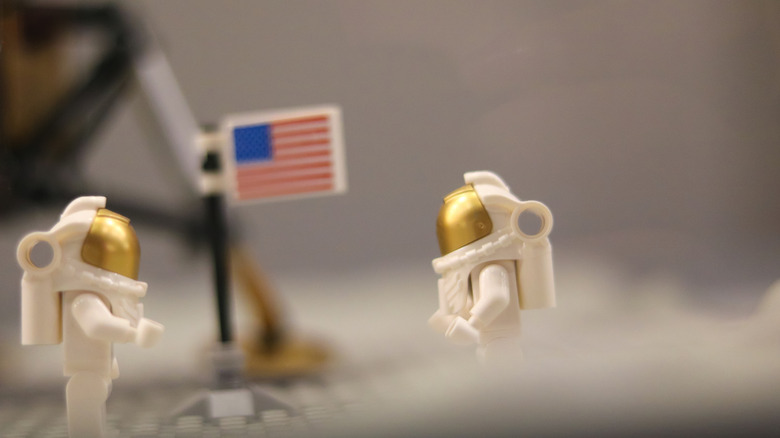
Lego bricks can be viewed as physical building blocks of the imaginative mind; children and adults alike assemble and dismantle structures using the durable ABS plastic that they're made from. It's not just bricks that makes Lego so popular, though — the company says that there are more than 4 billion Minifigures in existence around the world.
So you might be wondering, what's the correlation between a toy maker and space exploration? Well, the collaborative history between Lego Group and NASA dates back to the '90s. They were both participants in MIT Media Lab's First Robotics Competition, which gave birth to many robotics challenges with space themes in the years to come.
So, it was only natural for a space launch to involve Lego at some point — especially since young kids could be inspired to study STEM subjects through involvement with the association. That thinking manifested into reality on August 5, 2011, with NASA's Juno mission. Intended to gather data to study Jupiter, the spacecraft included three custom Lego figurines (representing the Roman God Jupiter, his wife Juno, and the Italian astronomer Galileo Galilei) amongst the state-of-the-art sensors. Besides the obvious inclusion of the first two, Galileo made several important discoveries about Jupiter before his eventual conviction of heresy.
A piece of the first ever airplane
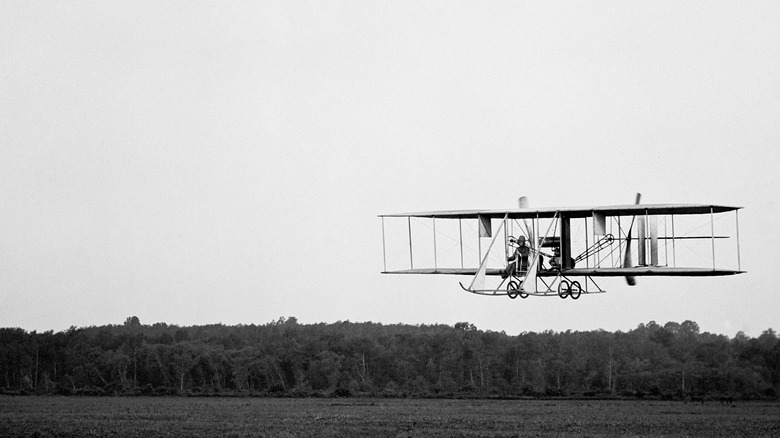
When Wilbur and Orville Wright, otherwise popularly known as the Wright Brothers, took humankind to the skies with a heavier-than-air craft for the first time in 1903, it's highly unlikely they foresaw a piece of their work making it to space. However, it would take less than 70 years for us to walk on the moon, and that's when the piece of history left our skies to touch the heavens above — however briefly that encounter lasted.
The moon landing was significant for several reasons, including the stamp of confidence to send human lives into the previously unknown and the culmination of the Space Race, to name but a few. To commemorate this moment that would forever be etched in history books, Neil Armstrong carried a few cuts of cloth and a piece of wood from the aircraft with him on his moonwalk.
Unlike other items on this list that are destined to float up there for millions of years, the pieces followed Armstrong and the Command Module back to Earth; they now reside in the Smithsonian.
The Golden Record
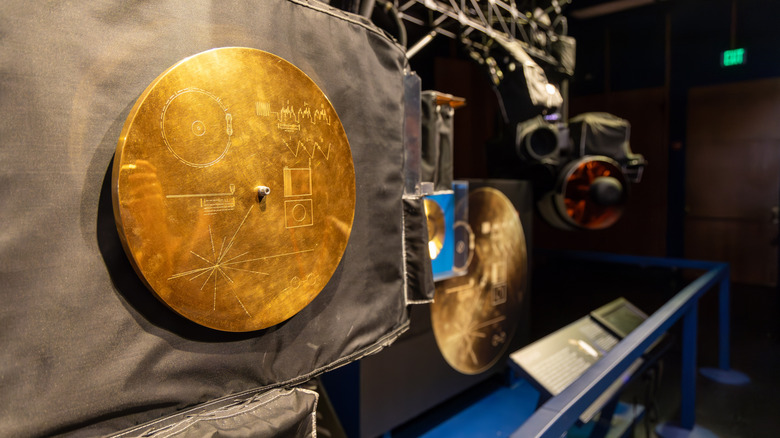
Scientists have long wondered if we're alone in the universe. Although it's clear there's no other planet of the eight in our solar system that supports life, it's still a possibility — however slim — that aliens exist somewhere out there. It's this thinking that birthed the Golden Record, a collection of sounds and images intended to introduce aliens to the human culture on Earth.
In the hypothetical scenario where an extraterrestrial civilization discovered one of our exploratory missions, we needed a way to distinguish ourselves from any other species that could be out there. So, Carl Sagan, the famous astronomer, designed phonograph records to perform the introductory rites for us on the Voyager missions in the 1970s.
Now, you might be wondering, what exactly is on NASA's Golden Record? Nothing short of a primer on humanity. Both Voyager 1 and Voyager 2 were outfitted with a record containing at least 115 digitally encoded pictures, spoken greetings in 55 languages from all over the world, and a selection of music spanning different genres from all eras — from classical sounds to contemporary jazz at the time.
Lightsaber

Star Wars is one of the most iconic franchises based on space exploration and adventure. As of 2019, it was the fifth-highest-grossing media franchise of all time, with an estimated value of around $68 billion. Amidst the varying civilizations and polarizing personalities in the franchise, one of the biggest symbols of the Star Wars universe is the lightsaber, which are one of the most popular toys on the market; Disney once claimed to sell north of 10 million units every year.
Given that the weapons are so popular and associated with space, it makes sense that a lightsaber has made the flight to honor the brand. As part of Star Wars' 30th anniversary celebrations, Luke Skywalker's lightsaber prop — the one in the legendary film "Episode VI: Return of the Jedi" — flew into space and back in 2007, accompanying a team of seven astronauts. The main purpose of the trip was to deliver the Harmony module to the International Space Station, but the addition of the lightsaber added a touch of pop culture relevance.
HeLa Cells

At the start of humanity's love affair with space, we used animals as de facto astronauts. For obvious reasons of uncertainty, human life couldn't be risked in such conditions. After the exploits of Albert II, the rhesus monkey in 1949, attention turned to whether the human body could withstand the environment. That's where HeLa cells came in.
The name "HeLa" is a melded version of Henrietta Lacks, an African-American woman who died in 1951 from cervical cancer. Unlike other patients whose cells would die shortly after, even in lab-preserved conditions, the cells from her cervical biopsy kept growing and reproducing in culture. A sample of these so-called "immortal" cells were sent to space in 1960 to study the void's environmental impact on living tissue. Only after these cells made the trip did Yuri Gagarin famously rocket into space.
The impact of HeLa cells on the field of microbiology can't be overstated, from linking HPV infections to types of cervical cancer to determining the number of chromosome pairs in human cells.
Human DNA Sequences
The concept of preserving human life in the event of a global catastrophe came to the forefront of collective consciousness at the height of the Cold War in the 1960s. Although the tension of that era has abated, the core idea still exists, and it's that idea that informed the memory microchip called the Immortality Drive.
Designed to be a digital backup of the human genome, the Immortality Drive is a memory device containing the complete DNA sequences of a select group of popular celebrities — most notably the renowned physicist Stephen Hawking. Transported to the International Space Station in 2008, the drive aims to preserve genetic information so that humanity is never forgotten.
However, the scope of this "memory" is rather limited. It's more of an identifier akin to a fingerprint than anything else; there's not enough genetic information in the samples to support cloning, if we ever perfect such technology in the future.