

5 Tools Makita Makes That DeWalt Doesn't
We may receive a commission on purchases made from links.
DeWalt is a very popular tool brand and for good reason — it has a wide assortment of high-quality tools that are often relatively affordable. However, it doesn't make everything you might need and, like pretty much all tool brands, there's likely a few gaps in its catalog you may have to look elsewhere for. Just as there are some DeWalt tools that Makita doesn't make, the inverse is also true.
If you're looking for floor sanders or crimping tools, DeWalt's got you covered. But if you're in need of a powered wheelbarrow or looking to cut a lot of mortises or rebar, you may be better off with Makita. For some applications, DeWalt may have some tool attachments or other options that can get close to what you need, whereas Makita will have exactly what you need.
There are also tools made by both brands, but ones where Makita offers something unique that DeWalt doesn't. For example, you can find several cordless circular saw models in both teal blue and black and yellow, but only Makita makes one with a 16-inch blade. If you're curious about some of the differences between the two, here are five tools Makita makes that DeWalt doesn't.
16‑5/16-inch Cordless Circular Saw
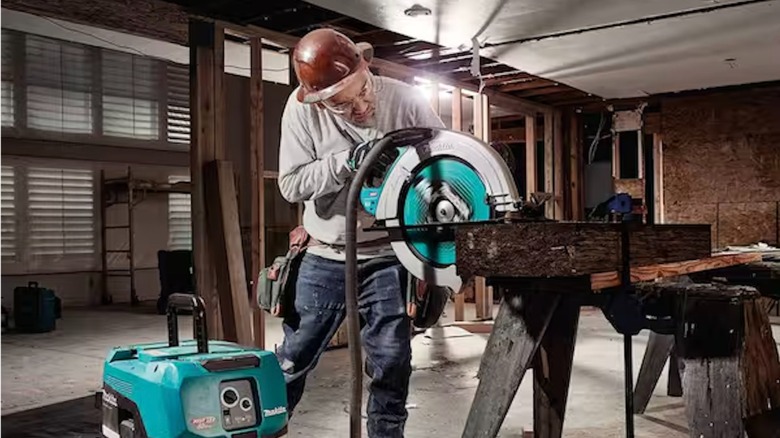
Like many major tool brands, DeWalt makes cordless circular saws, but — limited by battery power — the largest it offers is a 7-¼-inch blade. Makita, on the other hand, makes one that's over twice that size. In fact, the Makita 40V max XGT 16‑5/16-inch Circular Saw is the world's largest cordless circular saw, offering a battery-powered model for heavy-duty cutting that no DeWalt cordless tool can currently match. It's also a lot pricier than most cordless saws, which makes sense considering its size, and the hefty 40V batteries needed to power it aren't exactly cheap, either.
The Makita 40V max XGT 16‑5/16-inch Circular Saw (model GSH06Z) is powered by a brushless motor and can deliver up to 2,100 rpm, cutting up to 6-5/16 inches at 90 degrees and 4-¼ inches at 45 degrees. Makita says the saw is 30% faster than corded equivalents and allows for a soft start to help make more precise cuts. An electric brake and blade stabilizer are included and the tool has a bevel capacity between 0 and 45 degrees, with positive stops at 15, 30, and 45 degrees.
The behemoth is built from die-cast aluminum to help keep its weight down and making it easier to maneuver as well as transport (which is a big reason one might opt for a cordless tool in the first place). Weighing a little over 24 pounds, it's actually four pounds lighter than its corded counterpart and can tackle larger timber, logs, and pressure-treated lumber. When used on 6x12 lumber, the saw can make up to 75 cuts per charge when powered by a Makita 40V 5 Ah battery. Plus, the tool is compatible with Makita's Bluetooth Auto-Start Wireless System (AWS) that pairs with a dust extractor attachment that comes included.
Powered Wheelbarrow/Dolly

When it comes to tools, there isn't much simpler than the wheelbarrow, which DeWalt does make. Makita hasn't reinvented the wheel, but it does offer a powered wheelbarrow that uses a battery-powered motor to drive the wheels — something DeWalt does not currently make. With a power-assist, it can be much easier to push heavy loads, such as dirt, sand, or bricks, longer distances or up inclines. Makita offers three variants of the machine, including one with a dump bucket and one with a flat bucket.
The third version is the Makita 36V LXT Brushless Material Handling, Dump/Pipe Frame Dolly (model XUC05Z), which comes with no bucket included. Instead, you can use the flat frame to stack pallets and other large, heavy items for moving around the jobsite. It's designed with a telescoping loading platform that can extend to 63 x 42.5 x 40.5 inches in size. It can run at three different speeds and can go over 3 mph on a 12-degree incline.
While it must admittedly be nice to take the manual labor out of pushing and pulling heavy loads, one of the things to know about Makita's battery-powered wheelbarrows and dollies before purchasing one is that they're, obviously, a lot more expensive than standard, non-powered ones. They also run on not one but two Makita 18V batteries, which you'll also have to factor into the cost (along with a charger) if you don't already own any. The machine can actually hold four batteries at once, which allows it to run for up to 100 minutes when using 6 Ah units.
Cordless Rebar Cutter
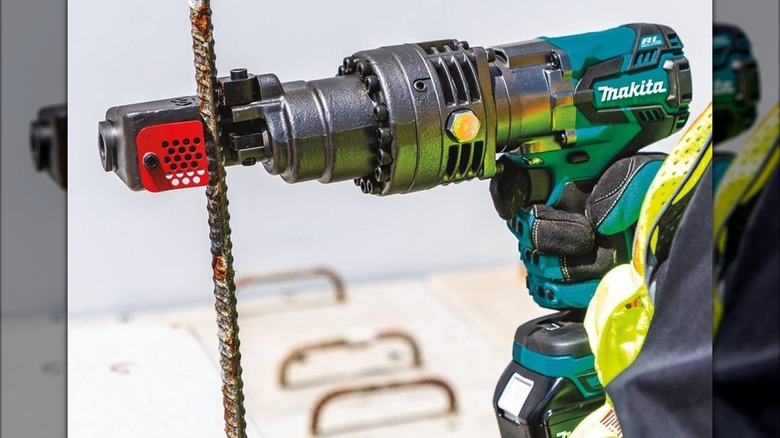
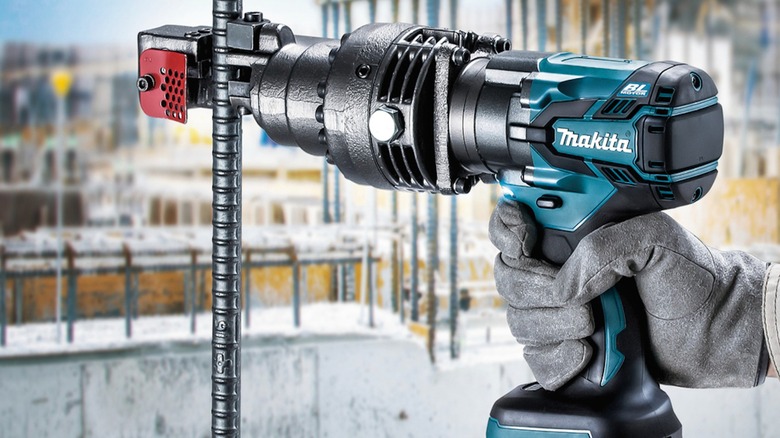
One of the gaps in DeWalt's product catalog is a powered cutter for heavy-duty materials, such as an electric bolt cutter, which is one of the tools Ryobi makes that DeWalt doesn't. Similarly, Makita has made multiple powered rebar cutters, which you won't find from DeWalt, though it does have manual light-duty rebar pliers. For what it's worth, the black-and-yellow brand does offer rebar cutter bits for its SDS-Plus rotary hammers, but these are meant to drill through rebar that's too difficult or impractical to remove.
If you want to actually cut rebar — especially a lot of it throughout the day — a dedicated rebar cutter will be much more useful. The Makita 18V LXT Rebar Cutter (model XCS04ZK) is a cordless tool powered by a brushless motor that can cut through #5 rebar in less than three seconds. It also does so without creating sparks, which you'll likely get when using a rotary hammer attachment. Also capable of handling steel rods, the tool has a cutting capacity range of ⅛-inch to ⅝-inch thickness.
Powered by a Makita 18V 5 Ah battery, the tool can make 233 cuts of #5 rebar in a single charge. It's equipped with a cutting head that rotates 360 degrees, allowing you to come at the rebar from any angle. An adjustable stopper can hold the material at a right angle to the blade for increased stability during use and has an integrated LED worklight. The tool also utilizes a pistol-grip design for better control and includes a rubberized soft grip for more comfortable use. One downside is that Makita's powered rebar cutters currently don't come cheap and you'll likely need to spend a couple thousand bucks at minimum for one.
Cordless Coffee Maker
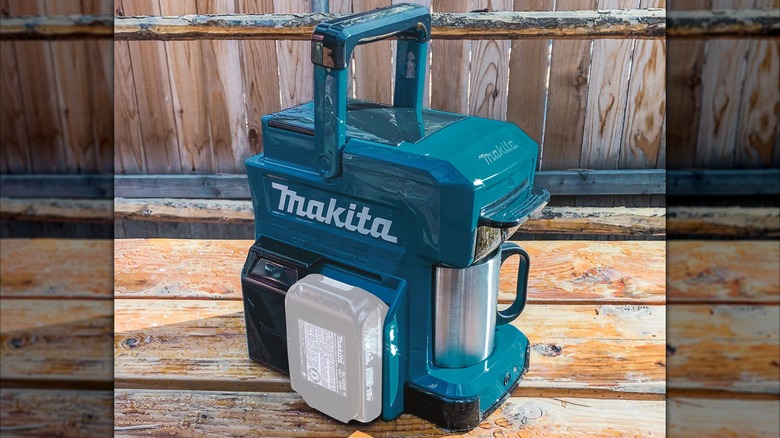
Earlier this year, DeWalt announced it was making a cordless 20V max coffee maker, which it called ToughBrew. However, this announcement was made on April 1 — and it may have fooled quite a few fans who ended up disappointed that DeWalt doesn't make a coffee maker. The idea of a tool company offering a coffee maker isn't fantastical — Makita offers not one but two different models. The advantage to using the brand's coffee maker over one of the many, many other options out there is that it's completely cordless and powered by the same batteries you'll already have on the jobsite if you're working with other Makita tools. That means you'll always have access to java, no matter where you're working.
Both models of Makita's coffee maker are essentially the same, though one is green and part of the brand's Outdoor Adventure line. Its traditional blue one — the Makita 18V LXT / 12V max CXT Cordless Coffee Maker (model DCM501Z) is compatible with both the brand's 12V and 18V batteries, making it more versatile than many of its cordless power tools. It's built to be compact and portable and is 8-9/16 inches tall, allowing for 3-½-inch cups or smaller.
Adding to its off-the-grid appeal, the coffee maker doesn't require paper filters and includes a permanent drip filter so you can pour grounds directly into the machine. The convenience of a battery-powered coffee maker is apparent, but don't be surprised if Makita's machine is nowhere near as good as a more traditional option. According to one redditor, Makita's coffee maker is "a gimmick. It takes about ten minutes to make half a cup of rather rubbish, lukewarm coffee, and burns an entire battery in the process."
Chain Mortiser
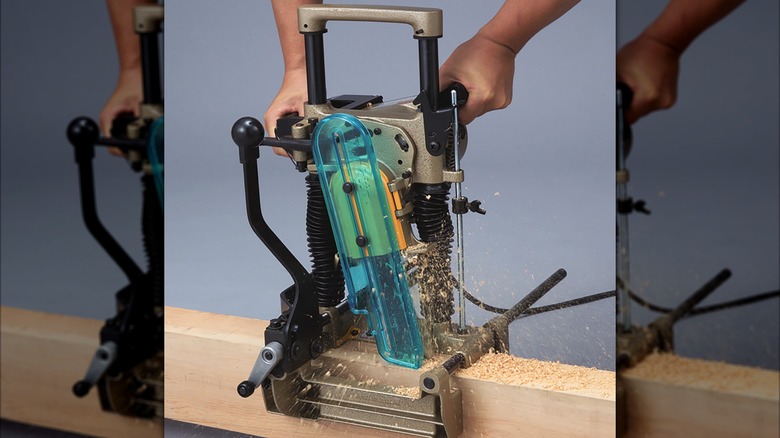
As with many things, using a dedicated tool is often preferable for a given application than using an attachment or other workaround. It shouldn't be a surprise, for instance, that a chain mortiser is often the best way to cut mortises — especially if you need to make a lot of them. Many woodworkers will use plunge routers for the job and while some say it's a completely fine way to work, others say it's hard to use the tool for mortises.
If you're in the latter camp, you may be dismayed that, though it makes a cordless plunge router, DeWalt doesn't sell a chain mortiser. Makita does, though, and the machine will cut deep and straight square-walled mortises into wood effortlessly. The Makita Chain Mortiser (model 7104L) can hold logs over a foot thick with its adjustable vice and is capable of cutting lap joints up to 5-⅛ inches. Its plunge depth adjustment is in ⅛-inch increments and the tool is equipped with a cutting line indication plate.
The machine is powered by a 10.5-amp motor that can deliver up to 3,200 rpm, allowing it to cut 1,000 feet per minute. While it's corded, the tool is still built to be portable and weighs under 40 pounds. However, Makita's chain mortiser costs thousands of dollars, so if you're not a professional and looking for Makita tools for DIY carpentry projects that are more low-key, perhaps learning to use a plunge router is the better option.