

What Are The Rarest Harley-Davidson Colors?
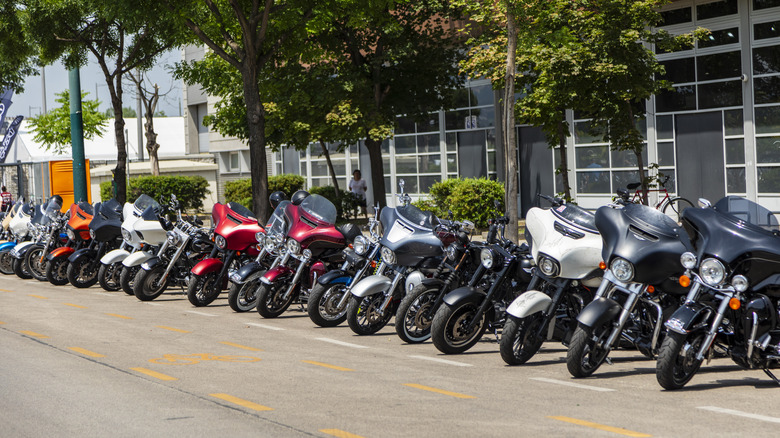
The rarer something is, the more value it's going to have. In the case of what constitutes the rarest Harley-Davidson colors, the scope will be limited to those used in the factory by the bike maker and not some custom mix concocted in the wild. These DIY colors might look great, but they skew the parameters because, by their very nature, they will always be one of a kind. Interestingly, Harley rolled out several new factory paint options for 2025 that are quite striking.
There are a handful of things that make a H-D color rare. Take, for example, short production runs in which a color was offered for a brief window of time or applied to a limited number of models. Then you have unique formulas (or recipes) for making a specific color, which won't be the same as they are today, primarily because paint standards are so drastically different. Perhaps the elements (ingredients) that make up that color no longer exist, or the formula was quickly discontinued and never properly documented, so guesswork is all anyone has to go on.
Even the methodology and systems used decades ago to apply paint play a factor. For instance, no one really sprays enamel anymore, and back in the day, Harley used single-stage paint that combined the color and clear coat into one layer. That evolved into a lacquer-based single-stage and eventually into a two-stage clearcoat that's used on modern vehicles.
Delphine Blue
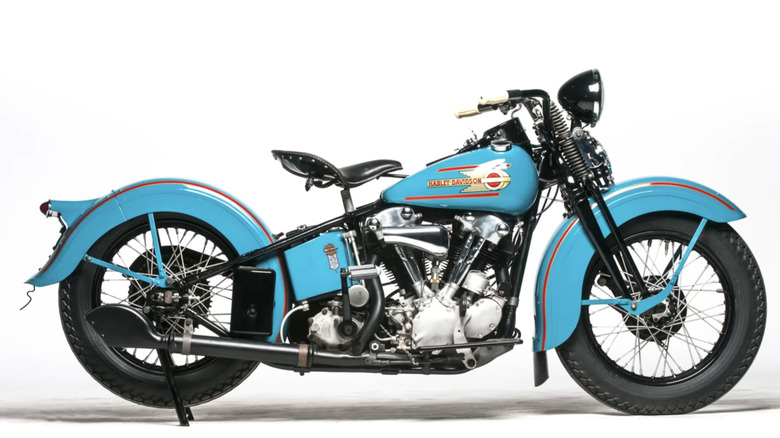
The company's rarest color is, without question, Delphine Blue, which appeared on Harley-Davidson's Knucklehead EL in 1937. Jon Block, of the YouTube channel Blockhead Moto, recently painted a bike with an approximation of Delphine Blue and said it was available for just half a year, making it even scarcer. In '37, the company released two color schemes: Teak Red with a black stripe edged in gold, and Bronze Brown with a Delphine Blue stripe edged in yellow. Neither apparently sold well, so to boost sales, Harley rolled out Delphine Blue, striped in Teak Red, and edged with gold.
Block went to great lengths tracking down the correct color for his build, which included inspecting existing examples like Billy Lane's race bike, a '37 Knucklehead owned by Mike Wolfe (of "American Pickers"), the Knucklehead restoration/giveaway done by Wheels Through Time Museum, and an actual 1937 Knucklehead straight from the Harley-Davidson museum. All were different shades thanks to varying formulas and application methods.
After more research, Block eventually obtained a quart for $400 from a local autobody paint magician named Milk Bone, who "muddied up" a 1970s General Motors blue base color and added greens and blues (the ratios of which are still unknown) until it turned into an acceptable representation of the original Delphine Blue. As explained by motorcycle customizer Billy Lane on his YouTube channel, only 1,829 Knuckleheads were made in '37. The number sprayed in that rarest of colors was but a fraction. One such model sold for $121,000 at a Mecum auction in February 2025.
Snake Venom and Radioactive Green
Harley-Davidson has made some pretty strange motorcycles over the years, a few of which have been collaborations with wild one-off paint jobs. For instance, a 2002 Harley-Davidson V-Rod dubbed the Cosmic Starship was painted by artist Jack Armstrong (nephew of astronaut Neil Armstrong and a friend of Andy Warhol). The Bucherer Blue Edition is a Softail Slim S painted entirely with Bucherer's trademark shade of blue. Neither makes our list because they're wholly custom, one-off colors.
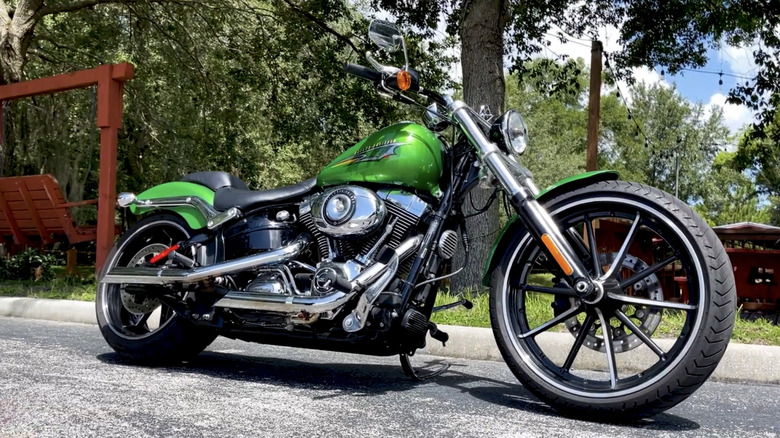
However, the color-shifting Snake Venom paint job does constitute a rarity because it was a factory color used for a limited time on a limited number of bikes. What makes it so striking and sought after is its ability to change color with lighting and angle, going from a deep, dark green to a rich purple. It was painted on 2021 models like the Road King, Street Glide Special, Road Glide Special, Ultra Limited, and Tri-Glide. It popped its venomous head back up in 2025 as a special color option for the standard Nightster. A Road Glide sold at the 2024 Palm Beach Barrett-Jackson auction for $24,200.
For the same reasons, Radioactive Green is also considered rare since it was applied to some bikes in 2015 (Exact numbers are again unknown.), including the Electra Glide Ultra Limited, Softail Breakout, Street Glide, and Fat Boy Lo. The intense green metallic flake sets it apart from the mostly darker hues commonly used by Harley. A Street Glide sprayed with the searing green sold for $14,300 at a Mecum auction in January 2025.
Quick Shifting Mayhem
Harley has released several special anniversary color schemes over the years, often done in two-tone combinations. The brand has also created some incredible Limited Edition bikes with unique styling and paint jobs. Again, those kinds of bikes don't make this particular list. However, there are two particular combination "schemes" that do need to be mentioned.
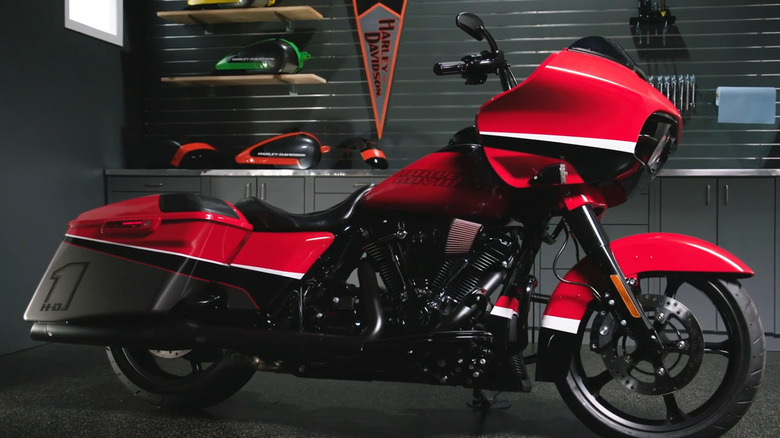
In 2019, Harley announced the release of two Limited Paint Sets for early 2020. The first was called Mayhem and featured a paint combo that included an Inferno Red Pearl and Phantom Black base, Ghost White with brushed silver highlights, and red stripes. The familiar #1 logo was set within Deep Charcoal saddlebags. Only 150 serialized bikes worldwide were issued with this paint scheme. The second set was called Quick Shift, and featured a Gun Metal Metallic and Vivid Black base separated by a Pewter pinstripe and featuring Hyper Green accents. This was only painted on the fuel tank and the front and rear fenders. Like the Mayhem, Quick Shift was limited and applied to only 100 serialized bikes globally.
Both bikes came with a certificate of authenticity. While Mayhem was available for a variety of domestic FLHX and FLHXS models, the Quick Shift scheme was only available for 2018 and later FXBR and FXBRS models. Neither had been offered at any of the well-known auction houses at the time of this writing, so their actual value remains unclear.